• Skip to primary navigation
  • Skip to main content
  • QUICK LINKS
    • CONTACT US
    • CONNECT
      WITH US
    • FACULTY APPLICATION
    • PUBLICATIONS
    • PRESS KIT
    • CAREERS
  • About
    • Mission & Values
    • Staff & Board
    • Accreditation & Institutional Research
    • Careers
  • Academics
    • Admissions
    • AA Degree
    • College Prep
    • Faculty
    • Apply To Teach
  • Students & Alumni
    • Students
    • Alumni
    • OpenLine Literary Journal
  • Resources
    • Practitioner Support
    • Resources for Incarcerated Students
    • Research on Prison Higher Education
  • News
    • Top MTC Stories
    • Recent Press
    • From the President
    • Commencement
  • Give to MTC
    • Donate
    • Shop

Mount Tamalpais College

Current Affairs

Letter from the President: Reflections on MTC’s 30-Year History

December 18, 2025 by Mt. Tam College

Dear friends,

As many of you know, what is now Mount Tamalpais College started in 1996 as an extension site of Patten College. In 2026, we will celebrate—with amazement and gratitude—the thirtieth anniversary of the College.

In its very first semester, the program offered two classes. By spring of 1999, the first semester I came into San Quentin to teach a class, about 100 students were enrolled in ten classes. Most were still writing their assignments with pencil; pens were scarce. Students scrounged together paper from clerical jobs or quarterly packages, and textbooks were donated by publishers or the occasional bookstore. 

Gang culture and the constant threat of violence dominated the lives of students. In the classroom, students generally engaged across racial lines, but on the yard, talking, playing basketball, sharing food, or even shaking hands with someone of a different race, could get a student hurt or killed.

After I began leading the program in 2000, our first major purchase was an industrial strength pencil sharpener. The first time we bought pocket dictionaries for the entire student body was a joyous occasion. Pocket calculators were a miracle. Every object brought into the prison was physically inspected by staff. Maps, considered escape paraphernalia, were categorically prohibited. Books could be banned simply because of their title or cover.

A teacher talking to a student one-on-one out of earshot of prison staff was viewed with deep suspicion; students were routinely placed in solitary or transferred out of the prison based on accusations of “overfamiliarity.” Lockdowns, generally due to violence, were frequent and often lasted for weeks. Violence within or between racial groups typically led to those entire groups being locked down; we routinely arrived to class to find all students of a particular race missing. Getting through a thirteen-week semester could take six months.

While there is no single explanation for all that has changed at San Quentin since then, a few factors played a critical role. Above all, people incarcerated at San Quentin wanted it to change. In many respects, MTC is in fact the manifestation of that desire for change.

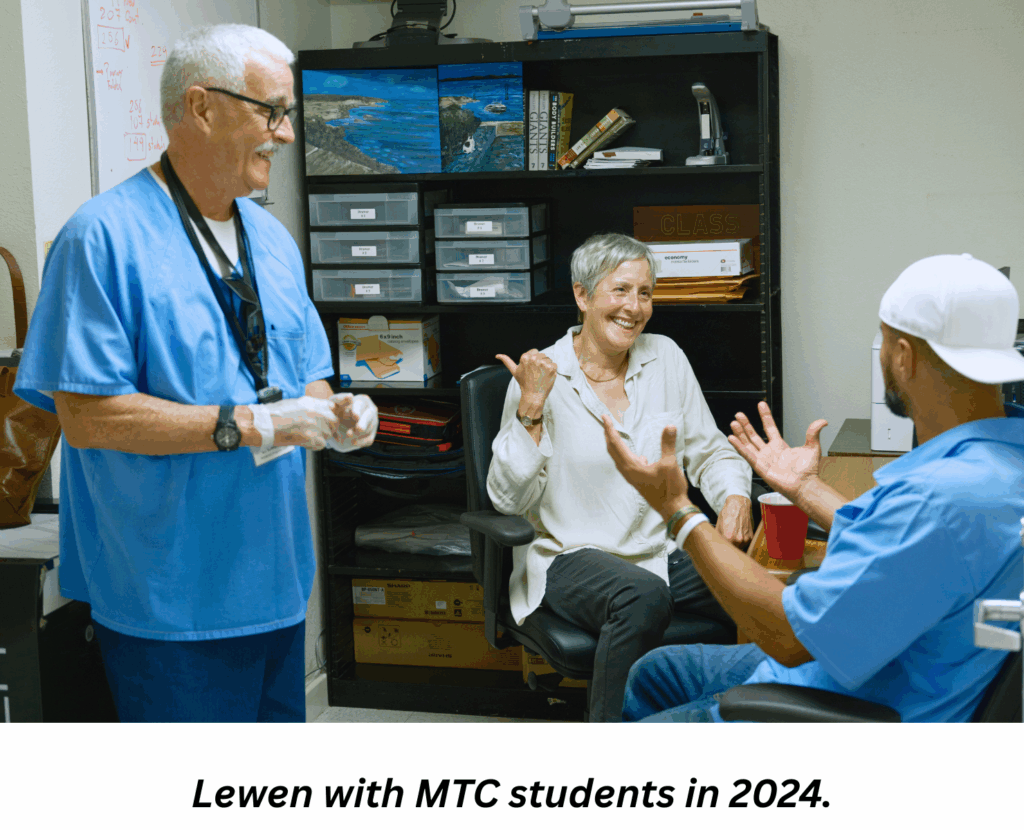
From the earliest years, students played a vital role in running the college program—organizing supplies, managing classroom space, personally delivering verbal messages and mountains of paper correspondence—all without internet access, or even a reliable mail system. It was students who recruited, mentored, and inspired each other. They did homework without tables or chairs. They looked out for program staff and faculty, de-escalated interpersonal conflicts, and through their constant studying, stood out starkly in the world of the prison. 

In those days, prison staff who openly supported “rehabilitative programs” were often mocked, ostracized, and even threatened by their colleagues. Without the integrity and commitment of a handful of key allies, the college program would not have survived. Yet many initially skeptical prison staff and administrators witnessed the impact of college on individual students; over time, they watched the social climate of the entire prison start to change. The respect that those students earned from both the rest of the incarcerated community and from prison staff—as a result of their hard work and intellectual growth—eventually formed a powerful protective shield around the College that persists to this day. 

Another one of the College’s superpowers has always been its all-volunteer faculty, whose intellectual brilliance and preternatural patience—in the face of delays, cancellations, scant technology, sweaty classrooms, pouring rain, and Bay Area traffic —have for decades been a powerful motivating force for students, and surely the single most stabilizing force for the College itself. From the earliest years, it was instructors who encouraged their colleagues to come in to teach; who forged the philanthropic origins of the fledgling program; and in myriad other ways catalyzed its growth.

Today, as a privately-funded, independent, accredited institution, Mount Tamalpais College is sustained by this same spirit of resilience, dedication, and belief in human potential upon which it was founded. Our thirtieth anniversary will mark a celebration of both the journey we’ve traveled and the one we now embark upon, as we enter yet another remarkable phase of growth.

We are deeply grateful for all you do to help carry MTC’s vital mission forward, and hope you will be inspired to continue generously supporting this work.

With warm wishes for a happy and healthy holiday season,

Jody Lewen
President

Make a gift to support MTC


P.S. Please save the date for Together We Climb: MTC’s 30th Anniversary Gala on Saturday, April 18, 2026 at the Conservatory at One Sansome in San Francisco, CA! 

Filed Under: Current Affairs, From the President, Homepage, Uncategorized

President of college based at San Quentin receives prestigious national award

November 30, 2025 by Mt. Tam College

KTVU Fox 2 News anchor Heather Holmes interviewed Mount Tamalpais College President Dr. Jody Lewen about the role of higher education in prison and its impact on individuals during and after incarceration. “It’s about realizing human potential and creating real opportunity,” said Dr. Lewen. The interview also celebrates Dr. Lewen being honored with the 2024 Howard W. McGraw, Jr. Prize in Education, a prestigious award that recognizes individuals whose innovative accomplishments make a difference in the lives of students.

Watch the full interview here. 

Filed Under: Current Affairs, MTC in the News

Accreditation in Action: ACCJC Highlights Mount Tamalpais College

November 29, 2025 by Mt. Tam College

Breaking Barriers: Mount Tamalpais College Provides College Access to San Quentin Rehabilitation Center – Transforming Higher Education Behind Prison Walls

Every person deserves the opportunity to grow, contribute to society, and better oneself through education. For many incarcerated individuals, that opportunity feels like an impossibility. Mount Tamalpais College (MTC), located within San Quentin Rehabilitation Center, stands as a beacon of educational quality and innovation, making dreams of college a reality for hundreds of incarcerated students. Founded in 1996 in the wake of federal restrictions on financial aid for incarcerated students, MTC (formerly known as the Prison University Project) evolved from a program affiliated with Patten University into the first independent liberal arts institution dedicated exclusively to serving incarcerated learners.

In January 2022, MTC achieved Initial Accreditation from ACCJC, marking a pivotal milestone in its journey toward institutional independence and excellence.

Read the full report here.

Filed Under: Current Affairs, MTC in the News

MTC Alumni Scholarship Awardee: Brian Asey Gonsoulin

October 16, 2025 by Mt. Tam College

For much of his life, Mount Tamalpais College alumnus Brian Asey Gonsoulin lacked the confidence to pursue education—a mindset, he explained, that was shaped by early struggles in the classroom, trauma he experienced at school, and the absence of positive role models.

“I didn’t have the confidence nor the grades to continue my education,” Brian said. He dropped out of high school in his senior year and later received an 83-years-to-life sentence. 

“I never thought of going back to school,” he added. “No one in my family, none of my acquaintances had ever gone to college. I had no role models who had done that, and school was the furthest thing from my mind.”

About fifteen years into his incarceration, he transferred to San Quentin, which offered a fresh start. Surrounded by peers pursuing higher education and supported by Mount Tamalpais College’s staff and volunteer faculty, Brian returned to the classroom.

“I started attending college classes in my 50s,” he shared. “My motivations evolved—I wanted to prove to myself that I could do this, that I could get a degree.”

Progress wasn’t linear. Early semesters were difficult, and the pandemic nearly derailed his plans. But encouragement from MTC faculty and a breakthrough research paper—his first-ever “A” grade in school—shifted his confidence.

“The assistance and assurance I received from MTC helped me build the confidence to move forward,” Brian shared. “It inspired me to be not only the first in my family to attend college, but the first to graduate with a bachelor’s degree.” He persisted through COVID-19 lockdowns to become part of the first graduating class of the newly independent, accredited Mount Tamalpais College.

In addition to his coursework, he stayed involved with a variety of programs at San Quentin that supplemented his studies and steered him towards his eventual career path: filmmaking.

“Working in the Media Center at San Quentin, I learned how to take an idea to a finished product,” Brian said. “The stories I want to tell are for the incarcerated—to motivate them to change themselves and reach for their own goals.”

In addition to earning his associate degree from Mount Tamalpais College during his time at San Quentin, Brian produced, directed, and edited the first TEDx San Quentin event in 2016. He also won a local Emmy for his production work on the 2024 short documentary Warriors Ground, a collaboration with the Golden State Warriors that profiles six members of the San Quentin Warriors basketball team, including Brian, who served as the team’s general manager.

After serving 26 years in prison, Brian paroled from San Quentin in early 2024. Today, he continues to build on the educational foundation he developed at MTC. He is currently a third-year Cinema major at San Francisco State University, and is one of 18 awardees of the 2025 MTC Alumni Scholarship Program, administered in partnership with 10,000 Degrees.

Since his release, Brian has also co-produced and directed the San Quentin Film Festival—the first industry-standard film festival held inside a U.S. prison—and serves as a producer and audio engineer with KALW Radio and its Uncuffed podcast, using storytelling to uplift incarcerated individuals and reshape how society views those impacted by incarceration.

Explore the MTC Alumni Scholarship Program and get to know the 2025 recipients.

MTC Alumni Scholarship Program

Filed Under: Campus & Community, Current Affairs, People Tagged With: Alumni, News_P-5

MTC Alumni Scholarship Awardee: Anthony Ammons Jr.

October 16, 2025 by Mt. Tam College

When Anthony Ammons Jr. arrived at San Quentin in 2012, the basketball court became his entry point into the prison’s broader community. As a member of the San Quentin Warriors basketball team, he found camaraderie, mentorship, and a sense of purpose that extended far beyond the game. That experience, he shared, sparked a deeper interest in personal growth, community service, and education.

“At San Quentin, I learned how to be a follower of good people,” Anthony said. “Instead of being a follower of the gang mentality, the negativity, I became a follower of good habits, because I was trying to train myself to do things differently.”

Although Anthony had been a standout basketball player all his life, he had never experienced the same success in the classroom. As he became involved in San Quentin’s many programs, he discovered that the prison’s education opportunities were unlike those he had encountered elsewhere.

“I was never a big fan of school, and what I saw at other prisons with education programs was that you can go to class, but there was no community afterwards. So I didn’t attend school there,” said Anthony. “Mount Tamalpais College was different, and that is what really motivated me to enroll.”

Through Mount Tamalpais College, Anthony began envisioning a future beyond prison. Education became a way to build on the lessons he had learned through basketball—teamwork, perseverance, and accountability—and to turn them toward achieving his personal and professional goals.

“I went to prison at age 16 with a sentence of 102 years to life, and I served 20 years,” Anthony said. “I knew my professional experience alone wouldn’t get me where I want to go in my career. MTC helped me understand that with an education to ground that experience, there is no door I cannot walk through and no community I cannot help.”

He credits MTC staff and volunteer faculty for their consistency, care, and high expectations, noting that their support encouraged him to shift his priorities toward education.

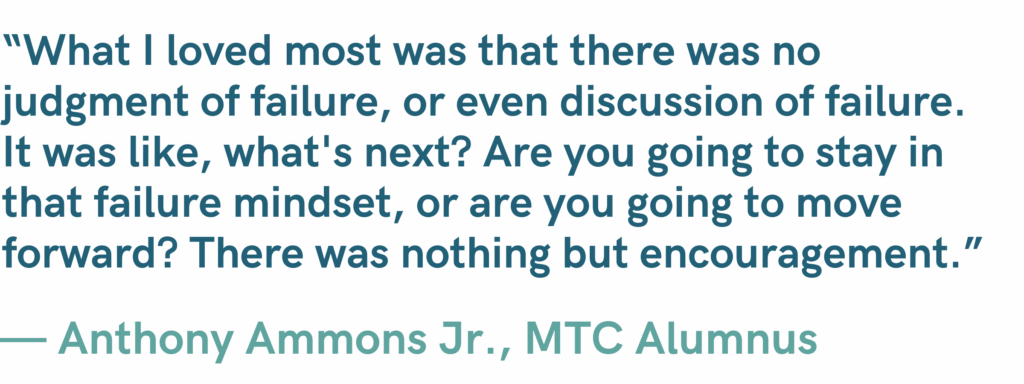
“I thought, wow—you’re coming to a prison to teach a class, with a smile on your face? I gotta get my education,” Anthony said. “And what I loved most was that there was no judgment of failure, or even discussion of failure. It was like, what’s next? Are you going to stay in that failure mindset, or are you going to move forward? There was nothing but encouragement.”

On the court, basketball was also opening new doors for him. His talent, energy, and work ethic led him to star as one of the central figures in the 2019 documentary Q Ball, which chronicles the relationships, challenges, and growth of the San Quentin Warriors basketball team.

Due to his participation in MTC courses and other programs, as well as his work responsibilities at the San Quentin hospital, Governor Jerry Brown commuted Anthony’s sentence in 2018, and he was ultimately released in 2020. As he navigated reentry into society, Anthony continued to focus on serving his community and furthering his education.

Anthony’s first job after release was as an elevator operator for the Golden State Warriors. While in that role, he was struck by a stray bullet in Oakland, leaving him with significant nerve damage to his foot.

“Because of the gunshot wound, I couldn’t play anymore,” he said. “It put me in a cold depression.”

Anthony committed himself to recovery and professional growth, eventually earning a position with Assemblymember Mia Bonta’s office as district scheduler and public safety advisor. He relearned how to run and has recently returned to the basketball court. He remains close with his former San Quentin Warriors teammates.

Today, Anthony serves as a Special Projects Coordinator with the California Attorney General’s CARE Team, connecting with community-based organizations on reentry, disability rights, and immigration. In addition to his full-time work, he is pursuing an associate degree in Criminal Justice Administration at Long Beach City College, and was recently selected as a recipient of MTC’s Alumni Scholarship Program, awarded in partnership with 10,000 Degrees.

Explore the MTC Alumni Scholarship Program and get to know the 2025 recipients.

MTC Alumni Scholarship Program

Filed Under: Campus & Community, Current Affairs, Homepage, People Tagged With: Alumni, News_P-4

Letter from the President: Current Events Impact

March 28, 2025 by Mt. Tam College

Dear friends, 

Over the last few months, many friends and colleagues have asked about how the current political turmoil in the U.S. is impacting Mount Tamalpais College, or might in the future. These conversations have sparked some reflections that I thought might be useful to share with all of you.

First, to answer the question most concretely: MTC receives no funding from the state or federal government; we are supported entirely by individuals and foundations. As a result, our financial situation is not directly threatened by any of the recent cuts to federally-funded programs and services. 

In addition, because San Quentin is a state, not federal, institution, the prison’s operational budget is not directly impacted by current federal budget cuts. How California might react to other fiscal impacts on the state as a whole, and how this might ultimately impact the California Department of Corrections and Rehabilitation, remains to be seen.

Despite MTC’s insulation from current federal budget cuts, we are clear-eyed about other potential challenges as we move through this uncertain time. One concern is that the individuals and foundations upon whom we rely for philanthropic support may shift their focus to other urgent needs that are now emerging as a result of current political events. The U.S. prison system is a massive humanitarian catastrophe, but chronic crises are easily forgotten when new disasters emerge—as they now do every day. Another potential risk is that fluctuations in the stock market might curtail both individual and foundation giving, whether due to diminished resources or wariness about the future.

For some MTC instructors, many of whom are faculty or graduate students at research universities, the dramatic cuts to federal funding for higher education institutions have already been devastating. The impacts expand daily: positions are being cut; years worth of scientific research is being irreparably disrupted; vulnerable communities and critical problems are being abandoned; some are reconsidering their own career paths. Many people are also deeply concerned about how cuts to the US Department of Education might degrade civil rights protections within education institutions, or undermine the capacity of accrediting agencies to maintain the oversight and accountability of colleges, among other consequences.

Inside San Quentin, as on the outside, some people are tracking current events closely; others much less so. The biggest difference I have long observed between the world inside and outside of prison in times of crisis is how much less shocked people inside are by the cynicism and destructiveness of social and political life. It’s not that they’re not deeply concerned; they’re just not as surprised.

One particularly impacted community at San Quentin, and throughout the prison system, consists of individuals who are not U.S. citizens, are undocumented, or who have loved ones in these situations. The risk of deportation post-release has always weighed heavily on those subject to it, but the sense of now being even more aggressively vilified and targeted—as both immigrants and people with criminal records—compounds that stress profoundly. Adding to the fear and isolation, particularly for non-native speakers of English, is the often frightening challenge of accessing accurate information, navigating the legal system, or finding support services. 

My hope at this moment is that the current state of the U.S. and the world will stand as a stark reminder of the critical importance of liberal arts education for society as a whole. In order for democracy to function, each one of us must be able to access and discern quality information; think critically and independently; communicate effectively; engage constructively with worlds far different from our own; and grapple, as a community, with the kinds of enormously complex and high-stakes questions with which we are increasingly confronted.

Why are millions of people fleeing Latin America? How do conflicts between the executive branch and the judiciary get arbitrated? What is the historical and political context of Russia’s invasion of Ukraine? What is “disinformation,” and who defines it? What does it mean to combat antisemitism? What are legitimate, or strategic, forms of political protest? 

The impact of MTC as an institution extends far beyond the students it serves and the ways it equips them to be informed and active participants in a healthy democratic society. Many of us who think of ourselves as “educated” live in profoundly homogenous cultural and ideological worlds; many seldom interact substantively with people from different socio-economic backgrounds and we generally consume media that reinforces our existing beliefs. Our conceptions of the political landscape, and the primary narratives through which we interpret events, are typically filtered through crude, culturally manufactured stereotypes about people whom we do not actually know. In an ideal world, educational institutions disrupt precisely such politically and culturally stultifying patterns.

As an academic institution, MTC works to fulfill precisely that promise of education: it does not just disseminate knowledge and formal skills, or teach people to think logically and critically; it also serves as a unique cultural site where people from vastly different worlds teach and learn together, transcend social barriers and stereotypes, and work to achieve the almost impossibly improbable but nevertheless crucial goal of building a high-functioning democratic society.

In this setting, long-neglected brilliance and creativity are cultivated, core assumptions are shattered, people with wildly different viewpoints treat one another with respect, and courageous leaders emerge. It is also a place where people continually reflect upon and model what it means to be loyal to a principle, rather than to a group–and what it looks like to boldly step away from one’s own cultural “tribe” and weather the often serious impact of dissent.

There has never been a more urgent time to cultivate this type of space–a space that  expands access to critical reading, writing, thinking, and debate; to bodies of knowledge like history, law, government, epidemiology, religion, economics, ethics, neuroscience, psychology, politics, and technology – in short, a space that develops the capacity of every single individual to contribute to building a healthier, more humane society, wherever they stand. 

With warm regards,

Jody Lewen
President

Filed Under: Current Affairs, From the President

Beyond Recidivism: Higher Education in Prison with Jody Lewen

December 11, 2024 by Mt. Tam College

In the Season 1 finale of the podcast Educating to Be Human, host Lisa Petrides sits down with Jody Lewen, President of Mount Tamalpais College at San Quentin Rehabilitation Center (formerly San Quentin Prison), the first accredited independent 2-year liberal arts college dedicated to incarcerated students. A visionary leader and tireless advocate for equitable access to education, Jody has spent over 20 years expanding higher education opportunities for incarcerated students. Her work at San Quentin challenges traditional ideas of who education is for and envisions learning as a tool for empowerment and purpose. In this episode, Lisa and Jody discuss: The realities and barriers of offering higher education in prison; how to create inclusive learning spaces within correctional facilities; the life-changing impact education has on incarcerated students; and why education in prison matters for both the inside and outside world.

Listen to the full episode

Attribution: This article originally appeared in Educating to Be Human with Lisa Petrides

Filed Under: Current Affairs, MTC in the News

‘I think that there is no higher calling’: 2024 McGraw Prize in Education winners see the impact of their work

November 16, 2024 by Mt. Tam College

At the 2024 Harold W. McGraw, Jr. Prize in Education Nov. 13 celebration, from left, Jody Lewen, Harold McGraw III, Penn GSE Dean Katharine Strunk, Robert Lerman, Edmund W. Gordon, and GSE Vice Dean of Innovative Programs and Partnerships Michael Golden. 

Edmund W. Gordon — the architect of the Head Start program, an educator who challenged outdated ideas about how to teach and assess learners of all ages, a mentor who counseled generations of education leaders — has dedicated most of his 103 years to transforming education. 

In accepting the Harold W. McGraw, Jr. Prize in Education on Nov. 13 at the Morgan Library & Museum in New York City, he laid out the stakes for his life’s work and that of his fellow honorees, Robert Lerman and Jody Lewen. 

“I think that there is no higher calling than that of helping in the cultivation of human intellective competence and character,” Gordon said. “The human brain is perhaps the finest expression of matter known to mankind. What else in the entire universe appears capable, on proper stimulation, of producing human thought? What other than the cultivated human brain seems capable of converting mere conceptions into reality?”

Gordon, Lerman, and Lewen were recognized with the 2024 McGraw Prize in Education for their groundbreaking work in helping learners cultivate their minds and improve their lives. Gordon, the Pre-K–12 winner, was praised for his decades of service, which continues. Lerman, the Lifelong Learning winner, has pushed Americans to rethink how we prepare people for careers. And Lewen, the Higher Education winner, is at the forefront of a new movement in prison education. 

Based at the University of Pennsylvania Graduate School of Education, the McGraw Prize is the most prestigious prize in education. Each winner receives a Prize sculpture and $50,000 and is honored at a celebration in New York City. Gordon, Lerman, and Lewen join a distinguished list of more than 100 teachers, professors, superintendents, university presidents, nonprofit leaders, entrepreneurs, and public officials who have shaped the education landscape.

Harold McGraw III, former chairman, CEO and president of The McGraw-Hill Companies, said this year’s winners represent educators everywhere who are doing remarkable work and overcoming obstacles to deliver quality education to children and adults everywhere. 

The awardees were submitted for consideration by their peers. Winners were then selected during three rounds of judging, including a final round by an independent panel of esteemed leaders in the field. Nominations for the 2025 McGraw Prize in Pre-K–12 learning, higher education, and lifelong learning are now open. 

“Your extraordinary work truly enriches the legacy of the McGraw Prize and speaks to our hopes for the future of education,” said Penn GSE Dean Katharine Strunk. “It is no exaggeration to say that, through your pioneering efforts and steadfast commitment, you haven’t just met the moment for education — you’ve made the moment.”

Lerman, co-founder of Apprenticeships for America and a fellow at the Urban Institute, has extended learning opportunities to those who want to tackle postsecondary pursuits through experiential learning and alternative pathways. 

In accepting his award, he gave a history lesson. When Lerman first started studying apprenticeships in the 1980s, he was skeptical, seeing them as restricting entry into jobs. But over time, he came to see that they engaged students in the context of real work far better than an “academic only” approach. 

“I believe that apprenticeships at scale can change the nature of work for many Americans, raising their earnings but also pride in their occupational expertise,” Lerman said. “With the self-esteem that comes with accomplishment, more Americans would feel good about themselves and the country.”

Noting that surveys routinely show the public believes higher education needs to align more closely with career development and employers want better-prepared workers, Lerman called for greatly expanding apprenticeship programs. 

“I’ve proposed three key steps to scaling up apprenticeships: One, tackle the toughest part — convincing employers to dive in. Let’s provide financial incentives to organizations that sell employers on apprenticeship and implement programs but pay only for new apprenticeships,” Lerman said. “Two, establish credible occupational standards to ensure apprentices reach high levels of competency in their fields. And three, fund quality instruction for the classroom portion of apprenticeships.”

Lewen recognized the power of higher education in prison soon after she began volunteering as an instructor at a college program at San Quentin Rehabilitation Center. Her experience inspired her to become the founder and president of what became Mount Tamalpais College, an accredited independent institution offering hundreds of incarcerated individuals access to a liberal arts associate degree, as well as intensive college preparatory programs, and student support services.

“We need to foster a culture within ourselves and within our institutions that allows people to literally break ranks. Stepping up and modeling unapologetic bridge-building is the essence of leadership,” Lewen said. “Innovation is not just about strategies, solutions, or practices, it’s about what we’re willing to question, what taboos we are willing to violate, and what risks we’re prepared to take — for the public good. We urgently need a revolution of both courage and imagination in ourselves, in our institutions, and in our society. My deepest thanks to all of you for lighting the way.” 

Mount Tamalpais provides comprehensive individualized academic advising and support, particularly for students with learning challenges. Despite not receiving any state or federal funding, the college charges no fees or tuition, and all school supplies and textbooks are provided free of charge.

Lewen is also a co-founder of the Alliance for Higher Education in Prison, a national network supporting education for incarcerated students. She serves as a trusted advisor to policymakers and has provided consulting to dozens of prison education programs nationwide. 

Gordon — a distinguished emeritus professor at Yale University and the Teachers College, Columbia University, and director emeritus of the Gordon Institute for Advanced Study at the Teachers College — was an early champion of supplemental education in its many forms. 

He served as the original director of research and evaluation for the Head Start program under President Lyndon Johnson. In that role, he emphasized that each student deserves sufficient opportunities and support to thrive academically and developmentally.

Throughout his career, his work has significantly influenced education policy, advocating for reforms that address systemic inequities and promote social justice in schools. His insights have informed the development of instructional strategies, curriculum materials, and teacher training programs aimed at fostering inclusive learning environments.

Gordon’s influence continues to shape the education policy and research landscape. In accepting his McGraw Prize, Gordon said he was fortunate to have the opportunity to have a life in education. 

“When we think of our profession as being responsible for the deliberate cultivation of intellective competence and character,” Gordon said. “It is not difficult to understand why I feel that it is such an honor for me to be thought of as one who has done education well.”

Featured Winners

Jody Lewen

Dr. Jody Lewen, an inspiring educator and visionary leader, has dedicated over two decades to transforming higher education in prisons.

Learn More about 2024 Prize Winner Jody Lewen

Edmund W. Gordon

Dr. Edmund W. Gordon, a luminary in education, has dedicated over six decades to transforming pre-K–12 education through his visionary leadership, pathbreaking scholarship, and profound commitment to promoting equity and access to quality education for all students.

Learn More about 2024 Prize Winner Edmund W. Gordon

Dr. Robert Lerman

Learn More about 2024 Prize Winner Robert Lerman

Attribution: This article originally appeared in Harold W. McGraw, Jr. Prize in Education

Photo courtesy of Penn Graduate School of Education, McGraw Prize in Education

Filed Under: Current Affairs, MTC in the News, Uncategorized

‘Our voice matters’: San Quentin prisoners cast their ballots in mock election

October 21, 2024 by Mt. Tam College

SAN QUENTIN, Calf. (KGO) — At San Quentin Rehabilitation Center, an election-year tradition just wrapped up. Prisoners casted their ballot in a mock election to make their voices heard, despite being denied the right to vote while serving felony sentences.

Hundreds of prisoners incarcerated inside of San Quentin are keeping current with the news not just to be in the know, but also to be informed voters.

“I like giving people the feeling of agency – that their voice matters,” said Juan Moreno Haines, who is incarcerated at San Quentin.

Haines is one of the estimated 4 million people nationwide who will not get a chance to vote in the 2024 election because they’ve been convicted of a felony, have not completed a prison sentence, or are on probation.

“Democracy needs everyone and we’re a part of the society,” said Haines. “The fact that we’re incarcerated, we’re still American citizens. We care about our communities and our voice matters.”

For the last four presidential elections, Haines has been a part of the team organizing a mock election at the facility: real views expressed, just not real votes.

The ballots these men cast won’t count in the final tally, but it will ensure their views are not counted out.

Nationally, roughly one in 52 adults can’t vote due to a current or prior felony conviction. In California, you can vote after you’ve served your time – but not if you’re currently in a state or federal prison.

MORE: San Quentin inmates find new purpose by training future service dogs

“Who are you going to vote for Juan?” asked ABC7 News anchor Julian Glover a few weeks before the vote.

“Well, I’m really undecided at this point,” Haines replied.

Haines may be undecided, but his voice won’t go unheard.

For the first time the mock election was assisted by Mount Tamalpais College, the accredited school that helps people incarcerated in San Quentin earn an Associate of Arts degree.

“You can close them behind walls, but there are other ways for their voices to be heard,” said Amy Jamgochian, Chief Academic Officer at the college.

Jamgochian’s class helped create the ballots sent to the more than 3,200 people incarcerated at the facility.

“What do you say to the people who say, I don’t want to hear from those incarcerated voices. I don’t care what they have to say?” asked Glover.

“What that means for America is that we have this vast swath of the population that no one’s hearing from that is not represented in elections,” said Jamgochian. “The U.S. has something to gain from hearing from incarcerated people.”

MORE: Here’s a look at the transformation of San Quentin State Prison

Mount Tamalpais College shared the results of the mock election with ABC7 News:

  • 341 prisoners at San Quentin returned their ballot for counting-that’s about a 10% participation rate
  • 57% voted for Vice President Kamala Harris for president while 28% voted for former President Donald Trump
  • Third party candidates RFK Jr. and Jill Stein both received 2% of the vote

Of the other races on the ballot, Democrat Adam Schiff beat out Republican Steve Garvey in the race for senate in the mock vote by 13 points – with the majority (46%) not voting in the race at all.

Prop 6 that would end involuntary servitude in prisons won with 77% of the vote and Prop 36 that would increase punishments for people of certain drug or theft crimes was voted down with 57% voting “no”.

“As somebody who’s been incarcerated his whole adult life. I’ve never had a chance to vote in society,” said Jessie Milo.

For people like Milo, this mock vote means engaging with the community you still care deeply about, even if you aren’t physically a part of it.

“So when we have a mock election, I imagine myself in the free world and I imagine my vote counting. And so it’s really cathartic that I get to express myself,” said Milo.

It’s a feeling shared with many who turned in their mock ballot writing things like, “I want to vote because we matter too,” and “my vote should be just as important as anyone else’s – I am an American.”‘

The Ella Baker Center for Human Rights helped educate prisoners on bills and ballot initiatives that affect them.

“If they’re curious about a bill or ballot initiative, we’ll send them the actual language so they can be as informed as possible,” said James King, Co-Director of Programs at the Ella Baker Center.

MORE: SF marathon a defiant step for former San Quentin inmates participating at event

King was once incarcerated at San Quentin, and is now supporting civic engagement from the outside.

“If they need the physical address of a legislator in Sacramento, then we can make sure that they can connect with them,” he added.

That makes all the difference in preparing these men for an eventual homecoming.

“Growing up in the community you learn violence as a form of communication. So once you take violence out of your life, you kind of feel powerless,” said Milo. “Civic engagement gave me my voice back.”

A voice, but not a vote in our increasingly divided democracy.

In California, people in County Jails awaiting trial do have the right to vote though many people don’t have access to a polling place.

In 2023, a proposal to give prisoners serving a felony sentence the right to vote – like the men you heard in the story-failed to gain enough support in Sacramento.

Attribution: This article originally appeared in ABC7 News on October 18, 2024.

Photo courtesy of Bonaru Richardson

Filed Under: Current Affairs, MTC in the News

Incarcerated Californians can’t vote. A prison held an election anyway

October 21, 2024 by Mt. Tam College

An estimated 4 million US citizens are barred from voting because they have a felony conviction. That includes most Americans serving prison sentences.

But last week at San Quentin, the 172-year-old prison in the San Francisco Bay Area, residents had a rare opportunity to weigh in on a US election where so much is on the line.

As incarcerated residents jogged on the yard and played pickleball, dozens stopped by the prison’s education department and slid paper ballots into a locked metal box with an American flag and the word “vote” painted on it.

The voters were participating in a mock election, organized by Juan Moreno Haines, a journalist incarcerated at San Quentin, and Mount Tamalpais College (MTC), a liberal arts institution based at the prison.

“It’s important for me to have a voice, especially if it’s being heard on the outside,” 

Michael Scott, incarcerated at San Quentin 45, who is due to be released next year after having been incarcerated for more than two decades, before casting his vote.

California, like most US states, prohibits incarcerated people with felonies from voting, affecting more than 90,000 people in state prisons. The US is a global leader in its incarceration rate and an outlier in its sweeping disenfranchisement; a recent report identified more than 70 countries with no or very few restrictions on voting based on criminal records. Roughly 1.7% of the US voting-age population can’t vote, with Black Americans disproportionately excluded and restrictions potentially affecting election results.

For San Quentin’s election, MTC, which recently became the first US accredited college exclusively operating behind bars, directed incarcerated students in its American government class to design ballots, choosing which races and initiatives to poll.

MTC sent all 3,247 residents a ballot. After a week of voting, 341 ballots had been returned, representing 10.5% of the population. Fifteen volunteers from MTC and the League of Women Voters tallied the results: Kamala Harris won 57.2% of votes, and Donald Trump won 28.2%. Claudia De la Cruz of the Peace and Freedom party, a socialist ticket, won 3.5% of votes; the Green party’s Jill Stein won 2.6%; Robert F Kennedy Jr won 2.1%; and Chase Oliver, a libertarian, won 0.3%.

In the California senate race, Adam Schiff, the Democratic candidate, defeated Republican Steve Garvey with 33.7% of votes, though nearly half of respondents left this question blank. Nearly 60% favored Prop 5, which would boost affordable housing funding; 78% favored Prop 32, which would increase the minimum wage; and 57.2% rejected Prop 36, which would increase penalties for certain drug and theft crimes.

Prop 6 would change the state constitution to abolish forced prison labor, making it a high-stakes measure for incarcerated people. Just more than 77% of respondents backed it.

The state of California, like most others in the US, allows for incarcerated people to be forced to work against their will. California profits from this form of involuntary servitude, with residents providing vital services for negligible wages. Most people in prison currently make less than $0.75 (£0.58) an hour for their jobs.

Prop 6 is meant to allow incarcerated people to choose their jobs and prohibit prisons from punishing those who refuse an assignment. Dante Jones, 41, said he wished he could vote for Prop 6 on 5 November: “We’ve got legalized plantations … They say they want us to be citizens, they want to rehabilitate us, but then they don’t do anything that allows that to happen. Technically, by the constitution, we’re slaves and they can whip our backs.”

Jones said he hopes if Prop 6 passes, incarcerated people can earn better wages to afford commissary, including food.

Jones’ assessment of the presidential race was grim: “I think we’re losing either way.” He reluctantly supported Harris despite her prosecutorial record and reputation for harshly punishing Black defendants: “She ain’t for her people. Do you know how many Black and brown people she put in prison? … She’s gonna be like a Bill Clinton, a conservative Democrat who is tough on crime.” Despite those misgivings, he couldn’t stomach supporting Trump: “Since he’s been in politics, he’s been courting racist white people who think that people who aren’t white are taking their country.”

Jaime Joseph Jaramillo, 53, said he supported Trump, appreciating his promise of mass deportations to “get rid of the drug cartels” and favoring him on foreign policy: “I want him to bomb Iran and drill, drill, drill.” He expressed sympathy for Palestinians, but said: “I want him to take out Hamas.”

Nate Venegas, 47, said he, too, favored Trump because “our system needs somebody who’s not a politician”. He thinks Trump could be more swayed on prison reform, citing the former president’s decision to pardon a woman’s drug offense after lobbying by Kim Kardashian while he was in office. But he also called Trump a “clown” and said he disliked his vigorous support of capital punishment: “I don’t believe there should be a death penalty. I don’t believe a man should kill another man.”

Scott voted for Harris “because she gives me something to look forward to. Trump hasn’t given me anything that he plans to do, except lock down the borders. We have problems with homelessness, jobs and climate change.”

Gabriel Moctezuma, 32, said he considered Harris “the lesser of two evils” and supported her on reproductive rights and immigration: “I think there would be a lot of progressive changes. There have been a lot of human rights taken away from people and she’ll bring some of those policies back.” But he worries about divisions in the country: “No matter who wins, this country is going to be split and I’m really hoping that there’s not the same amount of violence as January 6.”

On their ballots, some offered handwritten notes about why they voted:

“We have not always had the right to vote. So I would like to cast my vote for each of my [African American] ancestors that was denied access.”

“I only ever voted once in my life and I want to do so again.”

“Democracy is at stake.”

“I want to feel like I am a part of history.”

“[I’ve] been in prison for 29 years and never had an opportunity to vote.”

Vermont, Maine and Washington DC are the only places in the US where all incarcerated people can vote.

Amy Jamgochian, the chief academic officer at MTC, said the disenfranchisement of incarcerated people was a reminder that the US is “very confused as a society about what incarceration is for”.

“Is it for depriving people of humanity and rights? Will that help them? Are we trying to help them? Or are we just trying to warehouse them? If [the goal] is rehabilitation, then I don’t think we want to dehumanize them. We want to actually deeply respect their humanity, including giving them the right to vote.”

Venegas, who has been incarcerated for 25 years and is part of a civic engagement group at San Quentin, said he did feel society’s views on the purpose of the criminal justice system are shifting. He noted how, 20 years ago, the system was primarily focused on punishment, with little interest in getting people ready to come home.

Last year, the California governor, Gavin Newsom, renamed San Quentin a “rehabilitation center”, pledging to turn the prison into a complex resembling a college campus focused on programming and re-entry.

It’s just another reason why efforts like the mock election matter, Venegas argued. “People are starting to listen to us and care about having us as neighbors when we get out,” he said. “So our voices really matter … and I’d give anything to be able to vote and have a say.”

Juan Moreno Haines is an incarcerated journalist at San Quentin and editor-in-chief of Solitary Watch. Sam Levin is a staff reporter at Guardian US

Attribution: This article originally appeared in The Guardian on October 20, 2024.

Photo courtesy of The Guardian

Filed Under: Current Affairs, MTC in the News

  • Page 1
  • Page 2
  • Page 3
  • Interim pages omitted …
  • Page 16
  • Go to Next Page »
mtc seal

Contact Us

PO Box 492
San Quentin, CA 94964
(415) 455-8088


Please note: Prior to September 2020, Mount Tamalpais College was known as the Prison University Project and operated as an extension site of Patten University.


Tax ID number (EIN): 20-5606926

Quick Links

CONTACT US
CAREERS
PRESS KIT
ACCREDITATION
PUBLICATIONS
DONATE


Join Our Mailing List

© 2026 | Mount Tamalpais College | Photography by RJ Lozada | Design & Development by //DESIGN AGENCY//

  • About
    ▼
    • Mission & Values
    • Staff & Board
    • Accreditation & Institutional Research
    • Careers
  • Academics
    ▼
    • Admissions
    • AA Degree
    • College Prep
    • Faculty
    • Apply To Teach
  • Students & Alumni
    ▼
    • Students
    • Alumni
    • OpenLine Literary Journal
  • Resources
    ▼
    • Practitioner Support
    • Resources for Incarcerated Students
    • Research on Prison Higher Education
  • News
    ▼
    • Top MTC Stories
    • Recent Press
    • From the President
    • Commencement
  • Give to MTC
    ▼
    • Donate
    • Shop