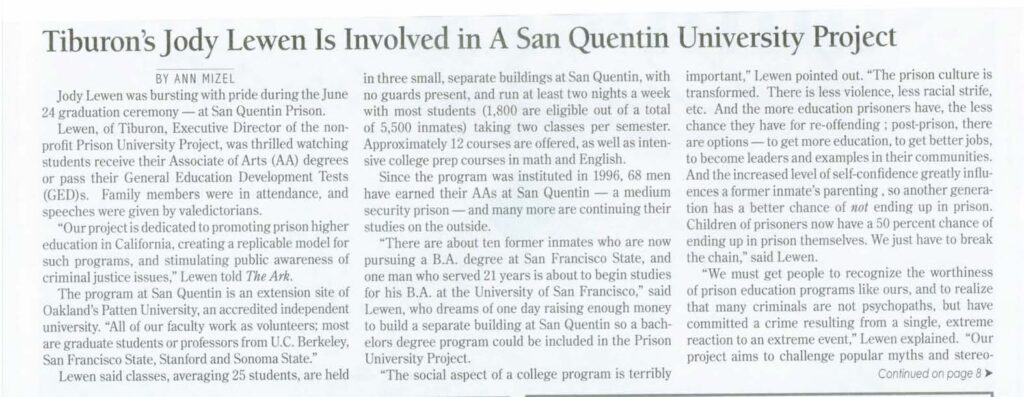
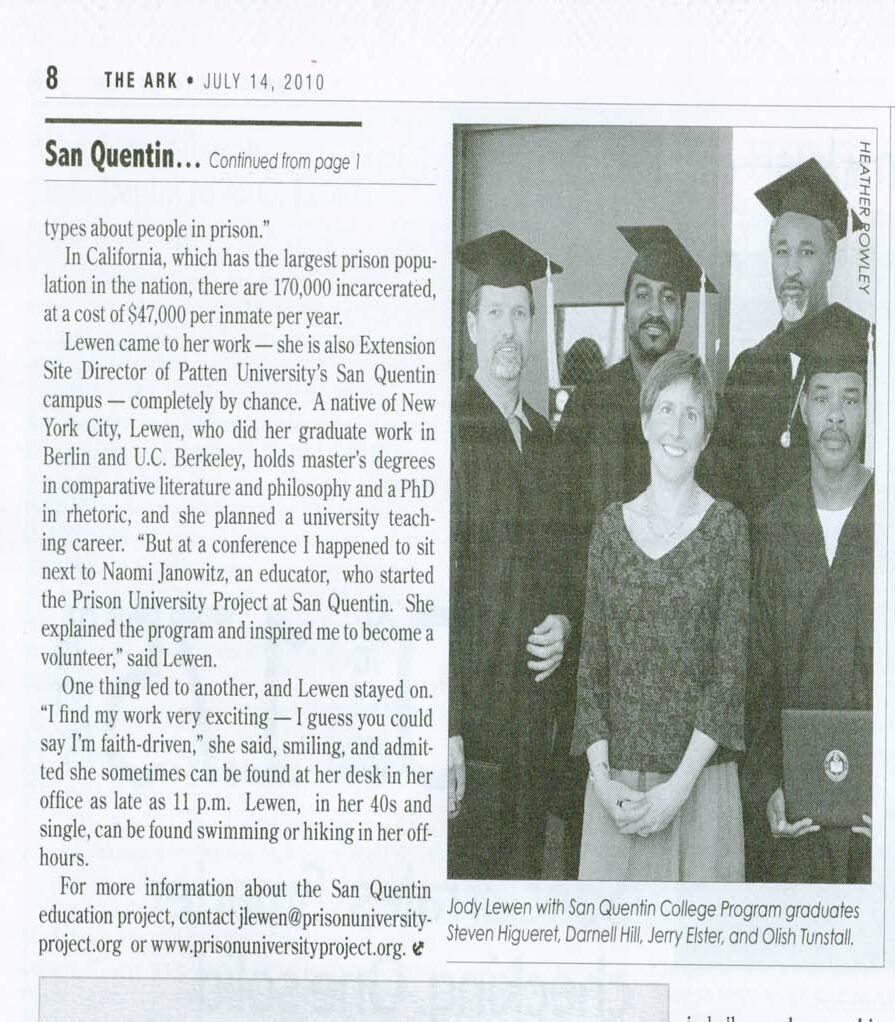
Attribution: This originally appeared on The Ark on July 14, 2010.
Please note that the Prison University Project became Mount Tamalpais College in September 2020.
Attribution: This originally appeared on The Ark on July 14, 2010.
Please note that the Prison University Project became Mount Tamalpais College in September 2020.
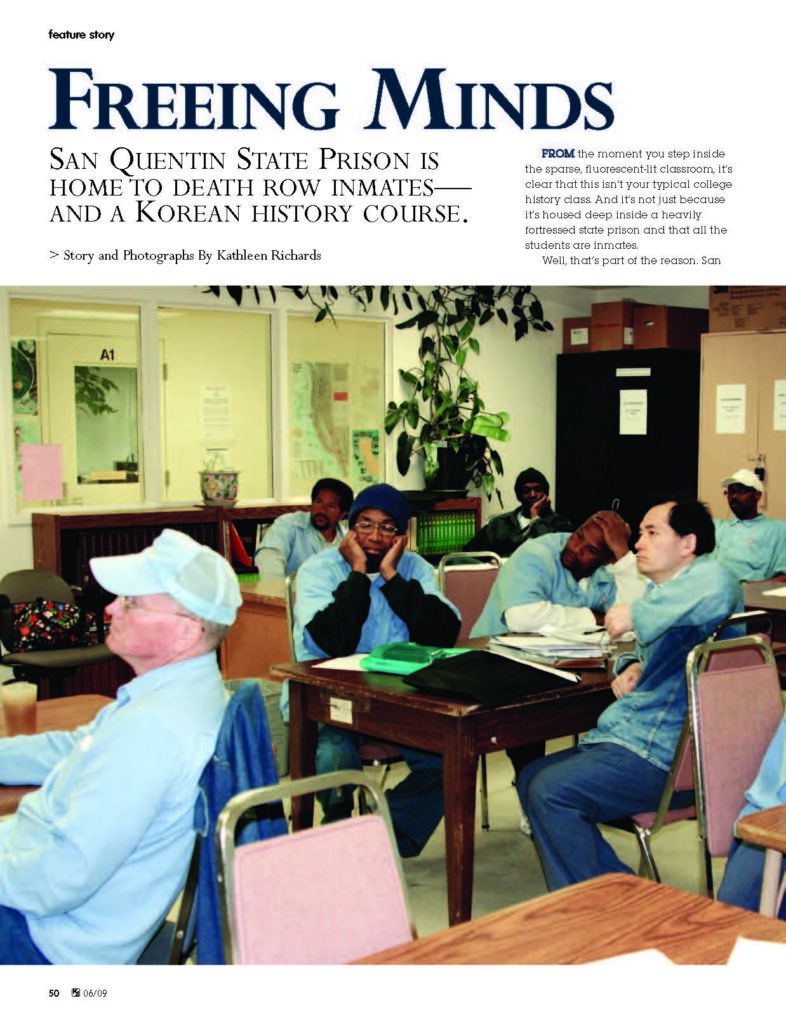
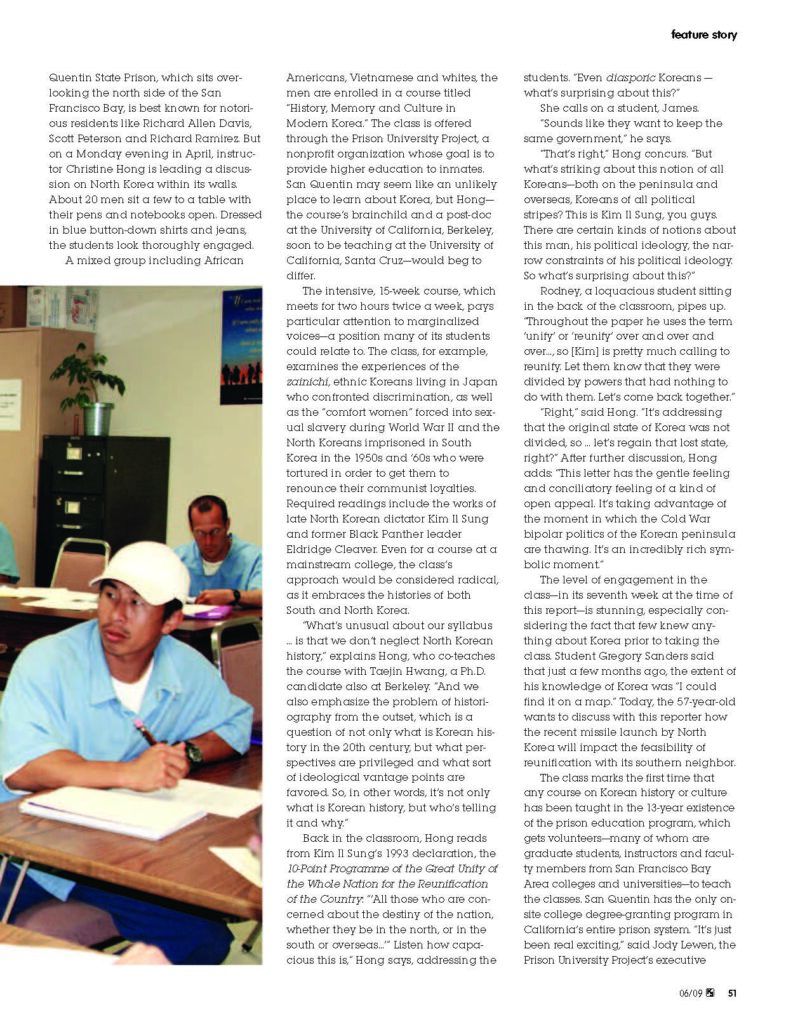
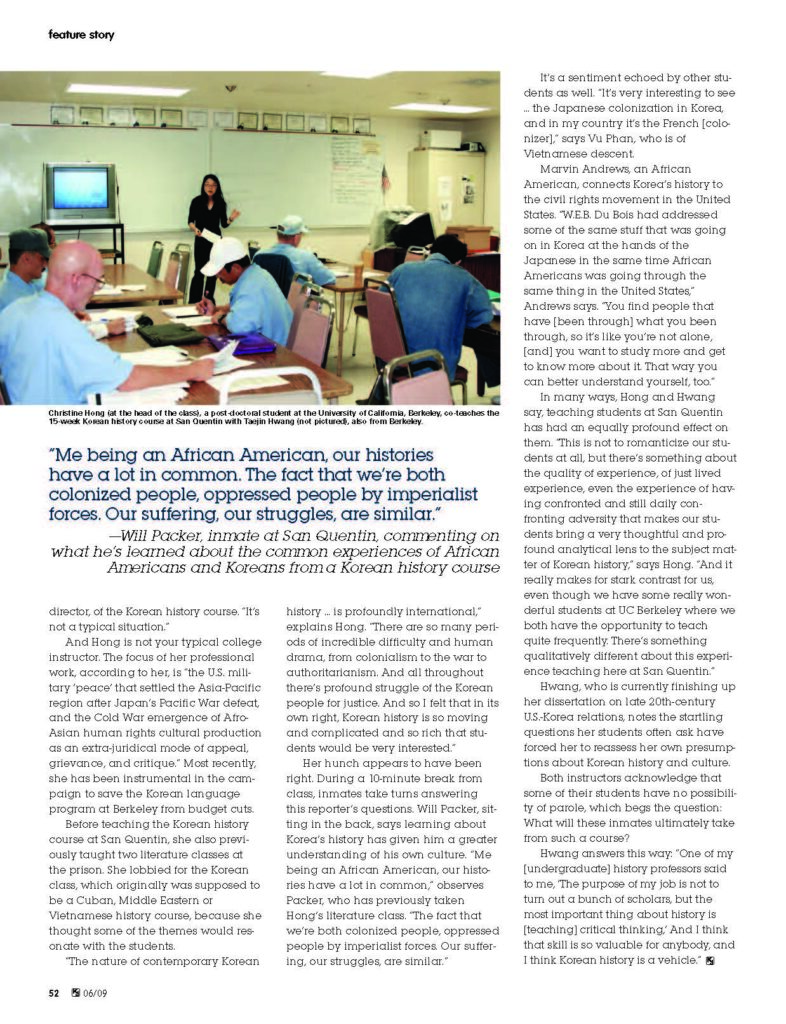
Attribution: This originally appeared on KoreAm Journal in June 2009.
Please note that the Prison University Project became Mount Tamalpais College in September 2020.
In our Behind the Scenes series, CNN correspondents and producers share their experiences in covering news and analyze the stories behind the events. CNN’s Soledad O’Brien and Stan Wilson visited San Quentin for “CNN Presents: Black in America” which premiered July 23 and 24, at 9 p.m. ET.
SAN QUENTIN, California (CNN) — San Quentin Prison sits like a fortress along the bay just north of San Francisco. It is bordered by some of the most expensive residential real estate in the country. But at the edge of this scenic peninsula, 5,400 inmates are locked up.
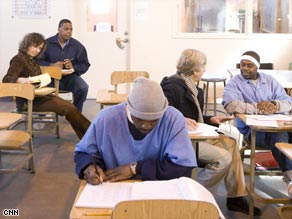
San Quentin has California’s only death chamber, with 656 inmates waiting to be executed.
On death row, each prisoner is confined to a cell just large enough for a bed and toilet.
Walking along these multitiered cells, where each inmate is closely monitored or escorted in shackles, reminded me of all the pain and grief endured by relatives and friends of victims like Laci Peterson, Polly Klaas or Christine Orciuch, a mother of three who was shot to death by gang member Marcus Adams in front of her 10-year-old son during a bank robbery in Santa Barbara.
Less than a few hundred yards from death row, the climate is vastly different.
We found makeshift classroom bungalows and an exercise yard where inmate Larry Faison was performing the tunes of Miles Davis with his vintage trumpet. This environment looked and felt more like a community college setting.
This is where low- and midlevel convicts are able to get out once a day. There is a tennis court, a punching bag, a baseball stadium donated by the San Francisco Giants, a library and visiting instructors from prestigious universities.
Lt. Sam Robinson, a 27-year veteran of San Quentin, gave a tour of 27 vocational programs run by about 3,000 volunteers as part of the Prison University Project, a nonprofit education program that offers many black men an opportunity to earn an associate of arts degree. It helps give those eligible for parole the intellectual tools to compete in a vastly changing job market.  Inmate: It took coming to prison to see someone in school »
Advocates say that many black men imprisoned across America, particularly nonviolent drug-related offenders, have enormous potential to become productive, law-abiding members of society through higher education in prison.
University of California at Berkeley professor Rebecca Carter volunteers as a biology instructor at San Quentin. During her first semester, she was startled by what she discovered.
“I’ve been teaching on the Cal campus and teaching at the prison at the same time, and they were significantly more engaged when I was in the prison,” Carter told CNN’s Soledad O’Brien. “Not always more in command with the subject matter but more engaged, doing the homework, asking questions because they were passionate about learning.”  Tour San Quentin’s Prison University Project »
Carter said there are also benefits for those serving a life sentence.
“There is a person in my biology class, who I know is a lifer, who has a teenage son. He was talking to me about how he was so glad to be in class because he was taking the same class that his kid was taking in high school and he could actually talk with his son about an intellectual thing, showing him that he took education seriously,” Carter said.
“He expects his children to take education seriously, and he does not want them to go down the path he went on, and he’s doing what he can to do something better for himself. And now, they could talk about mitochondria, and they can talk about ‘How did your class go?’ ” she said.
There is also the story of Willie Earl Green, whom I met in February during our documentary filming of inmates Chris Schurn, Marvin Andrews and Aly Tamboura.
Andrews, Schurn and Tamboura are all pursuing their associate of arts degrees through the Prison University Project.
Andrews and Schurn both earned their GED certificates at San Quentin. Andrews is serving a 15-year sentence for voluntary manslaughter, and Schurn is serving four years for cocaine possession. Tamboura, who tutors inmates, is serving 14 years for using a firearm in the commission of a criminal threat.
Green was serving 33 years to life for the murder, robbery and burglary of a Los Angeles woman in 1983 but always proclaimed his innocence. He earned a liberal arts degree in prison and tutored hundreds of others.
Green’s conviction was on appeal when we met, so I took a few notes but concluded that there was little chance his case would be overturned.
About one month later, I was surprised to learn that his case was indeed thrown out. A Los Angeles judge set the graying 56-year-old free, ruling that the prosecution’s star witness, Willie Finley, lied to a jury during key portions of his testimony.
“I was once a freedom marcher in Mississippi fighting for civil rights and social justice during the Martin Luther King Jr. era,” Green told me during his final days in prison. “I would never ponder harming anyone, let alone kill a human being, after spending my early life fighting for nonviolent social change the way King taught us.”
Our cameras were present at his release hearing, and we captured Green’s reunion with his wife, Mary, a breast cancer survivor.
On June 19, Green was invited back to San Quentin to deliver the commencement speech for the graduating class of 2008. He received a three-minute standing ovation from more than 300 inmates, prison officials and relatives. Green was a tutor of this year’s valedictorian and emphasized the value of education.
“I learned never give up, never give up hope, and never allow anyone to define you,” Green told the audience. He told me he felt guilty about leaving his friends behind, but the experience was much different. “This time, the sound of the prison gates closing was a good ‘cling,’ ” he said.
Ninety days after his release, Green told me that he is slowly adjusting to life and that he’s not bitter.
“I don’t hate anybody,” he said. “I don’t hate Willie Finley for doing what he did. I forgive him, too.”
Although most inmates are well aware that an associate of arts degree is not a ticket to success, it’s not the end of the educational road for many ex-cons.
Several inmates have been accepted at universities, and Carter, the Berkeley professor, is convinced that higher education in prison can reduce recidivism.
“I have followed the few people who have gotten out, who got their AA here and are now in school outside in San Francisco State in Santa Cruz and actively pursuing a degree because they know that’s the way to reestablish their level of responsibility,” Carter said.
Jody Lewen, executive director of the Prison University Project, is trying to broaden Carter’s objective.
“We have to talk about how much we hate and fear them first and challenge those thinking patterns,” Lewen said. “Higher education is an opportunity to reverse the trends because demonizing black men has been good for business. I want to change that.”
But the odds against breaking the cycle of incarceration are tough. There are nearly 1 million black men behind bars nationwide, and at least 50 percent of all ex-cons wind up back in prison in the state of California for nonviolent offenses.
Attribution: This originally appeared on CNN on February 26, 2009. Read Story
Please note that the Prison University Project became Mount Tamalpais College in September 2020.
Fifteen men settle into their seats in the classroom and open notebooks. “Hand forward your papers,” the instructor says. It’s the second essay of the semester, and for some of these students, among the first college papers they’ve written.
“Was the workshop on writing this paper helpful?” asks Tom Hendrickson, the history graduate student instructor.
“Yes. Tremendously,” answers one student. All the others agree, though one adds, “We’ll see what our grades look like. Then we’ll know how helpful it was.” Laughter ripples across the windowless classroom, which is warm from late-spring weather.
A typical classroom moment, but this is anything but a typical group of students. Each of these men in this ancient history class is an inmate at San Quentin State Prison. Their classroom, while lacking a view to the dusty yard outside, does have one glass wall that faces out to security guards seated in the hall.
At San Quentin, only the inmates can wear blue—the prisoner uniform consists of jeans and long, light blue shirts with the word “CDC PRISONER” in large letters across the back. Visitors, including instructors who come at least once every week, adhere to a strict dress code so they won’t be mixed up with prisoners or guards. Visitors are escorted by prison staff to the classroom portables across the yard, where inmates exercise and play basketball, with Marin’s brown hills rising outside the barbed wire fence.
Inside the class, past the various security checkpoints, it’s possible to forget that this is a medium-security prison. These men are here to learn, to discuss what they are reading, to engage one another in what may be the prison’s only racially integrated environment and to study history.
“We learn from our mistakes and we learn from our successes,” says Dan, a prisoner who is one of Hendrickson’s students, to explain why he’s in the class. “We all hear about the rise and fall of the Roman Empire, but how did it rise and how did it fall?”
San Quentin, California’s oldest prison, with its fortress-like facades and 1890s-era wrought-iron front gate, offers the state’s only on-site prison college degree programs (another, offered by San Diego City College, has been discontinued due to lack of funds). About 250 prisoners each semester enroll in college preparatory or associate of arts courses. The project at San Quentin is an extension site of Oakland’s Patten University. Since there is no tuition or state or federal funding for prison higher education, the program is supported by donations to the Prison University Project. Twelve courses are offered each semester, in the humanities, social sciences, math and science. All instructors are volunteers, and many, like Hendrickson, are from U.C. Berkeley. So far 74 men have completed their associate of arts degrees through this program at San Quentin.
Jody Lewen has directed the college program at the prison since 2000. Lewen, who received her doctorate in rhetoric from Berkeley, visits the prison frequently. Her commitment to the program is evident as she escorts a visitor across the prison yard, calling out greetings to men who gather in the yard before class in the fading evening light. Under her leadership the program has flourished. There are more volunteer instructors than the program can accommodate, but space is at a premium.
“Education isn’t the goal of the prison, clearly,” says Lewen, gesturing toward the ceiling of a barn-like structure that houses several math courses. While the building could easily accommodate two levels of classrooms, students and instructors crowd into the space, working in storage “cages” that have doors made of bars. “We have to use every nook and cranny.”
An inmate can take enough courses at San Quentin to earn an associate of arts degree—two years shy of a B.A. There are very few computers available, so most papers are turned in handwritten. Dan, the inmate in the ancient history class, earned his G.E.D. in county jail. In his cell at San Quentin he turns a bucket upside down to create a writing surface when the prison library is closed. The library, Dan says, has a limited selection of books, including a partial set of encyclopedias.
“I’m a high-school dropout,” he says. “I wasted 15 years and now I’m trying to make myself a success.”
Volunteering in a prison classroom was never what Victoria Kahn imagined doing when she became a professor of English and Comparative Literature. But the rewards have been high.
“The first semester I taught, they thanked me for showing up,” she says. “San Quentin students appreciate the power of the classroom. It’s very empowering for them because they are treated respectfully, like the human beings they are. You have 150 percent of their attention.”
Kahn’s first experience at San Quentin was co-teaching an English class. Keeping with the course’s theme of Nature and Human Nature, the class read Kafka’s novella, Metamorphosis, the story of a traveling salesman who wakes up one day to find he has turned into a giant cockroach.
She recalls one student who was very engaged in class discussions at the beginning of the semester, but then quite suddenly stopped coming. Then to Kahn’s surprise, he returned to class the day the paper was due. He seemed quite agitated, she says, and stood up to explain that he had had a hard time reading the book because Kafka was a Jew.
Kahn’s story illustrates how issues like race and religion are unavoidable and unique in prison culture. California is one of the last states to continue housing new prison arrivals in racially segregated cells, as a way to curb gang violence. Even though the U.S. Supreme Court ordered the state’s prisons to begin integrating prisoners this past July, it’s a slow process that has yet to have substantial impact at San Quentin. Technically, the non-housing areas of state prisons like San Quentin are already integrated, including the dining hall and yard. But in practice inmates self-segregate in those common areas, like grouping with others of their own race out on the yard.
Being in one of the prison’s classrooms may be the only time prisoners are in a racially mixed setting—not just sitting together, but actually interacting. While the classes are relaxed, instructors say they are always aware of the fact that they’re in a unique and potentially charged environment. Some say that while they ask Berkeley students to pair up in class to discuss material, they never do so at San Quentin. Pairing up, they say, might lead to unfriendly combinations and trouble.
So when Kahn’s student openly copped to his anti-Semitism in class, it was surprising and a little unnerving. But then he surprised her again.
“He wrote that even though Kafka was a Jew, he had a lot to teach about alienation,” Kahn recalls. “Later in class he actually said, ‘I really have come to appreciate what literature can do to change your mind.’”
Jody Lewen hears the question all the time: Why would somebody in prison for a long time, or even forever, need an education?
“I can’t imagine even believing that they wouldn’t need education,” she says. Her zeal softens when she considers the way most people see prisoners—as a faceless mass of bad people who are behind bars for good reason. She is also quick to note that, culturally, we tend to see education in just as limited a way.
“We are programmed to think about education as job training in the most sterile sense,” she says. And to be sure, she sees the practical value of education for these prisoners. Someday, she hopes, prisoners will be able to earn a B.A. and even study beyond the undergraduate level.
But what gets Lewen excited about her work is when she hears prisoners like Ricky talk about how the courses he’s taken through University Project have changed his life.
“I’ve learned a lot about myself and my culture, other cultures, ethics, imagination,” he says. “It seems like I should have been aware of these things at an earlier age. But I ended up at San Quentin and now I’m ready to reclaim my life.”
Ricky has taken classes in critical thinking and math, which make up the largest percentage of offerings in the Prison University Project, but courses in English and history are also well subscribed. In fact, teaching at San Quentin inspires some humanities professors to remember why they teach.
“I feel that teaching at San Quentin is an intensified version of what I do at Berkeley,” says Kathleen McCarthy, a professor of Classics and Comparative Literature. “A lot of these guys never expected to be in a college classroom, so to be treated as a student allows them to bring pure intensity to learning.”
McCarthy co-taught the Ancient History course with Tom Hendrickson in the spring. While many of her students at San Quentin may not have the same level of academic preparation as Berkeley students, McCarthy says that class discussions interpreting the similarities between our world and ancient civilization take place in much clearer relief in a prison classroom.
“It’s no surprise to me that teaching is the volunteer activity of choice for so many of our faculty and graduate students,” says Janet Broughton, a professor of philosophy and Berkeley’s current dean of arts and humanities. “They quite simply love their areas of study, whether literature, philosophy or history, and so for them, sharing this love of learning is deeply satisfying.”
To be sure, there are some headaches involved in teaching at San Quentin—communication with students outside of class is impossible. There can be no office hours or late-night e-mail conversations. Instructors also have to send all their course materials to Prison University Project staff well ahead of time to be copied and distributed, so they can’t be spontaneous with their lecture materials. Students also may have never taken a history course before and may have had little experience writing college papers.
But the level of student engagement is high. San Quentin students are more vocal in class than typical college students, instructors say. Inmates don’t hesitate to make their observations public. Students in McCarthy’s class pointed out similarities between Roman society and our own, noting, for example, that votes in Rome were cast in order of a person’s wealth, McCarthy says, so that by the time a poor person voted, an election may have already been decided.
“That’s good, that they are looking for parallels,” she says. “But sometimes I have to push them to think about history is a more nuanced way. What does it mean, I ask them, that unlike the Roman state the U.S. actually codifies equality in its constitution? That we strive for equality even if it seems that we don’t always achieve it?”
That notion might hit a nerve for Ricky, who says he can’t undo the mistakes he made that landed him in prison, but he wants a second chance.
“People make mistakes, but what are we going to do after those mistakes?” he says. “Are we going to keep people ignorant? My dream is to be an entrepreneur. I’ve spent a lot of time in prison studying the stock market and economics and capitalism, because if you don’t have any money, what are you going to do?”
———————————————
Is it Safe?, an exhibit of essays and photographs from the Prison University Project, will be on display through Oct. 22 at Alcatraz Island. For more information see www.prisonuniversityproject.org.
Kate Rix is an Oakland-based writer. She is a former editor of The Monthly.
Attribution: This article originally appeared in The Monthly in October of 2008. Read Story
Please note that the Prison University Project became Mount Tamalpais College in September 2020.
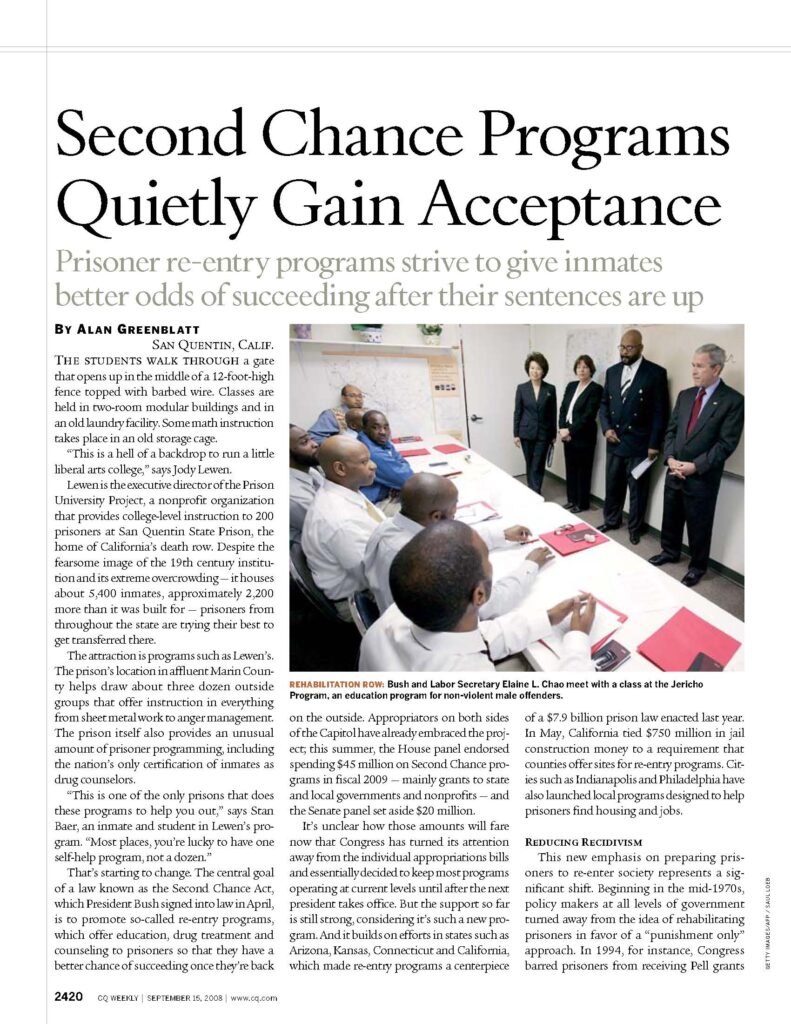
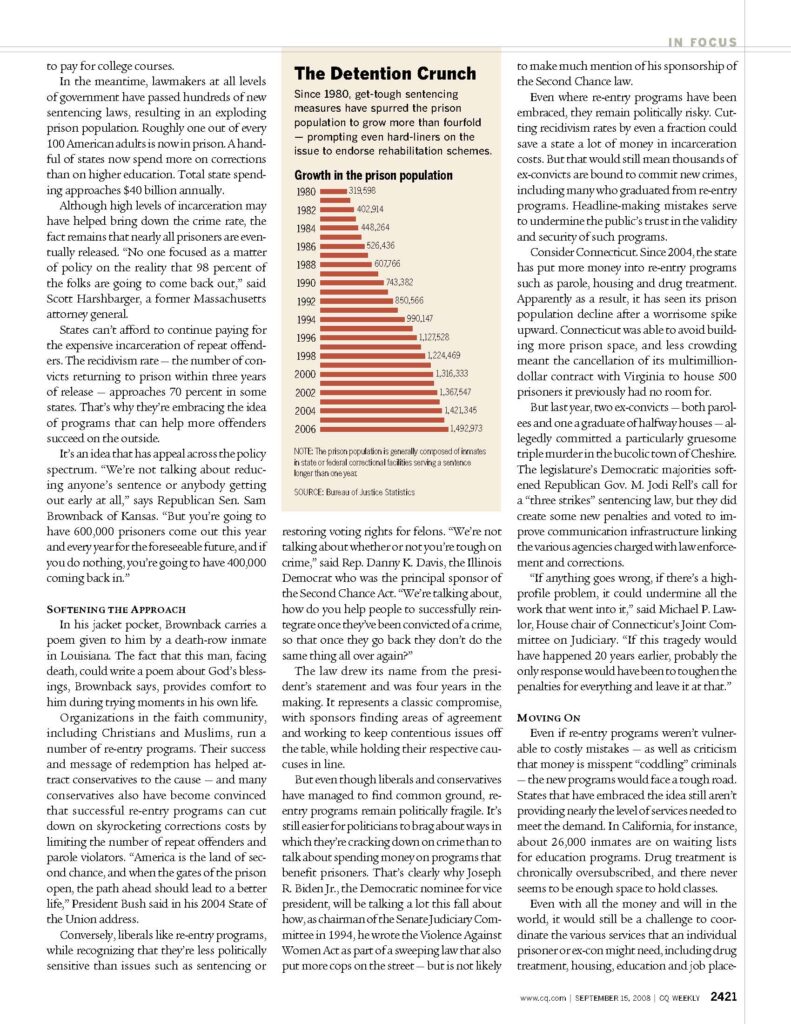
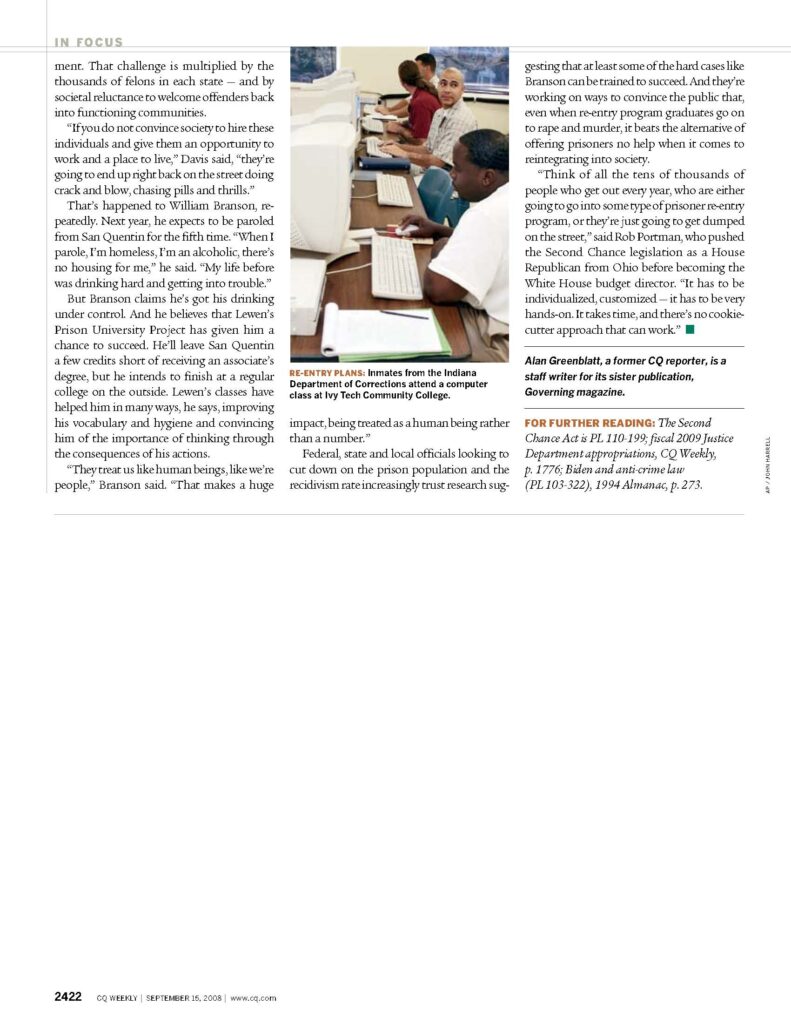
Attribution: This originally appeared on Congressional Quarterly Weekly on September 15, 2008.
Please note that the Prison University Project became Mount Tamalpais College in September 2020.
San Quentin’s Prison University Project helps inmates learn to read and write, secure an AA degree and gain new self-respect.
In 1996, when a jury convicted Jay Ly for manslaughter related to road rage, the judge ordered him to pay $3,500 for the funeral of the person he had killed. For a moment, Ly was shocked. “And I thought, ‘Oh, shoot—funeral,’” he says. “It had never occurred to me that there was a funeral.”
It wasn’t that Ly, then an 18-year-old Asian gangbanger from Southern California, didn’t know that he had killed someone. It was just that he had never thought about the consequences of his crime all the way through until that moment in the courtroom. He had never before considered the funeral and the grieving families and the loss that were caused by his actions. “Those thoughts had never been mentioned to me, and I never would have learned them if the judge hadn’t said that,” he says now.
It wasn’t until toward the end of Ly’s 10-year sentence, half of which was spent in Marin County’s San Quentin State Prison, that he continued the spark of deeper thinking he had started that day in the courtroom. He began taking classes at the Prison University Project at San Quentin.
Prior to the classes, even after five years of prison, Ly describes himself as being a bit of a hothead. When he first got to San Quentin in 2001, he almost started a riot against white inmates, but another prisoner stopped it at the last minute. Then he started hearing about the university, where inmates could take classes in everything from math to Spanish to philosophy.
“A couple of guys, Eddie and another guy, Mike, had all these books and were doing speeches and stuff, and they would come to my cell and say, ‘Hey, man,’ and would talk to me,” he recalls. “They were always talking about school and stuff and I was like, ‘Yeah cool, whatever,’ you know. But then the spring semester came and I took some courses.”
Over time, the classes began to work their way into Ly’s spirit. In his ethics class, reading Plato and Locke and other philosophers, he started looking at the world in new ways. He began to think critically, to reason, to question. And like that moment in the courtroom, he began to feel empathy for the world around him. “I would be in class and go, ‘Oh shoot, I never thought of it that way before,’” he says. “I was even a vegetarian for a while because I felt so bad for eating meat because of that class.”
San Quentin’s Prison University Project is the only onsite university for inmates in California. About 200 men take about two classes a semester toward their AA degrees. Since the university was founded in 1996, 68 students have earned AA’s at San Quentin, and many more have transferred and gone on to complete their studies after being paroled. The school is an extension of Patten University, a nondenominational Christian college based in Oakland.
Despite struggling at times, the Prison University Project gains momentum and prestige every year. It is also controversial. At a time when the cost of a four-year college education in California is approaching $100,000, many people are against providing free higher education to inmates.
“If you are a working-class family and you are law-abiding and struggling to put your kids through school, you may think, ‘Why should someone be able to commit a crime and then go to prison and get a college education?’” says Terry Thornton, spokesperson for the California Department of Corrections and Rehabilitation (CDCR). “People are supportive of education, but the taxpayers are not going to want to pay for prisoners to get a college degree while in prison.”
Building a School
Today, San Quentin’s university is completely privately funded. It didn’t start out that way. Originally, the university was supposed to be government-funded. Then, in 1994, Congress barred prisoners from receiving Federal Pell Grants, which in turn eliminated funding to higher education in prisons and forced some 350 programs to shut down. San Quentin would have done the same if it weren’t for one person: Jody Lewen.
In 1998, Lewen, a graduate student at UC Berkeley, went to a conference on psychoanalysis and happened to sit by someone who worked in San Quentin’s university program. Soon after, Lewen decided to volunteer to teach literature and composition to the inmates. Although she liked the university, Lewen could see how it could be so much better than it was, so she took an active role. She began e-mailing and contacting people in charge for more resources and bringing up her thoughts on the project to anyone who would listen.
Then the project’s executive director announced that he was leaving for another job in two weeks. People began saying the university would close down. They also started looking to Lewen for answers. “And I thought, ‘I’ll kill myself if I just stand here and watch this happen,’ you know,” says Lewen. “So I ended up saying, ‘This is really, really important to a lot of people, and I have to stabilize it somehow.’”
After she took over as executive director, Lewen found that she loved her new job. It was challenging, sure, but also satisfying. The inmates were so grateful and loved the classes so much, and it allowed Lewen a chance to teach and work in social justice at the same time.
“I was always a little uncomfortable teaching kids at Berkeley, because no matter what, I knew those people were going to be OK,” she says. “So I thought, ‘Oh, my God, here’s a way I can be in an academic setting and still help more marginal and needy people.’”
To generate funding, Lewen formed a nonprofit to support the university. Today, it is funded through donations from individuals, private foundations and corporations. Publishers donate textbooks. The classes are taught by approximately 60 volunteer teachers, most of whom are graduate students or instructors from Sonoma State University, UC Berkeley, SFSU and other Bay Area universities.
Freeing Minds
Running an accredited university within a prison system is a difficult challenge, to say the least. Much of Lewen’s time is divided between two things: getting funding and appealing to prison officials.
Since 2001, for example, Lewen has been trying to get officials to give her more classroom space. The university needs a minimum of eight classrooms five nights a week, but currently only has an average of three classrooms a night. Now, thanks to some pressure from members of the state Legislature, Lewen is seeing signs that her request may be granted. The Prison Industry Authority is building modular buildings, and one may be put aside for the university.
Although this is a positive development, six years is a long time to wait for such a basic resource. “Someone said to me, ‘Wow you’re running an entire college for us for free and all you’re asking for is some place to put it, and we can’t even do that,’” says Lewen. “‘What’s wrong with us?’”
While San Quentin’s program is the only on-site university in the state, other college opportunities are popping up for prisoners elsewhere. The CDCR is working with California community colleges to create opportunities for prisoners to learn online and through correspondence courses. In June, 71 inmates earned AA degrees this way at Ironwood State Prison and Chuckawalla Valley State Prison, making them the largest group of prisoners to graduate at one time with higher educational degrees in the United States.
Still, according to Thornton, there are no plans for taxpayers to pay for college education for prisoners. And we probably couldn’t afford to, anyway: the budget for the CDCR is $10 billion plus another $7.4 billion allocated to build 40,000 new prison beds. By comparison, the budget for higher education in California is around $15 billion. For the first time in the state’s history, Californians are paying more for prisons this year than they are for higher education.
On the other hand, studies suggest that spending money on educating prisoners may cost the taxpayer less in the long run. People who get an education in prison are far less likely to commit new crimes when they are released on parole, which means fewer repeat offenders. A 2001 study by the City University of New York found that prisoners who take college classes are four times more likely to behave themselves when they are released. It also found that college prison programs save taxpayers about $900,000 per 100 students every two years. It is more expensive to house a prisoner for a second and third time than to educate him once.
Prison education also lowers the toll that repeat criminals take on a community. “Ninety percent of people in prison today will be released back into the community,” says Owen Modeland, president of the Correctional Education Association, which serves educators and administrators who teach prisoners. “College education can mean that an ex-offender will get a job, pay taxes, support his family and stay out of trouble.”
Micro Macro
All inmates at the Prison University Project have to take college prep courses before they can start taking college-level classes, whether they have a high school diploma or GED or not. “I was naive about this when I went into the program,” says Lewen. “I thought, ‘Oh, a high school diploma. That means they should be able to write an essay, write a full sentence.’ No. A lot of students the schools are graduating can barely read or write.”
Half of California’s 173,000 prisoners read at a seventh-grade level and almost a quarter read below a third-grade level. Because of this, the college prep course in language skills starts with such basics as grammar and spelling. By the end of the semester, everyone has learned to write a five-paragraph essay.
The inmates are also required to take a college prep math course to get up to basic algebra. In some cases, this means reviewing decimals, fractions and multiplication tables. For other people, it means learning basic math for the first time.
“It is unbelievable,” says Lewen. “I had no idea going in what it was like. The story of what’s going on in California’s public school system is in the Prison University Project.”
Prisoners often couldn’t concentrate when they were in school because of other pressing issues like abuse, hunger, drug addiction, homelessness and gang activities. Additionally, a large portion of the prison population have undiagnosed learning disabilities, like ADD or dyslexia, making classroom time just that much more difficult. When they were ignored or chided by teachers for their disabilities, they may have acted out and slid into behavioral problems. Whatever the case, with most of them the educational system did not address their needs.
“In a way, prisoners are society’s failures,” says Department of Corrections spokesman Thornton. “When the average reading level is seventh grade, there have been a lot of failures. I’m not saying that that is the case with everyone; there are certainly people who deserve to be in jail. But a lot of people have been failed along the way.”
For these inmates, going back to school can bring back bad memories or unexpected emotions. It’s common for a prisoner to believe he is stupid and incapable of learning, and discovering this is not true can be upsetting. Some inmates will drop out of class when they start to do well, assuming it must not be a real class if they can get good grades.
Ly stayed in high school for the girls; if he had gone to an all-boys school, he jokes, he would have dropped out in the ninth grade. Yet he knew he was good at math. In 11th grade, he skated through calculus while barely paying attention, squeaking by with a C.
Still, Ly didn’t think of himself as intelligent until his prison classes. “I started realizing that I’m smart,” he says. “Not a super genius or anything, but I’m pretty quick. And I started thinking, ‘Hey, I could do something with my life.’”
This realization came slowly as Ly kept getting A’s. Then, for his intro to ethics class, he wrote a 30-page essay for his midterm, the longest thing he had ever written. When it was handed back, the teacher praised the essay in front of the class.
“She said, ‘This is the best paper in class,’” he remembers. “When I look back, it was nice. She said, ‘I don’t give out A-pluses very often.’ She had handed out only fours A-pluses in her whole career. I got an A-plus in that class because of that midterm.”
Life’s Random Pattern
Ly is one of many students who has been encouraged by the Prison University Project. When David Deutsch was sent to San Quentin for trafficking cocaine and marijuana in 2000, one of the first things he heard about from the other inmates was the university. “They absolutely loved that program,” he says. “There is no group of people more enthusiastic about learning than these prisoners.”
Deutsch, who got his bachelors from Humboldt State University in 1976, spent much of his time in prison tutoring other prisoners. Still, in his last year in San Quentin, he took some courses in Spanish. The class not only re-ignited his love of learning, he found that it distracted him from his situation in a way that almost nothing else did.
“When I would sit in Spanish class, I would forget I was in prison and just focus on Spanish,” says Deutsch, who was paroled in 2003 and is now pursuing a graduate degree in social work. “That may be another reason they love it so much. They completely forget about the fact that they are incarcerated. You temporarily forget where you are.”
Like most people, when Lewen first volunteered to teach at San Quentin, she was a little concerned about her safety. She was surprised to find that the prisoners were not threatening at all, but respectful and pleasant. In fact, in the program’s 11 years, there has never been a fight in a classroom and no teacher has ever been assaulted. By getting past the prison stereotype and getting to know the men as people, Lewen has started to see the potential the inmates once had—and, in many cases, still have.
“It’s almost like, as a society, we imagine people in prisons as a composite image of all the people who have ever committed a crime,” Lewen says. “Everyone imagines a psychopath. It’s just such a waste. Most of the people I see, if they had gone to my little private school in New York, they would have never been in prison. No way.”
For Ly, reentering society has been difficult after 10 years in jail, but he is still managing to get A’s in his five classes. While he finds the classes at SFSU are harder than the ones at the Prison University, the students are also less enthusiastic about learning.
“People here just sit in class, they don’t participate, they’re like, ‘Whatever, when are we going to be done?’” he says. “Half the class doesn’t show up. The class will have 60 students and only 30 will come.”
Ly can’t afford to be that apathetic. If he hadn’t gone to the Prison University, Ly thinks he would still be in jail now. Considering all it has given him, education is his top priority. “I know it’s work,” Ly says. “If I don’t have an education, with my background, things would be tough for me. That’s what education means to me.”
Attribution: This originally appeared on the Bohemian on October 31, 2007. Read Story
Please note that the Prison University Project became Mount Tamalpais College in September 2020.
To get past the triple set of iron gates of California’s notorious San Quentin State Prison, I must abide by the following rules: No cell phones, cameras, or recording devices. No backpacks, purses, or wallets. And no blue or orange clothing, because those are the colors that the inmates wear.

As I am being escorted across the prison yard to the modular education building, I’m moved by the sight of several hundred inmates dressed in prison-issued blue denim uniforms exercising and playing sports. They look just like ordinary people, and my initial fears about visiting this place subside. I’m here to observe a general chemistry course being offered for the first time to inmates taking part in the College Program at San Quentin.
The classroom looks like one found in elementary school. Colorful posters adorn the walls, and the students sit two or three to a table. In front of the room is a dry-erase board and an overhead projector. There are no computers and no visual aids; it’s chemistry without the frills.
When the instructor, Charles (Chip) Crawford, asks, “Who can describe what an ionic bond is?” five hands go up. “It’s where two atoms share an electron,” one student offers. “That’s a covalent bond,” Crawford says, correcting the student. And he proceeds to explain what an ionic bond is. The students—16 inmates, each wielding a calculator and the American Chemical Society textbook “Chemistry in Context: Applying Chemistry in Society“—are reviewing for their final exam.
From May through August, the class met for four hours every Friday. Starting with around 30 students, the class ended up with 17 taking the final exam. Crawford, a fourth-year chemistry graduate student in the lab of Alexander Pines at the University of California, Berkeley, taught the course with fellow UC Berkeley grad students Michael Rousseas (physics), Alex Fabrikant (computer science), and Erik Douglas (bioengineering).

The grad students say that these prisoners are some of the most motivated and hard-working students they have ever taught. The prisoners, in turn, say that these volunteers have inspired them to work hard and seek a better life for themselves. The truth is, this unusual chemistry class has changed the lives of everyone involved.
Studies show that prisoners who participate in educational programming are at a lower risk of relapsing into crime after being released from prison. A 2001 study conducted by the Correctional Education Association, for instance, reported that prisoners who participated in correctional education were 29% less likely to be incarcerated again than prisoners who did not participate in such programming.
Attribution: This originally appeared on Chemistry and Engineering News on October 22, 2007. Read Story
Please note that the Prison University Project became Mount Tamalpais College in September 2020.
Some of the men, who wore tasseled caps and gowns over their prison-issued blue denims, are serving life sentences. Others are newbies – behind bars less than a year. And the keynote speaker: a bank-robber-turned-author.
In an emotional graduation ceremony Thursday, seven inmates received associate’s degrees at San Quentin State Prison – the newest batch of graduates in the state’s only on-site prison college program. They were joined in the front pews of the prison chapel by a few dozen men who had earned their GEDs, high school diplomas and vocational certificates.
The keynote speaker, Joe Loya, told the graduates that, by seeking higher education, they created a future different from the one that their lives and circumstances seemed to dictate.
“You’re defeating your path,” said Loya, a playwright and essayist who spent seven years at a federal prison in Massachusetts. “You’ve moved closer to the world. And at this moment, the world has moved closer to you.”
A prison band, “Committed,” played a few R&B songs. Friends and family members, and a handful of the program’s 70 volunteer teachers, cheered them on. There were tears in remembrance of a friend who recently died, a fellow inmate who taught a plumbing course.
For some of the graduates, it was a heady mix of emotions.
“This here is a weird feeling,” said Carl Abdul Stewart, wearing a huge smile and a beaded necklace.
Stewart, 33, has been imprisoned for 16 years. He said he never saw education as important and was the first of his siblings to finish high school.
But his perspective has changed. After he saw someone in San Quentin get stabbed in the neck, he realized he wanted to find a way out. Encouraged by his cellmate and wife, Stewart became interested in learning.
“It took some growing up on Level Four,” he said, referring to a maximum security area. “This is not the life I want.”
Approximately 200 inmates are enrolled in classes and 68 have attained their degrees from Patten University in Oakland, said Jody Lewen, founder and executive director of the Prison University Project. Recently granted status as a nonprofit, the organization coordinates the program, from raising funds to acquiring donated textbooks.
The college program started at San Quentin in 1996, two years after the passage of a law that prevents prisoners from receiving federal Pell grants. It does not charge tuition for classes and the instructors – many of them professors and graduate students from the University of California at Berkeley, San Francisco State University and other local schools – are entirely volunteer.
One of their main goals is to help the men to lead healthy, safe and productive lives when they leave prison, Lewen said. “We want to give them the tools to become leaders and role models” – both inside and outside the gates of San Quentin.
If he’s released by the Parole Board in two years, Stewart wants to build a career speaking to young people.
“They’re out there killing themselves because they believe there’s no other way,” he said. “I want them to see it’s not too late.”
Edward Sprunck, 46, also has plans for his release in late 2008. With an associate’s degree under his belt, he has set his sights on acquiring a California real estate license.
His stepfather is pleased. “This is the first time I’ve ever heard him really be serious about going forward,” Andre Flandrois said. “Something good will come of this.”
Lewen said the program runs counter to the way many inmates think of themselves and that classroom learning opens them up to essential social skills like collaboration and debate.
“It ends up totally redirecting them,” she said. “The world is a different place because now there are all these options, possibilities, hope.”
Flandrois was struck by the sense of community he saw watching the men applaud one another.
“It’s almost like they’re graduating from Yale.”
Attribution: This originally appeared on Marin Independent Journal on June 28, 2007. Read Story
Please note that the Prison University Project became Mount Tamalpais College in September 2020.
Jody Lewen, who volunteered to teach inmates at San Quentin eight years ago, today heads the prison’s college program.
“I feel so strongly that everyone who is willing and able should be provided access to higher education,” said Lewen, director of the Patten University extension program at San Quentin. “I see this as a powerful opportunity to provide this access to people who would otherwise not have it.”
Lewen is the recipient of the 2006 Peter E. Haas Public Service Award given by the University of California at Berkeley, where she has a doctorate in rhetoric. She has a master’s degree in philosophy and comparative literature from Freie Universitt in Berlin.
She gave a lecture called “The Promise of Higher Education at San Quentin” during a ceremony at Cal’s Doe Library on Saturday.
Lila Blanco, associate director of university events, said Lewen was selected from 23 nominees.
Blanco said an eight-member committee felt Lewen best met the award criteria, which includes being a Cal alumnus who has made “a significant voluntary public contribution.” The award recognizes efforts illustrating the impact an individual can make through social change. The focus is on four areas: community service, health care, environmental work and education.
The most exciting thing about the award is the message it conveys that the university community is taking the issue of higher education for prisoners and the larger issue of the California criminal justice system seriously, and that is just good for everyone. It is good for the prison population and it is good for the state,” said Lewen, 42, of Berkeley.
San Quentin Lt. Eric Messick called Lewen a zealous professional who transformed the lives of many inmates.
“I have seen education turn the lives of many men around,” Messick said. “I have observed men who thought their only direction was criminal activity, through education and new forms of logic create a new reality for themselves. It all happened because Jody Lewen is zealous when it comes to promoting education for these men and because of all the volunteer instructors she brings in. Our appreciation goes out to them all.”
Lewen started as a volunteer teacher in the prison college program in 1999 – teaching English composition, literature and critical thinking – before taking over the program in 2000.
“By June, 68 students will have completed the associate of arts degrees, and hundreds others will have taken part in the program before returning to the community,” Lewen said.
She is executive director of the nonprofit Prison University Project founded in 2003.
“Its mission was to provide support to the college program at San Quentin because the program needed a budget, a vehicle to raise funds for textbooks and staff salaries,” Lewen said. “Over time, its mission has grown to become more involved with public education and advocating on issues related to reforming the criminal justice system.”
Attribution: This originally appeared on Marin Independent Journal on April 22, 2007. Read Story
Please note that the Prison University Project became Mount Tamalpais College in September 2020.
THIS IS A RUSH TRANSCRIPT. THIS COPY MAY NOT BE IN ITS FINAL FORM AND MAY BE UPDATED.
LARRY KING, CNN HOST: Tonight, back behind the walls of San Quentin with prisoners who may never leave. Here death row holds some of America’s most notorious killers. What’s it like to do life in a place like this? You’re about to find out in part two of our look deep inside San Quentin like you’ve never seen it before.
It’s next on LARRY KING LIVE.
Tonight, part two of our special series. We’re in the prison courtyard at San Quentin. Right behind my guests is the adjustment center. It has the worst of the worst, the most dangerous prisoners.
Before I talk to my guests, here’s a look at this notorious prison.
(BEGIN VIDEOTAPE)
KING (voice-over): Notorious and world famous, San Quentin was built by inmates in 1852. Overlooking the bay just north of San Francisco, it houses about 5,500 inmates.
Scott Peterson, the man who killed his pregnant wife Laci and unborn son Conner is on death row here. Serial killer Richard Ramirez (ph) is here too, the notorious night stalker, who terrorized Los Angeles in 1985. Another infamous San Quentin resident, Richard Alan Davis (ph), he kidnapped and murdered Polly Klaas.
All of California’s 638 male death row inmates are here, home of the state’s only death row chamber. It’s where gang founder Tookie Williams was put to death last year. Gangs (INAUDIBLE). Guards have been killed here. Killers, rapists, thieves, you’ll find them all inside San Quentin’s historic walls.
(END VIDEOTAPE)
KING: This is part two of our series from San Quentin. Let’s meet our guests. They’re Bryan Smith. He was 18 when he committed the robbery/murder that got him a life sentence.
Jerry Elster was 19 when he shot and killed a man in South Central L.A., convicted of second degree murder. He spent 23 years in prison.
Alberto Losno, serving 15 to life for second degree murder, committed the crime in 1981 when he was 19. He’s been in prison for 25 years.
Al Featherstone, he served two years here at San Quentin. He was imprisoned for assault with a deadly weapon and commission of great bodily injury. His victim was his girlfriend, the attack so brutal she lost an eye. This ex-convict now works as a counselor, church leader. He ministers to prisoners in San Quentin.
And, Jeff Elkins, Jeff was with us last night. He is also convicted of murder and he’s in for life and he returns tonight.
And also returning tonight is Vernell Crittendon, the San Quentin Prison spokesman, who started here as a guard and has worked at San Quentin for almost 30 years.
Bryan, what happened? What was your crime? What happened?
BRYAN SMITH, SAN QUENTIN INMATE: Larry, 26 years ago in August of 1980 me and a couple of my so-called friends participated in an assault, a robbery, and ultimately the tragic death of a very fine and innocent young man.
I’m here as a result of a lifestyle that led to that event and I’m here as a result of the choices that I made on that day and I’ve been in prison every since I was convicted of murder/robbery.
KING: How was he killed?
SMITH: The weapon was a knife.
KING: Did you use the knife?
SMITH: No, sir.
KING: One of the other?
SMITH: Yes, one of my crime partners decided that it wasn’t man enough just to carry a knife around all summer. He decided to use that knife that night and unfortunately and tragically someone died as a result of it.
KING: But since you were there and one of the assailants you count as well?
SMITH: Yes, I was an active participant in the assault and the robbery. In California that’s considered murder.
KING: Jerry, what happened with you?
JERRY ELSTER, SAN QUENTIN PRISONER: Well, my story is like not unusual, you know, the typical guy growing up in the inner cities. I grew up amidst gangs and drugs and a lot of other negativity. There were positive things around too.
But I chose to run with that group or crowd, the negative element. And, in doing so, I got into an altercation one time with an individual and it resulted and I ended up killing that individual.
I think that a lot of young men, especially coming out of the inner cities we’re faced with issues and stuff that we’re not ready to deal with and that was pretty much my thing, what happened with me. I was…
KING: Did they catch you right away?
ELSTER: Initially I turned — I mean afterwards, two weeks I turned myself in to the law enforcement after I found out they were looking for me.
KING: You have — do you think about it all the time?
ELSTER: I think about it all the time.
KING: I mean you killed someone.
ELSTER: Well, I think about it not so much in the sense where I’m thinking of it where it beats me up. I went through a lot of stuff since I’ve been incarcerated and because of my spiritual change, which has given me hope now, I have a hope that I can take that negative and use it, I mean make it out of a positive.
And, being here at San Quentin with all their programs that gave me an opportunity to do that, so what I do is I reach out to youth, through programs like Squires (ph), No More Tears, and stuff and I know that young man, the young Jerry.
So, when I look at a youth that’s going through some of the things and faced with the same kind of confrontation that they were faced with, I’m able to provide them with the necessary tools or helping them to understand some of the confusion they’re going through.
KING: We’ll be talking a lot about what they’re doing here at San Quentin. They’re doing some extraordinary things.
We’ll also talk a lot about life inside the prison. Hopefully as we learn more about this hidden place about which we know very little, it might help prevent someone from getting here.
Alberto, what happened with you?
ALBERTO LOSNO, SAN QUENTIN PRISONER: I, myself, got caught up and lashed out. I had no experience living as far as letting you could say fad in an era that just swallowed me up and basically I followed, like many youngsters today follow and I tried to pacify groups and somehow tried to live up to their expectations of me.
KING: Following the crowd?
LOSNO: Following the crowd and the era that it was back in let’s say late ’70s, early ’80s with that low rider mentality and I got caught up trying to pacify others around me and that led up to his murder.
KING: What did you do?
LOSNO: I participated in a murder as far as let’s say a neighborhood against a neighborhood type of squabble, confrontation.
KING: Gang? LOSNO: You can label it gang, you know. That word sometimes gets really blown out of proportion but at that time, yes, it was a gang- related murder.
KING: Did you, yourself, kill someone?
LOSNO: Yes, that particular day I participated and I’m guilty for my crime.
KING: But you got 15-to-life.
LOSNO: I got 15-to-life with the possibility of parole.
KING: So you’ve been in how long?
LOSNO: Twenty-five years. Yesterday was 25 years, Larry.
KING: Ten years past the 15?
LOSNO: Yes.
KING: Do you expect to get paroled?
LOSNO: I expect it. I see it and I confess in the name of Jesus I’m also a born again Christian.
KING: Al Featherstone, you’re no longer a prisoner, you attacked your girlfriend. What did you do?
AL FEATHERSTONE, FORMER SAN QUENTIN INMATE: It was an evening at the end of a three-day binge after using drugs and alcohol and went to the bar and started drinking and as a result of that I committed a heinous crime of which I’m remorseful today. I did my best to rectify that attitude and behavior in my lifestyle and now I’m giving back to the community.
KING: What happened to the girl?
FEATHERSTONE: The girl is OK. She didn’t actually lose her eye. It was just a tear duct was damaged. Even though it was heinous and I’m very remorseful about it, I think today if she would look at it and look at what I’ve done she would forgive me in her heart as well as I forgive myself.
And I’m doing my best to rectify that and make sure that none of the other young people follow my example of using drugs and alcohol and end up in a situation out of control.
KING: You haven’t heard from her though?
FEATHERSTONE: No, I haven’t.
KING: And you served how long?
FEATHERSTONE: I served two years on a four year sentence.
KING: We’ll hear Jeff’s story and a lot more when we come back. Don’t go away.
(BEGIN VIDEO CLIP)
ELSTER: Prison is nothing but like a (INAUDIBLE) of what society is out there, so of course we (INAUDIBLE). You know they got gangs in here but the gangs in here are just like the gangs on the street. They do their own thing. It’s not like the same thing as on the streets out there.
When you come to prison you got a choice to make if you’re going to get hooked up and caught up into all that or you’re going to do your time and try to get up out of here, learn from your mistakes. The majority of guys that come to prison don’t get caught up in the gangs here. They come here. They learn their lesson and they try to get back to society.
(END VIDEO CLIP)
(COMMERCIAL BREAK)
(BEGIN VIDEO CLIP)
SMITH: It took me quite a long time, about a dozen years, to really remove myself from the typical prison culture and decide I don’t want to die in here. And, if I don’t want to die in here, I’m going to have to change my life and I’m going to have to get educated. I’m going to have to try to find some marketable skills. I just recently, five years ago, gave my life to Christ, so that was a transformative moment.
(END VIDEO CLIP)
KING: We’re back at San Quentin, a return visit for night two. For those of you who missed it last night, we’ve invited Jeff Elkins to come back. Jeff, will you briefly explain what you did?
JEFF ELKINS, SAN QUENTIN INMATE: When I was 19, I took my friend’s life over drugs and money.
KING: How did you take it? What was happening?
ELKINS: I was deeply involved in drugs and alcohol. I was in debt. And, I killed him a baseball bat and took his money from him. I had no right to do what I did. If I could do anything to change that and bring him back, I would do that.
I spend my life now trying to help other people realize the mistakes that I made and not to get caught up so someone else doesn’t lose their life. The only thing I can do to try to — nothing I can do will ever make up for what I did but if I can save some lives it would make it easier for me to live with.
KING: What was it like to kill someone?
ELKINS: It was horrible. It was terrible. It was a nightmare.
KING: Did you feel terrible at the time?
ELKINS: Afterwards, yes I did. Yes, I did.
KING: Felt remorse?
ELKINS: Yes, I did.
KING: Felt you got what was deserving?
ELKINS: I deserved what I — the sentence that I got, yes.
KING: Vernell, are these prisoners typical or not typical?
CRITTENDON: For San Quentin I think you’ll find that these are men that are — hundreds of men here at San Quentin are just like that are going to through programs who have made transformations in their lives.
I think that’s the real thing. They’ve been involved with our educational program. Many of these men have been able to receive their college degrees just because of the fact that we offer that and we’re the only prison that offers it.
KING: Is this the worst you’ve ever seen, Bryan, this place?
SMITH: No, actually this place has a theme of rehabilitation to it.
KING: So, it’s a better prison than its image?
SMITH: Yes, exactly.
KING: Its image is not good.
SMITH: Its image goes back to the ’60s, the ’70s and the ’80s. This is a level two prison primarily. There’s 2,000 general population inmates and we have several programs, Larry.
I’m the inside coordinator for a program called Project IMPACT. IMPACT is an acronym that stands for Incarcerated Men Putting Away Childish Things. And when we talk about what’s going on in prison when you ask about violence and how horrific can this place be, any actions like that are the result of a grown man chronologically acting like a child. And knowing that, this program addresses that issue directly.
KING: But what’s it like to live here?
SMITH: What’s it like to live here? It’s like I’m trying to demonstrate to myself, to my family, and to my community that my life still has value. I participated in a tragic event and each day I wake up in a cage and each day I set forth to accomplish something.
As long as I’m learning something in here every day I feel like I’m making use of my time. And once I learn something that’s valuable it’s something that I see in the past where I was making those mistakes, simple mistakes that led to a tragic loss of life. I try to share that information with my peers.
KING: Looking at that cage, Jerry, doesn’t it ever get to you?
ELSTER: Well, yes. It can.
KING: I mean aren’t there days you wake up and say “God”!
ELSTER: Yes, it can become depressing but again if you look at the situation we’re in here and they got a lot of guys, a lot of people out in society right that go to work, work in a little booth. They’re not satisfied with their life. They go through changes.
And by being incarcerated and going through this, giving myself that space that’s helped me to look beyond just my present predicament, you know. I don’t wake up and look at a cage as if I’m trapped in here. I look now beyond those cages at the opportunities that I’ve been given to reach out and help others, you know, from my experience.
If I get caught up in the thing about — in a depressed state about me being incarcerated, sitting in this little 8×10, yes, I can fall into a deep depression. I mean I’ve seen men do it, you know.
But if you look beyond those and that’s why a lot of these guys talk about spiritual growth, that spiritual change within a man, when you hit bottom, Larry, when you hit rock bottom there’s no where to go but up.
You have a choice. You can sit there and you can linger in it or you can take advantage of the few opportunities that you do have and reach beyond that and that’s what I’ve chosen to do.
KING: Alberto, don’t you get depressed?
LOSNO: I’ll be honest with you, Larry, yes. I wouldn’t be human. But I look for avenues. I look for avenues. I participate here in the college program and also with the IMPACT program that Bryan discussed.
KING: What time do you get up in the morning?
LOSNO: I get up about 5:30, 5:45.
KING: And what’s there to look for, look forward to?
LOSNO: Well I got to discipline myself or I meditate. I take on a day. I thank God for another day. I look forward to the end of the week because usually on Friday is when we have these kids that come in here from the outside with these youths who are making these mistakes that could lead them here. So there’s where I find my avenue to escape and I speak to them.
KING: Helping people?
LOSNO: Helping the people.
KING: We’ll be right back. And, when we come back, we’ll talk about the — in addition to the worst things about being locked up, we’ll also talk about crime and the possibility of crime inside prison.
This is LARRY KING LIVE at San Quentin, night two. Don’t go away.
(BEGIN VIDEO CLIP)
CRITTENDON: This is where the level two inmates, the ones that go out to work, to go to our religious programs, our educational programs, this is where they are housed. We have approximately 830 men that live here inside of the north block. About 475 of them are serving a life sentence with the possibility of parole.
(END VIDEO CLIP)
(COMMERCIAL BREAK)
(BEGIN VIDEO CLIP)
CRITTENDON: Some of the most violent individuals that we have at San Quentin are now housed inside of this unit. Their movements are restricted. They are under direct escort whenever they are outside of the cells. They were placed on lockdown because they have caused some type of a disturbance.
This unit will be more noisy than you will find in most of our housing units because these men are confined to their cells for extended periods of time. Also, they don’t have any televisions or radios, so there’s really no distraction or babysitter in that cell for them.
(END VIDEO CLIP)
KING: Al Featherstone, is drugs the biggest problem in here?
FEATHERSTONE: No. I think it goes back to things that happened to us in our adolescent stage. We should have developed our coping skills, our communication skills and our problem solving skills.
KING: Not a lot of drugs in here?
FEATHERSTONE: Drugs is not the main front…
KING: Not?
FEATHERSTONE: …the main problem.
KING: What is?
FEATHERSTONE: It’s the ability to deal with difficulties in your life and bounce back and when you’re not able to do that then subsequently you do use some type of narcotic or some type of alcohol to kill the pain. But if you had good coping skills and you were able to deal with difficulties in your life, then there’s no need for drugs.
There’s no need to kill the pain. And when you have good communication skills, when you are assertive rather than being passive or aggressive or passive aggressive, then you’re able to communicate and have good boundaries in your life and so you can deal and communicate with people on a good level.
You have good self esteem. You’ll be able to have (INAUDIBLE) belief in yourself and confidence but you can do and you can change your life and be successful in life.
KING: Jeff, but there are a lot of drugs in here right, aren’t there? I mean logically aren’t there?
ELKINS: Larry, there’s probably drugs wherever you go. People want things…
KING: I know that but are there drugs in here?
ELKINS: Personally I couldn’t tell you because I’m not involved with any.
KING: Never seen it?
ELKINS: I don’t see it. I don’t pay attention to it. I know people that are in here that have drug problems. We hear of things every now and then but it’s not as prevalent as people like to make it out to be.
KING: Vernell?
CRITTENDON: You know, Larry, honestly there are drugs in this side of our prison.
KING: All right, the inmates we talked to last night and tonight they’re the cream of the crop aren’t they? These people are totally rehabbed?
CRITTENDON: They’re representative of hundreds of inmates that we have here at San Quentin. But I really want to say the drugs are definitely here. They’re not in the same quantity that you’ll find in the community but many drugs are inside the prison.
And we do have many men that have substance abuse problems and I think those problems go back to what Al Featherstone was saying. The real issue is their inability to have coping skills to understand boundaries and the drugs are merely the symptom of that.
KING: How do they get into the prison?
CRITTENDON: Drugs can be introduced into the security areas often by the loved ones that come in to visit with them. They can be brought in through packages and mail and on some occasions even employees at the Department of Corrections are guilty of bringing drugs into our prisons.
KING: Seen much violence in here Bryan?
SMITH: No, personally I haven’t seen a lot of violence. Talking about the conditions of prison I think one of the most fascinating things for me is that really this is an extension of the neighborhoods in Oakland and San Francisco and the rural areas up north. When I came to prison in 1982, it was a scary place. Now because of the mass amount of people that are doing time, people come to prison and they see their brothers, their uncles, their fathers, people they grew up with. It’s not as scary as it used to be…
KING: Oh, yes?
SMITH: …back then because there’s just a lot of people here and so it’s amazing how this place is an extension of the neighborhoods that are out there.
KING: Speaking of that, Jerry, do you ever get used to it to the point where getting out might not be so great? I mean this is my life. I live it.
ELSTER: That’s a good question. I mean that’s a question I had to ask myself during my transformation when I started to change. When I first came here I was angry, you know. I was a confused young man, you know, and I set back and I had to ask myself man seriously what are you doing with you life, you know?
You made a mistake. You did a terrible thing. You can’t even really refer to it as a mistake. You did a terrible thing. You took a man’s life and now you’re going to come in here and just — like you asked earlier waste away. You’re just going to just do the time, let the time do you like that.
And I had to come to a conclusion in my life, no, that ain’t what I’m going to do. And one of the most scariest things at that point I had to ask myself seriously was, man, do I want to just get used to this? Is it getting, you know, the life sentence do I take that literally to mean this is my life?
And, the answer I got back from deep within me was no. There is still hope. You can make a difference. You can take that, like I told you earlier, that negative and make a positive.
And that hope not only, I can’t keep that in here with me. I have to find a way to vent that out to others that’s going through the same situation because there’s thousands of peers across the nation in America that went through exactly what I went through and are going through that and they don’t have the answers.
KING: Yes.
ELSTER: If it took me going through this to learn that, to send that out, that’s what I do and that’s what keeps me motivated.
KING: You’re a little bugged, Alberto that you haven’t been paroled. You were sentenced to 15-to-life but you’ve served 25. Didn’t you think when you had 15-to-life you might get out after 15?
LOSNO: I stop. I ponder it. I ponder it seriously but…
KING: What does the parole board tell you? LOSNO: Well, that I’m doing good to keep up the positive program and that there’s a chance for me, so I take that and I continue the program in a positive way and I’ve never lost hope either.
But there’s one thing that I do, do with my extra time and I’m going to piggyback off what Jerry said and Bryan is that I talk to these youngsters when they come in here. There’s a question that you said earlier about if you ever left that cell you get frustrated and you want to just yell out and say “I hate the world” for example.
What am I going to do with that extra energy? And the answer sometimes comes when you get these kids come through that door right here. And like he had said they’re looking for answers.
KING: Yes.
LOSNO: And sometimes they have the questions. They’re just afraid to ask.
KING: Let me get a break. We’ll pick up a lot more on this.
(BEGIN VIDEO CLIP)
LOSNO: I’m a born again Christian and you hear that a lot too. It’s a cliche really people use it a lot but I believe in God. He’s opened the doors up for me many, many places that I never thought I’d ever find myself at or even needing.
And the Lord has opened up doors for me and not just physically opened doors up for me but the doors of my mind and my heart. That’s why I said I got dreams and I believe I will get out of here.
(END VIDEO CLIP)
(COMMERCIAL BREAK)
KING: We’re back at San Quentin. Jeff Elkins, you have family that visits you here?
JEFF ELKINS, SAN QUENTIN INMATE: Yes I do Larry. My mother, my stepmother and my sister when she can with her kids.
KING: And you — last time you told us last night that you married a woman and eventually got divorced.
ELKINS: Yes. We were married for six and a half years.
KING: Why would a woman — why would a man — marry in prison when you’re serving for life and you can’t have cohabitation?
ELKINS: Well, I’m serving 25 to life. I have the possibility for parole. I’ve been eligible since 1994.
KING: And what about marriage, though? Why would a woman marry?
ELKINS: She loved me. We fell in love. KING: But you don’t have the bliss that marriage can bring.
ELKINS: No, but you would be amazed at how close two people can become when they are — when sex isn’t part of the picture. And when you can communicate honestly and openly and intimately through letters and through conversations in the visiting room. We actually got to know people, and we spent more quality time talking to each other than many married couples out there today. See, the thing about prison, it’s designed to destroy families.
KING: Yeah I know. What family do you have? Bryan?
BRYAN SMITH, SAN QUENTIN INMATE: Before I mention my own family, I’d just like to acknowledge that, you know, all of us here represent the loss of a human life. And I think we should take the time to acknowledge the pain and the suffering of not only our victims but the family of our victims and anything, Larry, that we suffer while we’re in prison is not even going to approach or we cannot compare it to the pain and suffering that they have.
KING: Do you contact the victims’ families?
SMITH: No. Currently, I haven’t contacted the victims. It’s actually not legal for us. We have a program here called victims offenders education group. Within that group, we do a process that involves guilt, shame. We write letters, and what we do is we write letters, and we send them to the district attorney’s office. And then they will decide whether to forward them.
KING: What family do you have?
SMITH: I’m one of five siblings. I have a mother and a father. I also have an extended family and a wonderful support system. And I just thank God every day that I have such a wonderful —
KING: Do they all come see you?
SMITH: Yes, we visit in the visiting room. There was a time when we were allowed conjugal visits, and I’d go out there with all of my siblings and my mother and father and we would all spend the weekend. Fortunately, that was a time for us to reflect on the shame that I created in our own family and how we dealt with that. So that’s something that’s currently missed in the system.
KING: Did you visit family a lot, Al, when you were here?
AL FEATHERSTONE, FORMER SAN QUENTIN INMATE: Yes, I had a good support system. I basically was involved in the church. I made my religious conversion before I actually came to prison. And I had a good support system. I had a good church family that came and visited me. And they are one of the main reasons that when I got out, I had a good support system in place. I had a good sponsor when I got out, someone that taught me basically how to even shop when I got out. Because being incarcerated, you lose a lot of the skills that you’re supposed to have. And as a result of the good support system, I was able to go back to school, get my B.A. Degree in humanities and just about two and a half, three years I came back to San Quentin. I’ve been coming back for almost 16 years.
KING: Jerry, you have family visit you?
JERRY ELSTER, SAN QUENTIN INMATE: Yeah, I have my mother, my father, my little sister come and visit me.
KING: Don’t you think you should be allowed conjugal visits?
ELSTER: Well, sure. I was recently married. You know, before that subject came up, I was recently married. I like what Elkins said and it’s so true. If you think about relationships a lot of times you get caught up in the humbug things of society, and those relationships, you guys don’t get to really talk to each other, conversate, spend time with each other. And in here relationships are built like that. Yeah, I mean I would like to have family visits. But I have also learned that it’s so much more to life, Larry, than just sexual intercourse.
KING: You had to learn that.
ELSTER: I’ve had to learn that.
KING: Alberto, do you have family?
ALBERTO LOSNO, SAN QUENTIN INMATE: Yes, Larry. Every weekend, my family shows up like champions. I’ve got three brothers, three sisters. God still, he has blessed me with my mother and my father’s presence. I have lost a lot of family members. I have two beautiful daughters who have made me a proud grandfather, three granddaughters and a grandson that I see here in the visiting room regularly.
KING: Everyone outside of prison hears about being sexually bothered inside of prison. There’s jokes about it, etcetera. We’ll ask about it and we’ll talk about some well-known prisoners right after this.
(BEGIN VIDEO CLIP)
VERNELL CRITTENDON, SAN QUENTIN SPOKESMAN: The adjustment center is our top-line security here at San Quentin State Prison. We have 102 cells inside. We have identified 98 of the death row inmates that have proven to be a threat to staff safety. Since their arrival to state prison, those 98 men are now housed inside of the adjustment center. Such as Richard Ramirez. The media called him the night stalker. Richard Allen Davis who kidnapped Polly Klaas and some look at it as the linchpin for the three strikes law here in the state of California. Many of the men inside of the adjustment center are hardened gang killers.
(END OF VIDEO CLIP)
(COMMERCIAL BREAK)
KING: We’re back. Vernell Crittendon, are there a lot of rapes in prison. The public thinks it. CRITTENDON: Inside of our state prison systems, you’ll find that there’s a very, very low rate of male rape going on inside of the prison system. That is something, though, that the media has played on in the past in movies and things of that nature, which has added to that reputation. But it is not something that’s a reality inside of the prisons on a large scale.
KING: Would all of you agree with that?
Yeah, it’s true.
Absolutely.
KING: You’ve never been confronted with it?
No.
SMITH: Yeah, I’ve been confronted with it. As you know, I showed up in the penitentiary at a very young age. And I was tested along those lines. And, you know, you have to fight for who you are. And you can’t let somebody dictate what they want you to be. That was in 1982, though, Larry. The expansion of this prison system 26 more prisons and hundreds of thousands, there’s not a lot of sexual pressure on people today.
KING: Did you expect more when you came?
ELSTER: I did. Just like society out there, the millions of viewers that’s viewing this program had their preconception of what doing time or what prison is about. I had all these ideas of what prison was going to be about. Reflected to me from society and from the media and stuff like that. So when I came to prison, I thought that would just be running rampant. I have been in prison, incarcerated 23 years and have not once seen or even experienced anything like that.
KING: Let’s talk about some well-known people in here, the night stalker is here.
Yes, we have Richard Ramirez is here. I was actually in his wedding.
KING: He got married here?
CRITTENDON: He, in fact, did, yes, met his wife.
KING: He’s on death row isn’t he?
CRITTENDON: He is on death row. He’s housed in the building just behind me now up on the third floor.
KING: How’s he doing?
CRITTENDON: Richard Ramirez, I think he’s had better days. The adjustment center is the top security here at San Quentin and I’m sure he would prefer to be over in a less restrictive environment. KING: Polly Klaas’ killer is here, too, right?
CRITTENDON: Yeah, Richard Allen Davis is another inmate that I know that’s come from Sonoma County. He’s also here at San Quentin and is also housed in the building directly behind us, the adjustment center.
KING: And also, of course, Scott Peterson, we mentioned him last night. Is he adjusting?
CRITTENDON: You know, Scott Peterson really has made an adjustment to death row. I recall the very first day he showed up on St. Patrick’s Day, March 17th, about 3:45 a.m. And when he first stepped foot into the cell, there on the first floor behind me in the adjustment center, I can remember as he gave that blank stare and plopped down on the bed and just stared impetuously at the wall. Now you see him today he’s laughing and joking.
KING: Really?
CRITTENDON: With the other death row inmates, he’s establishing relationships and rapport with our correctional staff that work in the death row. And he’s adjusted very well to life at San Quentin.
KING: And he’s writing to one of the jurors?
CRITTENDON: He’s received still a regular flow of mail. Nothing like he was receiving when he first arrived in those early months, but he’s still receiving a consistent amount of mail, particularly from ladies.
KING: Do you guys talk about famous prisoners much?
ELSTER: Once you’ve been here, that’s like, you know, talking about your shoes. I mean, prison is prison. You come here and you realize that all that stuff you heard, it’s mostly just glam and that’s what happened to our kids out there. They hear that stuff, they watch these shows or they think that prison have the gangsters of the gangsters. Then you come here and see somebody’s dad, or like Elkins was talking about, brothers and mothers. Cousins, you know, you see regular people in here.
KING: The big house.
FEATHERSTONE: Yeah, this is the place for losers.
KING: Losers, right.
FEATHERSTONE: No matter how much we glorify it on the outside, when you get here, you’re just a loser. You know, you’ve got time to do. And the best thing for a man to do once he get here is to accept Jesus Christ in his life and begin to make the necessary changes that he can have some peace of mind.
KING: When we come back, what’s it like for a woman to work here? We’ll meet her. Don’t go away. JOHN ROBERTS, CNN ANCHOR: Coming up at the top of the hour on “360,” a CNN exclusive. New evidence, photographic evidence, of what happened in Haditha. The incident there left 24 Iraqis dead and charges are now being leveled that marines killed them in cold blood.
Also tonight, another exclusive, the parents of murdered college co-ed Imette St. Guillen speak out for the first time about what happened to their daughter. They recently returned to Imette’s college to receive her diploma and now talk about the bar bouncer accused of taking their daughter’s life. All that and more at the top of the hour on “360.” See you then.
(COMMERCIAL BREAK)
(BEGIN VIDEO CLIP)
JULIUS DOMANTAY, SAN QUENTIN INMATE: You wake up one day and say, you know what? You know, you look at these bars, the smell of the tears, and everything that’s around you. You wake up, and you say, this is not the life that I want. You know, this is prison. I shouldn’t be here. I always have hope that I know one day I will be out.
(END OF VIDEO CLIP)
KING: We’re back with our panel, and we’re now joined by Jody Lewen, director of the college program at San Quentin. She’s also executive director of the prison university project at San Quentin. How’d you get involved in all this?
JODY LEWEN, EXECUTIVE DIRECTOR, PRISON UNIVERSITY PROJECT AT SAN QUENTIN: I started coming in as a volunteer instructor in 1999. I heard about the college program coincidentally and was very interested. Taught for about a year, and then the fellow who was coordinating the program quit, and I ended up taking over the college program.
KING: Were you a teacher?
LEWEN: Yes, yes. I was actually a grad student at UC Berkeley at the time, and I started coming in, in the evenings to teach as a volunteer.
KING: What surprised you most about the prison?
LEWEN: The normalcy of the students, of the people here.
KING: The normalcy?
LEWEN: Yes. Yes. I mean there’s something very jarring about the realization that there are so many compassionate, intelligent creative people inside. I think that was disturbing.
KING: Have you ever been bothered?
LEWEN: You know, I grew up in Manhattan, you know, so I think every once in a while, you might walk by somebody who gives you kind of a funny look, but the overwhelming majority of people here are perfectly pleasant. And most of the time I feel like I have a few hundred older brothers when I walk around here.
KING: These men have talked about how it’s a lot like society.
LEWEN: Um-hmm.
KING: Only they can’t run away from it.
LEWEN: Right. I think the difference — I think the difference is that it’s an environment that’s structurally almost designed — not necessarily deliberately — but has the effect of bringing out the worst in people very often. It’s very, very difficult and often unsafe to trust people in this environment. And once that’s true, anybody placed in that situation is not necessarily going to behave the way they otherwise would.
KING: Jeff, do you think society believes that the prisoner can adjust, can be better?
ELKINS: Larry, when the kids come in, the youth, the first thing I tell them, I ask them, do they know where they’re at? And they usually say “San Quentin.” And I tell them, “welcome to the garbage can of society. Because society would rather be focused on their own interests than trying to do things to help people stay out of places like this.” The biggest industry in California is the department of corrections. And it’s the most lucrative business in California. If more attention was paid to educating people before they come in and to aftercare programs, when guys get out, do you realize that a guy gets out with $200, and he’s expected to — if he gets paid every week he’s got to live for two weeks on $200.
KING: What do you make here? There’s a furniture factory here, right?
Yes.
KING: What do they pay you?
FEATHERSTONE: They may start at 30 cents — you may start at 30 cents an hour and work your way up to 95 cents. When I — I get the same expression you give me, that’s what I get when I tell the kids that. They get to talk about how hard it is out there for them and how they’re not going to flip burgers and stuff, and I let them know, man, I mean, you come in here, you’re going to be glad to get that 30 cents an hour job.
KING: Do they still make license plates?
CRITTENDON: In Vacaville State Prison, they make the handicapped license plates. And at Folsom Prison, they also produce license plates. Unfortunately, we have some of our adjustment center inmates —
KING: They’re making strange sounds now. CRITTENDON: — are producing some background noise for you.
KING: Just letting off steam? Are you guys amused by this?
LEWEN: I think they may also be sort of playing on what they imagine your listeners expect prison to sound like.
KING: Because I hear someone yelling my name.
LEWEN: They know you’re here.
KING: I don’t know if that’s comfortable or not. I’m big on death row, huh?
ELSTER: Larry this is a small part of what the world is like. This is a little miniature part of it.
KING: And that’s a miniature part of this, right?
ELSTER: That’s a miniature part, exactly. Exactly.
SMITH: Larry, I’d like to highlight something about the college program. And also they have a GED program here and a literacy program. And one of the most profound experiences that I’ve experienced in prison was walking along — you know, we don’t have the knapsacks like they do on the universities out there. Some of us use pillowcases, prison pillowcases. I was carrying my books, and I had just finished a term paper. And I was going into a biology class to take a final. And when I walked across that yard over there, I wasn’t in prison. I was thinking about what that final was going to be, what the questions were, and it was an out of prison experience.
KING: That’s tremendous.
SMITH: You know, I think education is one of the things that need to be highlighted.
KING: We’ll be back with our remaining moments at San Quentin. Don’t go away.
(COMMERCIAL BREAK)
KING: We’re back. What about those who say that these are prisoners, they all killed somebody. They shouldn’t be allowed an education or any kind of privilege of life, television, anything.
SMITH: Well I think it’s important to realize that 90-plus percent of the people that are in prison will be returning to our society. And if we’re going to be here, you know, every day I wake up in a cage. And punishment is the theme that the people — they want us punished. But some of the hardest time I’ve ever done, Larry, was doing homework, studying, going to a vocational electric construction school, going to plumbing school. Those were the hardest years of my confinement, hanging out on the lower yard. And there’s a phenomenon down there about there’s a lack of truth on that yard. Playing dominoes, playing basketball, that stuff — that was easy for me to do. So the public needs to realize, first of all, that most of the people that are incarcerated will be returning to society.
KING: Well said.
SMITH: And while we’re here at 30 plus thousand dollars a year, let’s create some change. Let’s change some lives.
KING: Jody, are the teachers paid?
LEWEN: The teachers are not paid. All of the teachers in the college program at San Quentin are volunteers. Most of them are graduate students or instructors, faculty members at UC Berkeley, Sonoma State, San Francisco State, Stanford.
KING: Al?
FEATHERSTONE: Larry, its $34,000 plus to house a man for a year. It’s another $4,000 to keep him on parole. If the system would spend more time giving men skills — developing skills within them so when they go back to society, they would be able to function. As Jeff said earlier, there’s only $200 of gate money when you leave here. And you’re expected to rebuild your life on $200, and they do not prepare you with skills to be able to survive in society.
Myself, when I got out, I had to understand that I had a trade. I was a metal cutter, sheet metal cutter. So I was able to do pretty good. But then there came a time when I got older and I couldn’t really do the sheet metal work, so I had to go back to school and reeducate myself. And as I began to go back and educate myself, I found that there’s a whole new horizon that I had never discovered before through the power of education. I think if the system would provide more education for men, then the recidivism rate would be less.
LEWEN: I just want to also echo that. Prison education is crime prevention, and it’s about public safety. So even if you personally feel that you just want to see people kicking rocks and suffering for the length of their sentence, you really, I think, eventually you realize as you get more involved in the field, we’re really, as a society, making a choice. We’re going to prioritize public safety, or we’re going to prioritize, you know, vengeance.
KING: Jeff, you’re going to be paroled, you expect?
ELKINS: When God says it’s time for me to go, I’m going.
KING: Bryan?
SMITH: I’m confident that one day I will be released and be a productive tax paying member of society.
KING: Jerry?
ELSTER: Yes, I believe I’ll be paroled. And the thing that I’m here, while I’m here, I’m going to continue to live a positive life, pursue positive things and keep the hope I got so when I get out there, I can do something and make a positive change.
KING: Alberto?
LOSNO: I boldly confess it, I put my hope in Jesus Christ and I know I’ll be paroled someday, God willing.
KING: You were paroled, right, Al?
FEATHERSTONE: Yes.
KING: How did they tell you, you were paroled?
FEATHERSTONE: Well, at that time, they just simply gave me an opportunity to go to the counselor, fill out my parole plans.
KING: I mean did someone say to you “you’re paroled?”
FEATHERSTONE: No, I had a determinant sentence. In 1977 they came out with the SB-42 where you got a determined sentence and they ended the indeterminate sentence. And so I knew how much time I had to do when I came here. As a result of that, I was able to go back to society and do pretty good with my support system in place.
KING: Why do you like working here?
CRITTENDON: I like working here because one we’re truly providing public safety. We’re also involved with changing lives at San Quentin. I think we serve as a model for the rest of the nation on how lives can be turned around. Not all the lives, maybe not even most of the lives. Because a lot of these men, they choose not to take that journey. And as a result, they are housed in buildings like behind us.
But those that do wish to take the journey, they need to have the space, and they need to have the time, and the intervention in order to make the change in their lives. And that’s one of the things that we get not only from these men, but we really get it from our partnerships with people like Jody Lewen, Rudy Corpus who works out there as a community activist out in our community. Elected officials that are also coming in and supporting these kinds of changes.
KING: Bryan Smith, Jerry Elster, Alberto Losno, Al Featherstone, Jeff Elkins, and Vernell Crittendon and Jody Lewen, we thank them all for this extraordinary second night here at San Quentin. It’s a place, as I was telling Vernell that I fully expect to come back to and see more of — and see more people like this who give us a four- letter word, hope. “ANDERSON COOPER” is next. Good night.
Attribution: This originally appeared on CNN on June 7, 2006. Read Story
Please note that the Prison University Project became Mount Tamalpais College in September 2020.