• Skip to primary navigation
  • Skip to main content
  • QUICK LINKS
    • CONTACT US
    • CONNECT
      WITH US
    • FACULTY APPLICATION
    • PUBLICATIONS
    • PRESS KIT
    • CAREERS
  • About
    • Mission & Values
    • Staff & Board
    • Accreditation & Institutional Research
    • Careers
  • Academics
    • Admissions
    • AA Degree
    • College Prep
    • Faculty
    • Apply To Teach
  • Students & Alumni
    • Students
    • Alumni
    • OpenLine Literary Journal
  • Resources
    • Practitioner Support
    • Resources for Incarcerated Students
    • Research on Prison Higher Education
  • News
    • Top MTC Stories
    • Recent Press
    • From the President
    • Commencement
    • 2026 Gala
  • Give to MTC
    • Donate
    • Shop

Mount Tamalpais College

Current Affairs

Learning and Trust on the Road to College Readiness at San Quentin

May 3, 2012 by Mt. Tam College

When a person has learned to conceal vulnerability at all costs, how can s/he accept the help of a teacher? Jody Lewen, Executive Director of the Prison University Project, explains that fear of vulnerability is often the primary learning challenge for her students, but “getting help” can be taught, patiently, as a concept and a skill to overcome that challenge and transform lives.

Attribution: This originally appeared on Big Ideas Fest.
Read Story
 
Please note that the Prison University Project became Mount Tamalpais College in September 2020.

Filed Under: Current Affairs, From the President, MTC in the News, Perspectives

The Cost of a Nation of Incarceration

April 12, 2012 by Mt. Tam College

(CBS News) Is it fair to call the United States the “incarceration nation”? That’s what some experts say. And even some veteran law enforcement and correction officials think something’s gone wrong. Our Cover Story is reported now by Martha Teichner:

At the Gadsden County Jail near Tallahassee, Fla., there are bunks, and mattresses on the floor.

The jail has a capacity of about 150 inmates, but there are presently 230 inmates in the facility right now.

Walter McNeil, president of the International Association of Chiefs of Police, sees the same story everywhere he goes in the U.S.

A sign of overcrowding at Gadsden County Jail in Florida, where there are more inmates than beds.  CBS

In one “pod” of Gadsen jail, in which there are 24 bunks, there are 28 inmates – and by the time the weekend comes, there will be five or six more inmates.

That’s nothing compared to California. Overcrowding was so bad there, the U.S. Supreme Court called it “cruel and unusual punishment,” and last May ordered the state to cut its prison population by more than 30,000.

Nationwide, the numbers are staggering: Nearly 2.4 million people behind bars, even though over the last 20 years the crime rate has actually dropped by more than 40 percent.

“The United States has about 5 percent of the world’s population, but we have 25 percent of the world’s prisoners – we incarcerate a greater percentage of our population than any country on Earth,” said Michael Jacobson, director of the non-partisan Vera Institute of Justice. He also ran New York City’s jail and probation systems in the 1990s.

A report by the organization, “The Price of Prisons,” states that the cost of incarcerating one inmate in Fiscal 2010 was $31,307 per year. “In states like Connecticut, Washington state, New York, it’s anywhere from $50,000 to $60,000,” he said.

Yes – $60,000 a year. That’s a teacher’s salary, or a firefighter’s. Our epidemic of incarceration costs us taxpayers $63.4 billion a year.

The explosion in incarceration began in the early 1970s – the political response to an explosion in urban violence and increased drug use.

“So ‘Tough on crime,’ ‘three strikes, you’re out,’ ‘Let ’em rot, throw away the key’ – all that stuff resulted in more mandatory sentencing, longer and longer sentencing,” said Jacobson.

But nothing came close to the impact of the war on drugs. When it was announced in 1971, fewer than 40,000 people were incarcerated for drug offenses; now, it’s more than half a million.

And here’s the elephant in the room: Blacks use drugs at the same rate as whites, but go to prison more – nearly 3 out of 4 people incarcerated for drug possession are African-American.

“It’s emblematic of the way in which race is contributing to mass incarceration,” said Bryan Stevenson, executive director of the non-profit Equal Justice Initiative, and a professor at New York University Law School.

“How do you answer people who say, ‘Well, the people who are in prison are bad people, and if they happen to be African-American, it’s because there’s a higher crime rate in the neighborhoods where these prisoners have come from’?” asked Teichner.

“I’d say for most, for many offenses, it’s simply not true,” replied Stevenson. “Drug use is not a problem unique to the African-American community. This problem is as great a problem in white communities, affluent communities, [where] we prosecute it differently.

“In communities of color, you see devastating consequences as a result of our policies. Now, one out of three black men between the ages of 18 and 35 is in jail, in prison, on probation or on parole.”

Whatever the crime, if you go to the Equal Justice Initiative website, you’ll see the 70-plus 13- and 14-year-olds sentenced to life in prison without parole in this country. Nearly two-thirds are children of color.

Bryan Stevenson appeared before the U.S. Supreme Court last month to argue that, even in murder cases, sentencing kids that young to die in prison is cruel and unusual punishment.

“We can’t hide from these problems much longer, we really can’t,” Stevenson said.

U.S. Senator Jim Webb – ex-Marine and Vietnam War hero – couldn’t be called soft on crime. The Democrat from Virginia has tried and failed to get Congress to address the comprehensive reform he is convinced can’t wait.

“This is not a political winner, but it’s a leadership necessity in my view,” Webb said. “If you are a violent career criminal, you deserve incarceration. . . . But we can be much more adaptive in areas of non-violent crime, in length of sentences, and particularly in what we do with people when they begin to re-enter society.”

In a bad economy, just the expense of incarceration is beginning to create converts among state legislators faced with disastrous budget problems. In 2011 alone, 15 states passed significant sentencing reform legislation. Democrats and Republicans united in their determination to cut prison populations.

Which is why, not far from Tallahassee, the State of Florida is building a so-called re-entry center for 400 non-violent inmates.

Here they’ll cost taxpayers HALF what the state would spend on keeping them in prison.

“This is the smart way of trying to deal with our prison population,” said Chief McNeil. “We know that the vast majority of the people in prison are going to return to prison unless we do something different.”

Doing something different at the Gadsden County Jail, a few miles away, means teaching prisoners basic skills they’ll need when they get out – like how to dress for success, and how to interview for a job.

Wishful thinking? When non-convicts can’t even find jobs? Hardliners scoff at the notion that prison education programs lower recidivism.

But criminologists don’t. They see education as one tool among many that can help keep people from going back to prison.

At California’s formidable San Quentin Prison, inmates are encouraged to enroll in the Prison University Project. In a class on Greek tragedy, every man here took the plays personally.

Henry, an avid reader, says everything that he reads is “one more tool that I have to keep me – I’m not going to say keep me from coming back here, because I’M going to keep me from coming back here.”

But here are the statistics, from the U.S. Department of Justice: More than 50 percent of ex-prisoners will be back behind bars within three years.

So, how to keep them from going to prison in the first place, whether by rethinking the old lock-’em-up-throw-away-the-key mentality, or preventing crime with beefed-up policing in high crime areas?

That’s exactly what the State of New York has been doing. Between 2000 and 2010, its prison population DROPPED by more than 13,000 – nearly 20 percent. And guess what: The crime rate also dropped, by 21 percent . . . in New York City, by nearly 30 percent.

“No one can really explain exactly why,” said Jacobson. “The changing nature of the economy, change in drug use patterns, more targeted policing . . . But one of the things we know going forward, if we want to both continue and drive down crime even further, is that increasing the size of our prison systems will not get you there.”

In 2009, the number of inmates in state prisons declined by just under 5,000. It was the first drop in nearly 40 years, since 1972.

Was it merely a drop in the bucket? Or was it the beginning of the end of our epidemic of incarceration?

EDITOR’S NOTE: A transcription error mis-stated the cost per inmate as $47,421 per year. That is the annual cost of an inmate’s care in California. The average cost among 40 states surveyed by Vera Institute of Justice is $31,307.

Attribution: This article originally appeared in CBS News on April 12, 2012. Read Story

Please note that the Prison University Project became Mount Tamalpais College in September 2020.
Filed Under: MTC in the News

Inside San Quentin, Inmates Go To College

June 20, 2011 by Mt. Tam College

Correction officials in California see San Quentin State Prison, once a notoriously violent place, as a model for reform at a time when the state’s prison system is in crisis. It’s under a U.S. Supreme Court order to reduce its overcrowded facilities and continues to cut rehabilitation programs for lack of money.

San Quentin’s model is centered around some 3,000 community volunteers who conduct about 70 inmate programs, ranging from self-awareness groups, to veteran activities, literacy classes and even the opportunity to go to college because of a program called the Prison University Project.

Educating Prisoners

The Prison University Project is the only on-site, degree-granting college program in the state’s prison system. There are well over 100 teacher volunteers from schools such as UC-Berkeley, Stanford and San Francisco State. They go through three security checks to get into the prison. And then they hold classes in a nondescript trailer overlooking the prison’s baseball field.

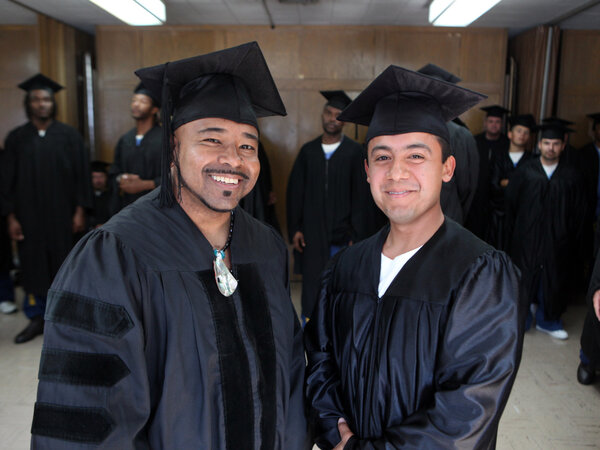
Phillip Senegal (left) and valedictorian Felix Lucero earned associate of arts degrees in 2009 at a ceremony in San Quentin state prison, where they are inmates. The college program is an extension of Patten University in Oakland, Calif.
Prison University Project

The program started in 1996 with two volunteer instructors. The program grew. But in 2000, its part-time coordinator quit. One of the volunteers, UC-Berkeley graduate student Jody Lewen, thought if nobody took the program over, it would fold. So she agreed to do it, thinking it would only be temporary. That turned into a full-time commitment.

Lewen decided she had to create an independent non-profit to raise funds to keep the program strong and stable. The project operates with no state or federal funds.

Today, 320 inmates are enrolled in the college program that could earn them an associate’s degree granted through a partnership between the Prison University Project and Patten University, based in Oakland, Calif. Two of this year’s five graduates have been paroled.

There are often tough questions for Lewen about the program, like whether it’s fair that people in prison have access to higher education when others do not.

“I completely understand,” she says. “But that’s not an argument against educating prisoners. It’s an argument in favor of universal access to higher education.”

Lewen feels she is helping to make up for the educational shortfall and hopefully, having a profound effect on the lives of these inmates.

Chris Deragon was still a high school senior when he committed a robbery and was an accessory to murder. He has served 15 years and won’t be eligible for parole for another seven. Deragon says taking college level courses has changed him in ways he couldn’t have anticipated.

“We’re in prison, so we’re trapped in this bubble. And there’s no way to expand outside of the bubble. And this allows you to do that,” Deragon says. “I have a professor from Berkeley teaching me how to grow my mind, how to read something and actually understand it. It helps me immensely as an individual and hopefully one day when I get out of prison, as a member of society.”

Bobby Evans Jr., graduated from San Quentin’s Prison University Project 5 years ago. Evans is shown here on graduation day with (back row, from left) son DeMario Porter, nephew Kelsey Evans, (front row, left) daughter Angelique Evans and son Preston Porter.
Courtesy of Heather Rowley

Bobby Evans Jr., graduated from San Quentin’s Prison University Project 5 years ago. Evans is shown here on graduation day with (back row, from left) son DeMario Porter, nephew Kelsey Evans, (front row, left) daughter Angelique Evans and son Preston Porter.Courtesy of Heather Rowley

Does that mean he’s only doing this so he can get out?

“I understand that point of view. Most people believe that I’m being punished and that I shouldn’t have the right to an education. But at the same time, if I’m released onto the street and I’m not educated, then you’re just releasing another criminal,” he says.

‘A Safer Place’

Scott Kernan, who manages day-to-day operations at California’s 33 adult prisons, says the college classes and other programs are important not only for the inmates. “You give them something meaningful to do, something they are engaged in, something that is exercising their mind, then it becomes a safer place for staff,” Kernan says.

If inmates are idle, he says, there’s a much higher chance of violence.

San Quentin certainly experiences the violence. In May, there was a riot in a wing of the prison dedicated to the short-term inmates awaiting transfers to other state facilities. They don’t have access to the college or other programs. But the general population is encouraged to participate. Among that group, which numbers around 1,800, there are far fewer incidents.

Bobby Evans Jr., who is not eligible for parole until 2020, earned his degree at San Quentin five years ago and now tutors other inmates.

“I’ve seen guys transfer in from other high-level prisons and they come in with that mask,” says Evans, who says he came in with that hardened attitude, too. He says it takes time for new arrivals, even those not in the college program, to get used to the calmer atmosphere at San Quentin.

“In a couple of weeks they start opening up, because it’s different,” he says. “The racial tension is less. We start valuing things, and we don’t want to destroy them. And so it’s a life-changing thing.”

The program may be helping to change attitudes inside the prison, but there are no rigorous studies yet that show, for example, if the program helps lower the state’s high recidivism rates. The evidence of the program’s success is largely anecdotal — and reaches outside the prison walls.

A Father’s Lesson

Desiree Lucero is 17. Her father, Felix Lucero, went to prison when she was just a year old.

She sits in the kitchen of her grandmother’s home in Stockton, Calif., about 90 miles east of San Quentin. “I guess you could say that he ‘found’ himself in prison,” she says, “because now he’s a smartypants.”

Desiree Lucero, 17, is inspired to go to college by her father, Felix, shown wearing the graduation cap and gown in the framed photo. Felix earned his Associate’s Degree from San Quentin’s college program in 2009. He has been incarcerated since Desiree was a year old.
Cindy Carpien

Felix Lucero, 32, was the first juvenile from his county to be tried as an adult for his part in a gang-related murder. Lucero’s eyes flash as he talks about his transformation after he arrived at San Quentin.

“I’d just come from old Folsom, around two years [in] lock down. I’m just kinda learning how to re-socialize and then boom! I’m in this classroom that has teacher aides, people discussing Sartre and different philosophers,” Lucero says.

Lucero says going to school changed his relationship with his daughter. “The more I learned stuff, the more I wanted to give it to her.”

“And he’d talk about a book I should read,” Desiree says. “He wants me to read Life of Pi. I’d like that. I’m not a straight-A student, and I had my downfall in high school. I figure I can still do what I want to do. Look what he did.”

Desiree is setting her sights on community college, perhaps becoming a nurse, inspired by her father’s graduation — as valedictorian — two years ago. “He’s gotten so far from where he started — a 16-year-old boy. It’s like watching him grow in a way. He’s watching me grow, but I’m watching him grow, too,” she says.

Felix Lucero is eligible for parole next year. There are no guarantees he’ll be released and fewer guarantees that he can find work as an ex-con.

Breaking The Cycle

But Lucero and other student inmatesmay have taken an important step, says program director Lewen. They are helping break a disturbing intergenerational cycle.

“Undereducation, poverty, unemployment, crime, incarceration — that goes on and on for generations,” Lewen says. “Our students’ kids have a 50-percent likelihood of going to prison.”

Even if its success is hard to quantify, one thing is certain. Not long ago, California spent about a billion dollars on rehabilitation programs, but that budget has been slashed by 60 percent. Lewen knows that state prison officials are looking to her model.

“They are in an increasingly desperate situation, and they are now finally, after all of these years turning to us and saying ‘How can we help you?'” Lewen says.

Just this year, Lewen was allowed to increase the number of classes offered a semester from 12 to 20. Still, the big question is, can the program be replicated elsewhere in the state? Or, will the Prison University Project remain, as Stanford criminologist Joan Petersilia describes it, “A little gem amidst a system that seems totally out of control.”

Attribution: This article originally appeared in NPR on June 20, 2011. Read Story

Please note that the Prison University Project became Mount Tamalpais College in September 2020.

Filed Under: MTC in the News, Uncategorized

Opinion: The Supreme Court Got it Right on Prison Overcrowding in California

June 10, 2011 by Mt. Tam College

The United States Supreme Court’s decision affirming an order placing a population limit on California’s prisons to prevent continued mental and medical health violations does not mean that “46,000 criminals – the equivalent of three army divisions – will be released,” as Justice Alito claimed in his dissent.  

His description of the consequences of the Supreme Court’s decision is an example of the hyperbole and hysteria used by Justices who are required to exercise sound reasoning in deciding cases.

Our perspective comes from having served more than 50 years combined in California prisons, and having witnessed the conditions under which men are confined, and the provision of medical treatment to those in need. We understand, too, that in an economy where many law-abiding citizens are out of work and unable to afford health care for themselves and their families, the lack of mental and medical health treatment for prisoners does not engender much sympathy. 

However, the U.S. is still a symbol of freedom across the world. How we treat the most despised of our own citizens is important if we are to have credibility and moral authority in advocating for human rights in other countries. The Court noted that the Constitution protects the “essence of human dignity in each person.”

Much of the criticism of the Supreme Court’s decision focuses on the remedy, which will require the early release of some prisoners. The release order was a remedy of last resort and necessary after more than a decade of failed attempts to fix a system that did not meet minimal health needs. 

The ‘criminals’ to be released under the Supreme Court’s decision would be released eventually, and many have made strenuous efforts to rehabilitate themselves so that they can return as assets to their communities. 

The conditions under which we incarcerate men directly influence what type of person is returned to the community. One of us [Héctor Oropeza] is a father of three; we, too, are concerned about who is released from prison – and this is why this order is so important to us. A former warden of San Quentin, Jeanne Woodford, testified that the conditions of prisons “make people worse” and “are not meeting public safety” by the way they treat people.

That for over a decade California has subjected prisoners to standards that amount to cruel and unusual punishment while maintaining an extraordinarily high rate of incarceration reflects an erosion of fundamental values of American society.  The closing of mental health facilities, cutting of school budgets, and conducting the “War on Drugs” are all factors inflating California’s prison population.  Many of those serving time in prison would have been better served through treatment for addiction, mental health problems, or job opportunities.

We have seen the deliberate indifference to the suffering of the mentally disabled and physically sick.  The majority decision noted that suicidal inmates were kept in “telephone booth-sized cages without toilets” and that “50 sick inmates were held in a 12×20 foot cell.” 

Communicable diseases, which do not respect the barriers of prison walls, are rampant in California prisons.  Prisoners who are released with communicable conditions or debilitating illness will continue to burden the health care systems in their communities.

It was disheartening to read Justice Scalia, in his dissent, describe the case as one “whose proper outcome is so clearly indicated by tradition and common sense, that the decision ought to be shaped by the law, rather than vice versa.”  

Justice Scalia’s respect for the requirements of the law apparently stops when convicted felons are the litigants. While he calls for common sense, he ignores the expert testimony, which led to the finding that prisoner release was necessary. He implies that 46,000 prisoners will be released en masse, and indiscriminately. At the time the opinion was issued, the prison population had already undergone a reduction of 9,000 inmates. 

The reality is that the releases will not be en masse and the figure will be much lower. Relatively few prisoners serve their entire sentences due to the availability of good-time credits, which provide for reduction in the time served. The state has great discretion to select those inmates whose early release presents a minimal risk to public safety. Many of those prisoners who are serving time for technical parole violations will be diverted to community-based programs. 

Justice Scalia also claims, without proof, that “Most of them will not be prisoners with medical conditions or severe mental illness; and many will undoubtedly be fine physical specimens who have developed intimidating muscles pumping iron in the prison gym.”  

Justice Scalia ignores the reality that gyms have been used to house prisoners for many years, which is part of the problem brought on by overcrowding. Overcrowding and lockdowns compromise the immune systems of prisoners due to a lack of fresh air and exercise. The lack of sanitary conditions in these gyms exacerbates the spread of disease. Weights have not been available in California prisons for more than a decade.

While Justice Scalia’s criticism of the majority decision is trenchant and beautifully written, it is based on a false notion of the conditions in prison and blindness to the consequences of subjecting men to inhumane treatment for more than a decade. Justice Scalia ignores the sad reality that many of those who suffer from mental or physical disabilities lack the ability or means to bring complaints to federal court, especially given the difficult obstacles placed by Congress and the Court to prisoner lawsuits in recent years.  

Only a class action lawsuit and the remedy approved by the Court’s majority could provide any meaningful recourse. Restoration of felons to society in a manner that benefits the community and the offender makes sense. The dehumanizing portrayal of inmates by Justice Scalia and his criticism of a reasonable and lawful decision through hysteria and hyperbole is unseemly.

Stephen Yair Liebb is a lifer who has served 30 years.  He was found to meet the standards for parole by a federal judge in 2010.  That decision was overturned by the U.S. Supreme Court.

Hector Oropeza was released from prison on June 8, after serving 20 years.  He attributes his continued mental health in prison to his educational opportunities, and his release, to access to the courts.

Attribution: This article originally appeared in the Fox News Latino June 10, 2011. Read Story

Please note that the Prison University Project became Mount Tamalpais College in September 2020.

Filed Under: Current Affairs, MTC in the News, Perspectives

Prison University Gives Inmates Hope

March 6, 2011 by Mt. Tam College

A college education is out of reach for most state and federal prisoners. California’s San Quentin is one of the few prisons in the country that offers college-level courses.

Jody Lewen has run the facility’s college program for over a decade and she’s the reason that the Prison University Project exists today.

Taking charge

When Lewen joined San Quentin’s college program in 1999 as a volunteer instructor, it was run by a small volunteer staff with no budget. At that time, she was a graduate student, with plans to return to academic research. But a year later, when the part-time director suddenly quit, Lewen found herself in charge.

“I thought for a long time it was just temporary and that somebody else was going to keep the program running,” she says. “But once I started doing the work and got more deeply involved, I also began to see the potential the program had. And I started to think more and more about what this program could become. There was nobody else to run it. And I thought it would just be one of those failures for the rest of my life if I let it fold.

Of the 5,500 prisoners currently housed at San Quentin, 300 enroll in the Prison University Project each semester.

Expanded program

Under Lewen’s leadership, the Prison University Project has expanded, now offering 20 classes in English, math, the humanities, social science and Spanish. Three hundred inmates enroll every semester, earning college credits which can lead to an associate of arts degree. Lewen has recruited more than 150 volunteer teachers and graduate students from nearby colleges and universities. She says attracting teachers is not difficult, although some of the new instructors are nervous their first time at San Quentin.

“When I talk to people about this work, very often they assume that the students are very aggressive and very difficult, all the stereotypes people have in their minds about people who are incarcerated,” says Lewen. “They assume they’re a lot of troublemakers and are goofing off and they don’t want to do their work. That stereotype has nothing to do with reality.”

Sookyoung Lee teaches a class on critical thinking and research. She finds her students are curious and engaged.

“I’m super surprised at how nice the students are. Most of the times, students are extremely respectful, way more motivated than the Cal [University of California at Berkeley] undergrads,” says Lee. “It’s always a pleasure for the teachers when the students are not taking learning for granted.”

Hope for the future

Charles Spence is serving a life sentence in San Quentin and has a few more courses left to finish his associate’s degree. He hopes to be paroled some day and wants to earn his master’s degree in psychology.

The Prison University Project - which has a long waiting list - offers 20 classes in English, math, the humanities, social science and Spanish.

The Prison University Project – which has a long waiting list – offers 20 classes in English, math, the humanities, social science and Spanish.

“This experience really has changed my life. It’s given me a lot of tools on how to express myself,” says Spence. “This program is really rare in the prison setting, so I’m really lucky. All of the guys feel the same. We’re really lucky to have the opportunity to get education, especially the way the economy is now. The odds are stacked against us when we get out, being convicted felons. This actually gives us a lot of hope and hopefully will help us succeed when we walk out the door.”

So far, 100 San Quentin prisoners have graduated with associate’s degrees and many more have continued their college studies after release. Research shows that the more education a prisoner has, the less likely he is to return to prison. Lewen says the recidivism rate among prisoners with college degrees is less than 10 percent.

Jody Lewen has run San Quentin's Prison University Project for over a decade.

Jody Lewen has run San Quentin’s Prison University Project for over a decade.

“I remember one student saying to me ‘This college program is the best drug treatment program in the world.’ And it was interesting because at first I really didn’t understand what he meant,” says Lewen. “And he was just saying ‘This program gives you hope and to stay clean and to live a healthy life, you need to have hope.'”

The Prison University Project survives on donations and foundation grants and receives no government funding. Lewen would like to see college programs in every prison but without government support, it’s not likely to happen any time soon. In the meantime, there’s a long waiting list of San Quentin prisoners who want to enroll in the college program. Some day, Lewen hopes to expand her program, making a college education available for most of the 5,500 prisoners currently housed at San Quentin.

Attribution: This article originally appeared in the Voice of America on March 6, 2011. Read Story

Please note that the Prison University Project became Mount Tamalpais College in September 2020.

Filed Under: Current Affairs, MTC in the News

Philosophy in Prison

March 5, 2011 by Mt. Tam College

Damon Horowitz teaches philosophy through the Prison University Project, bringing college-level classes to inmates of San Quentin State Prison. In this powerful short talk, he tells the story of an encounter with right and wrong that quickly gets personal.

This talk was presented at an official TED conference, and was featured by our editors on the home page.

Attribution: This video originally appeared in TEDx2011 in March 2011. Watch Here

Please note that the Prison University Project became Mount Tamalpais College in September 2020.

Filed Under: MTC in the News

Stanford Students Lead Classes in San Quentin Prison

February 17, 2011 by Mt. Tam College

Trying to get a better understanding of California prisons, 10 Stanford students are teaching and learning with a group of 20 inmates at San Quentin. They’re covering topics ranging from the history and culture of the state’s prisons to the relevance of Franz Kafka’s writings in the context of America’s penal system.

When Philip Senegal considers the 21 years and seven months he’s served in San Quentin since his murder conviction, he can’t help but think his time behind bars will one day come to an end. Although his parole was recently denied, he’s banking on another shot at freedom in seven years – the next time he’ll be allowed to make his case to the parole board.

So he had a keen interest in the class he was taking on a recent Sunday – a discussion led by Stanford students on parole policies. Eager to talk about how state and federal judges have weighed in on the issue, he also wanted the students to walk away with an understanding of his personal experience.

“There are a lot of intricacies to how the system works,” said Senegal, who is 43. “And you don’t understand them just by studying things on the outside. If you don’t come inside and see what’s going on, then you’re just uninformed.”

Stanford doctoral student Ronmel Navas and San Quentin inmate Philip Senegal
Stanford doctoral student Ronmel Navas, left, and San Quentin inmate Philip Senegal listen to a discussion about parole rights. Senegal, who has been in prison since his murder conviction more than 21 years ago, recently had his parole denied.

Getting that inside perspective is at the heart of the Stanford Prison Forum, an interdisciplinary workshop organized by Stanford Law School students Sara Mayeux and Maggie Filler and supported by the Criminal Justice Center and the vice provost for graduate education.

“We need more tools to understand prisons and issues like recidivism than just studying the legal system,” Filler said. “In law school, you look at things from the legal perspective – which is whether someone is guilty or not. I’m more interested in what happens once someone is in prison, and learning directly from people who are serving time makes sense. But once they’re in, they’re invisible for the most part.”

In a classroom inside a modular building next to San Quentin’s sprawling exercise yard, 10 Stanford students pursuing degrees in law, psychology, history and modern thought and literature have spent their Sunday afternoons this quarter studying, debating and learning with 20 inmates.

“We wanted to bring in perspectives from a range of different disciplines so students could see how criminal justice might intersect with their fields,” said Mayeux, who is a doctoral student in history as well as a law student. “People who are interested in studying prisons usually get boxed in as sociologists or criminologists, and there’s not a lot of thought about how disciplines like history and English can offer an important dimension when you’re talking about prisons.”

Led by different Stanford students each week, the group has covered topics ranging from the history and culture of California’s prisons to the relevance of Franz Kafka’s writings in the context of America’s penal system. The inmates prepare for the lessons by reading handouts and thinking about questions posed on the syllabus.

By the time the course ends in March, participants will have examined how incarceration affects families, what’s at stake by privatizing prisons and what’s been learned from psychological studies on conformity and obedience.

“Studying with prisoners will undoubtedly shape how the Stanford students think about issues like our criminal justice system, race and poverty,” said Debbie Mukamal, executive director of the Criminal Justice Center. “And experience shows that higher education transforms the lives of prisoners both while they’re incarcerated and when they get released.”

The classes take place in a room that could be in any American school. Encyclopedias, dictionaries and pre-algebra textbooks fill the bookshelves, maps hang on the walls and a dry-erase board fills up with notes, diagrams and points being jotted down by the instructors.

There are no locks and bars in the room. But outside the window, a guard tower and high fences topped with rolls of razor wire are constant reminders that this is a prison, not a college campus. Plans for the three-hour classes are sometimes interrupted: One was recently cut short when a guard ordered the inmates back to their cells for a head count.

But whether all 20 inmates show up or only one can make it, the classes are filled with give-and-take. During a recent conversation about a U.S. Supreme Court decision on parole rights, Filler – who led the class with fellow law student Alex Lampert – told the inmates she wanted to give them a taste of what it’s like to be in law school.

After a recent class was cut short so prisoners could return to their cells for a head count, Stanford students file out of the modular building where they teach and study with San Quentin inmates.

“Sometimes, professors will just call on you from out of the blue and ask for details of a case,” she told the class.

“So what’s this case about?” Her question fell to Jeff Brooks, who is serving time for armed robbery.

“Looks like it was a class-action suit brought against the board of parole,” he said. From there, the discussion was filled with terms like “liberty interest,” “due process” and “indeterminate sentencing.”

For the inmates, this class is an extension of the formal education they’ve already had at San Quentin. The prison is now the only one in California that offers an accredited college degree-granting program. The 20 prisoners have already received their associate’s degrees through the Prison University Project, a nonprofit organization that confers the two-year college degrees as an extension site of Patten University in Oakland.

“They’ve gone as far as they can go with classes,” Filler said. “This is sort of like graduate school.”

But the point isn’t to simply give prisoners activities meant to make their stays at San Quentin easier. Filler and Mayeux are also focused on the rehabilitation role of the prison system, and are hoping this course will make a difference when – and if – the inmates are released, by placing an emphasis on continuing education and building relationships, while building a sense of their own self-worth.

“People don’t realize that 90 percent of those who go to prison come out,” Mayeux said. “If you haven’t been thinking about them while they’re in prison, it’s not like you’re guaranteed to never see them again. They haven’t been banished from humanity, and you have to prepare for them to come back into society.” 

Attribution: This article originally appeared in Stanford News on February 17, 2011. Read Story

Please note that the Prison University Project became Mount Tamalpais College in September 2020.

Filed Under: MTC in the News

Prison Break: Inmates at San Quentin Study for Success

August 18, 2010 by Mt. Tam College

Classes held at Patten University’s San Quentin extension campus are just like those that one might find at any accredited junior college. Students stay up late or wake up early to finish assignments on time. The classrooms are packed, and sometimes students have to help each other out to work through a piece of literature. Except almost all of them attend night classes. And all of them are wearing the same light blue shirt.

Every year, some 150 inmates serving time in the San Quentin State Prison gather in small classrooms after dinner to discuss Shakespeare and math, among other topics. Led by instructors who hail from local universities, these classes are the result of the Prison University Project (PUP), a nonprofit committed to bringing college-level and college preparatory classes to prison inmates.

Offering around 12 classes every semester, the PUP prepares inmates for an associate’s degree, or at least an academic path. Inmates with a GED or higher are eligible to take the college-level offered. Those just short of the required high school diploma may take the college prep classes.

PUP executive director Jody Lewen doesn’t think the location—not exactly prime real estate for a college—makes any difference to the quality of education. “Actually,” she says, “it might be better than the average college degree program. The class sizes are smaller. Classes at Berkeley might have 150 people, and we have about 30.”

Lewen has other reasons to think so. The project’s success relies heavily on an army of volunteer instructors and teaching assistants, many of whom study or teach at local schools such as Cal, Stanford and Sonoma State. “We have a pretty substantial core of people who have been around for several years, and that is a great source of new faculty, too. A lot of them tell their friends,” Lewen says.

“Anytime you spend an extended amount of time in the yard,” he says, “it’s possible to get in trouble, or worse.” Hutton, who has been released from San Quentin, is currently taking classes toward a degree.

For Lewen, the project’s far-reaching impacts cannot be encapsulated in the academic or employment successes of those released from the prison, although they are considerable. Some of the inmates don’t get the opportunity to test the skills they’ve learned in the real world, as roughly 40 percent of them are serving life sentences.

“I think for a lot of people, when they talk about the value of the program, they don’t only talk about jobs,” Lewen says, “they really talk about the impact on their sense of their own potential, or what’s possible for them and their lives.” Lewen wants to take the project to the next level. “[The students] would love us to have a BA program.”

The only thing stopping her is funding. Classroom space is already at a premium; the program will need a new building before any plans for a BA program are made. “The department has basically said that if we could raise the money, we could build a new building,” she says. “That, to me, is the mother of all challenges. We could help so many people if we had that space.”

Attribution: This article originally appeared in the Bohemian on August 18, 2010. Read Story

Please note that the Prison University Project became Mount Tamalpais College in September 2020.

Filed Under: MTC in the News

Slideshow: San Quentin State Prison’s University

July 28, 2010 by Mt. Tam College

As a child, Troy Williams grew calloused to the South Central Los Angeles street ethos: Gangs, violence, drugs and firearms.

But Williams, now barrel-chested and 43-years-old, didn’t have the confidence to speak up in a classroom until he became a resident of San Quentin State Prison.

“In the past, I never even felt adequate in a classroom,” Williams said. “Now, I can come in, I can learn and be comfortable.”

Each weekday in this ancient, cinematic citadel – perched on the shores of San Francisco Bay since the mid-19th century – teams of educated volunteers try to provide convicted felons a college-level education.

Williams, along with about 300 inmates at the prison, qualify for enrollment in the Prison University Project, a nonprofit program that offers inmates basic education and even an associate of arts degree through Patten University, an accredited university in Oakland.

The program at San Quentin is a rare bright spot in a dismal era for California’s overcrowded prisons, which consume more than $8 billion annually. State budget crunches and tough sentencing laws have deteriorated the once model system to the point that in recent years federal courts have declared conditions in the state’s prisons unconstitutional.

Started in 1996 with just two classes and no budget, the project has incorporated as a nonprofit and runs on a budget of nearly $400,000 and a staff of about 60 unpaid volunteers, said Jody Lewen, the project’s executive director.

“One of the core commitments that we’ve been able accomplish is providing a real high-quality level education, not just a diploma mill,” Lewen said. “We’re preparing students so that they can succeed.”

Lewen said the budget is built entirely from private donations, which fund three full-time administrators. About 30 of the volunteers serve as math tutors, Lewen said, while the backbone of the program is the more than 20 volunteer teachers, all of whom have at least a master’s degree in the field they teach.

Kelly Jane Rosenblatt has taught English for three years at the prison, while working toward a doctoral degree in English Literature at the University of Oregon.

For Rosenblatt, 31, the work is personal.

“My father was incarcerated, and I realized when I was corresponding with him that there’s not a lot of opportunities in prison,” Rosenblatt said. “When I became a grad student, and eligible to volunteer, I felt like I needed to help.”

During her English 101 course, Rosenblatt guides nearly 20 students – men of all colors ranging in age from the mid-20s to the mid-60s – through an eclectic mix of short stories and novels. During a class in early June, the discourse meandered from urban farming to agricultural corporations, probing Roald Dahl’s “Pig” for insight and even touching on Upton Sinclair’s classic, “The Jungle.”

Rosenblatt challenged her students to identify complex strains of symbolism and allegory in with a rigor on par with a university-level curriculum.

The students engaged, sometimes clumsily, but with enthusiasm.

“I look forward to coming to this class a lot,” said Juan Haines, a graying, soft-spoken 53-year-old who has been in prison for 14 years. He is serving a life sentence for bank robbery. “To get into a classroom environment and to talk on an intellectual basis, with other human beings, is different than being out on the yard.”

The waitlist to enroll in classes at San Quentin is about 100 inmates, Rosenblatt said.

While the nonprofit education program is on the rise, rehabilitative and educational opportunities in California prisons have been steadily slashed over the years.

In 1994, the Violent Crime Control and Law Enforcement Act barred people incarcerated in the U.S. from receiving Pell Grants, a shift that decimated higher education in U.S. prisons.

In California, the decline has been particularly tragic, said Robert Perkinson, as associate professor of American Studies at the University of Hawaii and the author of “Texas Tough: The rise of America’s prison empire,” a book published last year.

“At mid-century, California was the model for professional, treatment-oriented, research-supported incarceration with an aim toward smooth reintegration,” Perkinson said. “The fall of this system into the waste that it is today is maybe the greatest tragedy in American prison history.”

Perkinson attributes the decline in rehabilitative and education programs to a triumph of politics over sound practices. As politicians realized they could score popularity with tough-talk against felons and cuts to programming in a system whose consumers don’t vote, Perkinson said, corrections policies have taken several steps back.

Now, nonprofits like the Prison University Project have stepped into the breach.

Lewen hopes the program doesn’t just give felons a better chance to succeed the next time they are released, but also raises awareness about the conditions in which more than 160,000 California prisoners live.

“We’re educating the inmates, but really what we’re also doing is bringing all these folks in from the (educational) academy,” Lewen said. “And they’re becoming educated about the prison system and the criminal justice system in a way they never would have been before.”

But the focus remains providing education in prison, bringing light into a place synonymous with darkness, despair and punishment, with an eye on reducing the numbers of parolees who re-offend.

Williams is one student who pledges his life has been changed forever. He has been in prison for 14 years, and is serving a life sentence with the possibility of parole for his role in a violent robbery.

Williams is known among his teachers as a quick study who enthusiastically participates in class discussions and always does his homework.

He said his favorite class is ethics.

If he is ever released, Williams vows to work with troubled youth.

“When I was 10-years-old, my older brother told me what a Crip and a Blood was,” Williams said. “That was where we grew up, that environment. I want to save other kids from going down the paths we went down.”

Attribution: This article originally appeared in the SF Gate on July 28, 2010. Read Story

Please note that the Prison University Project became Mount Tamalpais College in September 2020.

Filed Under: Current Affairs, MTC in the News

High Security, Higher Ed: San Quentin’s Prison University Project

July 26, 2010 by Mt. Tam College

San Quentin is the state’s oldest prison, and it is also the only one that still provides free college-level education to inmates. UC Berkeley graduate student Robert Rogers takes us inside the prison gates to explore the impact of the Prison University Project.

ROBERT ROGERS: Lt. Sam Robinson is San Quentin’s public information officer and a former guard at the prison. As he walks down the dim corridors of California’s oldest prison, the rusty metals and peeling paints convey a sense of time standing still.

LT. SAM ROBINSON: This is prison, as it has run here for decades.

But a short walk away, across a courtyard from the stifling cell blocks, there’s something else. It’s a college classroom with an instructor leading a discussion between students who are also San Quentin inmates.

Karen Martin is one of the dozens of volunteer teachers who comprise the backbone of the Prison University Project.

KAREN MARTIN [speaking to class]: The in-group out-group thing is whatever you are, people who are like you are in your in-group. But it could be on any given thing, it could be race, it could be class, it could be education …

The project is a private, nonprofit education program that offers about 300 inmates the opportunity to earn an associate of arts degree. The program was launched in the mid-’90s, soon after Congress voted to axe federal funding to higher education in prisons across the country. Today, the university project in San Quentin is the only accredited, free-of-charge higher education program behind California prison walls.

Executive director Jody Lewen says the program is more vital now than ever.

JODY LEWEN: The demand for education is just going through the roof. We get about, between five and ten letters a day from prisoners at other institutions in the state who are trying to get to San Quentin cause they’ve heard about our program. We have guys who are trying to sneak into our college prep classes because there’s nowhere else to learn.

Lewen, the project’s founder and executive director, is one of three paid employees of the nonprofit, which has an annual budget of around $400,000. Like most of her volunteers, Lewen is long on idealism.

LEWEN: There was no way not to go to college where I grew up. The vast majority of people in this institution, probably in this system, if they had gone to my little private school, never would have seen the inside of this place, no question.

Inmates at San Quentin may choose from a range of classes, from ethics and English to math and natural science.

Four students graduated with an associates degree in June, during a poignant ceremony in a prison worship hall. Prison officials and students’ families attended the ceremony.

GRADUATING STUDENT: Mom, this is for you as much as it for me.

Troy Williams is one of the success stories pointed to by prison officials. A hulking 42-year-old from Los Angeles, Williams is serving a life sentence for robbery and kidnapping.

After about two years in the program, the upbeat Williams is optimistic about earning a degree and, someday, rejoining society. He says education is a positive influence among prisoners.

WILLIAMS: When you come here and you have people who are able to be challenged intellectually and meet those challenges, they think of different ways to resolve problems, as opposed to the lowest level – physical violence. A lot of times what you will see around here is when stuff happens people will go to their mental toolbox as opposed to their physical toolbox.

One of Williams’ English teachers is Kelly Jane Rosenblatt, a 31-year-old PhD candidate and volunteer.

KELLY JANE ROSENBLATT: My father was incarcerated, and I realized when I was corresponding with him that there’s not a lot of opportunities in prison, and that’s when I first learned about this program.

Rosenblatt said failures in childhood education contribute to the state’s prison crisis.

ROSENBLATT: I used to teach middle school in East Oakland, at the lowest-performing middle school in Oakland, and I lost a lot of students over the course of two years. I come in here and I don’t see inmates, I constantly refer to them as students; I caught myself earlier talking about their dorms.

The wait list for classes at San Quentin’s University Project is long, with a hundred on the list. And it’s likely to get longer.

LEWEN: What’s wrong with this picture, how is it that people don’t understand what’s going on here?

Lewen hopes to see steady growth in the program, which relies entirely on private donations, but says a down economy might put a damper on the contributions.

LEWEN: We run the entire campus on less than a half-a-million dollars a year, we have almost 300 students. You’d think that’s an unbelievable bargain, but you talk to most higher education funders they say, ‘oh well, we don’t do criminal justice.’

While the state looks for further budget cuts in its corrections system, the university project is likely to remain the only program of its kind serving the state’s 30 plus prisons and 160,000 inmates.

This report was produced as part of the News21 program, a public service reporting project conducted at UC Berkeley’s Graduate School of Journalism and sponsored by the Carnegie Corporation of New York and the John S. and James L. Knight Foundation.

Attribution: This article originally appeared in SF Gate on July 26, 2010. Read Story

Please note that the Prison University Project became Mount Tamalpais College in September 2020.

Filed Under: Current Affairs, MTC in the News

  • « Go to Previous Page
  • Page 1
  • Interim pages omitted …
  • Page 12
  • Page 13
  • Page 14
  • Page 15
  • Page 16
  • Go to Next Page »
mtc seal

Contact Us

PO Box 492
San Quentin, CA 94964
(415) 455-8088


Please note: Prior to September 2020, Mount Tamalpais College was known as the Prison University Project and operated as an extension site of Patten University.


Tax ID number (EIN): 20-5606926

Quick Links

CONTACT US
CAREERS
PRESS KIT
ACCREDITATION
PUBLICATIONS
DONATE


Join Our Mailing List

© 2026 | Mount Tamalpais College | Photography by RJ Lozada | Design & Development by //DESIGN AGENCY//

  • About
    ▼
    • Mission & Values
    • Staff & Board
    • Accreditation & Institutional Research
    • Careers
  • Academics
    ▼
    • Admissions
    • AA Degree
    • College Prep
    • Faculty
    • Apply To Teach
  • Students & Alumni
    ▼
    • Students
    • Alumni
    • OpenLine Literary Journal
  • Resources
    ▼
    • Practitioner Support
    • Resources for Incarcerated Students
    • Research on Prison Higher Education
  • News
    ▼
    • Top MTC Stories
    • Recent Press
    • From the President
    • Commencement
    • 2026 Gala
  • Give to MTC
    ▼
    • Donate
    • Shop