• Skip to primary navigation
  • Skip to main content
  • QUICK LINKS
    • CONTACT US
    • CONNECT
      WITH US
    • FACULTY APPLICATION
    • PUBLICATIONS
    • PRESS KIT
    • CAREERS
  • About
    • Mission & Values
    • Staff & Board
    • Impact
    • Accreditation & Institutional Research
    • Careers
  • Academics
    • Admissions
    • AA Degree
    • College Prep
    • Faculty
    • Apply To Teach
  • Students & Alumni
    • Students
    • Alumni
    • OpenLine Literary Journal
  • Resources
    • Practitioner Support
    • Resources for Incarcerated Students
    • Research on Prison Higher Education
  • News
    • Top MTC Stories
    • Recent Press
    • From the President
    • Commencement
    • 2026 Gala
  • Give to MTC
    • Donate
    • Shop

Mount Tamalpais College

Open Line

San Quentin Is Still Punishing People for Being Sick

October 6, 2022 by Mt. Tam College

This story is part of the Inside/Out Journalism Project by Type Investigations, which works with incarcerated reporters to produce ambitious, feature-length investigations.

Wayne Hughes’s concrete home was windowless and filthy. For more than two weeks, he spent almost 24 hours a day in the six-by-eight-foot cell, which contained a built-in bunk, a grimy sink-toilet combo, and a large fluorescent light. The entire unit, composed of around 100 cells, was locked from the outside; even the correctional officers were locked in and had to be let out at the end of their shifts.

Hughes, who is 66 years old, usually lives in the general population of San Quentin State Prison, a large men’s facility 12 miles north of the Golden Gate Bridge. Typically, those incarcerated there are allowed to walk independently to meals, the yard, programming, and work assignments. But in his new unit, Hughes had to stick his hands through the food slot in the steel door to be handcuffed just to leave his cell for a seven-minute shower. Recreation—on the days it was offered—consisted of four hours alone in a small outdoor recreation cage. Some days, people on the unit are not allowed to leave their cells at all.

The unit has a name: the Adjustment Center. Often shortened to the AC, it has long served as the harshest of California’s death row units, usually used solely for solitary confinement of people whom officials consider a threat to the security of the institution.

But Hughes is not sentenced to death. Nor did staff consider him a risk to the prison’s security—at least not in the traditional sense. Instead, they put him in the Adjustment Center because he had COVID-19.

Since June 2020, San Quentin has used its Adjustment Center as its primary unit for medical quarantine (defined as separating someone who has been exposed to COVID) and medical isolation (separating someone with a confirmed or suspected case). Though the prison was widely criticized and even sued for its mismanagement during the pandemic, San Quentin has continued to send incarcerated people who have been exposed or infected to the notorious unit, including in the spring and summer of 2022, when outbreaks have been relatively less severe.

Type Investigations and The American Prospect spoke to Hughes and more than a dozen other men, many in their sixties and seventies, who told stories of being medically quarantined or isolated in San Quentin’s Adjustment Center throughout the COVID-19 pandemic. These interviews were possible due to Juan Moreno Haines’s unique access as a journalist incarcerated inside San Quentin. The California Department of Corrections and Rehabilitation did not respond to multiple requests for comment on the allegations that arose in these interviews.

Since his first stay in 2020, Hughes said he has been sent back to the Adjustment Center twice: once after a nurse overheard him clearing his throat, and again in spring 2022 after he tested positive for COVID-19.

Hughes and the other incarcerated people interviewed for this story described being trapped in dirty cells in conditions that felt punitive—sometimes while battling serious cases of COVID. They did not set foot outside the Adjustment Center until their quarantine or isolation was over: Even medical care was provided by a nurse inside the unit. And although solitary confinement has been shown to create or exacerbate mental illness, in the AC, people typically only speak with a psychiatrist virtually, by talking through their cell’s food slot, into a laptop held by a staff member on the other side of the door.

When San Quentin first turned the AC into a COVID unit in June 2020, the prison was gripped by a devastating outbreak that infected more than 62 percent of the population and killed 28 incarcerated people and one correctional sergeant over the course of several months. Over a year later, in a class-action lawsuit brought by more than 300 incarcerated plaintiffs (including Haines), Marin County Superior Court Judge Geoffrey Howard found that the California Department of Corrections and Rehabilitation (CDCR) had enabled this devastation by making mistakes and failing to take measures that would have helped stop the spread. (The use of the AC for medical isolation and quarantine came up in the testimony, but was not the focus of the suit.) Ultimately, Judge Howard found the department in violation of the Eighth Amendment banning cruel and unusual punishment. However, citing the safety provided by the 2021 arrival of vaccines in the prison, he did not order the department to make any changes, and denied the petitions as moot.

Although vaccines have helped reduce the risk of severe illness and death both inside and outside prisons, COVID is still everywhere. And while 94 percent of San Quentin’s incarcerated population is vaccinated, Type Investigations and the Prospect found that the prison’s use of the AC for medical quarantine and isolation, as well as the procedures and conditions inside the AC, remain unchanged. People in San Quentin now live under the constant threat of being thrown into one of the state’s most intense and punishing solitary confinement units at a moment’s notice, without doing anything wrong.

In August, California lawmakers passed a landmark bill to curb the use of solitary confinement in jails and prisons in the state. The legislation is awaiting Gov. Gavin Newsom’s signature. Medical isolation and quarantine, however, would still be permitted. There seems to be no end in sight for San Quentin’s use of the AC for medical quarantine and isolation.

Specifically, the solitary reform legislation allows medical isolation for “the shortest amount of time required to reduce the risk of infection, in accordance with state and federal public health guidance and with the written approval of a licensed physician or nurse practitioner.” But the law does not specify how long that should be. In response to a public- records request, CDCR provided us with two documents governing length of stay as of August 2022: one stating that medical isolation must last at least 14 days, and another requiring a minimum of 10 days. Some of those quarantined, however, report spending up to a month quarantining in the AC, especially early in the pandemic.

CDCR told Type and the Prospect it could not comment on pending legislation. When we asked CDCR about its medical isolation and quarantine plans for the future, the department directed us to its “Roadmap to Reopening.” That document outlines that any housing unit with three recent, linked cases must revert to “outbreak phase,” with limited movement among incarcerated people, a ban on family visits, and a halt in any programming that requires outside instructors or counselors. Units that go into outbreak phase may also provide physical and mental health care in-cell and postpone any “routine services.”

The document does not address any policies for the use of medical quarantine or isolation units, or what the conditions in those units should be.

Solitary Confinement as a COVID “Solution”

Many U.S. prisons and jails began relying on solitary confinement in an attempt to curb the spread in the early days of the pandemic, both to limit movement within facilities and to quarantine people who were infected or exposed. This strategy proved to be largely unsuccessful as the virus ravaged the incarcerated population. Many of the worst outbreaks in the country occurred in high-density, often overcrowded correctional facilities, which tend to hold many people with pre-existing conditions, leading to death rates three times higher than in the general population. At the same time, prisons and jails have failed to adequately test or treat people with COVID-19. As the outside world loosens restrictions and the CDC declares COVID-19 is “here to stay,” a new normal of lockdowns and isolation has taken hold inside prisons.

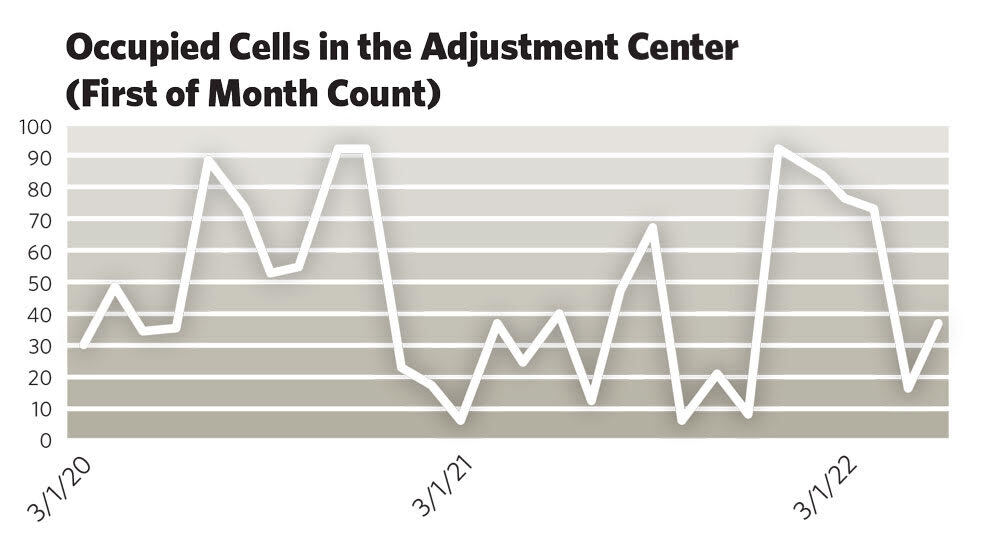
Through a public-records request, Type Investigations and the Prospect obtained monthly bed counts in the Adjustment Center that show the unit’s fluctuations over the past two-and-a-half years, as COVID waves ebb and flow. The number of people in the AC at a given time is often in the high double-digits. When the omicron variant hit California this January, for instance, there were 411 new COVID cases over a two-week period in San Quentin; a point-in-time bed count from the first of that month showed 91 people in the AC, and remained high by the first of February at 84.

William “Mike” Endres, 65, told Type Investigations and the Prospect he had managed to avoid solitary confinement throughout his entire time in prison, until he was sent to the Adjustment Center for 12 days in November 2021. “I’m on my 24th year of disciplinary-free incarceration with no hole time,” he said. “Yet this place found a way to put me in the hole for thinking I have COVID-19 when I didn’t.”

He described the AC as “a disciplinary setting.” Like Hughes, he said he was handcuffed behind his back any time he went to the shower or the yard. His sleep was disturbed by a correctional officer shining a light in his cell every half-hour. Endres said he was never told why he was sent to the AC, and was not given information about when he would be sent back to his normal housing. “I kept asking why I was in the AC, but nobody could tell me why I was there. To this day, I was never given an answer.” Endres says he tested negative four times over his 12 days in the AC, before he was finally transferred out.

Multiple people told us that Adjustment Center staff would come around and hit the doors or shine a light into cells routinely throughout the day and night. Hughes said there was knocking or beeping every 15 to 20 minutes. “It’s hard to get a good night’s sleep,” he recalled. “And you really need to get rest [when you’re sick], but the hitting the door and the beeping goes on all day and all night. It doesn’t stop.” Gregory Jackson, 60, who said he was quarantined in the AC in May 2022, told us that “every half-hour, they’d put something on the door that beeps.” CDCR did not respond to questions about these disturbances, but court records dating back to 2015 suggest they are related to suicide checks, where correctional officers are required to check on the well-being of people in the Adjustment Center every 30 minutes using a system with a hand-held wand and sensor.

Others described dirty cells and showers. Hughes said the sink, toilet, and walls were filthy in each of the cells he was assigned in his three stints in the AC. In one cell, the sink wouldn’t stop running. In another, the sink was covered in soap rings and dried toothpaste, and the toilet was so dirty he didn’t want to use it. When he requested cleaning supplies, he said a correctional officer told him the AC doesn’t have any. Another man, Charles Ross, 60, said he was quarantined in the Adjustment Center in September 2021 and April 2022. “The cells were torn up, they were nasty,” he said. “They wanted me to sign a paper, saying the cells were in good condition, but I didn’t sign it either time. The second time, I had to threaten to 602 them [a term related to filing a grievance application] to get a towel to clean the cell, but they gave me a T-shirt.”Reporter Juan Haines describes how Wayne Hughes has struggled after contracting COVID in San Quentin.

Reporter Juan Haines describes how Wayne Hughes has struggled after contracting COVID in San Quentin.

“You’ll get sick just from being in that filthy place,” Hughes said. “The only thing they do is check your vital signs twice a day. They could have done that in my North Block cell.” Back in his own cell, he said, “at least it’s clean and you have tools to keep it clean. AC is so unsanitary that the medical staff should be ashamed for even accepting that for quarantining people.” CDCR did not respond to questions about why the Adjustment Center was chosen for medical isolation and quarantine. In the 2021 trial, Warden Ron Broomfield testified that it was selected because it is the only unit in the prison (other than parts of the medical facility) with solid cell doors.

We have found that over the course of the pandemic, people have been sent to the AC for testing positive, exhibiting symptoms or having a known exposure to COVID-19, refusing to take a test, being transferred into the prison, or returning to the prison after attending an outside medical or court appointment. But when it comes to preventing COVID, there are alternatives to locking sick and exposed people in solitary confinement. Medical experts have stressed that when incarcerated people are housed alone for medical isolation or quarantine, they should not lose privileges and that the only similarities this experience should share with punitive solitary confinement is being single-celled and separated from the general population. And public-health officials have determined that the only real solution to stopping COVID spread in prisons is widespread vaccination combined with drastically reducing incarcerated populations. As of September 7, San Quentin was filled to 103 percent of its intended capacity.

IMAGE: JANDOS ROTHSTEIN/THE AMERICAN PROSPECT

“Prison Within a Prison”

The Adjustment Center was built in 1960, a relatively late addition to the fortress-like San Quentin, which was built in 1852. For years, it has held people on death row, along with a smaller number of non-condemned people sent to solitary confinement. It is infamous among the incarcerated, often referred to as a “prison within a prison.” In 2015, six men on death row brought a class action lawsuit, arguing the unit was so restrictive that it amounted to cruel and unusual punishment. In a settlement, CDCR agreed to cap stays in the AC (which had once been indefinite) at five years.

“The hollow steel cell doors have two slivered windows that look out onto a bleak hallway and a small locked slot that is used to deliver food to plaintiffs and to handcuff them before they are transported from their cell,” the 2015 complaint detailed. “The cells have no windows to the outside. Plaintiffs have no natural light or airflow in their cells.”

People who have been medically isolated or quarantined in the AC during the COVID-19 pandemic say the unit still matches the physical descriptions from the 2015 lawsuit.

After the 2015 lawsuit ended indeterminate stays in the AC, the unit’s population decreased. At the beginning of March 2020, there were only 30 people in the unit, according to bed counts provided by CDCR.

That changed when COVID-19 hit. In late May 2020, CDCR responded to an outbreak at another facility, the California Institution for Men (CIM), by transferring 122 medically vulnerable people by bus into San Quentin. About a week later, when it became clear some of the new transfers already had COVID, San Quentin officials sent much of the group to quarantine in the Adjustment Center. But COVID was already spreading, and by June 16, there were 90 people quarantining in the AC. As the AC filled up, officials relocated the remaining death row occupants out of the unit. The AC population has spiked back into the 90s at least twice since then, in November and December 2020, and again in January 2022. Terry Kitchen, 35, said he was sent to the AC for ten days in June 2022, after a rapid COVID test he was required to take to receive dental work came back positive. Although a staff member asked if he wanted anything from his old cell, he said nothing he requested—ten ramen packets, self-help program materials, college work, and hygiene products—was brought over.

He said the cell and showers were dirty, and the cell was bare except for a radio that didn’t work. “When I was over there I was so isolated,” Kitchen told Type Investigations and the Prospect. “There’s a little window [in the cell door] where all you can see is a wall. So your entertainment is watching spiders and ants walk around.” There was always a humming sound in the background, and he could hear someone yelling frequently.

He said medical and correctional staff would not answer his questions. “You don’t know anything about when you’re getting out of AC,” he said. “That in itself is stressful.”

The phones in the AC area weren’t working, according to Kitchen, and he said the staff did not give out prepaid indigent envelopes, which poor people can use to send letters. “I was isolated where I could not contact my family and let them know what was going on with me,” he said. “I couldn’t even write a letter, because I was not offered anything to communicate with my family. It was miserable, which traumatized me. Which is why I’m not going back to dental, until I don’t have to take a rapid test to be seen.”


‘You’ll get sick just from being in that filthy place.’

WAYNE HUGHES

The isolating nature of the Adjustment Center makes mental health care even more crucial—and even harder to access—than it already is in prison. Dr. Paul Burton testified as chief psychiatrist at San Quentin in the 2021 class action lawsuit that mental health interactions in the AC are conducted through the door’s food slot, through which he insisted, “you can actually hear pretty well.” Typically, he said, a nurse stands outside the cell door with a laptop, meaning the patient must communicate with his doctor through both a solid door and a computer. When telehealth appointments are conducted at the cell door in other units of the prison, the patient is offered headphones, so at least the doctor’s side of the conversation is confidential. But in the Adjustment Center, he explained, headphones won’t fit through the door slot, so the entire conversation is audible to passing officers and others incarcerated on the tier.

“It’s not confidential,” Dr. Terry Kupers, a psychiatrist who studies the psychological effects of solitary confinement, told Type Investigations and the Prospect. “You can be victimized because you’re mentally ill. What kind of situation is that, for a prisoner to have their only access to mental health treatment … in public, essentially, no privacy?”

“Horrendous Psychological Stress”

Solitary confinement is proven to cause mental deterioration, leading to higher rates of self-harm and suicide. The United Nations considers solitary to be torture when used for more than 15 days. But even shorter stays can be detrimental. Even after release from prison, people who spent any time at all in solitary are more likely to die prematurely than formerly incarcerated people who did not experience solitary, especially from suicide.

The practice “puts horrendous psychological stress on people,” said Kupers. No matter the length of the stint, he said, “each time you’re in a solitary confinement cell with no window and a solid door, and you go to a little cage to exercise, that’s no small thing.”

Instead of being locked alone in restricted cells, “those in medical isolation may be housed together with others who also have COVID-19,” suggests a paper lead-authored by David Cloud, research director at Amend, a program within the University of California, San Francisco, that focuses on the intersection of criminal justice and public health. The CDC similarly suggests that groups of positive people can be cohorted together in a “single, large, well-ventilated room with solid walls and a solid door that closes fully.” The CDC notes that this can conserve resources, and “mitigate some mental health concerns associated with individual medical isolation.” CDCR did not respond to questions about whether they considered this guidance.

And while the CDC recommends that people with a suspected case or known exposure should ideally be housed alone, Cloud notes that people held for medical reasons should be in sanitary, ventilated spaces and should have enhanced access to “resources that can make their separation psychologically bearable,” such as TV, radio, reading materials, tablets, phone calls, and outdoor exercise. He writes: “They should have easy access to medical and mental health professionals, and daily updates from healthcare staff as to why separation is necessary and how long they can expect it to last.”

Instead, fear of the harsh conditions awaiting them in the AC can make people less likely to alert medical staff when they are feeling sick, contributing to uncontrolled spread.

And being sick in the AC can be terrifying. Larry Williams, 47, was sent to the Adjustment Center after testing positive for COVID in June 2020, during the worst of San Quentin’s outbreak. “I went in the cell, they closed the door,” he told Type Investigations and the Prospect. “And then that’s when hell began.” Battling a serious case of COVID, Williams’s chest started hurting and he had trouble breathing. Next came excruciating headaches and an uncontrollable cough. He deteriorated from roughly 240 to 194 pounds.

Williams said his blood pressure dropped lower and lower, until a nurse knocked on the cell door late one night, telling him to stop taking his prescribed blood pressure medication immediately or he might have a heart attack.

Sleep was hard, he said, because he was terrified he wouldn’t wake up. He was surrounded by sickness and death. He recalled seeing bodies being carried out of nearby cells.

“It just made me afraid of my mortality,” he said. “And it made me start thinking deeper than I’ve ever thought.”Reporter Juan Haines recounts William “Mike” Endres’s time in the Adjustment Center.

Reporter Juan Haines recounts William “Mike” Endres’s time in the Adjustment Center.

Contrary to recommendations from groups like Amend, people repeatedly told us that conditions in the Adjustment Center made them feel like they were being punished, not treated for a serious illness. The official unit guidelines back up their claims. “All inmates will be treated according to the highest level of custody on your tier (Condemned, Ad-Seg, etc.),” outlines a set of “the AC Guidelines” handed out by prison staff to people sent there for medical isolation or quarantine, and obtained by Type Investigations and the Prospect. “You will be handcuffed and escorted by staff during any movement within the unit.” The document lists other rules: two toilet flushes per hour, 30 minutes of phone access per day, and seven minutes per shower (“Use your time wisely.”).

Osbun Walton, 73, said he was quarantined in the AC in April 2022, after returning to the prison from an outside resentencing hearing. He told Type Investigations and the Prospect that he was handcuffed just to go to the showers 15 feet from his cell, as well as to get an EKG on the unit, about 30 feet down the tier. “It was like we were there because we messed up.”

California Has Failed to Depopulate Its Prisons

Solid prison cell doors, like the ones in the AC, have failed to stop COVID-19: An analysis of COVID data from California prisons throughout 2020 showed the virus can, in fact, spread through units with solid-walled cells. An analysis published in June 2022 of San Quentin’s COVID outbreak found that the prison’s air filtration systems further contributed to the spread. Meanwhile, other CDCR policies appear to undermine San Quentin’s quarantine requirements. For example, due to contract stipulations with the prison labor union, the prison has not “cohorted” its staff during the pandemic, meaning that people can work some shifts in the AC and other shifts elsewhere in the prison, bringing the virus back and forth with them.

Throughout the pandemic, Kupers and other experts have said that prisons and jails must depopulate to save lives. A 2021 paper in the New England Journal of Medicine found that a 9 percent reduction in the population of a large urban jail led to a 56 percent decrease in transmission—and additional population decreases led to further transmission reductions. A 2021 paper in the Journal of Urban Health analyzed decarceration and transmission rates in Texas prisons, reaching similar conclusions.

Back in June 2020, CDCR was warned by Amend in an “urgent memo” to reduce San Quentin’s population by 50 percent from its then-population of 3,547. Three months later, a California state appeals court ordered CDCR to follow through on the recommendation. But while CDCR did manage to reduce San Quentin’s population by 33 percent, to 2,384 in May 2021, the population has since shot back up. Its population was 3,183 as of September 7, 2022, just about 10 percent lower than the 2020 number, and still over 100 percent of the capacity the facility is designed to hold. Absent a major population reduction, many people throughout the prison continue to be double-celled in tiny 11-by-4.5-foot cells—a worst-case scenario for limiting the spread of disease.


‘It just made me afraid of my mortality. And it made me start thinking deeper than I’ve ever thought.’

LARRY WILLIAMS

CDCR did not respond to questions about whether it has any plans to reduce the San Quentin population. In the 2021 class action trial, Warden Broomfield testified that he and other officials had not considered Amend’s recommendation, and stated, “I do not recall having conversations to reduce the population to 50 percent.” Pushed on whether there is a plan to depopulate San Quentin in the case of further outbreaks, the warden testified, “I am unaware of future plans to reduce San Quentin’s population.”

Instead of decarceration, the warden testified that any plans to prevent future outbreak revolve around the use of the AC: “We quarantine as many inmates as we can in the Adjustment Center to this day.”

Wayne Hughes is still struggling with the lingering effects of COVID. The infections left him with serious new ailments, including heart problems and blood clots in his lungs.

“Nothing was wrong with me before I caught COVID,” he told Type Investigations and the Prospect. Now, “each time I try to exert myself I get short of breath. I have to use three different inhalers on a daily basis.” He was put on blood thinners, which has made it unsafe to get a needed hernia operation. “My general health is poor. My emotions are sad because I don’t feel the medical staff is doing much of anything for me.”

Before contracting COVID, Hughes worked in the kitchen and filled his days with self-help classes that focused on anger management, domestic violence, substance abuse, and social skills. “I took a lot of groups because I’m trying to better myself for my future,” he explained. “I don’t want to repeat the same mistakes that got me in here.” But now, he said, programming is limited. “Things don’t seem to be getting better.”

“I’m so frustrated to almost being angry that they put me back there, again,” said Hughes of his most recent stint in the AC. “If AC is supposed to be for quarantine, why are they treating us like we’re being punished for getting COVID? The guards’ overall attitude is like we’ve done something wrong.” This fall, he has a tentative date for a parole hearing. Until then, he hopes he can avoid a fourth stay in the AC.


ABOUT THE REPORTERS

Katie Rose Quandt

Katie Rose Quandt is a freelance journalist based in the Bronx, who often writes about criminal justice and inequality. Follow her on twitter @katierosequandt.

Juan Moreno Haines

Juan Moreno Haines is senior editor of the San Quentin News and a contributing writer at Solitary Watch.

Attribution: This article was first printed in typeinvestigations on September 19, 2022 (The caged exercise yard of the Adjustment Center on death row at San Quentin State Prison on Aug. 16, 2016. IMAGE: ERIC RISBERG/AP PHOTO)

Filed Under: Open Line, Published Works

The Backstory: Juan Moreno Haines

October 2, 2022 by Mt. Tam College

Juan Moreno Haines talks about what drew him to investigate the Adjustment Center, the challenges of reporting while incarcerated, and what it was like to report on the prison’s Covid-19 crisis as he was living through it.

Type Investigation’s Inside/Out Journalism Project works with incarcerated journalists to produce feature-length investigations into the criminal legal system. For the project’s inaugural investigation, produced in partnership with The American Prospect, San Quentin News editor Juan Haines and journalist Katie Rose Quandt reported on San Quentin State Prison’s continued use of its Adjustment Center to isolate people infected or exposed to Covid.

In this conversation, we talk to Juan Moreno Haines about what drew him to investigate the Adjustment Center, the challenges of reporting while incarcerated, and what it was like to report on the prison’s Covid-19 crisis as he was living through it.

Paco Alvarez: What initially drew you to investigating San Quentin for use of the Adjustment Center for COVID quarantine and isolation? 

Juan Moreno Haines: Well, okay, so I got to San Quentin in 2007 and I started working with San Quentin News around 2009. I became a staff member around 2011. So living here in this community, the actual living conditions, were a concern with the overcrowding. This is all pre-pandemic kind of stuff. And so the one thing that really kind of drew my curiosity is how to deal with this disconnect between the medical department and the custody department when it came to infectious diseases. So I began just kind of like documenting and talking to people who got the flu – there was the flu, there was chicken pox, there was Legionnaires’ disease, there were staph infections. There was norovirus here. And then there was this strange – we just call it the San Quentin bug. You know, when somebody comes from another institution, they get the San Quentin, they get this weird flu like infectious disease that you have to get over. 

So when it came to the adjustment center, the first time I reported on the Adjustment Center was in 2015 when several death row prisoners filed – it was six death row prisoners filed a lawsuit about how they were being treated. And this was on the heels of the hunger strike in Pelican Bay. And so there were a lot of lawsuits floating around inside California prisons simply about the living conditions. So my reporting about the Adjustment Center being used for medical isolation didn’t happen in a vacuum. And I initially began reporting about this section in San Quentin called Carson. And it’s the housing unit in what’s called South Block in San Quentin. It’s a different area and it’s used for administrative segregation. Most people know that as ‘the hole.’ And if you get into any trouble the prison officials would send you to Carson Section and pending disciplinary findings or whatever, that’s where you land. So Carson is kind of like inside of a prison, it’s like a jail. It’s kind of a holding place for people who couldn’t make it on the main line areas of an institution, pending some sort of disciplinary or safety, the person is afraid for their life –they need to isolate that person, separate them from the regular population. 

In San Quentin, they were using administrative segregation for medical isolation. And so I started reporting on that. And when I met with the medical department, I was asking them, why would you send someone who’s sick to an area of the prison typically used for punishment or for isolation? Because the big deal about that is how the person is treated while they’re in that housing unit. In another words, in the mainline areas in San Quentin, people walk around freely to get to their programs, jobs, to the yard for recreation – so once, you’re like outside of your cell during normal hours, you conduct your business. It’s like a small town, just people milling about, doing whatever. But when you’re in administrative segregation, it’s a high security area. So any time you come out of your cell, you’re handcuffed behind your back, you’re wearing a white jumpsuit. You don’t mingle with the mainline population for obvious safety and security reasons. Now, San Quentin is using this for medical isolation. 

So that was the dilemma when I started reporting. Fast forward to the pandemic. I just met with the head doctor for San Quentin yesterday on this same conversation. Basically, “Why are we doing this? Why are we sending people who are sick to the hole?” And it actually makes medical sense to send someone to where the Adjustment Center is because there are solid doors and you can really isolate a person. But the problem is while they’re there, they’re treated like they’re being punished. And so the medical treatment is literally a punishment. And then I was thinking about this, why in the world would this be acceptable? And I can’t answer that question, but that’s the reality. And so what drew me to write about the Adjustment Centers being used for medical isolation, is the actual counterproductive result that happens. The reality is people don’t want to report that they’re sick. People are literally afraid of doctors around here because if you’re sick, they’re going to send you to the hole, and nobody wants to do that. 

Alvarez: And how did you go about developing the sources you spoke to? Were people generally open to speaking with you? 

Haines: San Quentin is a small town. I’ve been here since 2007, so there’s very few people that’s been in this institution longer than me. And I’ve worked with the newspaper almost all this time and I’m like the Clark Kent of Smallville. So everybody knows me and I’m trusted by the community because I listen to people and I tell their stories and the reason why I tell these stories is because if we don’t tell our stories, the mainstream media won’t. As an example to that, the past two months, San Quentin has been going on and off of quarantines. The rehabilitative reform nature of California prisons, San Quentin being the flagship of that, it’s not functioning because of infectious diseases. And I think that the reality is, what California prison officials are telling the public, touting all the rehabilitation, which is true, all the programs, which is true. They don’t function because we’re overcrowded, and so no one’s really giving to these programs because we’re overcrowded, and when we’re overcrowded, these infectious diseases rage and all the reform efforts that are put forth are pretty much mitigated, because we’re overcrowded. So that’s the story. 

Alvarez: What are some of the challenges of reporting while incarcerated? And how did those challenges impact your work on this investigation? 

Haines: So the biggest challenge for reporting while incarcerated is not the prison system. It’s not, news flash. I’m not going to say that prison officials don’t care what people say about the system. But I don’t think they’re afraid or leery of stories that talk about what the conditions are because this is prison and society accepts that. So the biggest challenge for incarcerated reporters is getting the public to understand what the reality is here. Because mainstream media, like, if you talk – if you read any article from Reuters, Associated Press, not so much The San Francisco Chronicle. But typically, if you read a story about prisons, it’ll be a single source story coming from prison officials, and you won’t get the side of the people who are directly impacted by incarceration. Now, the perception of people who are incarcerated are that this is, quote unquote, where all the bad guys are. So anybody who’s incarcerated, typically speaking, it sounds like, oh, that guy is just complaining about being in prison. And prison is not supposed to be easy, prison is supposed to be punishment. Prison is supposed to be hard. And that’s true. 

Nevertheless, the same people who are incarcerated are coming home. They’re coming out of prison. And the prison experience can do one or two things. It can either make you a better person or it can make you a worse person. Now, there’s a lot of policies that CDCR implements that are not good, and there’s some that are good. So for me, the challenge is being able to have access to do all the reporting about everything that’s happening behind bars and then getting those things in the public eye. There are very few incarcerated reporters doing this kind of work, and I’m gonna send a shout out to Arthur Longworth and John [J] Lennon, because these are two of my heroes because they’re doing the work, you know. 

Alvarez: What are some resources that newsrooms can provide to help incarcerated journalists report and write investigative pieces like this one?

Haines: I think one of the main things is like – I was fortunate to be able to work with Katie Rose on this piece and, like, if an incarcerated reporter was teamed up with a newsroom on the outside with their resources, if they would just have access to the resources of a reporter on the outside, then that would be tremendous, particularly when it comes to that data gathering or evaluating data or even interviewing and getting online and pulling up that amount of information. 

And then finally, just funding incarcerated writers is tremendous. I mean, it’s incredible because, the financial independence and stability allows the writers to just do their job. So just funding these types of journalists is incredibly rewarding to journalism. It’s much needed. 

Alvarez: You’ve been covering the COVID outbreak in San Quentin since the beginning. What was it like to be living through the crisis as you reported on it? 

Haines: It was traumatizing. One word to describe it is traumatizing. You’re trapped inside of an unventilated building that is typically held at about 150% designed capacity. In a place where you’re going to get sick, people are dying all around you. Your friends. One of my best friends died during the pandemic. Mike Hampton – I was at his wedding. This guy was just such a great human being. And he was on his way out of prison when he died from COVID. Stories like that over and over. I mean, my friends died because prison officials didn’t want to do the right thing. And a lot of these decisions were purely political. 

And I can guarantee you, a prison like San Quentin, where people are going to introspective programs to deal with their issues, to deal with who they used to be and who they are now, typically incarcerated 20, 25, 30 years in their 60 and 70 or in retirement age. And for political reasons you’re saying that, “oh, yeah, you’re still dangerous, you’re a threat to society.” You’re saying that about a person who hasn’t committed a violent act in decades, not because they’re locked up, but because they’ve truly made changes in their lives. And I’m talking about Mike Hampton. If he had walked out of this prison alive in downtown San Francisco, his big smile and gracious life would have blessed a lot of people. Lo and behold, you wouldn’t have known he spent a couple of decades in prison because he changed, turned his life around. 

But human beings are not given that second chance, that opportunity, for pure political reasons. Politicians are afraid to do the right thing when it comes to incarceration in the United States. It’s an easy political victory to say “I’m tough on crime, I’ll put that burglar behind bars.” And mainstream media doesn’t help the matter by continually connecting crime as a huge problem in the United States. And it is. But it’s out of context from the reality that there’s a lot of people who just need help and that the mental health crisis that this country is going through, the addiction problem that this country has. Tackling these problems at the end of crime is not going to solve addiction or mental illness. COVID reporting here for me was traumatizing because I lived through it. I got COVID. I was left for dead. Literally left for dead. 

I’m not even talking about the lawsuit that was filed against CDCR officials where the top appeals court judge in California, Anthony Kline, said what San Quentin prison officials did to its incarcerated population was morally indefensible, and constitutionally untenable, and ordered the prison officials to reduce the population to levels that are manageable. They didn’t do that and they’re still not doing it. And manageable, in objective terms from a medical perspective, everybody here knows that if we were living one person per cell, it would be a lot healthier. But that’s not the policy here. You have two people living in a jail, 4 by 10, smaller than your average parking space. And so if your cellmate gets sick, you can guarantee you get sick. I’ve gotten every disease, every infectious disease at San Quentin. Except for chicken pox, because I was vaccinated. I had Legionnaires’, infectious norovirus multiple times. I got COVID. I get the flu every season, even though I get a flu shot. It’s because this place is too crowded. Overcrowded. The only people that can help us, the incarcerated population, save us, are the courts, and they fail to do it because politicians definitely won’t. 

Alvarez: My last question is, have you received any feedback or retaliation from inside? 

Haines: No. For me, any type of retaliatory action against me is just another story, so no. I get, like, snide remarks and this and that, but at the same time I get praise from prison officials, not for the critical stories that I write, but I also write about restorative justice and drug treatment programs – policies that are doing a tremendous amount of good to the incarcerated population. I’m your regular small town reporter and I’m going to talk about the good, the bad and the ugly. There are a few good things happening behind these, and the biggest thing is the drug treatment program. And that program literally saved lives.

This Story was first printed by typeinvestigations on September 30, 2022

Filed Under: Open Line, Published Works

A Conversation With Joe Garcia About His Recent Page One Feature Story

September 13, 2022 by Mt. Tam College

PJP’s San Quentin Correspondent Joe Garcia talked to us about his recent feature covering the first in-person graduation of students from Mount Tamalpais College in three years. MTC is the nation’s only independent and fully accredited college program that operates exclusively in a prison. While a recent relaxing of the California Department of Corrections and Rehabilitation’s (CDCR) COVID-19 policy allowed the event to happen, persistent infection in various blocks complicated the celebration. Garcia’s piece explored the accomplishment of his peers alongside the heavyweight that COVID-19 restrictions continue to bear upon life for incarcerated Americans. Read our interview below to learn more about how this story came to life and the changing protocol inside the California prison system.

PJP: When did you realize there was a story here that PJP readers should read?

JG: I had a feeling the Mount Tamalpais graduation would be a good story because it was a huge deal to get everybody there in person. Because of the COVID-19 shutdowns, there hadn’t been an in-person graduation for the last couple of years. And, it was a big deal because one building was still on quarantine. The event wouldn’t have been allowed if the CDCR hadn’t updated their policies. At least a third of the graduates who were supposed to walk in their caps and gowns lived in that quarantined building. So there was this whole issue: Would they be excluded? Would CDCR figure out a way for them to test and get cleared quickly? Especially because their outside family members had been invited months ago to come to San Quentin and attend the event.

PJP: What was your process in writing this story?

JG: My process with any story is to take as many notes as possible. So often there are things that come up when writing, and I would wish I had paid attention to the clothes people were wearing or written down numbers, like how many people were present.

PJP: Can you say a little more about the emotional atmosphere of the ceremony?

JG: The emotions at the event were mixed. People are frustrated in general, with COVID-19 and the quarantines and the shutdowns. People are beaten down by the endless loss of programming. People have lost the opportunity to do the things that had been done at San Quentin for decades, so there was that subdued nature to it. But then also, there’s this inspirational, uplifting feeling of emancipation when these events actually happen. It’s like, wow, finally, this is what we’re supposed to be doing if COVID-19 wasn’t in the way. And because so many of these events are in the San Quentin chapel, there’s an extra layer of reverence, to some degree.

PJP: What was it like interviewing the families of the graduates? Were people eager to talk about the graduation?

JG: That was actually the best part of the whole thing: interviewing the family of graduates. Darryl Farris’s mom, at 90 years old, was just so vital and alive. It was amazing that she was able to attend.

PJP: How many other people incarcerated in SQ were able to attend the ceremony?

JG: Because of the quarantine, it wasn’t really billed as open for all residents. Under normal times, CDCR would have made sure that everybody who was supposed to be there was there and then they would just open the doors for anybody else who wanted to attend. But this time, there were only around 20 or 30 incarcerated guests. And then there were probably about 30 outside attendees.

PJP: What was its impact for those who were not able to attend or were not part of the festivities? Do you see this as a motivating event for others considering pursuing an education while incarcerated?

JG: It should have been a motivating event. It was in one sense, because they allowed it to happen and because it means so much to the whole community. But then the whole community couldn’t really partake in it, so that was negative. There was another negative aspect too because a lot of people were really upset that the staff allowed guys from the North Block to test and go to the chapel and hang out with their families. Other guys in North Block who weren’t graduates weren’t allowed to test and visit with their families because, when a building is on quarantine, all their visits are canceled. And then, on top of that, there was the general feeling that these quarantines were so arbitrary and stifling and nonsensical because no one was really sick.

Read more of Joe Garcia’s stories here, and stay tuned for his newest report on San Quentin’s COVID-19 policy.

Filed Under: Open Line, Published Works

Social Distancing: Then and Now

September 8, 2022 by Mt. Tam College

In March of 2020, San Quentin State Prison had an outbreak of Covid-19. Social distancing was the first line of defense against the virus. Social distancing seems to work for the public, who stayed in their homes; they worked from their home and at the same time safeguarded their community. A spacious environment is ideal for combating the coronavirus. There is a big debate over the Government telling people what to do and when to do it, but people had no problem following social distancing protocol. 

There was a mandate for all residents at San Quentin State prison to social distance. The question is how you can social distance in an overcrowded prison. To manage the health care of incarcerated people against COVID-19, it requires more than what was done. The prison has had problems with viruses, and other outbreaks. After three months had gone by, prison officials started to move its residents to different parts of the prison. Prison Industry Authority workshops were cleared out and turned into makeshift dormitories. Tents were set up on the main exercise yard so that people could be housed there. The thing about dorms and tents there was still no social distancing because there were too many people in the dorms. If you have a prison facility built for a limited capacity, and then you succeed in that capacity, that is too many bodies in one area. Social distance was good for the public, but not an overcrowded prison. San Quentin is a very old prison dating back to the 1800’s, its original design was for less than half the people housed in it today. 

The prison remained in social distance protocol for about a year. The virus had become minimal so the social distancing was working. The housing unit was 80% single cell occupancy. The prison even transferred a number of the incarcerated to other facilities within California. Therefore, when there were less people in area design occupancy, social distancing worked. However, after all the social distancing, COVID-19 infections seemed to be minimal. In mid-2021, the prison went back to regular programming. The residents at the prison filed Writs of Habeas Corpus in Marin County Superior Court, based on deliberate indifference. The residents watched the court proceedings via zoom. The prison authorities began to double-occupy all cells once again. In January of 2022, the virus was back; all the programs were suspended at San Quentin, in April of 2022, a little over two years after the original outbreak. The cells in West Block and North Block were at full double bunk capacity, and then there was another outbreak. Once again, the prison failed to adequately fight the virus because of its eagerness to hold on to overcrowding. 

Today the virus is still present. Busses are still coming into San Quentin, increasing the population. Prior to the pandemic, a Federal Three Judge Panel said, overcrowding causes inadequate healthcare, and assigned Federal receivership to oversee CDCR medical responsibilities. Some of our friends did not make it through the first or the second outbreak, how many more lives can we lose? Is there any concern within California’s Justice System for the incarcerated healthcare, or is there a systematic disregard for the life of prisoners?

Filed Under: Creative Writing, Open Line

My Wild and Winding Path to a College Degree Behind Bars

September 7, 2022 by Mt. Tam College

As a kid, I didn’t see the value of education. My mother sent my brother and me to Catholic school as a path out of our dangerous Brooklyn neighborhood, but I saw it as the place where bullies lay in wait for us kids wearing plaid uniform ties. I got good grades until high school, when I made fighting bullies my priority. The altercations escalated, leading me to transfer to different New York City schools before finishing in Detroit. I did not attend the graduation ceremony because my classmates were strangers.

When it came time to apply for college, I didn’t bother. My grades did not match my brains, and I lacked athleticism, so a scholarship was not happening. Plus, I did not know what I wanted to be. Without rich parents to foot the bill, going into student debt to find myself was out of the question. I needed an immediate income to get out of Brownsville, Brooklyn.

College did not seem like the answer for me, but I remember attending my mother’s graduation. This single Black woman had earned her bachelor’s degree in sociology, but that piece of paper did not translate into a six-figure income or a house in the suburbs. I didn’t realize that more funding went to filling prisons than sociological studies about the root causes of crime. I certainly didn’t expect to earn a double-life sentence for murder, or to graduate from college at San Quentin State Prison during a global pandemic.

Behind bars, I found a passion for writing that turned into a drive for education. However, I couldn’t follow that drive for over a decade. During my first 10 years of imprisonment, I was housed in prisons that mainly offered correspondence college courses. The books were often expensive, and they were not covered by financial aid or the schools. I made 19 cents an hour as a teacher’s assistant and a clerical worker, and had to spend my outside resources on food to supplement the small and often inedible meals the prison served.

In 2013, my security classification dropped to Level Two, and I was transferred to San Quentin, which has a college right on the grounds and free books, even for the correspondence courses available from two California community colleges. I added my name to the waiting list for Patten University’s Prison University Project, and in the meantime, I took courses with Coastline and Feather River community colleges.

Finally, in 2015, I was able to start at Patten. I dove into every writing course they had. Lessons I learned in English 101, Creative Writing and other classes advanced my skills and led to me writing for dozens of publications.

By January of 2020, I was one history course away from earning my associate’s degree. I worked hard, but in March, just as our finals were due, Patten staff stopped coming into the prison because of the COVID-19 epidemic. About a week later, the whole prison went on an indefinite lockdown. I sat in my cell wondering if I would survive this new, super-contagious virus.

I found that out in June 2020, when I contracted COVID-19. It gave me a headache, body aches, weakness and congestion that lasted for 10 days. Others fared worse — they had hospital trips and respirators. Twenty-nine people died at San Quentin, including a beloved sergeant. The deadliness of the virus underscored the need for continuing the lockdown — and it delayed my graduation.

Finally, in October 2020, I received a notice from Patten, which by then had become Mount Tamalpais College (MTC), the nation’s first independently operated and fully accredited prison liberal arts institution. We would finish the history class via correspondence. Using my top bunk as a desk, I completed the required work two months earlier than the December deadline. I waited for confirmation that I passed, but didn’t hear anything for more than six months.

When prison programming finally resumed in September 2021, I was able to talk to the MTC coordinators. I learned that my work had been lost, but then found. I passed my class and earned my associate’s degree, but I would have to wait for the graduation ceremony to hold my diploma in my hands.

The pages of the calendar turned to 2022, but there was still no graduation or diploma. Then, in April, MTC notified me that we would have the ceremony at the prison on June 24, and I could invite three visitors. I had skipped my graduation from Southeastern High School in Detroit because I started there mid-quarter senior year and did not feel a connection to the class. Plus, my family back in New York was too far away to attend. While I couldn’t invite my relatives to my college graduation because COVID-19 made prison lockdowns too common and unpredictable, I looked forward to celebrating with some of the men with whom I’d survived a murderous virus. Plus, Susan and Mandy, two dear friends who live in nearby Oakland, agreed to come.

Two months before the ceremony, San Quentin began its second quarantine lockdown of the year. The lockdown was lifted in time for our graduation, but my hopes were once again dashed when someone in my cell block tested positive. That meant more quarantine.

Luckily, three days before graduation, MTC notified us that graduates from our block could attend the ceremony. All each of us had to do was test negative for COVID-19.

At 7:45 a.m. on Friday, June 24, 2022, about 10 of us soon-to-be graduates were called for a rapid COVID-19 test. We lined up before a nurse, knowing that if any of us tested positive, our big day would end with quarantine in the administrative segregation building — the hole. To add insult to injury, the ad-seg building faces the chapel where the ceremony was being held. That meant we’d be watching guests attend the graduation through a bar-covered window.

Each person stuck a cotton swab up their nostrils and handed it to a nurse who tested the sample. I was about fifth in line and kept peeking at the box of test tubes. After I tested negative, I paced the flats — what we call the ground floor of the block.

At 8:30 we heard an encouraging announcement: “College graduates, report to the Mack Shack.” Gathering at this small CO station meant the ceremony was on! Our next stop was Chapel A to put on our black caps and gowns. At 9:30 we walked into Chapel B to the applause of fellow incarcerated people, prison staff, teachers, formerly incarcerated guests and our visitors.

Seeing my formerly incarcerated friends and visitors lifted my spirits. It was the first in-person visit I’d had in months, and it felt like a family reunion. And the ceremony, which included the graduating classes of 2020, 2021 and 2022, did not disappoint. Warden Ron Broomfield gave a surprising speech about George Washington Carver’s path to education. Then Tommy “Shakur” Ross, the former co-host of the “Uncuffed” podcast, who had just been released two months prior, appeared wearing a sharp black leather jacket and a matching ankle monitor. Ross, also the 2019 valedictorian, spoke to us about the challenges of being on a strict parole, the power of human connections — and his trips to a Giants baseball game and the first International Prison Radio conference in Norway.

Our valedictorian was John Levin, a 5-foot-4, bespectacled man in his late 50s. “I lost my speech, but have no fear. I wrote a speech for every occasion as a high school student,” he said, leafing through papers in a tan folder. “Let’s see, here’s the one about being the MVP of the NBA finals. Oh, here’s the one about winning a Nobel Peace Prize.”

As the crowd laughed with him, he found his speech about graduating from college while in prison. Things turned serious, bringing people to the brink of tears.

Then, finally, each graduate took the stage one-by-one to receive a piece of parchment rolled up tight with an official silver seal. Inside was an IOU note instead of an actual diploma, but my feelings of pride, joy and love were real. Watching my friends turn up in the small crowd, I smiled, grateful to be able to share the moment with people I love despite the prolonged violence of COVID-19.

Attribution: This article was first printed in The Marshall Project on September 2, 2022

Filed Under: Open Line, Published Works

Graduation Day

August 31, 2022 by Mt. Tam College

Today was a day that I can only describe as a magical day of celebration. I have conferred an Associate of Arts degree from the recently accredited institution named Mount Tamalpais College. The campus is within the walls of California’s San Quentin State Prison, and I am an incarcerated person. 

I believe that there is a direct correlation between my being expelled during the first week of high school and being incarcerated. At 14 I was expelled for smoking pot before class began. Because of an abusive stepfather, I did not return home that day. Instead, I ran away from home and never did return. I was in prison for five years for bank robbery.

While in federal prison I earned a GED with little effort and witnessed others in the class who were sleeping or writing letters earn theirs as well. My social and problem-solving skills were shaped more by simply surviving day-to-day, than by any concept of the future. My behaviors were based on what I could do in the moment to quell or quiet the fear and foreboding I always felt. My world was small and I was the center of it. This needed to change.

I decided to return to school while serving my third term of incarceration. By this time I was 54 years old and had been in 11 different prisons in five different states. My coping skills amounted to an easy way and a hard way. I was careless, apathetic, and dangerous. But I wanted to be a good person and hoped going to college would show me what that looked like.

My hopes were realized in spades by enrolling in the Prison University Project here at San Quentin. My social and problem-solving skills were expanded and constructed altruistically.  The community became the center of my world to which I became a contributor. My world expanded into teachers, tutors, cohorts, and conversations of understanding. I learned to ask for help and to help when asked. I made honest and open connections with family and new friends. I was taught to teach and love enough to love others. 

I learned that stepping out of my comfort zone broadened my comfort zone. I learned the joy of understanding others is greater than being understood. I learned to succeed and to enjoy the success of others. 

On graduation day I found friends in everyone present. My niece and her family traveled 1,000 miles to spend less than three hours watching me walk across the stage in a cap and gown. The magic of that day was that after running away from home at 14, I felt as if I had finally come home after 48 years!

There were so many people who were responsible for putting the event together that it is impossible to thank them all. But, if anyone is wondering if they are making a difference, I want them to know that they already have. Thanks to Mount Tamalpais College, Warden Broomfield, and my family, I am no longer a careless, apathetic and dangerous person. I am remorseful, empathetic, and a contributing member of my community. I am a good person. 

I wrote this with an immense sense of joy and thankfulness. I hope you accept your part in my transformation due to education. Going through life not being able to name things kept me confused. Education allowed me to recognize, organize, measure, hypothesize, experiment, and adjust.

Education gave me tools and explained how to use them to find my balance and voice. It is a great relief to not be the center of my world. It’s also with great relief that I know more than just an easy or hard way to find a solution to life’s challenges. Getting an education in prison is going to keep me from returning.

Being a third striker proves that I did not have the capability before. I’ll not be coming back to prison because I have already moved so far forward. Thank you for keeping the opportunity alive to earn a college degree in prison. 

Filed Under: Creative Writing, Open Line

Time to Go

August 12, 2022 by Mt. Tam College

It has been a long time coming. I have been incarcerated since August 15, 2017, and all praise due to God, I left San Quentin State Prison on August 9, 2022.

This has not been an easy five years. I’ve lost close to 12 people during that time of incarceration and one of those 12 people, I couldn’t understand why it happened.

I’ve lost the man who raised me to heart failure three years ago, but I still can’t fathom the loss.

I have been through one institutional lockdown and five COVID lockdowns. I was here when we lost over 30 people to COVID-19 and all I could think was “I’m next.” 

Through it all, Mount Tamalpais College (formally known as the Prison University Project) has been a saving grace.

This release from prison is bittersweet. I’m overjoyed to be leaving prison, but leaving people behind still gets to me. 

For those I’m leaving behind, I will become something and fight for prison reformation. I will change the stigma placed on incarcerated people and the narrative of how we are viewed.

Mark my words, you have not heard the last of Quincy Q. Paige, also known as Journ-E Tha Premier. I have recently been offered a job working as a  sound engineer.

I owe a lot to MTC for believing in me and showing me my value. I would love to extend my deepest gratitude to my English professor who always pushed me to dig a little deeper. I guess me being successful would be the outcome to her teachings and mentorings.

I want to shed light on my therapist for telling me to be a turtle and showing me what it means to be a turtle. A turtle slows down and takes things as they come, and a turtle also takes his home “comfort” with him everywhere he goes.

So to all: be a turtle!

Filed Under: Creative Writing, Open Line

Black Tears

July 26, 2022 by Mt. Tam College

Montreal Blakely 

Filed Under: Open Line

My Name is Gibson

July 12, 2022 by Mt. Tam College

Following my conviction, I did criminal law research and I could not find where my humanity was stripped away like a passport, as a condition of bail. Rahsaan Thomas wrote the article, “How I Convinced my Peers to Make Language a Priority”. Thomas wishes to change the language used to reference incarcerated people by the media. Some people, including Thomas, believe that words such as “inmate” say that you are someone who is undeserving of compassion or empathy and have no worth. Thomas has valid points, which I agree with; however, I do not believe that words such as inmate, convict, or prisoner alone are the cause of our dehumanization. 

In the article, he discusses a piece he read about an “inmate” firefighter who should be compensated for his hazardous work. But, Thomas argues, the choice of wording undermines the argument. The writer is championing him while using the label “inmate”, which says he has no value.

Thomas makes other valid points about how language can be used to dehumanize a group of people. As he points out in another example of an instance when doctors coerced incarcerated women into being sterilized. The women were “inmates” and “criminals” and that translated to worthlessness to the doctors and staff involved. What was done to those ladies was no different than spaying or neutering a pet. There are also the prison guards who use the words “inmate” or “convict” to desentize themselves from those they guard. The emotional detachment allows them to separate or feel superior to the imprisoned men and women.

Thomas makes a great case about how “inmate, convict, and prisoner” are used to dehumanize and keep all those incarcerated under one umbrella. Arguably, “criminal” may be the most unfavorable of all the labels, because it’s used outside prison walls. But, how did this language gain its power?

There are some people who do not know their value and have resigned themselves to being “criminals”. I was one of those people. I acted the part and fit the stereotype. Yet, my humanity was not taken, but lost, when I stopped being compassionate, empathetic, or showing kindness to others. When I found myself and learned to emotionally connect with others, my humanity began its return.

It does not matter what labels are used to describe men and women in prison. They are but words. It’s our actions and beliefs that determine who we are. “Inmate, convict” or “prisoner” can not dehumanize us without our help. Thomas’ argument that language can be used to be harmful and degrading to the incarcerated are all true and he makes some great points. However, we give those words their power through our beliefs and actions. 

When I have had encounters with prison guards who use the word inmate as though it’s something dirty, my reaction is always the same: I tell them my name is Gibson.

Filed Under: Creative Writing, Open Line

Op-Ed–In prison, the work of journalism is challenging but essential

July 12, 2022 by Mt. Tam College

I am one of nearly 3,000 people in San Quentin State Prison who are paying for past mistakes. Most of us want to do the right thing so that we can earn parole or clemency and get back to our families and Communities.

My “right thing” is journalism. Every day I walk the yard listening to the struggles and triumphs of fellow prisoners, gathering material to tell our story. My goal is to answer: So what?

More than 26 years behind walls have shown me that free people aren’t really paying attention to what’s happening in our society’s prisons and jails. Journalists, especially those on the inside, have a duty to show what is going on and why it matters. To answer the “so what.” Here are some reasons you should care about what my reporting shows.

California taxpayers are doling out roughly $100,000 a year to incarcerate each prisoner. A disproportionate number of the more than 40,000 people serving life sentences in California prisons are elderly, one reason our state has the highest prisoner healthcare spending in the Nation.

The annual incarceration cost in the U.S. exceeds $80 billion.

About half of us here in San Quentin, me included, are serving a life sentence — and yet well over 90% of incarcerated people will eventually get out. So what’s happening behind these walls is rippling into the outside world. That means rehabilitation programs inside prison make a difference to everyone outside prison as well. 

Right now, San Quentin is so overcrowded that COVID-19, for the third time, has forced this prison into quarantine and stymied rehabilitative services. That’s a loss for everyone, because these services work. 

One effort in California aims to address the drug abuse crisis inside prisons. 

In 2020, the state began implementing the largest medication-assisted drug treatment program in the country. While official mortality data for 2020 is still pending, preliminary information shows a decrease in overdose deaths. Mortality data is just one early indicator: The largest payoff for society ought to come when incarcerated individuals who had a drug problem are released — not as active addicts back on the street, but as individuals who are in recovery and have tools to avoid using.

I’ve also reported on the availability of rehabilitative services that transformed the destructive nature of people, once out of touch with their communities, to people who’ve become accountable, empathetic and compassionate. Guiding Rage Into Power is a 52-week introspective program aimed at teaching its participants nonviolence, emotional intelligence, mindfulness and victim impact. Hundreds of prisoners completed the program. GRIP’s data shows that  just one of nearly 1,000  has returned to prison. 

These kinds of programs matter to society as a whole, but they operate inside a black box. Only incarcerated journalists are in a position to observe the interventions up close and to speak with affected individuals. Unfortunately, we operate at an extreme disadvantage.

There is no privacy and no access to the internet. I use a typewriter and pen to send my stories to publications. Sometimes I feel the pressure that I may offend powerful interests. As an example, since contradicting the official report regarding the 2015 Legionnaires’ disease outbreak at San Quentin, I’ve been persona non grata to some prison officials. 

No wonder professional journalism about prisons and jails from an incarcerated voice is rare. 

Since 2009, I’ve been writing about what happens on my side of the wall. I’m now the senior editor for San Quentin News and a contributor to Solitary Watch, a nonprofit watchdog group. 

When I report that a rehabilitation program is promising, there’s not likely to be much pushback. On the other hand, my piece “How Not to Fight a Prison Pandemic” continues a series of articles about the cruelty that prison officials inflict on the incarcerated population. Prison officials aren’t pleased — but the work is important. 

Most of the time, it feels like I’m walking a tightrope. I’m always being yelled at and also praised. Still, I’m compelled to pick up my pen, because our walled- off voices need to be heard. How else can Americans learn what’s working and what’s broken inside the prison system? It’s up to incarcerated journalists to inform those conversations.

Juan Moreno Haines is senior editor of the San Quentin News and a contributing writer at Solitary Watch

Attribution: This article was first printed in Los Angeles Times July 8, 2022

Filed Under: Open Line, Published Works

  • « Go to Previous Page
  • Page 1
  • Page 2
  • Page 3
  • Page 4
  • Page 5
  • Page 6
  • Interim pages omitted …
  • Page 12
  • Go to Next Page »
mtc seal

Contact Us

PO Box 492
San Quentin, CA 94964
(415) 455-8088


Please note: Prior to September 2020, Mount Tamalpais College was known as the Prison University Project and operated as an extension site of Patten University.


Tax ID number (EIN): 20-5606926

Quick Links

CONTACT US
CAREERS
PRESS KIT
ACCREDITATION
PUBLICATIONS
DONATE


Join Our Mailing List

© 2026 | Mount Tamalpais College | Photography by RJ Lozada | Design & Development by //DESIGN AGENCY//

  • About
    ▼
    • Mission & Values
    • Staff & Board
    • Impact
    • Accreditation & Institutional Research
    • Careers
  • Academics
    ▼
    • Admissions
    • AA Degree
    • College Prep
    • Faculty
    • Apply To Teach
  • Students & Alumni
    ▼
    • Students
    • Alumni
    • OpenLine Literary Journal
  • Resources
    ▼
    • Practitioner Support
    • Resources for Incarcerated Students
    • Research on Prison Higher Education
  • News
    ▼
    • Top MTC Stories
    • Recent Press
    • From the President
    • Commencement
    • 2026 Gala
  • Give to MTC
    ▼
    • Donate
    • Shop