• Skip to primary navigation
  • Skip to main content
  • QUICK LINKS
    • CONTACT US
    • CONNECT
      WITH US
    • FACULTY APPLICATION
    • PUBLICATIONS
    • PRESS KIT
  • About
    • Mission & Values
    • Staff & Board
    • Accreditation & Institutional Research
  • Academics
    • Admissions
    • AA Degree
    • College Prep
    • Faculty
    • Apply To Teach
  • Students & Alumni
    • Students
    • Alumni
    • OpenLine Literary Journal
  • Resources
    • Practitioner Support
    • Resources for Incarcerated Students
    • Research on Prison Higher Education
  • News
    • Top MTC Stories
    • Recent Press
    • From the President
    • Commencement
  • Give to MTC
    • Donate
    • Shop

Mount Tamalpais College

Published Works

After years in California prison, voting is a personal triumph over my silent past 

October 25, 2024 by Mt. Tam College

I was sent to juvenile hall at 10 years old, and never once did I think about losing my voting rights or any other rights — besides my freedom.

While most kids were exploring the world, I was either being bounced around from one dysfunctional foster home to another or behind bars, having my formative years masked under the umbrella of shame and oppression the legal system imposes on children.

At 18, my mom told me to register to vote. When I got to the part about whether I was a Democrat or a Republican, I froze. “What am I?” I asked myself. I’m unsure what I checked, but it wasn’t Democrat or Republican. 

By the time Election Day came around, I was again incarcerated and didn’t get the opportunity to vote.

The reality is that most of my adult life was spent in the California Department of Corrections and Rehabilitation. I didn’t care about voting or laws that didn’t apply to me. My daily concerns were survival and coping with the harsh violence and deprivation of prison life. 

My life, marked by early incarceration and systemic failures, has been a continuous struggle for recognition and rights. The act of voting is not merely a civic duty, but a personal triumph over a past that sought to silence me. 

My views on voting and civil rights changed drastically in 2004 when Proposition 66 was on the California ballot. Prop. 66 was the first attempt to roll back the draconian three-strike law responsible for putting men and women behind bars for life, in some cases for trivial infractions. This initiative would have allowed me to get out of prison early if passed by voters.  

I remember that election season encouraging our friends and family to vote for Prop. 66. We campaigned in the prison yard and passed out fliers with information about Prop. 66. I remember watching the election results on my tiny black-and-white television in my prison cell at Centinela State Prison. Prop. 66 led by a wide margin that evening as more votes poured in.

Sitting in my prison cell, I thought the proposition would win. But as the evening went on, Gov. Arnold Schwarzenegger appeared on my television screen, declaring that if Prop. 66 passed, California would release thousands of “rapists, murderers and child molesters.” When I saw this commercial, my heart and hopes diminished. 

When the polls closed the following morning, the measure was defeated.

Since that somber day, I’ve always wondered if money, fame or votes mattered in that election.

Most people impacted by the criminal legal system take civil and voting rights for granted. We have witnessed time and time again how rights only apply to privileged people. A friend I met during my incarceration even voted for the three-strikes law. 

He realized his mistake when he was sentenced under the law he supported. 

It added over six years to the time he spent behind bars. He then understood how he and many California voters were misled into thinking the law only applied to repeat offenders. He also told me he believed laws are written for a select portion of society and did not think of himself as the part of society the three-strikes law targeted. 

We laugh today when he tells me it was the first time he realized he did not belong to one of the privileged groups.

I was released early, not because of a change in law but because Gov. Jerry Brown saw the flaws in the California criminal legal system. My sentence was commuted at 48, which marked the end of a long and arduous journey. I missed many milestones, including the opportunity to exercise my right to vote — but that will change this year.

Registering to vote made me uneasy. I was now being asked to participate on a jury. I know as a “citizen” it is supposed to be my “duty” to vote. Nothing said this more to me than when I received a postcard from Assemblymember Juan Alanis asking me to help “eliminate early release for inmates” with my vote.

My ability to vote is even more relevant in 2024, given that it is my first opportunity to vote in a presidential election. The candidates, former President Donald Trump and Vice President Kamala Harris are polarizing figures with solid support and opposition on both sides. I am somewhat disillusioned and question whether my vote will make a difference, though. 

My skepticism stems from a lifetime of systemic neglect and my personal opinion that we have always lived in a divided country where rights don’t matter and laws are only applied to the underprivileged.

However, my internal struggle mirrors a broader societal question: Is voting worthwhile when the change we seek seems far-fetched? For me, voting is an act of empowerment, a symbolic gesture of resilience and determination.

Each vote I cast will be a step towards reclaiming my voice and identity and participating in a society I will always be somewhat excluded from. While doubts about the efficacy of voting persist, the importance of this right cannot be overstated. 

It is through voting that I affirm my place in a democratic society and contribute to the collective voice seeking change.

Attributions: This article originally appeared in Cal Matter on September 11, 2024.

Photo Courtesy of Cal Matters

Filed Under: Open Line, Published Works Tagged With: Openline_P-3

A day in the life of a formerly incarcerated organizer

July 25, 2024 by Mt. Tam College

When you’re in prison, the state strips you of all of your agency and your dignity. You feel completely powerless. From what you eat to what you wear to when you wake up and when you sleep, to being forced to work for almost no pay — your life is no longer your own when you’re behind bars.

So it’s still a shock to me, now as an organizer with the Ella Baker Center for Human Rights, that I’ve gone from feeling utterly powerless to accessing a seat of power in California and speaking directly with lawmakers about legislation that will impact incarcerated and formerly incarcerated people.

I felt out of place the first time I went to the State Capitol in Sacramento. My typical attire is hoodies, jeans, and Jordans, but I had to don what felt like a costume of “appropriate attire” to fit in. Now, I’m used to this code switch and show up excited and ready to go.

Walking into the State Capitol–surrounded by trees, open lawns, and often construction–you first have to go through metal detectors before walking to the lobby where you usually run into legislative staff, legislators, and policymakers heading to legislative hearings where legislators consider several bills. Getting there early is a must since the hearing rooms fill up quickly with advocates and witnesses. Once the hearing rooms are full, you have to wait in the hallway for your bill to be called before lining up to speak in support or opposition. Outside the hearing rooms, you can also hear classes of young students excited to tour the Capitol and learn about the legislative process.

For our most recent lobby days in Sacramento, we met a week ahead of time to assign our roles, run through the day, and prepare our talking points on the bills we were pushing for — the Racial Justice Act for All (AB 2065), Judicial Review of Old Sentences (SB 94), Voting Options for Incarcerated Californians Expanded (AB 544), and the Parole Hearing Language Accessibility Act (AB 2310), among others.

We arrived in Sacramento at 8:45 AM, checked in with our team, and then split up into small groups to talk to legislators and their staff.

Lobbying is dope because you get the chance to talk to the legislators who have the power to get your bills passed. For me, the most exciting part is talking to legislators who oppose our bills or are on the fence about it because that challenges me to influence them to be on our side. I have to be on top of my game, telling my own story of incarceration and connecting my story to the bill I’m lobbying for like SB 474, for instance — which was passed last year to limit canteen markups in California prisons to no more than 35% for basic necessities like toothpaste, food, deodorant, and medication.

My goal is always to build relationships with politicians to help them see the people trapped in prisons and encourage those in power to join us in imagining and creating just alternatives to confinement.

During our recent lobby day, we had breaks but we were pushing and attending meetings most of the day, engaging in as many impactful conversations with legislators as we could. Another powerful part of the day was sitting in legislative hearings. We showed our support and solidarity for bills our coalition allies were sponsoring, and when our bills were up for debate our allies also stood with us. This is a way for us to build our collective strength. There is always some opposition to bills from police who want to put more people in cages rather than help us tear down a system that locks up Black and Brown men, women, and children with no opportunities for transformation. But our stories are stronger because we speak truth to power and come from a place of hope and justice instead of prejudice and fear.

Advocating for #SmartSolutions with my brother in this movement, Phil (Philip Melendez), at a press conference at the State Capitol

I’ve been an organizer on the outside now for almost 2 years and I was organizing on the inside for over 5 years. But I learned to be an organizer while I was still incarcerated. I went into prison for the first time when I was 15 and was shuffled between facilities for decades. At San Quentin, I co-founded and organized the San Quentin Civil Engagement group and developed inside/outside organizing opportunities for incarcerated people to impact policy. At the same time, I was preparing to go before the parole board, mentoring other incarcerated folks, and trying to survive the day-to-day humiliations of incarceration. So, I wasn’t able to fully appreciate or celebrate how much we were accomplishing. Our inside organizing was instrumental in winning two bills — SB 483 and SB 136 — which repealed inhumane laws on the books that added 3-year and 1-year “enhancements” to sentencing.

In 2023, after returning home, I became an Outside Policy Fellow with the Ella Baker Center’s Inside Outside Policy Fellowship, a transformative program that normalizes working with currently incarcerated and formerly incarcerated organizers in movement spaces and paying these organizers for their labor. We know that those closest to the problem are closest to the solution.

In prison, there are so many different people from different backgrounds forced together under very stressful and dehumanizing conditions. I had to learn to meet people where they were instead of where I thought they should be. Being honest and authentic, I learned, is the best way to relate to people who come from different places and have different life experiences than you. I still use the skills I learned behind bars when I talk to legislators today.

My focus now is on justice for incarcerated youth. You have kids going into the system like I did at 14 or 15 and spending the rest of their teen years and much of their adult lives behind bars. We always aim to get people out of prison because we know prison doesn’t work. So we formed a coalition to free our children from prison because, at the time I was incarcerated, nothing like that existed.

Transformation does work. Liberation and empowerment work.

Locking people up and beating down and oppressing people who are already beaten down and oppressed is never going to work. But transformation does work. Liberation and empowerment work. I’ve taken the horrible experience of being incarcerated and transformed into an organizer. I want others to have the same opportunity. I want to bring young folks into this work and share everything that’s been given to me. I’ve learned from those who came before me, and now it’s time for the next generation to step up and carry the torch. Young people will have to keep this movement going.

Just like incarcerated people should lead the movement to transform the system that puts us behind bars instead of giving us opportunities, young people should have the agency to lead the youth justice movement against juvenile incarceration.

If you’re reading this now, I hope you can join us in this fight for liberation for all our people.

Attributions: This article originally appeared in Medium on July 2, 2024.

Photo Courtesy of Medium

Filed Under: Creative Writing, Open Line, Published Works

Guest Commentary: Decarceration Can Be Compassionate

July 25, 2024 by Mt. Tam College

California Deactivates 46 Housing Units at 15 Prisons: Activists Celebrate, Prisoners’ Cringe

On April 20, I awake to a silent cell block… 800 men sleeping their prison sentences away. I’m a heavy sleeper and after 16 years of eating breakfast at dawn, I still have a hard time waking up on time. As I am wondering why I suddenly feel so awake at this hour a thudding of fists tumbles out of the darkness, punctuated by a harrumph and a clatter of belongings across concrete floor.

When a cell fight breaks out, nearby neighbors usually hear an argument or other preamble, but this outbreak has arrived without warning, and at such a dim hour I can’t help but wonder if it’s not a scuffle, but an attempted rape or a murder in the making.

Fistfall fades quickly, giving way to long moans, and my stomach turns at the thought of having to listen to yet another rape… but that thought is quickly brought into question by a gurgling, wheezing sound that might mean one of my downstairs neighbors is getting strangled by his cellmate.

No doubt this clamor is wakening the neighborhood, but it is not loud enough to reach the ears of the night guards who sit behind a desk at the other end of the cellblock. Listening neighbors will abide by the Code of Silence, unless one of the combatants calls for help. If someone calls for help, neighbors will immediately amplify the SOS by yelling, “Man down!” But until consent is given the rule is to allow the fight, rape, or murder to proceed.

However, what if someone is being strangled and can’t call for help? What then? Am I listening to exactly that situation right now? There is no way for me to be certain, and if I call for help without consent, and I misjudge the situation, I could easily make an enemy of the man I mean to help… As this thought crosses my mind sounds of struggle cease.

Was that the critical moment? Has every neighbor who hesitated, myself included, now participated by acquiescence in a midnight killing?

My ears strain for proof of continued struggle, the moments drag out, and finally a few hasty curses and thuds emanate, followed by a single, labored wheezy word.

“Emergency…” the voice struggles to say.

Another voice from a neighboring cell asks, “What cell are you in?” “276”, the man says.

“Consent given”, a host of voices fills the night. “Man down, 276”

“Man down, 276”

“Man down, 276”

Men in cells on the other side of the cell block join in, passing the alarm along. “Man down, 276”

“Man down, 276”

The faint jangle of keys on belts announces the approach of guards.

“He’s killing me…” the voice says quietly now. “Help… help… he’s killing me…” “Hey! Hurry the fuck up! This is serious!” someone yells at the guards.

My cell is a floor above the fight, so I can’t see the officers arriving, but as soon as they arrive the man under attack urges the officers to, “Get the knife.”

An officer starts bellowing, “Stop, get off of him! Hey, stop that!” but he can do nothing other than yell until the cell door is opened, and the door can’t be opened until another officer at the end of the tier finds the right key, unlocks a padlock, and then throws a lever.

“Hey, hurry the fuck up!” the officer at the cell front yells to the officer who’s working to throw the lever.

Hundreds of men now lay awake in bed, listening and waiting, wondering if this poor bastard will be able to hold out for another critical couple of minutes or if he will be murdered with help looking on only a few feet away unable to reach him through the bars of his cell.

Finally there is a sound of steel sliding on steel, a door swinging open, a clash of shouts, the spicy tang of pepper spray wafts through the cellblock, and the scene becomes too muddled to know what’s happening by ear. When the chaos subsides a nurse is heard speaking to the man who was attacked and from the sound of it he will survive his wounds.

Later in the day the details are sleuthed out, one piece at a time, as neighbors trade their respective snatches of the nightmare. Larry caught glimpses through a shaving mirror, which he shoved through the bars of his cell so he could peer down the tier to see the officers drag both men out of their cell – one clinging to the other, stabbing his cellmate in the face even while the guards beat him and pried them apart.

Others got a better look at the survivor as guards walked him by their cellfronts, handcuffed, missing an ear, covered in blood and caustic orange spray.

***

This may sound like a story about a kind of violence between cellmates that is just an unavoidable fact of prison life. But it’s actually a story about a kind of violence that only occurs in prisons that force incarcerated people to live in close quarters together – two people to a cell. Many prisons around the world do not force incarcerated people to “double-cell”. And when incarcerated people are each given their own cell, no one gets beaten, raped, or murdered by their cellmate in the middle of the night, because no one has a cellmate.

Prior to the era of mass incarceration many US prisons housed only one person per cell, but as the human warehousing industry grew, space efficiency spurred a shift toward housing multiple prisoners per cell. Biased research generated at that time suggested there were no harms associated with double- celling, but evidence has sense emerged exposing the truth. In 2020 some jails switched from a double- cell standard to a single-cell standard and found that rates of violence dropped dramatically. In Seattle, Washington, the King County jail witnessed a 67% drop in fights and assaults. This confirms what incarcerated people have always said: When you have a cell mate, the simple act of going to sleep is not always safe.

A campaign to ban double-celling in California should be a winnable fight. Not only is it a clear cut matter of human rights, it will also reduce prison capacity and exert a decarceral pressure on the entire prison system.

No state-wide ban has been proposed, but in the White Paper transforming San Quentin Governor Newsom’s advisory board states, “We strongly recommend eliminating mandatory double-celling.” The advisory board said they recommend San Quentin shift to a one person per cell housing standard because, “people cannot transform their lives when they are in survival mode.”

San Quentin residents overwhelmingly support the recommendations forwarded in the governor’s White Paper – from improved food quality to the retraining of officers into roles that are more social than correctional – but few of the paper’s recommendations are as popular as the call for a shift to single-celling. If this recommendation were implemented statewide no one would have to fight for their life in the middle of the night or be happy they only lost an ear.

Transitioning the entire prison system onto a one person per cell housing standard would need to occur in a staged process, because there are presently over 90,000 people in California prisons and only 15,000 empty beds. But the state’s prison population is projected to fall for years to come, so the transition to a single-cell standard could be achieved over time. Unfortunately, the loudest voices in

California’s justice movement presently refuse to prioritize reductions in population density. Instead they are rushing to close facilities, blocking the path to a single-cell standard, and at the cost of further overcrowding remaining prisons.

Specifically, the CURB Coalition has been pushing the state to close five prisons, on the grounds that the California Department of Corrections and Rehabilitation (CDCR) is operating 15,000 empty prison beds. While CURB sees these beds as nothing but institutional bloat, when incarcerated people look at 15,000 empty beds, we see peace of mind and safety. Many of us see the possibility of taking five prisons off of the double-cell standard.

Importantly, most of these empty bunks do not represent empty cells. They represent prisoners sharing a cell with no one but an empty bunk, who are grateful to live alone. Those empty beds are safety cushions and for many people the most prized possession they will have while they are incarcerated.

If activists want to reduce CDCR’s housing capacity these beds can be eliminated, without exposing incarcerated people to harm, simply by removing one bed per cell, leaving behind a single bed in each of 15,000 cells. This will feel anticlimactic to activists who long for the prison system to shrink in more symbolic ways. But the capacity of the prison system is reduced just as surely by pulling beds as by closing facilities, and this way rates of violence would be driven down, rather than up.

If, however, all those beds are to be converted into prison closures, thousands of prisoners will lose the safety of a cell to themselves and be forced into cells with others. This is exactly the direction the state is now moving, as a result of CURB’s closure campaign. While the state has rejected CURB’s request to slate five more facilities for closure, the campaign appears to have achieved the worst of both worlds, because the state has agreed to deactivate 46 housing units in 13 prisons. This means everyone living in cellblocks scheduled for deactivation will now get shoved into other cellblocks which are already over- full. In short, CURB got none of the actual closures they asked for but all of the prison overcrowding and harm of closures.

In most cellblocks people who end up living on their own are the ones who refuse to live peacefully with others, or those who are unusually vulnerable. This means that violence does not just rise steadily as prisons fill up but rises more sharply the closer the system gets to being completely full. Due to CURB’s efforts we may soon start to reach thresholds that precipitate more serious violence.

It’s time that CURB, and other prison closure activists, start to remember that it is not empty prison beds that are the problem, but the ones that have people in them. It’s time to ask, are we fighting against buildings, or are we fighting for liberty? The answer to that question will dictate completely different policy strategies. The top priority should be to reduce prison populations, and to do so compassionately. Prison closure campaigns do neither of these things.

In CURB’s Prison Closure Roadmap a lot of ink is wasted on the argument that the process of transferring prisoners from one prison to another is so harmful that when prisons are closed

incarcerated people should not be transferred to another prison, but instead should be set free… without regard to completion of sentence. This proposal is not moveable. When COVID was killing scores of incarcerated people, and a judge was weeping openly on the bench, not a single person was released. So the idea that US courts would ever order mass releases simply to avoid exposing people to bus rides and changes of address is ridiculous.

Prison closures may provide activists with symbolic victories, but if they are not preceded by a shift to a single-cell housing standard and by adequate population reductions, their impact can only be measured in terms of beatings, rapes, and murders. So, for the time being, prison closure campaigns are harmful to incarcerated people. We must abandon the obsession with purely symbolic victories over infrastructure and adopt a clear cut focus on Compassionate Decarceration. This will require we prioritize the reduction of prison populations, and the reduction of population density, over all else.

If we win the fight for population reduction, prison closures will eventually follow. But if we lose the fight for population reduction recent facility closures and unit deactivations will mean nothing. The state will simply reactivate and reopen everything.

Kelton P. O’Connor is incarcerated at San Quentin

Attributions: This article originally appeared in The Davis Vanguard, on July 20, 2024.

Photo Courtesy of The Davis Vanguard

Filed Under: Creative Writing, Open Line, Published Works

Learning the Value of My Vote

April 16, 2024 by Mt. Tam College

I never knew the understated yet entirely raw power of voting until Super Tuesday, 2024.

At 44 years old, it was the first time in my life I’d ever cast a ballot, the first time I’d had any say in the governance of my country. Afterward, as I went about the rest of my day with an I Voted! sticker beaming from my chest, I felt like a fraud. Like a liar, laying claim to something of immense value that wasn’t really mine.

Before I tell you how I got to this point, I might as well address the proverbial elephant.

I’ve been to prison. Multiple times, in fact, most recently for second-degree robbery. But I’ve served multiple terms of incarceration, starting when I was 15 years old. I’ve hurt a lot of people, and I’ve done a lot of damage that I wish to God I could take back.

I weave no pitiful tales of woe, I tell no half-truths or outright fabrications to shield me from my actions. Make no mistake, it was nobody else’s fault. I did terrible things, both on and off drugs, for which I had to be held accountable—until I could learn to hold myself accountable.

Now, today, I write to share some of what I’ve learned the hard way, through the onerous process of facing and overcoming some of my own inner shit, and from my experience transforming trauma into purpose.

I was a Cold War kid, growing up in the 1980s, being taught to duck-and-cover in the classroom, to hate Communists and fear the atom bomb. 

But in all the years since the Soviet Union crumbled, I’ve never been anything but a political spectator, the ubiquitous heckler in the stands. I knew who I liked and who I didn’t, and I parroted a lot of critical opinions built almost exclusively on ignorance. But I never read past the headlines, I had no real views of my own, and didn’t care enough to invest any energy in changing that status quo.

In truth, civic apathy was among the lesser of my character defects, as my godparents can attest. I’ve never known more honest, loving people. Some years ago, they took me in when I had nothing, when I had no home and no hope. They fed me, clothed me, loved me like their own. And in return, I lied to them, stole from them and my god-brother, and betrayed their love and trust on every level.

Somehow, although their trust was battered beyond recognition, their love for me remained undiminished. I never knew love like that before, and it sparked within me a motivation to change, to examine the ugliest parts of myself and start dealing with some of the unresolved bullshit I’ve been packing around all my life.

My godmother is a woman of kindness and compassion. Every fiber of her being is stitched and woven from love, pure and true. It’s the core of her existence, her most defining characteristic.

But my godfather’s brand of love is an amalgam, interwoven with other values like moderation, integrity, and responsibility. Head of his household, provider and protector, a linear thinker with a rational mind—when I consider the man I want to be, the man I strive to be, it’s his image I hope to see in my mirror one day.

My godfather takes voting very seriously, and with good reason. He and my godmom came from nothing, moving to California from New York after his discharge from the Army Reserves. He served as a Vietnam-era radio operator, following in the footsteps of his dad, a WWII veteran who helped retake the Philippines from Japan. 

My godfather went on to build a career as a field engineer for Kodak, Versatec, and Xerox. Now retired, he continues to serve his country as a poll worker, showing up at six in the morning to pull a 15-hour tour on election day. Voting, he says, is the quintessential expression of American freedom, and a fundamental, foundational American right. 

To drop a ballot and have your voice counted—there is no greater privilege or duty in a democratic republic like ours.

It took far too long, but in the painful process of personal change, I eventually learned two profound lessons which go hand-in-hand: how important it is to care about one’s community, and that caring means nothing in the absence of action.

My ballot came in the mail along with a voter’s guide that I perused and discarded. I didn’t want someone else’s summaries, I wanted to get my information straight from the horses’ mouths.

I don’t know how much time I spent online doing research. I checked out the candidates’ websites, YouTube’d speeches and interviews, and tried to get a feel for each one’s stance on the issues that are important to me. I called my godparents and got a feel for how their views and values shaped their preferences for one candidate over another.

Holding my ballot in my hand, I felt the weight and texture of the paper, and imagined the wealth and value contained in it when I picked up my pen and filled in my little bubbles. I wanted to treat my vote like it was something tangible, something made of gold: I wanted it to go to the candidate that had earned it.

On the morning of Super Tuesday, I looked up the nearest polling place and got my walking shoes laced up. But I felt a vague, unnamable discomfort at the thought of showing up in person. Reflecting on it later, I came to understand I still feel out of place in the world, like an unwelcome trespasser in the Land of the Free. As if maybe I shouldn’t have this powerful, profound instrument, as if holding the vote in my hand should burn.

Though still out of reach for those in prison, the right to vote was only recently restored to people on parole. It was a voter initiative that my godparents heartily supported. Running my fingers over the envelope, I knew that wasn’t something I was willing to let pass through my fingers.

I stepped out my front door and turned to walk up the street, but in the opposite direction from the polling place. In front of a grocery store in my neighborhood, I dropped my mail-in ballot in a big blue USPS mailbox. Then I pulled out my I Voted! sticker, stuck it to my chest, and took a selfie.

Down deep, I still felt like an imposter. Like a fraud. Nonetheless, I did it—I voted. 

Come November, I’m going to vote again. This time, in person. In fact, I’m going to follow my godfather’s suggestion and volunteer to be a poll worker. I don’t know if they’ll have me, but I’m going to try.

There have been times since my release that I have felt devastated and powerless. Not by anything that I have been experiencing personally, but by the stark contrast of the world before I went to prison, and the world that I have come back into.

It’s not the same world.

Being dependent on public transit, my bike, and these two feet for transportation, I have come across a number of heart-rending homeless encampments. Tent cities have sprung up like mushrooms in a rainforest. They are everywhere now, where once they seemed scarce and scattered. 

So many people are hungry and wanting, so much hope has been lost in America. I realize I have to be part of the solution now—starting with my vote.

The United States of America isn’t in Washington, DC, or some fabled “heartland.” It’s everywhere, right in front of and all around us. We seem to have forgotten that, or perhaps never learned. It’s something that I needed to be reminded of.

So I’ve gotten into the habit of taking action: Picking up trash in my neighborhood, volunteering at a food bank near my house. Come to find out, there is incredible strength in selflessness, in giving even when we ourselves are in need.

Down here at the ground level, this is where I’ve come to know my country best.

Andrew Hardy spent several years as senior layout designer for the award-winning San Quentin News, eventually becoming managing editor of Wall City Magazine, and reporting on issues of social and criminal justice. He is currently editor of the San Francisco International Arts Festival’s newsletter and is interning with California Lawyers for the Arts while continuing to write as a freelancer.

Attributions: This article originally appeared in Street Spirit. April 2, 2024.

Filed Under: Creative Writing, Open Line, Published Works

Listening to Taylor Swift in Prison

September 15, 2023 by Mt. Tam College

The first time I heard about Taylor Swift, I was in a Los Angeles County jail, waiting to be sent to prison for murder. Sheriffs would hand out precious copies of the Los Angeles Times, and they would be passed from one reader to the next. Back then, I swore that Prince was the best songwriter of my lifetime, and I thought Swift’s rise to teen-age stardom was an injustice. I’d look up from her wide-eyed face in the Calendar section to see gang fights and race riots. The jail was full of young men of color who wrote and performed their own raps, often about chasing money and fame, while Swift was out there, actually getting rich and famous. How fearless could any little blond fluff like that really be?

In 2009, I was sentenced to life in prison. Early one morning, I boarded a bus in shackles and a disposable jumpsuit, and rode to Calipatria State Prison, a cement fortress on the southern fringes of California. Triple- digit temperatures, cracked orange soil, and pungent whiffs of the nearby Salton Sea made me feel as though I’d been exiled to Mars. After six years in the chaos of the county jail, however, I could finally own small luxuries, like a television. The thick walls of Calipat, as we called the place, stifled our radio reception, but an institutional antenna delivered shows like “Access Hollywood,” “Entertainment Tonight,” and “TMZ.” I was irritated by the celebrity gossip, but it was a connection to the outside world, and it introduced me to snippets of Swift’s performances for the first time. Here and there, I’d catch her on “The Ellen DeGeneres Show” or “Fallon,” and was surprised by how intently she discussed her songwriting. I didn’t tell anyone that I thought she was talented.

In 2013, when my security level was lowered owing to good behavior, I requested a transfer to Solano state prison, the facility with a Level 3 yard which was closest to my family in the Bay Area. I got the transfer, but my property—a TV, CD player, soap, toothpaste, lotion, food—was lost in transit. I shared a cell with someone in the same situation, so, for months, we relied on the kindness of our neighbors to get by. Our only source of music was a borrowed pocket radio, hooked up to earbuds that cost three dollars at the commissary. At night, we’d crank up the volume and lay the earbuds on the desk in our cell. Those tiny speakers radiated crickety renditions of Top Forty hits.

During that time, I heard tracks from “Red,” Swift’s fourth studio album, virtually every hour. I was starting to enjoy them. Laying on the top bunk, I would listen to my cellmate’s snores and wait for “We Are Never Ever Getting Back Together” to come around again. When it did, I would think about the woman I had lived with for seven years, before prison. I remembered bittersweet times when my sweetheart had visited me in county jail. We’d look at each other through security glass that was reinforced by wire. It didn’t seem fair to expect her to wait for me, and I told her that she deserved a partner who could be with her. But we didn’t use the word “never,” and deep down I always hoped that we’d get back together. When I heard “Everything Has Changed,” I had to fight back tears of exaltation and grief. Swift sings, “All I knew this morning when I woke / Is I know something now / Know something now I didn’t before.” I thought back to our first date, and how we had talked and laughed late into the night. We had to force ourselves to get a few hours of sleep before sunrise.

After several months, my belongings, including my CD player, finally caught up with me. I was getting ready to buy “Red” from a catalogue of approved CDs when I learned that the California Department of Corrections and Rehabilitation, or C.D.C.R., had placed me on another transfer list. I didn’t want the album to get stuck at the prison after I had been transferred, so I resorted to a country station that regularly featured Swift.

Sometimes, hearing Southern drawls and honky-tonk medleys, I’d laugh out loud at myself. But that was the station that played the widest variety of her music, from “Tim McGraw” to “I Knew You Were Trouble.” There was, in her voice, something intuitively pleasant and genuine and good, something that implies happiness or at least the possibility of happiness. When I listened to her music, I felt that I was still part of the world I had left behind.

Hitting a new yard—in this case, the prison known as the California Men’s Colony (C.M.C.)—means finding new friends and allies. Each table and workout area was claimed by a different gang or ethnic group. I’m Asian and Hispanic, and I chose to join the Asians in a cement workout area. When they asked me what kind of music I liked, I confessed that I was anxiously waiting for a Taylor Swift album. Everyone laughed. “Oh, my God, we’ve got a Swiftie on the yard!” Lam, a muscular guy, told me. “You in touch with your sensitive side? Are you gay?” He especially loved to heckle me in front of his buddy Hung, who spoke little and laughed almost silently.

I was waiting for “Red” to arrive when I saw Swift perform “All Too Well” at the 2014 Grammys. That became the song that I played first when I peeled the plastic wrap off the disc, and the song I’d stop at and repeat whenever I spun the album. (Her ten-minute version is even better.) As Swift sang about love’s magical moments, how they are found and lost again, I thought about a time before my incarceration, when I briefly broke up with the woman I loved. She came to my house to return one of my T-shirts. When she hung it on the doorknob and walked away, I was on the other side. I sensed that someone was there, but, by the time I opened the door, she was gone.

When “Red” arrived, I finally found out why Lam had been clowning me in front of Hung. “Red” was the only Swift CD that Hung didn’t own—because he considered it a misguided pop departure from the country greatness of “Fearless” and “Speak Now.” Eventually, Lam outed himself as a Swiftie, too. For six months, the three of us would work out and debate which album was best. Then Hung transferred out of the prison, taking his CDs with him.

Around the time Swift dropped “1989,” I acquired an old-school boom box. Technically, exchanging property and altering devices is against C.D.C.R. rules, but every prison has guys who fill their cells with radios, TVs, and speakers to repair and resell. I looked out for one guy, G.L., when he first hit the yard, and he became one of the best electronic fix-it guys I’ve ever met. He loved reconfiguring different speakers to get the best sound. He rewired the boom box for auxiliary cables and gave it to me. At C.M.C., I had a cell to myself, so I’d turn up the music enough to drown out obnoxious sounds outside my cell. Of course, some people always think that Swift is the obnoxious sound. “What’s up with the damn Taylor Swift?” a neighbor yells out. Another voice chimes in with requests: “Play ‘Style.’ That song’s tight right there.” By the time the song ends, someone new will admit, “That girl’s got jams.”

When you transfer between prisons, you can’t take any undocumented property with you. At the end of 2015, I gave that boom box back to G.L. and left C.M.C. for Folsom prison. After a year, I landed at San Quentin. I started working at the San Quentin News, the in-house newspaper, for a quarter an hour. Around that time, C.D.C.R. started allowing a vender to sell us MP3 players for a hundred dollars. They charged $1.75 per song and ten dollars for a memory card. Eventually, I asked my family to order one and would call my cousin Roxan with requests. “What’s up with all the damn Taylor Swift?” she’d say during phone calls. By the time Swift released her album “Lover,” in 2019, I had almost every song she’d ever released. And, when the MP3 players were restricted because crafty folks were using the memory cards in illegal cell phones, mine was grandfathered in.

One of my homies at San Quentin had a pristine radio that played CDs and cassette tapes. When he earned parole, everybody hounded him for it. He knew how much I’d appreciate such a luxury, but I didn’t join the herd of pesterers making offers, and I think he appreciated that. He gave it to me as a parting gift. I was even able to have it officially documented on my property card. The MP3 player clipped neatly into the cassette door, so now I could see my playlists while I listened. My neighbor, Rasta, was the weed man for the building, so I played Swift to drown out the guys who were lighting up outside. Rasta made fun of me, but the crowd always liked her “Bad Blood” remix, featuring Kendrick Lamar. “That’s the shit right there,” they’d say. “Who would’ve thought?”

Seven months after “Lover” came out, C.D.C.R. shut down all programming because of the COVID pandemic—no indoor group interactions, no volunteers from outside the prison, no visitors. C.D.C.R. brought the coronavirus into San Quentin when it moved some sick guys from another prison in. By the end of June, 2020, hundreds of us were testing positive and getting sick, including me. I lugged all my property to an isolation cell in a quarantine unit, where I shivered and sweated through a brain fog for two weeks. My only human contact came from nurses in full-body P.P.E., who checked my vitals, and skeleton crews of officers—the ones who weren’t sick themselves—who brought us intermittent meals. I followed San Quentin’s death tallies on the local news. Would I die alone in this cell, suddenly and violently breathless? I made a playlist of Swift’s most uplifting songs, listening for the happiness in her voice.

Alone in a prison cell, it’s virtually impossible to avoid oneself. As my body and mind began to recover, I started to question everything. What really matters? Who am I? What if I die tomorrow? I hadn’t been in touch with my sweetheart in more than two years, because she had told me that she was trying a relationship with someone who cared about her. Now, though, I wrote her a letter to see if she was O.K.

A week after I mailed my letter, I received one from her. Prison mail is slow enough that I knew it wasn’t a response—we had decided to write to each other at the same time. “The lockdown has afforded me plenty of time to reflect on all sorts of things,” her letter said. “I’ve been carrying you with me everywhere.” Reading it brought to mind Swift’s lyrics in “Daylight”: “I don’t wanna think of anything else now that I thought of you.” She was single again, and we started talking every week. In lockdown, between paltry dinner trays, I did pushups, lunges, squats, and planks in the twenty-two-inch-wide floor space in my cell. The twentieth year of my incarceration was approaching.

In 2020, the California legislature passed a law that made anyone who served twenty continuous years, and who was at least fifty years of age, eligible for parole. I’m fifty-three, and I’ll get my first chance at release in 2024. I couldn’t help but think of “Daylight” again. “I’ve been sleeping so long in a twenty-year dark night,” Swift sings. “And now I see daylight.”

These days, I call my sweetheart as often as I can. Officers can shut down the phones with the flick of a switch, and technical glitches often take the system offline, so I treat each call as if it were my last. It often feels like she’s waiting to hear from me. She tells me that it’s complicated and confusing for her, speaking to the ghost who disappeared twenty years ago. But, leaning against a wall, next to all the other guys talking with loved ones on the phone, I don’t feel like a ghost. I feel alive. Just recently, she told me, “Talking like this over the phone so much, I think we’ve gotten to know each other way better than before.” We talk about how much we have changed. “You might not even find me attractive anymore,” she tells me. “I’m not the same person I was back then.”

One morning in October, 2022, I had breakfast in the chow hall and made it back to my cell in time for “Good Morning America.” My TV doesn’t have any speakers, so I plugged it into my boom box. Suddenly, I heard a familiar voice singing an unfamiliar chorus: “It’s me, hi / I’m the problem, it’s me.” The anchors on the broadcast were giddy to announce Swift’s new album “Midnights,” and play clips from the music video of “Anti-Hero.” Swift appeared as a larger-than-life figure, arguing with different versions of herself. I laughed to myself. Here we go again.

Our MP3 distributor was always slow to release new music, so I spent a couple of weeks hearing about the album on the news, waiting for my chance to listen. Then, out on the prison grounds, I bumped into a volunteer whom I’d known and worked with for years. We were walking through the yard together when they started looking around to make sure no one was watching. After confirming that the coast was clear, they slipped me a brand-new copy of “Midnights” and wished me a happy birthday. The gesture nearly brought me to tears. That evening, after dinner, I peeled off the plastic and brushed a bit of dust out of the boom box’s CD player. “Lavender Haze” played as I read the liner notes. “What keeps you up at night?” Swift writes.

For the past two decades, sleep has not come easily to me. Often, when I get into bed, I think about the day I was arrested at the scene of my crime. Some neighbors called 911 and reported gunshots. I can still see the grieving family members of the man I killed, staring at me in the courtroom at my trial. I’m guilty of more than murder. I abandoned my parents and my sweetheart, too. There’s no way to fix this stuff.

Taylor Swift is currently the same age, thirty-three, that I was when I was arrested. I wonder whether her music would have resonated with me when I was her age. I wonder whether I would have reacted to the words “I’m the problem, it’s me.” Hers must be champagne problems compared with mine, but I still see myself in them. “I’ll stare directly at the sun, but never in the mirror,” Swift sings, and I think of the three-by-five-inch plastic mirrors that are available inside. For years out there, I viewed myself as the antihero in my own warped self-narrative. Do I want to see myself clearly?

In “Karma,” Swift sings, “Ask me what I learned from all those years / Ask me what I earned from all those tears.” A few months from now, California’s Board of Parole Hearings will ask me questions like that. What have I learned? What do I have to show for my twenty years of incarceration? In the months ahead, when these questions keep me up at night, I will listen to “Midnights.” The woman I love says she’s ready to meet me
on the other side of the prison wall, on the day that I walk into the daylight. Recently, she asked me, “If you could go anywhere, do anything, that first day out, what would you want us to go do?” That question keeps me up at night, too.

Attributions: This article originally appeared in The New Yorker on September 2, 2023.

Filed Under: Creative Writing, Open Line, Published Works

The Radical Shift in Drug Treatment Happening Inside California Prisons

January 31, 2023 by Mt. Tam College

DRUG ABUSE HAS BECOME AN URGENT CRISIS WITHIN PRISONS. THIS PROGRAM MAY OFFER A RAY OF HOPE.

In January of 2020, the California Department of Corrections and Rehabilitation (CDCR) began implementing the largest prison drug treatment program in the country. The effort was done to curb an alarming rise in overdoses in California prisons: In 2019, 64 people incarcerated by CDCR died from an overdose, making it the second leading cause of death.

This May, however, the Union of American Physicians and Dentists, the largest union representing licensed doctors in the United States, with headquarters in Sacramento, called into question the continued rollout of the drug treatment program, which makes available the three most effective opioid medications to people incarcerated. 138 doctors, who represent a third of the doctors who work in California state prisons, drafted a petition explaining that while they support medication-assisted treatment, they were concerned over the brand-name drug Suboxone and its potential for abuse throughout prison facilities.

Suboxone is controversial as it has “street value” both inside and outside of prison. But it’s a safer drug than methadone, according to the DEA, with less risk of overdose and illegal use.

CDCR’s program provides medical treatment alongside intensive counseling and peer support — care that’s literally unheard of across most U.S. prisons. At San Quentin State Prison, the program is having a marked impact on people who have long struggled with drug addiction and previously had no support or treatment. It has also become a pathway for currently and formerly incarcerated people who successfully overcame their addiction to counseling others trying to do the same.

“This is a harm reduction strategy,” Alex Tata, a counselor with San Quentin’s program, says of the support. “Addiction is a symptom of something greater — until you fix the root of the problem, the addiction is not going away,” she continues. “That’s why I like this work so much because it gets to the why of the why.”


Drug abuse has become an urgent crisis inside America’s prisons. From 2001 to 2018, the number of people who died of drug or alcohol intoxication in state prisons increased by more than 600%, according to data from the Bureau of Justice Statistics. In county jails, overdose deaths increased by over 200%.

But treatment is rare, even when people’s crimes are caused by recurrent drug abuse. A 2019 report by the National Academy of Sciences showed only 5% of people with opioid use disorder in jail and prison settings received treatment.

Kevin Flanagan, who has been serving time at San Quentin since 2017, says his experience with heroin turned him to criminal activity. “By the time I was 32, I thought I’d be an addict all my life, I’d come to terms with it.”

He hadn’t received holistic treatment until he became an early enrollee in CDCR’s program in February 2020. He began Medicated Assisted Treatment (MAT) and an in-class program called Integrated Substance Use Disorder Treatment (ISUDT).

Flanagan says his Suboxone prescription helps keep his desire to use drugs at bay. “That’s with the meds alone, but with the classes, it’s really changed my perspective on things.” The importance of the in-class treatment, he notes, is “learning how to accept myself and my issues, and objectively take a step back and look at my problems in a way I can deal with them.”

CDCR’s program takes about one year to complete. Doctors place participants in the program, then counselors use “motivational interviewing” to encourage them to stay. These are one-on-one conversations where counselors ask clients open-ended questions about their hesitancy of participating. The counselors give clients affirmations and “roll with the resistance,” says Shadeeda Yasin, a counselor with the program.

They often summarize what the client tells them, to “open the door for a dialogue about the client’s program hesitancy,” she adds.

When participants join, they attend two-hour sessions of ISUDT on Monday, Wednesday and Friday in groups of no more than 12. Each session begins with a check-in where current feelings are expressed.

“We need to be aware of what that person is going through at that time,” says Raul Higgins, a certified and incarcerated counselor. “Sometimes a client would shut down, if they’d undergone something traumatic, like a death in the family.”

After the check-in, the group goes through a grounding meditation that takes 3-5 minutes of centering and deep breathing. Then the group begins the curriculum in the workbook Helping Men Recover.

The workbook — grounded in research, theory and clinical practice — is the first gender-responsive and trauma-informed addiction treatment designed for men. “The program explores core issues from social construction of masculinity, the role of anger in men’s lives, impact of abuse and violence on men’s relationships and perceived male privilege,” Higgins says. Part of an effective treatment plan, he adds, “recognizes the physical, emotional, psychological and spiritual aspects of the addiction.”

Tata, who was trained by CDCR to teach two ISUDT classes at San Quentin, says the classes also help participants develop relapse prevention life skills. “It helps them stay on track and meet the goals that they want.”

CDCR is currently measuring the impact of the first year of the program. While the department’s official mortality information for 2020 is still pending, preliminary data shows a decrease in overdose deaths, according to Ike Dodson, a communications manager for the program. This June, 13 students became the first graduates under the new treatment program model. As of September 30th, 15,822 patients are receiving treatment for substance use disorder and 12,657 program participants are receiving medication-assisted treatment across all 34 state prisons.

“Staff are working hard to expand access to these services, and [the department] will continue to hire, provide enhanced training, provide technical support, and expansion of its provider network,” Dodson says.

At San Quentin, counselors are providing a model of offering personalized treatment despite the prison setting, where mental health care is lacking. Cristina Islas-Banthi, the Associate Program Director for San Quentin’s MAT/ISUDT program, stresses the importance of “a willingness from drug counselors to be open to learning about what’s needed to improve lives,” and clients “to receive guidance and help.” She adds, “I don’t want the participants to feel like they’re a number — we have to get people away from feeling as if they’re a number, they are people.”

Outside counselors don’t do the work alone, however; a core component of the program is the peer support from formerly and currently incarcerated people who have beat their addiction. In 2012, Higgins graduated as a Certified Alcohol and Drug Counselor I, an Internationally Certified Alcohol and Drug Counselor, and a Certified Relapse Prevention & Certified Denial Management Specialist for CDCR’s Division of Rehabilitative Programs.

Once he finished the training, he immediately transferred to San Quentin to work side-by-side with Yasin as a counselor. All counselors, incarcerated and non-incarcerated, meet twice a week to go over the curriculum or issues that may come up in the classes. “For clients to see incarcerated mentors working with someone like me gives the incarcerated population empowerment and builds up self-esteem,” Yasin says. “It’s important to have a good working relationship with incarcerated co-workers.”

“Today, I am a man driven with vision and purpose,” Higgins says. “In my nine years of service, helping and encouraging men with addictions is one of the most difficult tasks of all and MAT is very helpful.”

The currently incarcerated mentors also played an important role during San Quentin’s Covid-19 shutdown. In August 2020, the outside counselors began coming back to San Quentin to deliver correspondence packets of therapeutic lessons taken out of the workbook. Each Monday, the packets were delivered to the incarcerated counselors to give to clients in their respective housing units. The following Monday, completed lessons would be picked up.

About 85 percent of the clients participated in the correspondence programming, according to Higgins. “They wanted something to do,” he said.

This February, ISUDT began in-class sessions in cohorts based on housing units.

“Consistency and stability have been worrying,” Flanagan says about stopping and starting the program during the pandemic. Shortly after the program restarted, the housing unit where Flanagan lives underwent two short quarantines for norovirus. He also learned about the suicide of his cousin. “Having the program available is important to me,” he says.

The continuation of both medical treatment and personalized care will be important to Flanagan’s success upon leaving prison. And the early years of the program have laid the groundwork for real addiction treatment inside U.S. prisons. “My vision is to turn this program into the change where people can come to and have a safe place to be treated like a human being,” says Michael Davila, who was once incarcerated and now is the Program Director for San Quentin’s MAT/ISUDT program.

Davila recalls an interview with a potential client where the client got very emotional: “I asked him why he was so emotional — he told me that it was because he felt like he was being treated as a person,” he says. “To me, I was just acting normally. I saw that he wanted help and I knew this program could provide it. That’s why I want this program to be a beacon for change for anyone who wants it. I want this to be a ray of hope.”

Juan Moreno Haines is a journalist incarcerated at San Quentin State Prison; senior editor at the award-winning San Quentin News; and member of the Society of Professional Journalists, where he was awarded its Silver Heart Award in 2017 for being “a voice for the voiceless.”

Attributions: This article originally appeared in Next City, October 15, 2021.

Filed Under: Open Line, Published Works

At San Quentin Prison, Law Students See Restorative Justice In Action

January 31, 2023 by Mt. Tam College

A Santa Clara University law professor says her students should experience the criminal justice system beyond just “reading legal theories and judges’ decisions.”

After serving 36 years and seven months, Tommy “Shakur” Ross counted down the last four days of serving a life sentence with the possibility of parole at San Quentin State Prison. Months earlier, the parole board had already approved his release.

Nevertheless, last April, he volunteered to play a part in a restorative justice class. As eight law students and eight other incarcerated restorative justice facilitators listened, he sat in a circle with them to discuss the 1985 murder conviction that had led him to prison.

“Talk to somebody,” Ross told the students. “Tell somebody the truth. You can’t keep it all inside.” Because it was participating in restorative justice programs at San Quentin, he says, that helped him find a sense of redemption.

And on this day, through their impact statements and a number of exercises, Ross and his co-facilitators were helping the law students reconsider what accountability and the criminal justice system could look like.

Santa Clara University School of Law professor Margaret Russell says her aim is to ensure her students experience the criminal justice system beyond just “reading legal theories and judges’ decisions.”

The experience made a clear impression on her students. “Restorative justice programs help to address the roots of trauma that are often ignored by society,” one student told Next City, adding that such practices can be an effective crime prevention strategy, too.

Organized by Billie Mizell, director of ALIGHT Justice, the class aims to bring restorative justice to incarcerated communities, especially incarcerated LGBTQ individuals. The organization creates spaces for people to convene and find “healing solutions” to the trauma individuals and communities face, through programs that “ignite new ways of thinking for our communities on both sides of the prison walls,” as the group’s mission statement reads.

“We’re wearing blue,” facilitator Chris Marshall said, referring to the color of his and the other incarcerated facilitators’ clothes, “because we’ve made a negative impact, but our work with ALIGHT makes a positive impact.”

As Ross and the other eight facilitators – who together had spent a combined 179 years incarcerated – introduced themselves, they acknowledged the harm they had committed against their communities.

Ross reflected on his experiences with child abuse — “I don’t recall getting any empathy as a child…if you aren’t seen, you can’t believe you’ll be heard,” he said — and his mindset as a former gang member. He talked about his sadness and remorse after the rival gang retaliated against him, murdering his mother and brother.

Ross wasn’t always able to speak about his experiences and actions so openly. It was a “long journey in becoming candid” about his role in the tragedy as well as the impact that his actions had on the victims and survivors, he told students.

About a quarter-century into his sentence, he had his first chance to sit in a restorative justice circle at San Quentin. He can’t say exactly what happened to him in that circle, but before he left it, he had shared the truth about his crimes for the first time. Once he broke his silence, he was able to begin moving forward.

“I’ve facilitated a lot of groups,” Ross told those listening. “They’ve all brought me a level of healing, including sitting here with you students.”

Facilitator Anthony Tofoya took the group through training based on one of ALIGHT’s programs, Acting with Compassion and Truth – the nation’s first in-prison LGBTQ and gender studies program.

In an exercise designed to build empathy, Tafoya drew five columns on a whiteboard: misogynistic, anti-LGBTQ, racially charged terms, terms that disrespect your manhood, and marginalized incarcerated people. The group filled the chart in with corresponding words – including, many of the students were surprised to hear, the term “inmate.”

“Each of us see ourselves represented by at least one of these columns,” Mizell told the group. “When we see these words in our own column…the words hurt. It’s a stark illustration that we’re all connected.”

Mizell told the class that people have the power to change the world by simply paying attention to language used.

“If we never used these words to dismiss or disparage others, then they wouldn’t have the power to hurt us when we end up on the receiving end.”

After participating in the sessions, which included several restorative justice exercises, one of the law students suggested that visits to San Quentin’s restorative justice programs should be mandatory for all first-year law students at Santa Clara University.

“Most students probably have no idea that the restorative justice model is holistic in its consideration of victims and communities,” she says.

Juan Moreno Haines is a journalist incarcerated at San Quentin State Prison; senior editor at the award-winning San Quentin News; and member of the Society of Professional Journalists, where he was awarded its Silver Heart Award in 2017 for being “a voice for the voiceless.”

Attributions: This article originally appeared in Next City January 23, 2023.

Filed Under: Open Line, Published Works

First-ever International Prison Radio Conference shows potential of ‘story power’ to effect change

October 20, 2022 by Mt. Tam College

Prison may seem like an unlikely place to start a podcast, but more and more incarcerated people are doing just that. In recognition of this growing movement, the first-ever International Prison Radio Conference brought together practitioners from around the world to Oslo, Norway, in June.

“It was cool to see there is a community in other countries working on radio programs,” said Ninna Gaensler-Debs, a reporter at KALW in San Francisco who directs the team behind Uncuffed, a podcast produced at California’s San Quentin State Prison.

Held June 15–18, the conference included presentations, discussions, and tours of Norway prisons and drew representatives from prison radio programs in Israel, Austria, England, India, Trinidad, and Norway. Prison Radio International, a U.K.-based organization, staged the event, which was hosted by the Norwegian Prison Services. It aimed to foster discussion about how prison radio programs can work together to increase their impact.

“Knowing that there are other countries that have ideas about storytelling, that work through the various issues and red tape of a prison to use story power to create good change, feels like you are not alone,” Gaensler-Debs said. “There are tons of different things that you can now do when you know that you have strength in a collective. This is the beginning of so many opportunities and ideas and ways for people to come together and become stronger individually as storytellers and change-makers, but also together to get more people’s stories out there and effect change.” 

After Tommy “Shakur” Ross was paroled from San Quentin in April, ending 36 years in prison, he scrambled to get a passport and permission from his parole officer to fly to Oslo. Ross has been part of San Quentin’s radio program since its inception in 2012. He became a co-host and co-producer of Uncuffed when it launched from San Quentin after starting in Solano State Prison in 2018.

Ross spoke at the conference about how the radio program started at San Quentin, which began with KALW being invited to train incarcerated people to tell their own stories. 

“It was surreal,” Ross said. “I wasn’t out on parole 60 days before visiting a prison overseas.”

KALW raised funds through its website to take six formerly incarcerated men to Norway and pay them for their time. “Fundraising was not easy, but we pulled it off,” Gaensler-Debs said. 

“There was no way we would go and not bring everyone we could,” Gaensler-Debs said. “If anyone needed to speak, it was [system-impacted people].”

Thanh Tran was paroled from San Quentin in May after serving more than 10 years. He shot videos for Forward This, a film production crew run by incarcerated people, and hosted and produced for Uncuffed.

“Uncuffed taught me how to start a podcast from scratch,” Tran said. “These are employable skills that empowered me to go to Norway.”

At the conference, Tran spoke about why journalists should use “people-first” language. Calling someone an “inmate” dehumanizes them. Journalists should use the person’s name or the term “incarcerated person,” Tran told the international audience.

“A lot of people at the conference were saying ‘inmate,’” said Angela Johnston, an editor, and instructor with Uncuffed. “Words matter. Changing one word can change a lot of things.” 

‘Prisons are prisons all over the world’

The Uncuffed crew split into two groups to tour prisons in Norway. The country is known for its progressive system. Facilities have cells with showers and private bathrooms. Each unit has a kitchen, and prisons have grocery stores. Correction officers socialize with their wards, sharing meals, discussing problems, and playing games. 

Norway’s award-winning Rover Radion, which translates to “Bandit Radio,” rivals its American counterparts. Created by incarcerated people, it can be heard outside the prison walls as a podcast and as a weekly half-hour show on a Norwegian government radio station. Yet while conditions in Norway prisons sound like those of a luxury hotel compared to San Quentin, budget cuts have led to 22-hour lockdowns, Tran reported.

“Prisons are prisons all over the world,” said Adamu Chan, a photographer, and filmmaker who was paroled from San Quentin in 2020. While incarcerated, he co-produced and co-hosted First Watch, a video show. KALW hired him to conduct interviews for Uncuffed in Oslo and take photos at the conference.

“Conditions are different, but the emotional experience and purpose of prisons is the same everywhere,” Tran said. “A prison may look like a hotel, but we need to understand what’s going on inside the walls and inside of the people.” 

Tran and Chan said they see the potential for audio journalism to make a difference. “Its heartening prison radio is being used all over the world as a tool … to advocate for people,” Tran said. 

“It’s interesting to think about what the insider perspective is,” Chan added. “The administration usually sets the narrative, but when we can hear the perspectives from people inside, the emotional experience is powerful and can create a public consciousness beyond some entertainment value.”

Representatives with Uncuffed said they left the conference with plans to continue networking and to start cross-promoting with other prison productions. Gaensler-Debs said she has started following up with connections she made. In July, just a few weeks after the conference, she visited England for a friend’s wedding and toured a prison where she checked out the country’s National Prison Radio program.

“They have a much nicer studio than we do, but they only broadcast inside,” Gaensler-Debs said. 

Members of the Uncuffed team said they see the conference as a gateway to new opportunities. 

“I’m excited about the next conference to go further because we didn’t get to talk about: How do you run your prison radio program?” Gaensler-Debs said. “I felt like this conference was the 101 where you just learn the basics, but now that we have the connections, we can level up on an international level and have more specific conversations. I would love for us all to focus on one topic and do a bunch of shows and programs from prison talking about that one topic.” 

Both Uncuffed and Ear Hustle are producing episodes about their teams’ Norway adventures that will share more details about their experiences. In the meantime, Tran mentioned an added value he got from traveling to Norway.

“When you’re traveling, you’re your true self,” Tran said. “There’s no stigma because nobody knows you have been to prison. I was just Thanh Tran, exploring the world.”

Attribution: This article originally appeared in Current on Oct. 17, 2022.  Photo/Adamu Chan

Filed Under: Open Line, Published Works

San Quentin Is Still Punishing People for Being Sick

October 6, 2022 by Mt. Tam College

This story is part of the Inside/Out Journalism Project by Type Investigations, which works with incarcerated reporters to produce ambitious, feature-length investigations.

Wayne Hughes’s concrete home was windowless and filthy. For more than two weeks, he spent almost 24 hours a day in the six-by-eight-foot cell, which contained a built-in bunk, a grimy sink-toilet combo, and a large fluorescent light. The entire unit, composed of around 100 cells, was locked from the outside; even the correctional officers were locked in and had to be let out at the end of their shifts.

Hughes, who is 66 years old, usually lives in the general population of San Quentin State Prison, a large men’s facility 12 miles north of the Golden Gate Bridge. Typically, those incarcerated there are allowed to walk independently to meals, the yard, programming, and work assignments. But in his new unit, Hughes had to stick his hands through the food slot in the steel door to be handcuffed just to leave his cell for a seven-minute shower. Recreation—on the days it was offered—consisted of four hours alone in a small outdoor recreation cage. Some days, people on the unit are not allowed to leave their cells at all.

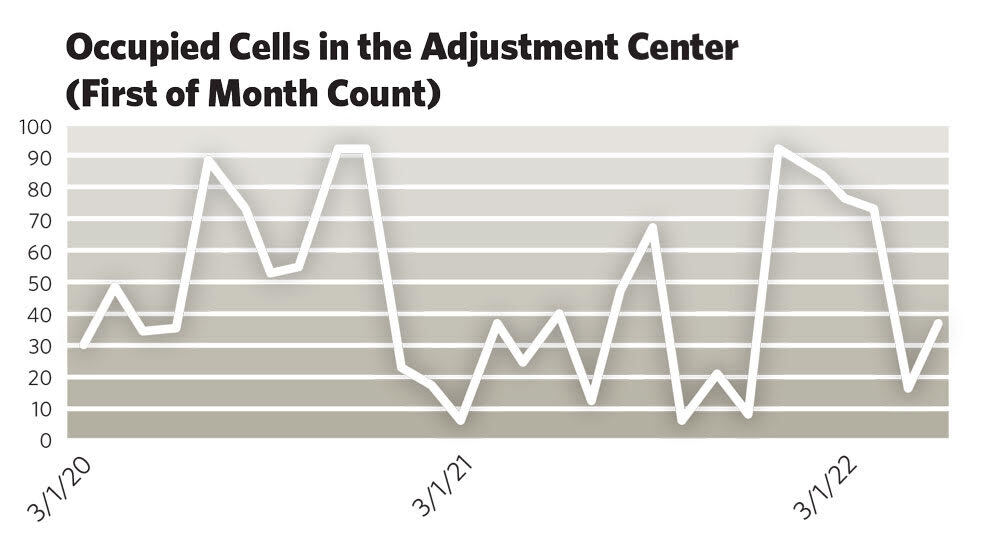
The unit has a name: the Adjustment Center. Often shortened to the AC, it has long served as the harshest of California’s death row units, usually used solely for solitary confinement of people whom officials consider a threat to the security of the institution.

But Hughes is not sentenced to death. Nor did staff consider him a risk to the prison’s security—at least not in the traditional sense. Instead, they put him in the Adjustment Center because he had COVID-19.

Since June 2020, San Quentin has used its Adjustment Center as its primary unit for medical quarantine (defined as separating someone who has been exposed to COVID) and medical isolation (separating someone with a confirmed or suspected case). Though the prison was widely criticized and even sued for its mismanagement during the pandemic, San Quentin has continued to send incarcerated people who have been exposed or infected to the notorious unit, including in the spring and summer of 2022, when outbreaks have been relatively less severe.

Type Investigations and The American Prospect spoke to Hughes and more than a dozen other men, many in their sixties and seventies, who told stories of being medically quarantined or isolated in San Quentin’s Adjustment Center throughout the COVID-19 pandemic. These interviews were possible due to Juan Moreno Haines’s unique access as a journalist incarcerated inside San Quentin. The California Department of Corrections and Rehabilitation did not respond to multiple requests for comment on the allegations that arose in these interviews.

Since his first stay in 2020, Hughes said he has been sent back to the Adjustment Center twice: once after a nurse overheard him clearing his throat, and again in spring 2022 after he tested positive for COVID-19.

Hughes and the other incarcerated people interviewed for this story described being trapped in dirty cells in conditions that felt punitive—sometimes while battling serious cases of COVID. They did not set foot outside the Adjustment Center until their quarantine or isolation was over: Even medical care was provided by a nurse inside the unit. And although solitary confinement has been shown to create or exacerbate mental illness, in the AC, people typically only speak with a psychiatrist virtually, by talking through their cell’s food slot, into a laptop held by a staff member on the other side of the door.

When San Quentin first turned the AC into a COVID unit in June 2020, the prison was gripped by a devastating outbreak that infected more than 62 percent of the population and killed 28 incarcerated people and one correctional sergeant over the course of several months. Over a year later, in a class-action lawsuit brought by more than 300 incarcerated plaintiffs (including Haines), Marin County Superior Court Judge Geoffrey Howard found that the California Department of Corrections and Rehabilitation (CDCR) had enabled this devastation by making mistakes and failing to take measures that would have helped stop the spread. (The use of the AC for medical isolation and quarantine came up in the testimony, but was not the focus of the suit.) Ultimately, Judge Howard found the department in violation of the Eighth Amendment banning cruel and unusual punishment. However, citing the safety provided by the 2021 arrival of vaccines in the prison, he did not order the department to make any changes, and denied the petitions as moot.

Although vaccines have helped reduce the risk of severe illness and death both inside and outside prisons, COVID is still everywhere. And while 94 percent of San Quentin’s incarcerated population is vaccinated, Type Investigations and the Prospect found that the prison’s use of the AC for medical quarantine and isolation, as well as the procedures and conditions inside the AC, remain unchanged. People in San Quentin now live under the constant threat of being thrown into one of the state’s most intense and punishing solitary confinement units at a moment’s notice, without doing anything wrong.

In August, California lawmakers passed a landmark bill to curb the use of solitary confinement in jails and prisons in the state. The legislation is awaiting Gov. Gavin Newsom’s signature. Medical isolation and quarantine, however, would still be permitted. There seems to be no end in sight for San Quentin’s use of the AC for medical quarantine and isolation.

Specifically, the solitary reform legislation allows medical isolation for “the shortest amount of time required to reduce the risk of infection, in accordance with state and federal public health guidance and with the written approval of a licensed physician or nurse practitioner.” But the law does not specify how long that should be. In response to a public- records request, CDCR provided us with two documents governing length of stay as of August 2022: one stating that medical isolation must last at least 14 days, and another requiring a minimum of 10 days. Some of those quarantined, however, report spending up to a month quarantining in the AC, especially early in the pandemic.

CDCR told Type and the Prospect it could not comment on pending legislation. When we asked CDCR about its medical isolation and quarantine plans for the future, the department directed us to its “Roadmap to Reopening.” That document outlines that any housing unit with three recent, linked cases must revert to “outbreak phase,” with limited movement among incarcerated people, a ban on family visits, and a halt in any programming that requires outside instructors or counselors. Units that go into outbreak phase may also provide physical and mental health care in-cell and postpone any “routine services.”

The document does not address any policies for the use of medical quarantine or isolation units, or what the conditions in those units should be.

Solitary Confinement as a COVID “Solution”

Many U.S. prisons and jails began relying on solitary confinement in an attempt to curb the spread in the early days of the pandemic, both to limit movement within facilities and to quarantine people who were infected or exposed. This strategy proved to be largely unsuccessful as the virus ravaged the incarcerated population. Many of the worst outbreaks in the country occurred in high-density, often overcrowded correctional facilities, which tend to hold many people with pre-existing conditions, leading to death rates three times higher than in the general population. At the same time, prisons and jails have failed to adequately test or treat people with COVID-19. As the outside world loosens restrictions and the CDC declares COVID-19 is “here to stay,” a new normal of lockdowns and isolation has taken hold inside prisons.

Through a public-records request, Type Investigations and the Prospect obtained monthly bed counts in the Adjustment Center that show the unit’s fluctuations over the past two-and-a-half years, as COVID waves ebb and flow. The number of people in the AC at a given time is often in the high double-digits. When the omicron variant hit California this January, for instance, there were 411 new COVID cases over a two-week period in San Quentin; a point-in-time bed count from the first of that month showed 91 people in the AC, and remained high by the first of February at 84.

William “Mike” Endres, 65, told Type Investigations and the Prospect he had managed to avoid solitary confinement throughout his entire time in prison, until he was sent to the Adjustment Center for 12 days in November 2021. “I’m on my 24th year of disciplinary-free incarceration with no hole time,” he said. “Yet this place found a way to put me in the hole for thinking I have COVID-19 when I didn’t.”

He described the AC as “a disciplinary setting.” Like Hughes, he said he was handcuffed behind his back any time he went to the shower or the yard. His sleep was disturbed by a correctional officer shining a light in his cell every half-hour. Endres said he was never told why he was sent to the AC, and was not given information about when he would be sent back to his normal housing. “I kept asking why I was in the AC, but nobody could tell me why I was there. To this day, I was never given an answer.” Endres says he tested negative four times over his 12 days in the AC, before he was finally transferred out.

Multiple people told us that Adjustment Center staff would come around and hit the doors or shine a light into cells routinely throughout the day and night. Hughes said there was knocking or beeping every 15 to 20 minutes. “It’s hard to get a good night’s sleep,” he recalled. “And you really need to get rest [when you’re sick], but the hitting the door and the beeping goes on all day and all night. It doesn’t stop.” Gregory Jackson, 60, who said he was quarantined in the AC in May 2022, told us that “every half-hour, they’d put something on the door that beeps.” CDCR did not respond to questions about these disturbances, but court records dating back to 2015 suggest they are related to suicide checks, where correctional officers are required to check on the well-being of people in the Adjustment Center every 30 minutes using a system with a hand-held wand and sensor.

Others described dirty cells and showers. Hughes said the sink, toilet, and walls were filthy in each of the cells he was assigned in his three stints in the AC. In one cell, the sink wouldn’t stop running. In another, the sink was covered in soap rings and dried toothpaste, and the toilet was so dirty he didn’t want to use it. When he requested cleaning supplies, he said a correctional officer told him the AC doesn’t have any. Another man, Charles Ross, 60, said he was quarantined in the Adjustment Center in September 2021 and April 2022. “The cells were torn up, they were nasty,” he said. “They wanted me to sign a paper, saying the cells were in good condition, but I didn’t sign it either time. The second time, I had to threaten to 602 them [a term related to filing a grievance application] to get a towel to clean the cell, but they gave me a T-shirt.”Reporter Juan Haines describes how Wayne Hughes has struggled after contracting COVID in San Quentin.

Reporter Juan Haines describes how Wayne Hughes has struggled after contracting COVID in San Quentin.

“You’ll get sick just from being in that filthy place,” Hughes said. “The only thing they do is check your vital signs twice a day. They could have done that in my North Block cell.” Back in his own cell, he said, “at least it’s clean and you have tools to keep it clean. AC is so unsanitary that the medical staff should be ashamed for even accepting that for quarantining people.” CDCR did not respond to questions about why the Adjustment Center was chosen for medical isolation and quarantine. In the 2021 trial, Warden Ron Broomfield testified that it was selected because it is the only unit in the prison (other than parts of the medical facility) with solid cell doors.

We have found that over the course of the pandemic, people have been sent to the AC for testing positive, exhibiting symptoms or having a known exposure to COVID-19, refusing to take a test, being transferred into the prison, or returning to the prison after attending an outside medical or court appointment. But when it comes to preventing COVID, there are alternatives to locking sick and exposed people in solitary confinement. Medical experts have stressed that when incarcerated people are housed alone for medical isolation or quarantine, they should not lose privileges and that the only similarities this experience should share with punitive solitary confinement is being single-celled and separated from the general population. And public-health officials have determined that the only real solution to stopping COVID spread in prisons is widespread vaccination combined with drastically reducing incarcerated populations. As of September 7, San Quentin was filled to 103 percent of its intended capacity.

IMAGE: JANDOS ROTHSTEIN/THE AMERICAN PROSPECT

“Prison Within a Prison”

The Adjustment Center was built in 1960, a relatively late addition to the fortress-like San Quentin, which was built in 1852. For years, it has held people on death row, along with a smaller number of non-condemned people sent to solitary confinement. It is infamous among the incarcerated, often referred to as a “prison within a prison.” In 2015, six men on death row brought a class action lawsuit, arguing the unit was so restrictive that it amounted to cruel and unusual punishment. In a settlement, CDCR agreed to cap stays in the AC (which had once been indefinite) at five years.

“The hollow steel cell doors have two slivered windows that look out onto a bleak hallway and a small locked slot that is used to deliver food to plaintiffs and to handcuff them before they are transported from their cell,” the 2015 complaint detailed. “The cells have no windows to the outside. Plaintiffs have no natural light or airflow in their cells.”

People who have been medically isolated or quarantined in the AC during the COVID-19 pandemic say the unit still matches the physical descriptions from the 2015 lawsuit.

After the 2015 lawsuit ended indeterminate stays in the AC, the unit’s population decreased. At the beginning of March 2020, there were only 30 people in the unit, according to bed counts provided by CDCR.

That changed when COVID-19 hit. In late May 2020, CDCR responded to an outbreak at another facility, the California Institution for Men (CIM), by transferring 122 medically vulnerable people by bus into San Quentin. About a week later, when it became clear some of the new transfers already had COVID, San Quentin officials sent much of the group to quarantine in the Adjustment Center. But COVID was already spreading, and by June 16, there were 90 people quarantining in the AC. As the AC filled up, officials relocated the remaining death row occupants out of the unit. The AC population has spiked back into the 90s at least twice since then, in November and December 2020, and again in January 2022. Terry Kitchen, 35, said he was sent to the AC for ten days in June 2022, after a rapid COVID test he was required to take to receive dental work came back positive. Although a staff member asked if he wanted anything from his old cell, he said nothing he requested—ten ramen packets, self-help program materials, college work, and hygiene products—was brought over.

He said the cell and showers were dirty, and the cell was bare except for a radio that didn’t work. “When I was over there I was so isolated,” Kitchen told Type Investigations and the Prospect. “There’s a little window [in the cell door] where all you can see is a wall. So your entertainment is watching spiders and ants walk around.” There was always a humming sound in the background, and he could hear someone yelling frequently.

He said medical and correctional staff would not answer his questions. “You don’t know anything about when you’re getting out of AC,” he said. “That in itself is stressful.”

The phones in the AC area weren’t working, according to Kitchen, and he said the staff did not give out prepaid indigent envelopes, which poor people can use to send letters. “I was isolated where I could not contact my family and let them know what was going on with me,” he said. “I couldn’t even write a letter, because I was not offered anything to communicate with my family. It was miserable, which traumatized me. Which is why I’m not going back to dental, until I don’t have to take a rapid test to be seen.”


‘You’ll get sick just from being in that filthy place.’

WAYNE HUGHES

The isolating nature of the Adjustment Center makes mental health care even more crucial—and even harder to access—than it already is in prison. Dr. Paul Burton testified as chief psychiatrist at San Quentin in the 2021 class action lawsuit that mental health interactions in the AC are conducted through the door’s food slot, through which he insisted, “you can actually hear pretty well.” Typically, he said, a nurse stands outside the cell door with a laptop, meaning the patient must communicate with his doctor through both a solid door and a computer. When telehealth appointments are conducted at the cell door in other units of the prison, the patient is offered headphones, so at least the doctor’s side of the conversation is confidential. But in the Adjustment Center, he explained, headphones won’t fit through the door slot, so the entire conversation is audible to passing officers and others incarcerated on the tier.

“It’s not confidential,” Dr. Terry Kupers, a psychiatrist who studies the psychological effects of solitary confinement, told Type Investigations and the Prospect. “You can be victimized because you’re mentally ill. What kind of situation is that, for a prisoner to have their only access to mental health treatment … in public, essentially, no privacy?”

“Horrendous Psychological Stress”

Solitary confinement is proven to cause mental deterioration, leading to higher rates of self-harm and suicide. The United Nations considers solitary to be torture when used for more than 15 days. But even shorter stays can be detrimental. Even after release from prison, people who spent any time at all in solitary are more likely to die prematurely than formerly incarcerated people who did not experience solitary, especially from suicide.

The practice “puts horrendous psychological stress on people,” said Kupers. No matter the length of the stint, he said, “each time you’re in a solitary confinement cell with no window and a solid door, and you go to a little cage to exercise, that’s no small thing.”

Instead of being locked alone in restricted cells, “those in medical isolation may be housed together with others who also have COVID-19,” suggests a paper lead-authored by David Cloud, research director at Amend, a program within the University of California, San Francisco, that focuses on the intersection of criminal justice and public health. The CDC similarly suggests that groups of positive people can be cohorted together in a “single, large, well-ventilated room with solid walls and a solid door that closes fully.” The CDC notes that this can conserve resources, and “mitigate some mental health concerns associated with individual medical isolation.” CDCR did not respond to questions about whether they considered this guidance.

And while the CDC recommends that people with a suspected case or known exposure should ideally be housed alone, Cloud notes that people held for medical reasons should be in sanitary, ventilated spaces and should have enhanced access to “resources that can make their separation psychologically bearable,” such as TV, radio, reading materials, tablets, phone calls, and outdoor exercise. He writes: “They should have easy access to medical and mental health professionals, and daily updates from healthcare staff as to why separation is necessary and how long they can expect it to last.”

Instead, fear of the harsh conditions awaiting them in the AC can make people less likely to alert medical staff when they are feeling sick, contributing to uncontrolled spread.

And being sick in the AC can be terrifying. Larry Williams, 47, was sent to the Adjustment Center after testing positive for COVID in June 2020, during the worst of San Quentin’s outbreak. “I went in the cell, they closed the door,” he told Type Investigations and the Prospect. “And then that’s when hell began.” Battling a serious case of COVID, Williams’s chest started hurting and he had trouble breathing. Next came excruciating headaches and an uncontrollable cough. He deteriorated from roughly 240 to 194 pounds.

Williams said his blood pressure dropped lower and lower, until a nurse knocked on the cell door late one night, telling him to stop taking his prescribed blood pressure medication immediately or he might have a heart attack.

Sleep was hard, he said, because he was terrified he wouldn’t wake up. He was surrounded by sickness and death. He recalled seeing bodies being carried out of nearby cells.

“It just made me afraid of my mortality,” he said. “And it made me start thinking deeper than I’ve ever thought.”Reporter Juan Haines recounts William “Mike” Endres’s time in the Adjustment Center.

Reporter Juan Haines recounts William “Mike” Endres’s time in the Adjustment Center.

Contrary to recommendations from groups like Amend, people repeatedly told us that conditions in the Adjustment Center made them feel like they were being punished, not treated for a serious illness. The official unit guidelines back up their claims. “All inmates will be treated according to the highest level of custody on your tier (Condemned, Ad-Seg, etc.),” outlines a set of “the AC Guidelines” handed out by prison staff to people sent there for medical isolation or quarantine, and obtained by Type Investigations and the Prospect. “You will be handcuffed and escorted by staff during any movement within the unit.” The document lists other rules: two toilet flushes per hour, 30 minutes of phone access per day, and seven minutes per shower (“Use your time wisely.”).

Osbun Walton, 73, said he was quarantined in the AC in April 2022, after returning to the prison from an outside resentencing hearing. He told Type Investigations and the Prospect that he was handcuffed just to go to the showers 15 feet from his cell, as well as to get an EKG on the unit, about 30 feet down the tier. “It was like we were there because we messed up.”

California Has Failed to Depopulate Its Prisons

Solid prison cell doors, like the ones in the AC, have failed to stop COVID-19: An analysis of COVID data from California prisons throughout 2020 showed the virus can, in fact, spread through units with solid-walled cells. An analysis published in June 2022 of San Quentin’s COVID outbreak found that the prison’s air filtration systems further contributed to the spread. Meanwhile, other CDCR policies appear to undermine San Quentin’s quarantine requirements. For example, due to contract stipulations with the prison labor union, the prison has not “cohorted” its staff during the pandemic, meaning that people can work some shifts in the AC and other shifts elsewhere in the prison, bringing the virus back and forth with them.

Throughout the pandemic, Kupers and other experts have said that prisons and jails must depopulate to save lives. A 2021 paper in the New England Journal of Medicine found that a 9 percent reduction in the population of a large urban jail led to a 56 percent decrease in transmission—and additional population decreases led to further transmission reductions. A 2021 paper in the Journal of Urban Health analyzed decarceration and transmission rates in Texas prisons, reaching similar conclusions.

Back in June 2020, CDCR was warned by Amend in an “urgent memo” to reduce San Quentin’s population by 50 percent from its then-population of 3,547. Three months later, a California state appeals court ordered CDCR to follow through on the recommendation. But while CDCR did manage to reduce San Quentin’s population by 33 percent, to 2,384 in May 2021, the population has since shot back up. Its population was 3,183 as of September 7, 2022, just about 10 percent lower than the 2020 number, and still over 100 percent of the capacity the facility is designed to hold. Absent a major population reduction, many people throughout the prison continue to be double-celled in tiny 11-by-4.5-foot cells—a worst-case scenario for limiting the spread of disease.


‘It just made me afraid of my mortality. And it made me start thinking deeper than I’ve ever thought.’

LARRY WILLIAMS

CDCR did not respond to questions about whether it has any plans to reduce the San Quentin population. In the 2021 class action trial, Warden Broomfield testified that he and other officials had not considered Amend’s recommendation, and stated, “I do not recall having conversations to reduce the population to 50 percent.” Pushed on whether there is a plan to depopulate San Quentin in the case of further outbreaks, the warden testified, “I am unaware of future plans to reduce San Quentin’s population.”

Instead of decarceration, the warden testified that any plans to prevent future outbreak revolve around the use of the AC: “We quarantine as many inmates as we can in the Adjustment Center to this day.”

Wayne Hughes is still struggling with the lingering effects of COVID. The infections left him with serious new ailments, including heart problems and blood clots in his lungs.

“Nothing was wrong with me before I caught COVID,” he told Type Investigations and the Prospect. Now, “each time I try to exert myself I get short of breath. I have to use three different inhalers on a daily basis.” He was put on blood thinners, which has made it unsafe to get a needed hernia operation. “My general health is poor. My emotions are sad because I don’t feel the medical staff is doing much of anything for me.”

Before contracting COVID, Hughes worked in the kitchen and filled his days with self-help classes that focused on anger management, domestic violence, substance abuse, and social skills. “I took a lot of groups because I’m trying to better myself for my future,” he explained. “I don’t want to repeat the same mistakes that got me in here.” But now, he said, programming is limited. “Things don’t seem to be getting better.”

“I’m so frustrated to almost being angry that they put me back there, again,” said Hughes of his most recent stint in the AC. “If AC is supposed to be for quarantine, why are they treating us like we’re being punished for getting COVID? The guards’ overall attitude is like we’ve done something wrong.” This fall, he has a tentative date for a parole hearing. Until then, he hopes he can avoid a fourth stay in the AC.


ABOUT THE REPORTERS

Katie Rose Quandt

Katie Rose Quandt is a freelance journalist based in the Bronx, who often writes about criminal justice and inequality. Follow her on twitter @katierosequandt.

Juan Moreno Haines

Juan Moreno Haines is senior editor of the San Quentin News and a contributing writer at Solitary Watch.

Attribution: This article was first printed in typeinvestigations on September 19, 2022 (The caged exercise yard of the Adjustment Center on death row at San Quentin State Prison on Aug. 16, 2016. IMAGE: ERIC RISBERG/AP PHOTO)

Filed Under: Open Line, Published Works

The Backstory: Juan Moreno Haines

October 2, 2022 by Mt. Tam College

Juan Moreno Haines talks about what drew him to investigate the Adjustment Center, the challenges of reporting while incarcerated, and what it was like to report on the prison’s Covid-19 crisis as he was living through it.

Type Investigation’s Inside/Out Journalism Project works with incarcerated journalists to produce feature-length investigations into the criminal legal system. For the project’s inaugural investigation, produced in partnership with The American Prospect, San Quentin News editor Juan Haines and journalist Katie Rose Quandt reported on San Quentin State Prison’s continued use of its Adjustment Center to isolate people infected or exposed to Covid.

In this conversation, we talk to Juan Moreno Haines about what drew him to investigate the Adjustment Center, the challenges of reporting while incarcerated, and what it was like to report on the prison’s Covid-19 crisis as he was living through it.

Paco Alvarez: What initially drew you to investigating San Quentin for use of the Adjustment Center for COVID quarantine and isolation? 

Juan Moreno Haines: Well, okay, so I got to San Quentin in 2007 and I started working with San Quentin News around 2009. I became a staff member around 2011. So living here in this community, the actual living conditions, were a concern with the overcrowding. This is all pre-pandemic kind of stuff. And so the one thing that really kind of drew my curiosity is how to deal with this disconnect between the medical department and the custody department when it came to infectious diseases. So I began just kind of like documenting and talking to people who got the flu – there was the flu, there was chicken pox, there was Legionnaires’ disease, there were staph infections. There was norovirus here. And then there was this strange – we just call it the San Quentin bug. You know, when somebody comes from another institution, they get the San Quentin, they get this weird flu like infectious disease that you have to get over. 

So when it came to the adjustment center, the first time I reported on the Adjustment Center was in 2015 when several death row prisoners filed – it was six death row prisoners filed a lawsuit about how they were being treated. And this was on the heels of the hunger strike in Pelican Bay. And so there were a lot of lawsuits floating around inside California prisons simply about the living conditions. So my reporting about the Adjustment Center being used for medical isolation didn’t happen in a vacuum. And I initially began reporting about this section in San Quentin called Carson. And it’s the housing unit in what’s called South Block in San Quentin. It’s a different area and it’s used for administrative segregation. Most people know that as ‘the hole.’ And if you get into any trouble the prison officials would send you to Carson Section and pending disciplinary findings or whatever, that’s where you land. So Carson is kind of like inside of a prison, it’s like a jail. It’s kind of a holding place for people who couldn’t make it on the main line areas of an institution, pending some sort of disciplinary or safety, the person is afraid for their life –they need to isolate that person, separate them from the regular population. 

In San Quentin, they were using administrative segregation for medical isolation. And so I started reporting on that. And when I met with the medical department, I was asking them, why would you send someone who’s sick to an area of the prison typically used for punishment or for isolation? Because the big deal about that is how the person is treated while they’re in that housing unit. In another words, in the mainline areas in San Quentin, people walk around freely to get to their programs, jobs, to the yard for recreation – so once, you’re like outside of your cell during normal hours, you conduct your business. It’s like a small town, just people milling about, doing whatever. But when you’re in administrative segregation, it’s a high security area. So any time you come out of your cell, you’re handcuffed behind your back, you’re wearing a white jumpsuit. You don’t mingle with the mainline population for obvious safety and security reasons. Now, San Quentin is using this for medical isolation. 

So that was the dilemma when I started reporting. Fast forward to the pandemic. I just met with the head doctor for San Quentin yesterday on this same conversation. Basically, “Why are we doing this? Why are we sending people who are sick to the hole?” And it actually makes medical sense to send someone to where the Adjustment Center is because there are solid doors and you can really isolate a person. But the problem is while they’re there, they’re treated like they’re being punished. And so the medical treatment is literally a punishment. And then I was thinking about this, why in the world would this be acceptable? And I can’t answer that question, but that’s the reality. And so what drew me to write about the Adjustment Centers being used for medical isolation, is the actual counterproductive result that happens. The reality is people don’t want to report that they’re sick. People are literally afraid of doctors around here because if you’re sick, they’re going to send you to the hole, and nobody wants to do that. 

Alvarez: And how did you go about developing the sources you spoke to? Were people generally open to speaking with you? 

Haines: San Quentin is a small town. I’ve been here since 2007, so there’s very few people that’s been in this institution longer than me. And I’ve worked with the newspaper almost all this time and I’m like the Clark Kent of Smallville. So everybody knows me and I’m trusted by the community because I listen to people and I tell their stories and the reason why I tell these stories is because if we don’t tell our stories, the mainstream media won’t. As an example to that, the past two months, San Quentin has been going on and off of quarantines. The rehabilitative reform nature of California prisons, San Quentin being the flagship of that, it’s not functioning because of infectious diseases. And I think that the reality is, what California prison officials are telling the public, touting all the rehabilitation, which is true, all the programs, which is true. They don’t function because we’re overcrowded, and so no one’s really giving to these programs because we’re overcrowded, and when we’re overcrowded, these infectious diseases rage and all the reform efforts that are put forth are pretty much mitigated, because we’re overcrowded. So that’s the story. 

Alvarez: What are some of the challenges of reporting while incarcerated? And how did those challenges impact your work on this investigation? 

Haines: So the biggest challenge for reporting while incarcerated is not the prison system. It’s not, news flash. I’m not going to say that prison officials don’t care what people say about the system. But I don’t think they’re afraid or leery of stories that talk about what the conditions are because this is prison and society accepts that. So the biggest challenge for incarcerated reporters is getting the public to understand what the reality is here. Because mainstream media, like, if you talk – if you read any article from Reuters, Associated Press, not so much The San Francisco Chronicle. But typically, if you read a story about prisons, it’ll be a single source story coming from prison officials, and you won’t get the side of the people who are directly impacted by incarceration. Now, the perception of people who are incarcerated are that this is, quote unquote, where all the bad guys are. So anybody who’s incarcerated, typically speaking, it sounds like, oh, that guy is just complaining about being in prison. And prison is not supposed to be easy, prison is supposed to be punishment. Prison is supposed to be hard. And that’s true. 

Nevertheless, the same people who are incarcerated are coming home. They’re coming out of prison. And the prison experience can do one or two things. It can either make you a better person or it can make you a worse person. Now, there’s a lot of policies that CDCR implements that are not good, and there’s some that are good. So for me, the challenge is being able to have access to do all the reporting about everything that’s happening behind bars and then getting those things in the public eye. There are very few incarcerated reporters doing this kind of work, and I’m gonna send a shout out to Arthur Longworth and John [J] Lennon, because these are two of my heroes because they’re doing the work, you know. 

Alvarez: What are some resources that newsrooms can provide to help incarcerated journalists report and write investigative pieces like this one?

Haines: I think one of the main things is like – I was fortunate to be able to work with Katie Rose on this piece and, like, if an incarcerated reporter was teamed up with a newsroom on the outside with their resources, if they would just have access to the resources of a reporter on the outside, then that would be tremendous, particularly when it comes to that data gathering or evaluating data or even interviewing and getting online and pulling up that amount of information. 

And then finally, just funding incarcerated writers is tremendous. I mean, it’s incredible because, the financial independence and stability allows the writers to just do their job. So just funding these types of journalists is incredibly rewarding to journalism. It’s much needed. 

Alvarez: You’ve been covering the COVID outbreak in San Quentin since the beginning. What was it like to be living through the crisis as you reported on it? 

Haines: It was traumatizing. One word to describe it is traumatizing. You’re trapped inside of an unventilated building that is typically held at about 150% designed capacity. In a place where you’re going to get sick, people are dying all around you. Your friends. One of my best friends died during the pandemic. Mike Hampton – I was at his wedding. This guy was just such a great human being. And he was on his way out of prison when he died from COVID. Stories like that over and over. I mean, my friends died because prison officials didn’t want to do the right thing. And a lot of these decisions were purely political. 

And I can guarantee you, a prison like San Quentin, where people are going to introspective programs to deal with their issues, to deal with who they used to be and who they are now, typically incarcerated 20, 25, 30 years in their 60 and 70 or in retirement age. And for political reasons you’re saying that, “oh, yeah, you’re still dangerous, you’re a threat to society.” You’re saying that about a person who hasn’t committed a violent act in decades, not because they’re locked up, but because they’ve truly made changes in their lives. And I’m talking about Mike Hampton. If he had walked out of this prison alive in downtown San Francisco, his big smile and gracious life would have blessed a lot of people. Lo and behold, you wouldn’t have known he spent a couple of decades in prison because he changed, turned his life around. 

But human beings are not given that second chance, that opportunity, for pure political reasons. Politicians are afraid to do the right thing when it comes to incarceration in the United States. It’s an easy political victory to say “I’m tough on crime, I’ll put that burglar behind bars.” And mainstream media doesn’t help the matter by continually connecting crime as a huge problem in the United States. And it is. But it’s out of context from the reality that there’s a lot of people who just need help and that the mental health crisis that this country is going through, the addiction problem that this country has. Tackling these problems at the end of crime is not going to solve addiction or mental illness. COVID reporting here for me was traumatizing because I lived through it. I got COVID. I was left for dead. Literally left for dead. 

I’m not even talking about the lawsuit that was filed against CDCR officials where the top appeals court judge in California, Anthony Kline, said what San Quentin prison officials did to its incarcerated population was morally indefensible, and constitutionally untenable, and ordered the prison officials to reduce the population to levels that are manageable. They didn’t do that and they’re still not doing it. And manageable, in objective terms from a medical perspective, everybody here knows that if we were living one person per cell, it would be a lot healthier. But that’s not the policy here. You have two people living in a jail, 4 by 10, smaller than your average parking space. And so if your cellmate gets sick, you can guarantee you get sick. I’ve gotten every disease, every infectious disease at San Quentin. Except for chicken pox, because I was vaccinated. I had Legionnaires’, infectious norovirus multiple times. I got COVID. I get the flu every season, even though I get a flu shot. It’s because this place is too crowded. Overcrowded. The only people that can help us, the incarcerated population, save us, are the courts, and they fail to do it because politicians definitely won’t. 

Alvarez: My last question is, have you received any feedback or retaliation from inside? 

Haines: No. For me, any type of retaliatory action against me is just another story, so no. I get, like, snide remarks and this and that, but at the same time I get praise from prison officials, not for the critical stories that I write, but I also write about restorative justice and drug treatment programs – policies that are doing a tremendous amount of good to the incarcerated population. I’m your regular small town reporter and I’m going to talk about the good, the bad and the ugly. There are a few good things happening behind these, and the biggest thing is the drug treatment program. And that program literally saved lives.

This Story was first printed by typeinvestigations on September 30, 2022

Filed Under: Open Line, Published Works

  • Page 1
  • Page 2
  • Page 3
  • Interim pages omitted …
  • Page 5
  • Go to Next Page »
mtc seal

Contact Us

PO Box 492
San Quentin, CA 94964
(415) 455-8088


Please note: Prior to September 2020, Mount Tamalpais College was known as the Prison University Project and operated as an extension site of Patten University.


Tax ID number (EIN): 20-5606926

Quick Links

CONTACT US
CAREERS
PRESS KIT
ACCREDITATION
PUBLICATIONS
DONATE


Join Our Mailing List

© 2025 | Mount Tamalpais College | Photography by RJ Lozada | Design & Development by //DESIGN AGENCY//

  • About
    ▼
    • Mission & Values
    • Staff & Board
    • Accreditation & Institutional Research
  • Academics
    ▼
    • Admissions
    • AA Degree
    • College Prep
    • Faculty
    • Apply To Teach
  • Students & Alumni
    ▼
    • Students
    • Alumni
    • OpenLine Literary Journal
  • Resources
    ▼
    • Practitioner Support
    • Resources for Incarcerated Students
    • Research on Prison Higher Education
  • News
    ▼
    • Top MTC Stories
    • Recent Press
    • From the President
    • Commencement
  • Give to MTC
    ▼
    • Donate
    • Shop