• Skip to primary navigation
  • Skip to main content
  • QUICK LINKS
    • CONTACT US
    • CONNECT
      WITH US
    • FACULTY APPLICATION
    • PUBLICATIONS
    • PRESS KIT
    • CAREERS
  • About
    • Mission & Values
    • Staff & Board
    • Accreditation & Institutional Research
    • Careers
  • Academics
    • Admissions
    • AA Degree
    • College Prep
    • Faculty
    • Apply To Teach
  • Students & Alumni
    • Students
    • Alumni
    • OpenLine Literary Journal
  • Resources
    • Practitioner Support
    • Resources for Incarcerated Students
    • Research on Prison Higher Education
  • News
    • Top MTC Stories
    • Recent Press
    • From the President
    • Commencement
    • 2026 Gala
  • Give to MTC
    • Donate
    • Shop

Mount Tamalpais College

Open Line

COVID 911

June 2, 2022 by Mt. Tam College

In March 2020, the world seemed like it shut down. Shelter in place orders around the world confined citizens to their houses except for essential work or to get groceries. As prisoners, we did not think that our living conditions could get any worse and we were unsure how the shelter in place orders were going to affect us. All of our information about the outside world was coming from network television.

As people in the outside world began to get sick, so did people inside San Quentin. Prisoners began to get transferred from their cells to different parts of the prison in an attempt to spread us out. People deemed at “high risk” from COVID complications due to their advanced age were transferred to cells instead of dormitories, collectively known as H-unit, some prisoners were transferred to live in the prison gymnasium. The administration’s objective was to bring the population down in each housing unit without actually releasing people. This caused a whole avalanche of subsequent problems.

Our daily lives in H-unit changed drastically. None of us really knew what was going to happen from day to day, so we all just went along with what prison officials told us to do. We had to wear our masks twenty four hours a day. The only time we were allowed to not have our masks on were when we were sleeping, eating, or at our bunks. First we were given orange cloth masks, which were made by state prisoners, then we had patterned cloth masks which were donated to the prison, then we had n95 masks, then we had surgical masks. Policies and protocols were constantly changing. Our communication with other prisoners was limited. Everything we did was contained within our own housing unit. All movement by prisoners was restricted throughout the prison, even though correctional officers would regularly travel between housing units, acting as potential vectors for COVID.

As they started shifting the prisoners to different cells and different dorms, we started paying more and more attention to the news. We started seeing how more and more people were contracting this deadly disease outside of the prison walls. Hospitals were being overwhelmed and people were dying everywhere. 

Prison officials were overwhelmed due to an outbreak at a prison in Southern California, and instead of releasing prisoners from that overcrowded prison, they transferred a busload of prisoners to our already overcrowded prison. With that bus, came COVID. Prisoners started catching the disease everywhere. It became so bad that it began to scare prisoners who hadn’t caught it yet, and it terrified the prisoners who already had it. Just hearing someone cough or sneeze caused anxiety for those in the vicinity. It’s not that we didn’t want to follow social distancing guidelines, but that we couldn’t. We were locked in an overcrowded, confined space. COVID 19 had finally landed front and center, the number one problem in the world had finally breached the walls of San Quentin.

Inmates here were being checked for healthy temperatures and oxygen levels several times a day. We were checked so often that it became tedious, yet we still had to succumb to the tests. We didn’t have a choice in the matter.

Like I said before, things were new to us. Even the way we ate. We did not even travel to the chow hall to eat. Instead, our food was brought to our building, but at one point, COVID was so widespread that the prison could not staff the kitchen which prepares our food. The administration compensated by giving us boxed lunches with crackers and bologna. It was so bad that after several days, we decided to protest. We refused to eat and threw our lunches in the middle of the common room. Once we started, all of the housing units were doing it and the conditions here made it on the local news. Before you knew it, we were getting catered food from the streets and it tasted pretty damn good. That lasted for a few weeks.

You want to hear something ironic? Here in San Quentin’s H-unit, a separate dormitory unit in San Quentin, COVID somehow never reached us, no prisoners living in the dormitories got sick even though virtually every prisoner living in cell housing contracted COVID. Matter of fact, it seemed like for over a year no one even sneezed or coughed here in H-unit. We were wondering when it was coming to H-unit. We weren’t wondering if we were going to get sick, but when we were going to get sick.

How could so many people get sick around the prison, but it never hit H-unit? It was almost like a miracle.

Here at San Quentin everybody was so scared when the nurses came around almost demanding that we be vaccinated against COVID-19. For several days, I wondered if I should take the shot. By this time there were so many people around San Quentin who had been sick that I felt I had to. The shot that I took was Moderna shot and for some reason I thought that was the only dose I was going to have to take. Two weeks later I had to take another one, which made me sore for almost a week. All in all I think it helped because I haven’t been sick since.

Two years later, the emergency in prisons is supposedly over. The big scare has died down, as society, both inside and outside of the prison, is faced with coexisting with this diseaseNow I sit here in San Quentin, and the administration is trying to put everything back together. Remember how they tried to disperse us? Well now they’re trying to bring the population back. Prison officials are trying to stuff more inmates into our already overcrowded prison just like it was before the pandemic.

Not only has COVID changed the prison system, but the whole world around it has changed too. Now people are asking how we survived COVID in prison. From an inmate’s perspective, how did COVID survive us?

I’m writing this to tell you that I am one of those inmates that never caught COVID, and I’ve never felt better in my life. It’s kind of ironic that I’ve been wearing a mask for over two years, but I must say that I haven’t been sick in over two years. So, I am a strong believer that the more you’re masked up, the more chances you have of avoiding this deadly disease.
Filed Under: Creative Writing, Open Line

A Letter From and For Your Future

May 23, 2022 by Mt. Tam College

To My Dearest,

I’m writing to you with some mind-boggling realizations and some helpful information on the COVID-19 epidemic: worldwide and heading your way. Francesca Melandri, an Italian novelist, wrote “A Letter to the U.K.” about what she knew of our future while living amidst the onslaught of COVID-19. Between Melandri and myself we will relate to you “our” struggles in hopes of preparing you for the precautions you’ll need to deal with COVID-19 and as Melandri puts it that “will completely take charge of your life as you know it”.

Melandri notes, “she is but a few steps ahead of me in the path of time” COVID-19 time. The Italians are being told to lock themselves inside their houses. You’ll have many questions: Will you be able to keep your job and work from home or will you lose it? Schools will be closing. Children will have on-line schooling from home. Yes, children will be home 24-7 and if they’re teenagers, good luck! And she makes sure to emphasize that with this lockdown, there will be plenty of time to eat.

You will be told that “society is united in a communal effort, that you are all in the same boat!” But you will be sailing your own boat and arguing with those who say it’s only a cold or it’s the flu. Your social life will be put on hold. Although with cell phone in hand it will be non-stop “on-line” apps, Zoom, Skype! After you do all that, you’ll most likely eat again. 

Melandri paints me such a beautiful picture: “We turn our gaze to the distant future unknown to you and to us too. When all of this is over the world will not be the same.” You cannot travel to see your adult children and grandkids, you’re scared to go shopping alone, rules to venture outside will be made. And since she is in Italy informing me of what she knows of my future with COVID-19, she warns that “she is just small-scale fortune-telling.” Off to the kitchen to eat again.

So, here I am in California State Prison San Quentin with COVID-19 knockin’ at the gates. One day we’re goin’ about daily routines exercising in the yard, education classes, library when I turned around and masks were being handed out to everyone with instructions to wear them over the nose and mouth. With them came lockdown. To the cells we went. No more yard, no school, no more, period! COVID-19 has arrived and taken over. I believe this is the realization Melandri was warning about. So, while I mull this over I’ll eat again.

With COVID-19 raising its deadly head and taking over the prison, the sports field has turned into a MASH unit, a tent city for quarantine. Medical performing COVID tests on all inmates and staff. I contracted COVID, which lasted about a week (I’m so grateful that I’ve been tobacco free for seven years) and didn’t attack my lungs. Most correctional officers also had COVID and in the cities around us, hospitals are full with COVID patients. We can still order from the canteen once a month; my order just got filled, time to eat once again.

We learned quickly to live with this nightmare. Rules became daily rituals: never forget your mask, hand washing, sanitizing your cell, and social distancing. A few school and college courses went to correspondence, some privileges returned such as phone usage, outdoor time, showers. It’s now a year’s time and gradually we began to overcome and get back some sort of normalcy. Medical and dental began making appointments and testing swabs are still up your nose. We’re gaining an upper hand on COVID. More and more of the population here are vaccinated. I believe we are on our way; always with a mask. Shall we eat again? 

I do hope my letter is in your hand before COVID-19 is. Melandri’s letter was a heads-up awakening for me. Hopefully between the two of us, you should have a head start with taking on COVID-19 with an understanding. It’s not a weekend cold, but a serious respiratory infection wreaking havoc on the populations, both sexes, all nationalities, hitting the old with deadly force, but for now sparing the young children. Start preparing, so I may see your heart-warming smile again!

Love,

Dad

p.s. In the basement cabinets with my vinyl L.P. records and VHS tapes is Jane Fonda’s complete set of work-out tapes. You’ll need them for all the “eating” you’ll do when you’re locked up in the house for a year!

Filed Under: Creative Writing, Open Line

Mourning Our Losses

May 4, 2022 by Mt. Tam College

Two years ago, in spring of 2020, the COVID-19 pandemic changed life as we know it and ushered in a period of acute trauma for the residents at San Quentin and their loved ones. Within the first few months of the pandemic, 75% of the population became infected, hundreds became seriously ill, and 28 died. In honor of the two year anniversary of this horrific time, we are publishing a series of writings from students reflecting on the COVD pandemic. 

In December of 2019, the coronavirus began to sweep across our world, like a dark shadow slowly eclipsing our planet. With this unknown shadow came shock waves of fear that rippled through every community, one after another. We all questioned the fate of humanity, whether openly or in secret. Our questions evidence a deep seeded fear that we all felt, and still feel, whether expressed or unexpressed. 

But, for those of us considered to be in a state of ill repute, enclosed within the death traps that are American prisons, our fears were heightened ten times over. As a California prisoner, I was only able to watch news reports of what was happening from my prison cell in San Quentin; and catch snippets regarding the dire situation from conversations with volunteer staff that frequent the prison from the community. None of what I observed on television, or learned from those conversations foretold, or would prepare me for the situation that was to come. 

The disease marched rapidly across our planet devouring all in its path. Like nothing anyone had ever seen before. At first, even though I (by skin complexion, ethnicity, and prisoner status) am undesirable in the structure of the American system, my fear invoked this attitude of American exceptionalism. Backed up by Trump’s misguided denials and misinformation, I found myself saying “that’s happening to those other people; it (the disease) will never hit ‘US.’ Our scientists will find a cure.” This illusion lasted only a moment. 

On May 30, 2020, the disease hit San Quentin like an atomic bomb. A fear like I had never known before swept over me and the entire institution. It was palpable. I could taste it. I could feel it. It was all around me, thick like Jell-0. Making my fears worse, there was complete silence from those prison officials who were supposed to be in the know—prison administrators, doctors, and staff. No one relayed information to those of us trapped within these walls. It was like being handcuffed and-blindfolded on a shooting range—Covid being the marksman and bullet. You hear people being struck all around you, and you think to yourself if someone would just tell me which way to turn, to run, to duck, something, I could save myself. However, no warnings came. The only thing left for me to do was stay still, make myself as small as possible, and pray. 

On June 23, 2020, my worst fears were realized, I was struck by COVID. I was placed in the hole under the auspices of quarantine. There I sat for 60+ days alone struggling to cope with what was happening to me. No smell, no taste, struggling to breathe, every moment wondering, is this where my life ends. In that dusty, smelly cell (not legally big enough for a dog), I believed I would breathe my last breath. It may have been because of fate, a higher power, or just pure dumb luck; I survived, but not unscathed. I, like so many others, have tried to resume life as though nothing has happened, as though the events of the last two years are a common everyday occurrence. As though I was bigger than the event. But, knowing better and having learned from the explosion which led me to attempt to murder another human being, I know unprocessed trauma is a fuse leading to an explosion. I know the events I have just survived traumatized me, and if I don’t admit and acknowledge that trauma, it will explode.

In the weeks and months since improving from COVID and being released from the hole, I feel the buildup of old pressures: agitation, animosity, anger, and negative feelings toward people for no reason and from a source unknown. This I know to be signs of trauma for me. I know if left unchecked this trauma will come out in other areas of my life and most likely in self-destructive ways. 

As I look around my prison yard, I see the same signs of trauma in others that I see in myself. The only difference being, very few know the origins of what they feel, why they feel it, or what to do about it. Understanding this mounting pressure of trauma, I know there is an explosion to come. Whether there will be many small explosions or one giant explosion, I cannot predict. One thing is for sure though: there will be an explosion if our trauma is left unacknowledged and unchecked. 

The knowledge of my own trauma and how it has played out in my past is what motivated me to commit my all to the “Mourning Our Losses” event held in November 2021 to memorialize those we lost to COVID. I know the first, and perhaps most important step in healing from any form of trauma is admitting that hurt, fear, and uncertainty is threatening my sense of security. To pretend to be unaffected by a situation like COVID  is a recipe for disaster. Without serious professional help for everyone, especially those of us trapped within these walls during COVID, suffering will be the consequences of our failure, for us and our communities. 

Acknowledging and mourning what we have lost to COVID as a community, is essential to a healthy processing of this unprecedented event. I believe it to be my duty to contribute my all to establishing a healthy community. My participation in the “Mourning Our Losses” event was, for me, a small step in that direction. 

Perhaps this event, put on by a handful of people in blue, will spark a larger movement both on the inside and in the community to speak about the trauma that COVID has brought; and produce a resolute commitment to mourn and heal as a community. (Read more about Mourning Our Losses.)

Photo Courtesy of San Quentin News

Filed Under: Creative Writing, Open Line

On Resilience: Aaron Kurtis Mikkelsen

January 25, 2022 by Mt. Tam College

As 2021 — another challenging year, especially for the incarcerated community—  came to a close, we invited students to reflect on the idea of resilience. The below essay was written as part of that series, which was shared as part of our end-of-year fundraising campaign.

You Can Too

by Aaron Kurtis Mikkelsen

I am asked to talk about resilience and what that means to me, but that is almost like describing a color when you haven’t seen it before. Resilience is “to withstand” by definition, but it doesn’t tell the entirety of what it means to “be” resilient. In my lifetime I have experienced many struggles. I may fit the description of the definition of resilience, but from where I stand under lock and key with my past of pain, if I did “withstand” my struggles, why did I continue this legacy of trauma? If resilience is just living scared under your bed sheets, if living is just on the whims of the monster in the closet, did I ever truly live? How does dust withstand under the mortar and pestle, crushed and ground further to be groomed fine powder?

After all I’ve suffered, resilience to me was not bowing my head to live, but now years later to speak out when specters of the past rear their ugly heads.

Now, I am resilient, to withstand those specters when they resurface.

Now, I am resilient, to look those specters in the eye and tell them no.

Now, I am resilient, because I know who I am and I can love me for me.

And you can too.

Filed Under: Creative Writing, Open Line

On Resilience: Ray Ray

January 25, 2022 by Mt. Tam College

As 2021 — another challenging year, especially for the incarcerated community—  came to a close, we invited students to reflect on the idea of resilience. The below essay was written as part of that series, which was shared as part of our end-of-year fundraising campaign.

Resilience Is My Family

by Ray Ray

During the year of the pandemic, resilience didn’t exist. The pandemic was the most traumatic experience I went through. My entire family was exposed to COVID, and this gave me so much anxiety, because I was already expecting the worst. Then, the worst came. My mom and dad were getting worse, the chance of living was zero percent – that’s what I was telling myself. I was afraid that my greatest fear would come true: losing my parents while in prison. 

That’s when I started to doubt my beliefs in my life and religion. Why do my parents have to suffer? Why not me? Sadly, this self-reflection of myself led me to doubt my existence on this earth.

I was on the verge of committing suicide, because my family is all that I have left. However, it was like God heard my cry for the first time. On that same day, I received three letters from Mount Tamalpais College, Humans of San Quentin, and Marin Shakespeare. They don’t understand how they saved my life, saved me from myself. It showed me that my true resilience comes from the people who love and believe in me. If I didn’t have support or people who are loyal to me, I know I wouldn’t be here. I will forever be faithful and supportive towards Mount Tamalpais College, Marin Shakespeare, and Humans of San Quentin. Thanks to God, my family is doing better.

No matter what we went through during the pandemic and in life, we always find a way to come together without seeing the difference in others, but rather seeing the equality and the strength in each other. We are one race, the human race. As long as we have a support network, and family that believes in us, we can survive any crisis.

I love y’all. Thank you! 

Filed Under: Creative Writing, Open Line

On Resilience: Carl Raybon

January 25, 2022 by Mt. Tam College

As 2021 — another challenging year, especially for the incarcerated community—  came to a close, we invited students to reflect on the idea of resilience. The below essay was written as part of that series, which was shared as part of our end-of-year fundraising campaign.

Resilience

by Carl Raybon

Early in life I assumed everyone suffered the same challenges I experienced: alcoholic parent, absent parent, witnessing domestic violence in the home, feelings of hopelessness, insecurity, abandonment, low self-esteem, etc. (just to name a few!). While I managed to survive and live to the age I am now (57), I did not make the connection to how resilient I am. I was showing resilience by surviving, using the skills and techniques I employed to combat the dysfunctional conditions I was limited to. Skills that served me, no matter how damaging they would, ultimately, prove to be.

Today, I have come to see life in a different light, and in that, in the morning when I rise, my outlook on life is to be the best representation of what honesty, open-mindedness, acceptance, and willingness to treat others as I wish to be treated looks like.

Resilience is enduring and maintaining a sense of being through the challenges, shortcomings, and expectations of others that can deter me from accomplishing any goals or endeavors I wish to achieve. Even if that is just taking life one day at a time. It is the optimism generated from resilience that encourages me to never give up, because I have, indeed, experienced consequences and circumstances that I believed I would not live through, but I did and I learned from those situations. The quality of life I am now aware of allows me the presence of being to share with others what it means to be resilient during times of uncertainty and moments of crisis.

Filed Under: Creative Writing, Open Line

Why Should I Have to Forgive You?

December 21, 2021 by Mt. Tam College

Why should I have to forgive you

when you took me from a land 

where I mattered?

Why should I have to forgive you

when you bound me in shackles

and dispersed me around this world?

Why should I have to forgive you

when you held me in servitude

that created wealth for you and your

descendants?

Why should I have to forgive you

when you kept me in this bondage

for two and one half centuries?

Why should I have to forgive you

when you created an amendment 

that placed me back into an act of

indentured servitude for any

infringement of a (policy) law?

Why should I have to forgive you

when you put a noose around

my neck, and I became a strange

fruit hanging from a tree?

Why should I have to forgive you

when you deny my children a 

school system equal to a school

system for your children? 

Why should I have to forgive you

when I wanted to vote I was beaten,

threatened, and killed for the right to vote?

Why should I have to forgive you

when you red lined me in where

I should live?

Why should I have to forgive you

when you amended an Amendment

that bars me from bearing arms?

Why should I have to forgive you

when you introduced heroin into 

my communities?

Why should I have to forgive you

when you bussed me to all white 

schools instead of busing your 

children to all black schools?

Why should I have to forgive you

when you began your campaign of 

the war on drugs?

Why should I have to forgive you

when you have always marginalized

or disenfranchised me?

Why should I have to forgive you

when you encourage me to get

out of poverty via entertainment

for your amusement?

Why should I have to forgive you

when you have made me out to be

the bogeyman (villainized)?

Why should I have to forgive you

when you have flooded my communities 

with cocaine?

Why should I have to forgive you

when you keep enacting policies

on top of policies that has one in 

four Black men incarcerated or on

some type of supervision release?

Why should I have to forgive you?

My caregivers told me to remember

that we all come from one man and 

one woman, who created many tribes

and nations. We are not to despise one

another, but we ought to get to know one

another.

If there is one thing the -isms of 

philosophy has shown me is the “ought”

in a person’s life is more subjective

rather than objective.

So, did my caregivers have it all wrong?

Tell me why should I have to forgive you.

Filed Under: Creative Writing, Open Line

From a Dishonorable Life to an Honorable Life: In Memory of Uncle Bill

December 20, 2021 by Mt. Tam College

I’m an incarcerated man who has changed my life and will always hold myself accountable for the decisions I’ve made in my past. As an ex-firefighter incarcerated for several violent felonies, with a release date of 2050, the opportunity to give back to my state, as well as my community, is a goal worth achieving. I propose that we put a couple of twenty-man crews together to clean our forests by doing small, controlled burns next to homes and properties with the primary goal of saving lives: human, as well as animal. There are long-term violent offenders, like myself, who have lived a dishonorable life in our communities and are willing to do the work and be held accountable. 

My Uncle Bill reached out to me, a troubled, at-risk young person, as soon as I turned eighteen years old. Uncle Bill was a well-known firefighter for the US Forest Service. Through them, he gave me a few tests, and I became a seasonal firefighter from 1985 – 1986. However, my violent choices as a youngster eventually put me in prison, and I was never afforded the opportunity to be a firefighter in prison, due to being a violent offender.

While fighting fires with my Uncle Bill, I noticed how he was always alert and well aware of his crew and their surroundings. He always told us to “do your SAs” — Situational Awareness. That meant keeping an eye on each other, as well as the fuel and the moisture around you. This means to pay attention to which way the wind is blowing and how much wind the fire is creating. Sometimes a combination of wind, fuel, and terrain conspires to produce a blow up, which the fire explodes out of control. We call this “super heating”. Normally, radiant heat drives volatile gases called terpenes out of the pinyon and juniper just minutes before they are consumed. The gasses lie heavily along the contours of the slopes, and when the right combination of wind and flame reaches them, they explode. (Junger) 

Throughout my incarceration, I have always felt the need to fight fires. I never lost the feeling of a firefighter bond. I’ve watched the news and I’ve noticed  how violent the fires have become over the past 30 years. The loss of property, as well as life, is astounding. I saw a childhood friend named Brian on the news. Having lost everything to fire he said, “It all burned up.” My nephew John also lost his home in Paradise, CA. Thank God they survived and we still have them both. 

Since I have been an inmate in San Quentin, the fires have been some of the most intense in California. I have felt helpless growing old and dying in a prison cell as the person I am today. What a waste. I have walked down prison tiers over half my life as a long-term inmate, waiting for the day my legs will fail, as I open my cell door and take that deep scorching breath, and find my way to my cold metal bunk to wonder if I will awaken for another day. Or will the CDCR send my body to my wife to cremate, and spread my carbon ashes, only to be remembered by most people as a violent offender who died in prison for voluntary manslaughter? 

Dying in a prison parallels the experience of dying in a forest fire, as Sebastian Junger details in his book Fire, where he writes, “dying in a forest fire is actually like experiencing three deaths. First, the failure of your legs as you run, then the scorching of your lungs, finally the burning of your body. In the end, nothing is left but carbon.” (Junger) 

In 2020, California Governor Gavin Newsom signed the bill, AB2147P85, allowing inmate firefighters to have their records expunged. Long-term violent offenders would love the opportunity to step in place of all the inmates released early due to COVID-19. There are those who have made violent choices 10 – 20 years ao. Yet, today they have the determination to live nonviolent lives. We must get serious about providing pathways for those who show dedication to turning their lives around. 

I believe that incarcerated people with 10 years of disciplinary free behavior should be allowed to apply for these long-term violent forest management crews. Our numbers will be remembered as honorable men in California. Violent choices made decades ago does not mean we’re bad people. Lifer inmates who are released are assets to our state and communities, many of them working with gangs, drug addicts, and at-risk youth. The opportunity to give back is priceless. 

It took 30 years for our forests to become violent, killing, property-destroying machines. With a lot of hard work we can change this. The same goes for humans. Hurt people hurt people. And as we say in Guiding Rage into Power (GRIP), “healed people, heal people.” It all comes from some sort of abuse, neglect, and more: just like our forests. From 30 years of abuse of the forest, you get blow up fires. With abused people you get long term violent inmates. With the right kind of help, love, and care, rehabilitation for our forest, just like for long term inmates, is possible. Peace will follow. 

We know how to stop megafires. We need California land managers as well as the CDCR to use available resources. Working for our state and our community, saving lives and property, is a small price to pay to be remembered as a man who turned their life around, instead of as a long term violent inmate. 

Give us the opportunity to clean the litter out of our beautiful California Forest and to be remembered as honorable men, just like Uncle Bill. 

Reference:

Junger, Sebastian. Fire, Harper Collins, 2002.

Filed Under: Creative Writing, Open Line

Who Am I?

December 17, 2021 by Mt. Tam College

“Once you aren’t considered human your life isn’t valued.”

This is a quote from Rahsaan Thomas in his article, “How I Convinced My Incarcerated Peers to Make Language a Priority,” where he writes about how the media uses words that dehumanize those who are incarcerated. I agree that once you are deemed a monster, it’s easier for society to disengage and lack empathy for you. But as my dad would say, “It’s not what they call you, it’s what you answer to.”

I am not an inmate, nor a convict. I identify as an incarcerated person. 

Translation: 

I am flesh

I am bones

I am organs

I am a beating heart

I am someone who has made a mistake…

… a human.

I am not what this world calls me: I am not ignorant, so don’t call me Nigger.

It seems to me that the name “inmate” was created in the same way that the name “Nigger” was: to assert dominance over individuals and to make them feel less than. As James Baldwin wrote in his essay, “A Talk to Teachers,”

“In order to justify the fact that men were treated as though they were animals, the white republic had to brainwash itself into believing that they were indeed, animals…” 

In this essay, Baldwin discusses educating young people on the realities of what happened in history. His words still ring true today.

During the coronavirus outbreak at San Quentin Prison (a.k.a “The Q”), 29 lives were lost. Yet, the news announced and focused on their crimes: rape, murder, serial killer, and used dehumanizing words like “heinous” to further rip the lives we’ve lost from society. These labels, as Thomas notes in his article, “invite people telling our stories to obscure the complexity of crime… [yet] it’s a journalist’s duty to use unbiased language.” Not once did the news speak of the good these people did, nor mention their rehabilitation. Nothing was spoken of the families who lost a father, son, brother, uncle, or grandfather.

So very few came to our rescue.

Something that leaves me befuddled is how when you go to the parole board, or when you speak with a psychologist, you’re asked what your gender pronouns are. Yet, I don’t get a say on whether someone calls me inmate, convict, or prisoner. I stand for equality, always. Just because I’m in prison, paying off a debt, for which I’m almost done, for a mistake I made, don’t treat me like the scum of the earth. I will always have respect for you, society. So, show me a little respect too. Stop using dehumanizing words, names, and phrases to define me, to ignore me, to other me, to unsee me. I am not these things. I am…

… a loving, but strange son. I am a strict, but trusting father. I am a protective, but open brother. I am a timid, but direct writer. I am a forgiving, but cautious Christian. I am a confusing, but confident artist. I was born Quincy Quinn Paige in Denver, Colorado. 

References:

Baldwin, James. “A Talk to Teachers.” Zinn Education Project, 16 Oct. 1963, 

Thomas, Rahsaan. “How I Convinced My Incarcerated Peers to Make Language a Priority.” The 

Marshall Project, 13 Apr. 2021,

Filed Under: Creative Writing, Open Line

Black Tears

November 2, 2021 by Mt. Tam College

Lil Treal died December 15, 2012. Where a man should always be buried by his son, instead there I was, burying my son. He was a 17-year-old football star, a senior in high school with a 3.8 grade point average, when he was murdered by another Black kid. He had promised his mom and I that he was going to get his GPA up to a 4.0 before he graduated. 

He was my Junior. He was my journey.

Nine years later, Lil Treal would have been 26 this year, and I sit here inside San Quentin. The pain still exists but now I can live with it. I don’t think it will ever go away, but I want others who have lost a child to know that there’s a way to live with it.  

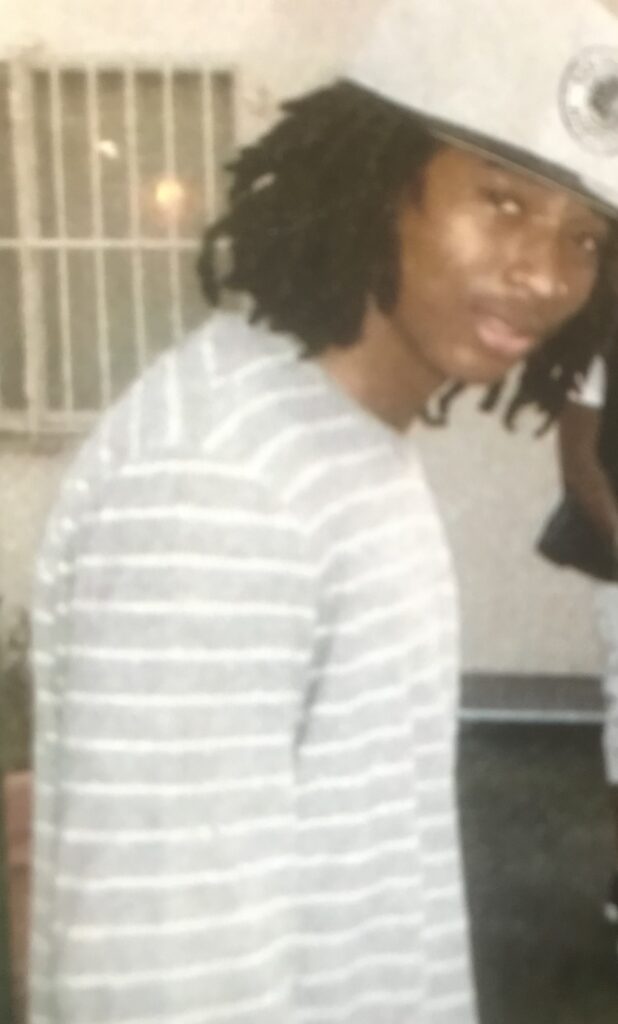
Lil Treal. Photo provided by Montreal Blakely Sr.

I tell you my story because I don’t want other parents to cry Black Tears too.

When Lil Treal was born, I cut the umbilical cord. The day that I lost him, I lost something inside of me. Today I still can’t express to you fully what I’ve lost. Did I lose me, did I lose my breath, did I lose my vision? 

I’ve often been asked by people how I deal with it. I tell these people, it’s like being in the middle of a fire, and you’re burning up. You can’t outrun the fire. You can’t jump out of the fire. You can’t put the fire out. You accept the burning pain. You don’t want to cover up the pain. You live with the pain. 

At times, I often wondered how it would be when I die, and the pain my death would cause for others.  Sometimes I wish that I was dead, so I wouldn’t have to say that I buried Lil Treal.

After my son died, I didn’t dream any more. When I went to sleep it was just dark for years.

Black Tears: because my tears seem to be really black. Black Tears: colored black from darkness, depression. Black Tears: shared with other Black mothers and fathers who suffer from killings in our community. 

Over the years, people have asked me to tell them how I felt when it happened, and I tell them that it’s difficult to explain because I can’t find the words to accurately portray the way I feel inside. It’s like I belong to an exclusive club that no one wants to be a part of.

Surprisingly, there are not too many people in prison who can fully empathize. It’s one of those situations where I can’t talk to anyone. I’m surrounded by hundreds of men, yet there’s no one I can talk to because not many fathers bury their 17-year-old and there aren’t many people who really care. A lot of fathers of children who die aren’t even around to cry Black Tears. When my son died, I had friends and family, yet it’s hard to talk about losing a part of you.

I tell this story from the point of view of a Black man who has lost a Black boy and who still cries Black Tears.

Montreal Blakely Sr. is just a man who has walked in many different pairs of shoes. A man that is trying to keep learning. A man that is trying to become a better husband, a better father, a better human. Montreal Blakely Sr. has created a foundation in memory of his son. For more information, please visit the site here.

Filed Under: Creative Writing, Open Line

  • « Go to Previous Page
  • Page 1
  • Interim pages omitted …
  • Page 3
  • Page 4
  • Page 5
  • Page 6
  • Page 7
  • Interim pages omitted …
  • Page 11
  • Go to Next Page »
mtc seal

Contact Us

PO Box 492
San Quentin, CA 94964
(415) 455-8088


Please note: Prior to September 2020, Mount Tamalpais College was known as the Prison University Project and operated as an extension site of Patten University.


Tax ID number (EIN): 20-5606926

Quick Links

CONTACT US
CAREERS
PRESS KIT
ACCREDITATION
PUBLICATIONS
DONATE


Join Our Mailing List

© 2026 | Mount Tamalpais College | Photography by RJ Lozada | Design & Development by //DESIGN AGENCY//

  • About
    ▼
    • Mission & Values
    • Staff & Board
    • Accreditation & Institutional Research
    • Careers
  • Academics
    ▼
    • Admissions
    • AA Degree
    • College Prep
    • Faculty
    • Apply To Teach
  • Students & Alumni
    ▼
    • Students
    • Alumni
    • OpenLine Literary Journal
  • Resources
    ▼
    • Practitioner Support
    • Resources for Incarcerated Students
    • Research on Prison Higher Education
  • News
    ▼
    • Top MTC Stories
    • Recent Press
    • From the President
    • Commencement
    • 2026 Gala
  • Give to MTC
    ▼
    • Donate
    • Shop