• Skip to primary navigation
  • Skip to main content
  • QUICK LINKS
    • CONTACT US
    • CONNECT
      WITH US
    • FACULTY APPLICATION
    • PUBLICATIONS
    • PRESS KIT
    • CAREERS
  • About
    • Mission & Values
    • Staff & Board
    • Impact
    • Accreditation & Institutional Research
    • Careers
  • Academics
    • Admissions
    • AA Degree
    • College Prep
    • Faculty
    • Apply To Teach
  • Students & Alumni
    • Students
    • Alumni
    • OpenLine Literary Journal
  • Resources
    • Practitioner Support
    • Resources for Incarcerated Students
    • Research on Prison Higher Education
  • News
    • Top MTC Stories
    • Recent Press
    • From the President
    • Commencement
    • 2026 Gala
  • Give to MTC
    • Donate
    • Shop

Mount Tamalpais College

Open Line

A Dream Deferred

August 29, 2017 by Mt. Tam College

My grandma didn’t graduate from high school. She’s a survivor of crushing racism in the deep South. She moved to California where she scrubbed bathrooms to put my father through medical school. My father represented a phenomenon in the black community called “making it.” My family lived the story of sacrifice amidst racial injustice so that the next generation could climb a little higher, could leave poverty a little further behind: the African-American dream.

My brothers and I are all in prison or on parole. We live beneath the poverty line, beneath the crushing weight of systematic racism. My family’s African-American dream died with us. Except the story isn’t over until the book closes. My book is open, and a college degree is the next chapter in revising my family’s dream. My dream. It’s my next step in building a legacy that instead of dragging my kid down, will lift her up.

How will this legacy look?

It begins with the most important thing I want to teach my daughter. No matter how bad things get, no matter how low you fall, it’s never too late and you’re never in too deep to turn toward the light.

The legacy continues with an MFA. I want to design curriculums for inner-city schools that will take advantage of art’s power to manifest positive change in communities and in individual lives. Cycles of addiction and violence in urban communities are often fueled by a sense of powerlessness, a sense that you have no power over your life except that which you can immediately seize through violence or other antisocial behavior. The youth trying to survive these cycles need a healthy way to exercise power, and while activism and sports are healthy exercises of self-determination, artistic expression is what saved me in my 20s. By then I was already serving a life sentence in prison. I want to teach children what I learned in my 20s while they’re in elementary and junior high school.

The legacy ends, well, never. We live in a divided world, and our divisions are destroying us. I’ve often witnessed the power my writing has to bridge differences between people. If I can teach generations to write with the consciousness that their work can heal our world, and they teach generations after them, the legacy continues.

Filed Under: Creative Writing, Open Line

Dungeons & Dragons—A Life Changing Experience

August 21, 2017 by Mt. Tam College

The California Prison System has a significant obstacle in its efforts to rehabilitate its inmates: segregation. It occurs most frequently in the form of racial segregation. In his study of racial segregation in California Reception Centers, Philip Goodman states, “‘Race’ is one of the most important factors—if not in certain locales the preeminent factor—organizing and structuring contemporary American prison culture in men’s prisons” (Goodman, 2008). Race determines everything from what part of the yard a person uses for recreation, to whom a person lives in a cell with. Upon arriving at prison, one of the very first questions asked by the guards is: “Who do you run with, Blacks or Others?” As time passed I learned that besides race, people were segregated by other factors like geographical origin or gang affiliation. Along with these types of segregation was unwritten but violently enforced (by inmates, not guards) rule that certain groups of inmates are not allowed to associate with other specific groups. In general, Blacks cannot socialize with Whites; Whites cannot socialize with Northern Hispanics; Northern Hispanics cannot socialize with Southern Hispanics; Southern Hispanics cannot socialize with Blacks; and so on.

After years of everyday practice, the negative behavior of segregation becomes ingrained in inmates with Pavlovian efficiency. The statistics show that of the inmates currently incarcerated, approximately 95 percent will eventually be released (Hughes & Wilson, 2002 ). If inmates take this behavior back into society, it does society further harm beyond the crimes the inmates have committed.

How can we overcome this obstacle? During my incarceration, I have found one possible and viable solution: Dungeons & Dragons. Dungeons & Dragons (hereafter D&D) is regarded by many inmates as one of the few acceptable multicultural social activities in prison (exceptions being prisons with the highest level of security and inmates fully immersed in gang affiliation). While not all inmates play D&D, those who play can do so without violently enforced retaliation. The purpose of this paper is to show how D&D can be used as one solution to segregation in prison. Specifically, the questions this paper answers are: 1) How do the participatory practices of D&D promote healthy social rehabilitation for the incarcerated; and 2) How can its effects be optimized and broadened to be used as therapy for the soon to be released? I will first explain the relevant areas of D&D and then I will show how D&D has more value than just entertainment.

D&D is a fantasy based Role-Playing Game (hereafter RPG) in which a group of participants use collaborative efforts to overcome a myriad of challenges like rescuing a kidnapped princess or defeating a tyrannical ruler. Although D&D is not the only RPG available, it is the original RPG. In Corey Walden’s thesis on the practices of D&D, he quotes M. Tresca about the influence of D&D. Walden states, “Many digital RPGs have been directly inspired by D&D, including Asheron’s Call, Boldur’s Gate, Bard’s Tale, … and World of Warcraft” (Walden 3-4). Many of the concepts and rules of D&D are found throughout these and other popular RPGs making D&D the most universally recognized game by those who play.

The interesting thing about this game is that diversity is the key to success. Each participant, or ‘adventurer’, creates a character from one of the various ‘classes’ available. The character becomes the means of expression for the adventurer, and determines the boundaries by which the role can be played. These classes are derived from one or more different types of characters. The four major types are: 1) Spellcasters who control the battlefield with their mastery of the arcane arts, like a ‘wizard’; 2) Scoundrels who disable traps or con their way past the guardsman of the drawbridge, like a ‘rogue’: 3) Healers who save the adventuring party by channeling primal energies or with their devotion to the divine, like a ‘cleric’: 4) Warriors who are the strategic combatants and the party’s shield against imposing danger, like a ‘fighter’.

Along with character classes, another important option D&D provides is ‘race’. There are not only different cultures and personalities with a single race, as with actual human beings, but there are a number of races of beings. The core races are dwarf, elf, gnome, half-elf, half-ore, Halfling, and human. Each race, and each culture and/or region of geographical origin, brings with it its own pros/cons and unique perspective that affects the character role chosen by the adventurer. For example, mountain dwarves have a racial hatred for goblins and ores (These are two of the evil races and, in many instances, the ‘enemy’ in the adventures). This gives mountain dwarves a bonus to combat these races, but this hatred could be a hindrance if a dwarf had to work with a goblin for the greater good. Alternatively, the hatred does run that deep in hill dwarves and they are merely unfriendly towards them.

The game sessions for D&D are run by a Dungeon Master (hereafter DM). S/he does not make choices for the players. The DM is a rules arbitrator and storyteller, a neutral guide.

D&D combats segregation by presenting a different perspective on the very thing that people use as a reason to segregate: the difference of others. The game sessions of D&D require diversity not only with classes, but also with race. The adventures are formatted in a way where different people and different skills are needed at different times to complete them. For example, a party of all fighters might do well in the combat scenes, but they would suffer when it came to social situations or intellectual challenges. In addition, no one knows what race of being the party may encounter that leads to the next stage of the adventure. If the party cannot be represented by someone who can be seen as friendly to that individual, the adventure may end prematurely.

About six years ago, my friends and I were starting a new adventure at a prison in San Luis Obispo when someone walked up and asked to play. At first we were hesitant because he, a white inmate, had clearly visible tattoos that indicated that he was at one time involved in violence against black inmates. The DM pulled me aside and said, “I think we have an opportunity here. I believe he wants to make a change in his life or he wouldn’t be willing to play with you on the yard where everyone could see. If you’re not cool with this, he’s out. If a problem occurs between the two of you, he’s out. But I think we should play the game because we have a chance to make a real difference in someone’s life.” Reluctantly, I agreed. The DM asked me to play a dwarf and asked the other guy to play a half-ore. In effect, the DM wanted me to play the racist and wanted the other guy to play someone whose only crime was being born.

During the adventure, between in-game dialogue and sidebar conversations, we actually became good friends. We talked about how the segregation in prison made us feel and why we felt the way we did. Sometimes we even played out some of the scenarios we discussed in our game, but with the unique perspective of being in each other’s shoes. Plus he played a thief whose skills and cunning were needed to get us out of numerous sticky situations. I played a cleric whose moral fortitude kept us focused on completing our goals without sliding into spiritual abyss. We could not have succeeded without each other.

Our experience did indeed have a profound effect on his life. He gave up his old ways and made many friends of other races before his tragic death from heart complications. Near the end, when he knew it was time to say goodbye, he chose to spend his final weeks playing as much D&D as possible.

The differences that segregate people in real life are fundamental to D&D, thereby making cooperative diversity mandatory for game advancement. Even though these are imaginary characters they are controlled by real people who must accept this diversity in order to play the game. As Walden notes, “Mechanically and philosophically, the flexibility of D&D continues to allow participants the ability to negotiate issues of conflict, violence, and moral uncertainty”. In other words, between the dialogue that develops amongst the adventurers during gameplay and the outside-the- game conversations that inevitably take place during breaks, D&D is a vehicle that allows for people to discuss and navigate their way through the real life problems presented in the game. D&D gives some the opportunity to voice their objections to certain situations, and others the opportunity to combat stereotypical judgments while in the safety of a game environment. In my 28 years of RPG experience, I have found that most people find it easier to express themselves when they have the buffer of ‘make believe’ that is associated with gaming. The buffer grants a person a pipeline to situations that are too personal or sensitive to discuss in direct conversation.

The next step in the rehabilitative process is developing bonds. Merely putting people together is not enough. However, D&D has the tools to promote social growth. Walden says, “RPGs fit the criteria for modern-day ritual, as they draw on mythology and archetypal symbolism – creating social bonds through community, and allowing for co-created epic narratives to occur in the process,” (Walden 17). Through dialogue, and the rite of passage of cooperating to overcome adversity, the adventuring party builds a communal bond. Combined with primary function of any game, which is fun, D&D becomes a potential tool for social rehabilitation.

D&D can then be optimized, changing from a potential tool to an effective tool. First, the DM must have training in psychology, sociology, and conflict resolution. S/he must also be someone from outside the prison system. As controversial situations arise and are resolved, the DM could use proven methods in these areas to discuss with the players what exactly occurred-beyond the surface of the circumstance- and how it could have been better resolved with a rehabilitative focus. With two or three volunteers with similar training as assistants to the DM, there could be one-on-one sessions with the adventurers for more personal and in-depth rehabilitative therapy.

Second, play the game in a way that positively reinforces behavior that advances the adventurer towards the desired rehabilitative goals. For example, reward the party when it resolves potential conflict without combat or when the party accepts one of the enemy races as a fellow adventurer. A system based on the repetition of positive behavior can be used to fight Pavlov with Pavlov. The focus here should be on restorative justice, working towards fixing the problem, rather than punitive justice- which we are already experts in.

The purpose of the optimization is to give each adventurer the opportunity, and the stage, to express whatever turmoil that is within the individual, while having professional help observe and guide the adventurer along the path of rehabilitation. If a stimulus provokes a response that exceeds what is deemed acceptable by societal Jaws, then the individual is a danger to that society. At this time, no medium exists to measure and inmate’s proclivity for violence besides a psychiatric review that depends largely on the honesty of the inmate. If D&D is played in the optimized way, the professionals could better gauge whether or not an inmate still poses a danger to the society s/he is about to be released to. Does the inmate, more often than not, respond to a situation with combat when diplomacy will do? Does the inmate unnecessarily kill a clearly defeated foe? These and other hallmarks could be used to tailor make a specific rehabilitation program for each inmate. Optimized D&D addresses not only segregation, but also its violent responses. Lastly, not one of the many self-help groups available in the California Prison System is dedicated to repairing inmates’ social skills.

Allowing men and women to be released back into the Divided States of America with a segregationist attitude is not acceptable. Doing so would be adding fuel to the fire. Something must be done. D&D is a push in the right direction. The basic elements of D&D, cooperation and community should be the exact ideals instilled into society’s failures. Along with paying for a crime, a person bettering her/himself should be the desired outcome of a prison sentence. The availability and accessibility of D&D are the perfect opportunities for a person to spend their time in prison wisely and productively.

WORKS CITED:

  • GOODMAN, PHILIP. “It’s Just Black, White, or Hispanic: An Observational Study of Racializing Moves in
  • California’s Segregated Prison Reception Centers.” Law & Society Review 42.4 (Dec. 2008): 735- 770 Print
  • HUGHES, T & D.J. WILSON. Reentry Trends in the United States. Washington, D.C.: U.S. Department of Justice, Bureau of Justice Assistance, 2002

Filed Under: Academic Writing, Open Line

I Thought Being Gay Was a Sin Until I Saw My Friend Suffer in Prison

August 17, 2017 by Mt. Tam College

I was walking the prison track on a sunny southern California day in 2006 when a friend I’ll call Michael joined me. He looked like he could barely hold it together. His dark complexion was ashen, and there was dried toothpaste around his mouth. When I asked him how he was doing, it took a full four seconds before he answered.
“I’m going to kill myself,” Michael said.

He said it matter-of-factly, but when I looked at him to see if he was joking, his shoulders were slumped, his head down, his eyes focused on the track immediately in front of him. I wondered if he had the same feeling I had, that any verbal misstep could end in disaster.

“Come on man,” I responded, with a lightness that I hoped hid the nervousness I felt. “Nothing could be that serious.”

“There’s a guy in my building that won’t leave me alone. He’s pressuring me to have sex with him.”

This threw me for a loop. I knew just about everybody on the Yard, and I was skeptical of his claim of abuse. I remembered that Michael had a reputation in our circle of friends for being overly dramatic. Often, he would bring up “problems” that were just attempts to get attention.

After a few minutes, we rounded the track past the handball courts and came up to a row of picnic benches on the south side of the Yard.

“Let’s have a seat,” I said.

He took it like I was trying to create some privacy for us, but in truth, I was stalling for time. In my seven years of incarceration, I had never been propositioned for sex, let alone pressured. Of course, I’d grown up hearing the stories and the “don’t drop the soap” jokes that people tossed around so freely. But I still couldn’t shake my skepticism — why would this predator pick Michael, of all people?

Yet something about Michael’s demeanor seemed sincere. If he was making this up, what did he hope to get out of such an embarrassing story?

Slowly, Michael began to tell me what had happened, starting very early on in his life. He’d grown up in an abusive household — I’m talking about one of those homes where the kid never has a fighting chance. Beatings with extension cords, whole days locked in the closet. It seemed like everybody in his life either hated him or was indifferent.

One of his mother’s boyfriends had been different, though. He would let Michael hang out with him while he ran around the hood; he’d buy Michael brand new clothes, or take him out for pizza; he’d come into Michael’s room late at night to spend time with him.

It soon became clear that the only person who’d shown Michael any attention had also sexually assaulted him.

To me, this was clearly an abusive relationship, but Michael said he didn’t see it that way. He seemed to appreciate the positive attention that his older male companion had shown him, and spoke about their relationship with an affection he didn’t bother to hide.

By this time, I realized Michael was not lying about the guy pressuring him. I also realized that Michael might be gay and therefore, according to my way of thinking at the time, shared some blame for what he was going through.

“I know what the problem is,” I said. “You have a spirit of homosexuality. So does the guy pressuring you. If you reject that spirit, I believe he’ll leave you alone.”

“The fact that I’m attracted to men has nothing to do with this. Because I’m not attracted to this guy…”

I was extremely uncomfortable at this point. For some reason, Michael could not see that this person was reacting to Michael’s homosexuality. And to top if off, he was unapologetic about it.

Still, Michael was a friend of mine. I couldn’t let him continue doing what I then felt, like many inmates do, was a sin, a weakness that made him deserving of all he got in prison.

“It doesn’t work like that,” I told him. “You can’t play around with homosexuality and just think you’ll only attract people you like. In that lifestyle, predators come after you. Especially in prison. Besides,” I said, “you’re a Christian.”

Then he said, “Is that Christianity, or just your understanding of it?”

Looking back, I now realize that, like many survivors of childhood abuse and neglect — so many of whom are in prison — Michael was well-acquainted with shame. My response, which was to blame him, was as familiar to him as his name.

Over the next few months, Michael and I had many more talks. Though I prided myself on being a compassionate Christian, I never missed a chance to subtly attack him for his sins. And since my attacks fit the ashamed self-image that he had internalized as a child, we slipped seamlessly into our new roles.

Perhaps two years after our conversation, Michael propositioned a friend of his. The guy attacked Michael in the middle of the dayroom. It took three guards and a full can of pepper spray to pull them apart. They took Michael to the hole, and he never came back.

By 2014, he was a distant memory. I was in church listening to a visiting preacher give a sermon about godliness when he spotted two gay men sitting in the pews. Without hesitation, he said, “You can’t play with God. You can’t be swishing around here trying to entice men, and thinking you can just go to heaven.”

Every eye in the room focused on the men. People were smiling with approval, loudly proclaiming “Amen, brother!”

All I could see, though, was the hurt and embarrassment on their faces.

Anger started to burn inside of me. Here I was, sitting in a room full of men who had no problem stealing from the kitchen or lying to the guards. A thought struck me: Who were the sinners here? When it comes to women, I have little choice in who I feel attracted to, and I was sure these men didn’t, either.

I also realized that I was guilty of the same hypocrisy. The question Michael had asked me long ago came to mind. Was this Christianity, or just our — or my — understanding of Christianity?

Michael and I are no longer in the same prison. From time to time, I find myself wondering how he’s doing. I believe he’s still incarcerated; I just hope he has found some friends who are wiser and kinder than I once was.

Attribution: This article originally appeared in The Marshall Project on August 17, 2017.
Read Story

Filed Under: Current Affairs, Open Line, Perspectives, Published Works

The Value of Educating a Lifer

August 15, 2017 by Mt. Tam College

I was sentenced to a total sentence of 55 years to life. The judge’s pronouncement still echoed in my head six months later as I paced the short distance from back wall to front gate of a maximum-security cell. As insanity wrestled with humanity, I had to decide who I wanted to win. The decision wasn’t mine alone. Society had to decide if I was worth giving the time and space to make something from the ashes of my life, or if I should be thrown away with the key.

I voted for humanity. Recognizing that my voice was still free, I declared myself a writer. I envisioned it as a career that could happen even from behind bars. I dreamed of writing something so profound, people would be motivated to change their lives for the better. However, I didn’t have the skill to match the passion. I never went to college and I had barely finished high school. I didn’t even have one of those “Writing for Dummies” books. To really become an effective writer, I needed the space and opportunity to learn the skill. I needed society to decide that a Lifer is worth giving a college education.

Society’s split on whether to provide a free education to the incarcerated. “Why educate men who may never go home?” some asked. “Lifers ruined their lives, so a degree would be a waste. I say, educating Lifers makes sense because the overall value of doing so adds to society.

Lifers matter to society because we are all connected. Whether or not we go home, we come into contact with those who are set free everyday like prison staff, corrections officers, and other incarcerated Americans with parole dates. How those relationships go can have a ripple effect on all of society. If Lifers give others attitude or traumatize others, those individuals will take that out into the community. That could mean arguing with significant others, road rage, alcoholism, suicide, or harming other people.

College teaches skills that make interactions between Lifers and everyone else productive. Communications classes teach us how to use verbal judo instead of violence. Ethics classes give us a better sense of right and wrong under extreme conditions. English classes help make Lifers articulate, which in turn leads to better relationships with their families, better odds of being understood on appeal, and eliminates the frustration that can build from feeling like no one is listening to you. From history classes, we learn how our government was formed—how it works and how to work from within it. Simply put, college courses help make Lifers better people, and our society a better place.

Educating Lifers can also have a positive effect on the rest of the incarcerated population. Some of us have committed crimes that have made us legends in the minds of some young people. If the younger men see us going to school, it may inspire them to do the same. Education can transform us from ghetto legends into positive role models.

Now let me tell you what being educated has done for me. Getting a college education has elevated my ability to write, which has given me a career that transcends being incarcerated. My writing is good enough to be published in several publications like The Marshall Project, and the Missouri Review. Plus, former heavyweight champion Shannon Briggs has entrusted me—a Lifer—with writing his memoir. Additionally, I write for San Quentin News. The Society of Professional Journalists recognizes us—a bunch of Lifers—as professional journalists. My education is something I am using right now—from a cage—to better myself and to better society.

A college degree has a value well beyond getting a job, or the scroll it is printed on. Everybody should have access to a college education because everybody counts. Everybody matters. Everybody has value. Recognizing the value in each other from those in the lowest positions to those in the highest is important because we are all impacted by each other. We are all connected to each other. Remembering to educate the forgotten is a smart move.

Filed Under: Creative Writing, Open Line

Why Do I Want a College Degree?

August 8, 2017 by Mt. Tam College

Many people talk about “seeing the light.” It’s clichéd, I know. My education has been that proverbial light. It just so happens to have taken 20 odd years for me to see what people saw in higher education. Like the cave dwellers in Plato’s “Allegory of the Cave,” I was limited in how I perceived the world. I viewed life through very narrow lenses and because of that restricted vision, I wasn’t capable of critically thinking my way beneath the surface.

Attending college has afforded me the opportunity to escape the cave of darkness and obscurity and enter a world of new experiences. As a student, I have learned so much from my instructors and other students through classroom, lectures, discussion, and brainstorming. Most important of all, what I have learned concerns my own development. Education has given me the confidence to actualize my potential.

Many critics question why prisoners should get free education. I say, why not offer education to prisoners? Too many incarcerated Americans enter the criminal justice system with little to no education. I committed my crime at 15 and received a 25 years to life sentence. Before that, I was expelled from high school three months into my freshman year. It was a long journey and I worked towards earning my high school diploma. Today, I am not the lost, insecure kid who sought acceptance from his peers. I have a college education. I can discuss Plato’s Republic, or the complicated mind of Nietzsche, who claimed Plato preached virtue as a means to keep the lower class in the lower rung of society, or the prison industrial complex and its insatiable appetite. Education unlocked that side of my mind that was confined as Plato’s cave dwellers were confined by their legs and their necks. A college degree will ensure that I stay out of the cave and help those still shackled to unchain themselves and crawl towards the light.

Filed Under: Creative Writing, Open Line

Allow Parole for Lifers—Reformed Violent Criminals—Under Proposition 57

April 24, 2017 by Mt. Tam College

In November, 64 percent of California voters passed a proposition to allow early parole for qualifying non-violent offenders. But Proposition 57 also permits accelerating parole for prisoners who committed violent crimes by giving more good-time credits for exceptionally good behavior.

Some fear that paroling reformed violent offenders will increase violent crime rates, but the people the proposition would affect can actually reduce violence. They can reach youth caught in cycles of violence and save them.

When I was 19 years old, a violent felon saved me. He was a skeletal man in his 50’s with fingertips that were blunt and burned from hard labor and the hot glass of crack pipes. He’d been a high-ranking militant and former prison hit man decades ago.

I was a depressed teenager with father issues facing 67 years to life for two violent felonies. I would’ve made a perfect soldier. Instead of recruiting me, he spent nights in our cell convincing me to never join a prison gang. He stripped the romanticism from gang life and showed me that I would never find the love I wanted in a gang. I listened to him because he barely knew me, but he loved me.

Legislators meet this month about how Proposition 57 can cost-effectively reduce prison overcrowding while maximizing society’s safety. When they meet, they should remind themselves why Alcoholics Anonymous succeeds.

Recovering alcoholics make passionate and effective proselytizers for sobriety. Love born of empathy exists between recovering alcoholics and alcoholics who have not yet started AA. The same phenomenon operates in people sentenced to indeterminate terms, like 25 years to life — we call them lifers — who committed violent crimes in the past but have reformed.

I’ve dedicated my life to stopping violence, and I learned that dedication from violent felons. They taught me that my violence as a teenager stemmed from unresolved traumas I experienced as a child. I took classes taught by violent felons to learn how to help other incarcerated people stop their cycles of violence. And it works. Often the men who’ve found healing show the same urgency to pay it forward as I feel.

Most lifers become eligible for parole after a fixed term like 25 years. The corrections department reported that of the lifers released in the 2009- 2010 fiscal year, 0.3 percent returned to prison for new felonies. Compare this to the national recidivism rate of 60 percent. It’s clear that reformed lifers are the safest people to release.

Given that California is obligated under federal court order to stop deadly prison overcrowding, why not release people with passion and life experience to decrease violent crime? Imagine the social transformations that would be possible.

Actually, you don’t have to imagine. Several reformed lifers have been paroled and they’re changing their communities. For example, Malachi Scott was paroled in 2013, and today he’s leading restorative justice groups, teaching empathy and responsibility for one’s community in the Bay Area.

There are many lifers like Scott ready to serve. Under Prop 57, they’re eligible for 20 percent time reduction credits while other prisoners are eligible for 50 percent time credits.

I ask that legislators take steps to give these people back to their communities by making violent offenders eligible for Prop. 57’s 50 percent time reduction credits and by applying the credits retroactively. I ask that readers contact their local representatives and ask them to extend 50% time credits to people like me.

Attribution: This article originally appeared in The Mercury News on April 24, 2017.
Read Story

Filed Under: Current Affairs, Open Line, Perspectives, Published Works

Stories of Friendship

February 14, 2017 by Mt. Tam College

From Moe:

Chris and I met in Restorative Justice. My first impression was one of those white-boys that thinks he’s tough and has a lot of war stories about how bad he is. Knowing that he had did time I assumed he was a racist especially after looking at his tattoos and he said he was from Orange County. But at the same time I said to myself let me not be judgmental because I don’t want anyone judging me. I learned that me and Chris had a lot in common – he was a former skinhead and I was a former gang member. We both been through a lot and he had been through some things I had never been through as a kid. I really felt bad for him and was hurt by the things he said he been through. At that moment in my heart I felt he was going to be my brother I never had. We started to open up to one another more and more about our kids and family. When he found out his father was sick he came to talk to me about it. That made me know our relationship was one of true brotherly love. So when my aunt’s boyfriend who attacked her while he was on PCP and bit her face so badly to where she had to have plastic surgery came to San Quentin, the first person I went to talk to was Chris for support. Because like I said he’s a brother to me and I trust him. Despite all the hurt and hate we both had in us. We both just wanted to be understood and loved unconditionally and we found that in one another. I could not have asked for a better brother than Chris and our relationship has showed me to never judge a book by its cover. I believe the negative lifestyle we once lived was a cry out for brotherly love and we found that in one another.

From Chris:

Moe and I first met sitting in a restorative justice roundtable circle. My first impression was that he was one of the darkest African American men I’ve ever seen.

I believe our friendship today is one of the best I’ve ever had. He is my brother. I’ve learned many things from Moe but the most important lesson to me is to face life’s challenges, no matter how stressful, as calmly as possible.

The changes I’ve experienced as a result of our friendship are mostly related to my past beliefs as a skinhead with racial views. Additionally I believe I’m a much happier person overall.

Filed Under: Creative Writing, Open Line

When a Wedding Narrowed the ‘Emotional Distance’ of Prison

February 9, 2017 by Mt. Tam College

The first and only wedding I ever attended was in prison, when an inmate I knew only in passing invited me to serve as his best man.

Why would this virtual stranger invite me into one of the most personal moments of his life? Instinctively, I knew that his asking me suggested more about the walls inmates set up around our private lives than it did about any personal relationship I had with him. The truth is, Dee (at the time I only knew his nickname), was looking for someone who wouldn’t embarrass him in front of his family. Someone who wouldn’t talk about prison stuff all day — like who is snitching, or who owes who, or how corrupt the system is.

In fact, here in prison, family is off-limits. Many incarcerated men, when they receive mail, immediately rip off the return address and flush it down the toilet. If you see someone on the phone, the unspoken rule is that you never approach them for any reason. If you see someone you know in the visiting room, you should wait for them to make eye contact with you to see if it’s acceptable for you to approach, because they are in the presence of their family. It doesn’t matter if this is a prisoner you’ve known for 20 years. Family is off-limits.

So prison becomes a strange blend of intimacy and emotional distance. When you share a four-by-eight cell with a person, you get to know him pretty well, but only in certain ways. My cellie likes to get up about 4:30 a.m. to read while the building is still quiet; he’s passionate about politics — our most heated argument came when I made a dismissive remark about Bernie Sanders. He loves grilled-cheese sandwiches with ice-cold milk.

What I can’t tell you is if he has kids. Or if his parents are still alive.

When I arrived at Dee’s wedding, I was immediately overwhelmed — the smell of cologne in the visiting room was overpowering. The hundreds of incarcerated men in the small space had clearly attempted to drown out the stale prison odor.

The visiting room itself was bracingly loud with the squeal of children, and the joyful, foreign sound of women’s laughter.

I carefully stepped to where Dee and his family were seated.

I’d seen Dee plenty of times in the yard, but we ran in different circles and had never really conversed. He was in his mid-20s but didn’t carry himself like a lot of the other youngsters. Perhaps it was his slender build, or his state-issued glasses with the black plastic frames, or the way he always seemed to be headed somewhere.

But at the wedding, within minutes, I was learning that Dee is actually Daniel. He has a little sister who will begin her first semester of college very soon. She’s interested in social activism. Her love for her brother was clearly capable of trumping her fear of being in a prison for the first time. She adoringly caressed his hair.

And Daniel: gone was the weary, wary look and the body language that is universal to the incarcerated male. In its place was an attentive, respectful demeanor that left no doubt his mom ran a tight ship. He was polite and humble, and his eyes shone a light that you never really see in prison.

Suddenly, I realized that around the visiting room, that same, rare light was everywhere: genuine smiles, open expressions, intimacy.

The wedding itself was brief. I expected a state bureaucrat with a certain grudging efficiency, the type who is impatient with anyone who doesn’t already know the routine, to lead the ceremony with one eye on the clock. Instead, a retired military chaplain came in and within moments said something that blew me away.

“I can tell that you two really love each other,” he said, with a kind smile.

Most state employees, or free people who come into prison, can’t see past our state-issued uniforms. They rarely look us in the eye, and usually don’t say anything to us at all.

But this chaplain hung out with us as we took pictures, ate microwaved buffalo wings from the vending machine, and laughed and joked as we did. And not once was there a disapproving glance at the bride-to-be for marrying an incarcerated man.

Occasionally, as the couple said their vows, one of the incarcerated men in the room would see me gazing his way, and immediately his walls would snap back into place.

What exactly are we so on guard against, I thought? Was it that soon enough someone would be sympathizing with you, and then demanding that you help them out with a few things, like commissary? By now, didn’t we know that each of us was basically alike, a person just trying to get through the day so that one day we can get home to our family?

But that final level of trust eludes us.

As Daniel and I re-entered the yard after his marriage, he lightly touched my arm to get my attention, then looked me straight in the eyes. “Thank you,” he said. I wanted to tell him that he had given me a far greater gift than I had given him. But as I searched for the words, I felt the prison environment washing back over me.

“It was nothing,” I replied.

Attribution: This article originally appeared on The Marshall Project on February 9, 2017.
Read Story

Filed Under: Current Affairs, Open Line, Perspectives, Published Works

What Does It Mean to Be a Real Man?

October 12, 2016 by Mt. Tam College

One of my cousins told me he could not wait to come to prison. That statement caught me off-guard, and I asked him what he meant.

He told me his friends told him that only real men go to prison and survive, and one was not considered a man if he did not go to prison. I was shocked.

I have six immediate uncles, my mother’s brothers. Four of them I heard about only from stories because they were always in prison. I met my Uncle Rodney only once, and he told me that prison was not a good place to be. A few months later, he attempted a robbery and found himself back in prison. He died right here in San Quentin.

My uncles Larry and Michael are uncles I only met a few times, and they told me about how bad prison was, and how they did not want to see me go there. So how did prison get glamorized?

There are certain books and shows, styled “urban,” that make it seem like crime and prison are rites of passage, and that only “the real” go to prison, only to get out and make it big. While it is a world of hope that success can spring from being in prison, one does not have to go to prison to be successful. Does that make sense?

One can be successful without having to hit rock bottom. It is very easy to go to prison but very difficult to come out.

I have been incarcerated nearly 10 years, and I had the idea that my manhood would be tested thoroughly. The other side of that glamorous prison life is the idea that inmates are killing and raping each other. I have seen a bit of both, but it is not a frequent thing.

I was 27 when I fell this time, and I never believed that prison was the place to be. Ever. Do not misunderstand me: Without this time, I would have been killed in the street, either by a past or present victim, or by the police. That does not mean that I could not have changed my life without going to prison. I did not have to get locked up to learn to love myself, and neither does anyone else.

One of the biggest struggles in prison is dealing with modern-day slavery. We work for pennies on the dollar, most of us doing work some people believe is beneath them. Guards talk down to us, some of them anyway, and they seem to forget that one bad choice can land them behind these walls.

Some people point to Tupac for glamorizing the “thug life,” but songs where he rapped about killing or crime, at the end of the song he was either in jail or dead. Prison sucks. It is not at all like the movies or music. Imagine watching your children grow up through pictures instead of being there with them, or your siblings growing up without you.

I’ll say this: Coming to prison saved my life, though only because I was too stubborn to listen to my parents, my family, my friends or my own instincts. I can admit that freely, and I can admit that I had to come to prison to free myself from the chains of mental slavery and to see the face of oppression and racism in a clear and present sense.

I do not recommend tearing yourself away from your loved ones in order to get your life together. As long as one has family and friends, one can succeed. Communicate. Listen. Learn.

Attribution: This article originally appeared on the Juvenile Justice Information Exchange on October 12, 2016.
Read Story

Please note that the Prison University Project became Mount Tamalpais College in September 2020.

Filed Under: Current Affairs, Open Line, Perspectives, Published Works

Creating a Healthy Society

April 29, 2016 by Mt. Tam College

Prison University Project graduate and community mentor Sam Vaughn recounts how a program offering radical interventions of love and support to the most violent young men has dramatically reduced the homicide rate in one of the most dangerous US cities. Sam is a TEDMED 2015 speaker and Neighborhood Change Agent in the City of Richmond, California. 


A person can have a healthy heart and diseased lungs, or a healthy brain and kidney failure. Would you consider that person healthy? Society is quite similar. Until we create a culture of health that is inclusive of all citizens, we cannot consider ourselves a healthy society. Thus, we cannot create a healthy society until we deal with issues of personal security, like crime and gun violence.

As I mention in my TEDMED talk, at the Office of Neighborhood Safety, we identify individuals who are most likely to be perpetrators or victims of gun violence. We work with them through a program called the Operation Peacemaker Fellowship, a seven-step process to help them become self- and socially-aware of their roles in society, and to affirm their God-given and Constitutional rights to happy, safe and successful lives. Perhaps most importantly, we meet and accept them where they are, with no judgement, and recognize the social, structural and strategic injustices that they have faced most of their lives. We challenge them to accept that, despite those injustices, they still have a responsibility to themselves, to their families, and to their communities to do better.

The first step of the Fellowship, and one that is vital to our success, is for us to build a relationship with these individuals. Most young people don’t care what you know until they know that you care. Once trust is established, we create a LifeMAP with them, helping them see that a different future is possible by showing the changes that others have made. We help them envision a future as bright and fulfilling as they can possibly imagine, and we connect them to resources and service providers that can help make that dream become a reality. We connect them to mentors and coaches, a group we call Elders, who are older successful men of color who have successfully made changes in their own lives, and are now reaching back to help others.

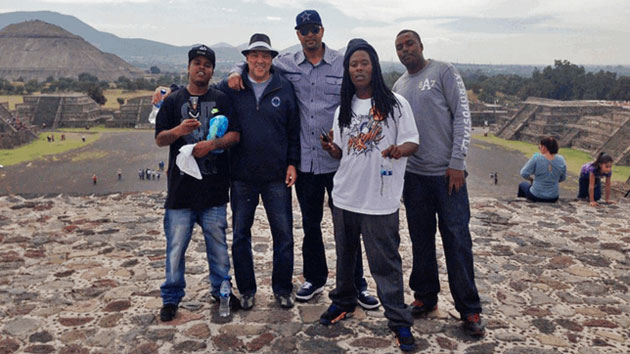
[pictured] Sam Vaughn, Devone Boggan, and Fellows on a retreat at the Teotihuacan Pyramid of the Sun, Mexico City.



Additionally, in a step riddled with great risk but even greater reward, we take the Fellows on trips around the globe, to help them see how good life can possibly be and get them addicted to living. The catch to this amazing travel opportunity is that they must travel with someone from what would be considered a “rival community.” As they begin to see themselves, and the world they live in, in a different light, they start to see each other differently as well.
Because we believe hard work should be rewarded, we provide a stipend to our Fellows, a practice that is seen as controversial by some. Critics frequently disparage this, claiming that we are paying criminals not to commit crime. Let me counter that by saying that, when I was young, my parents would give me $5 for every “A” I got on my report card. Were they paying me to go to school? Absolutely not– they were rewarding me for working so hard. We aren’t paying these young men for what they aren’t doing. We are rewarding them for what they are doing.

Our final step is to introduce our Fellows to mainstream society and the workforce through subsidized employment. In this stage, they develop a strong work ethic, effective workplace communication and the skills of being a team player. Eventually, they become employable by their own means, without subsidy.

Frankly, our goal is to provide these individuals with what every young person in this country receives when they grow up in a healthy, nurturing community. We’ve been successful. Of those who have participated in our Fellowship, 94% are alive, 84% haven’t been injured by a firearm, and 79% have not been suspects in new firearm-related crimes. During the period of our interventions with these youth, the city of Richmond, California has experienced a 66% reduction in firearm assaults and a 55% reduction in firearm related homicides between 2007 and 2015. By attending to these young men who are and have been traditionally underserved and abandoned by the mainstream services platform, the City of Richmond is creating a culture of health in a once dangerous city that is today a much more desirable place to live, learn, work and play.

You can watch Sam’s TEDMED talk here.

Please note that the Prison University Project became Mount Tamalpais College in September 2020.

Filed Under: Current Affairs, Open Line, Perspectives, Published Works

  • « Go to Previous Page
  • Page 1
  • Interim pages omitted …
  • Page 9
  • Page 10
  • Page 11
  • Page 12
  • Go to Next Page »
mtc seal

Contact Us

PO Box 492
San Quentin, CA 94964
(415) 455-8088


Please note: Prior to September 2020, Mount Tamalpais College was known as the Prison University Project and operated as an extension site of Patten University.


Tax ID number (EIN): 20-5606926

Quick Links

CONTACT US
CAREERS
PRESS KIT
ACCREDITATION
PUBLICATIONS
DONATE


Join Our Mailing List

© 2026 | Mount Tamalpais College | Photography by RJ Lozada | Design & Development by //DESIGN AGENCY//

  • About
    ▼
    • Mission & Values
    • Staff & Board
    • Impact
    • Accreditation & Institutional Research
    • Careers
  • Academics
    ▼
    • Admissions
    • AA Degree
    • College Prep
    • Faculty
    • Apply To Teach
  • Students & Alumni
    ▼
    • Students
    • Alumni
    • OpenLine Literary Journal
  • Resources
    ▼
    • Practitioner Support
    • Resources for Incarcerated Students
    • Research on Prison Higher Education
  • News
    ▼
    • Top MTC Stories
    • Recent Press
    • From the President
    • Commencement
    • 2026 Gala
  • Give to MTC
    ▼
    • Donate
    • Shop