• Skip to primary navigation
  • Skip to main content
  • QUICK LINKS
    • CONTACT US
    • CONNECT
      WITH US
    • FACULTY APPLICATION
    • PUBLICATIONS
    • PRESS KIT
    • CAREERS
  • About
    • Mission & Values
    • Staff & Board
    • Accreditation & Institutional Research
    • Careers
  • Academics
    • Admissions
    • AA Degree
    • College Prep
    • Faculty
    • Apply To Teach
  • Students & Alumni
    • Students
    • Alumni
    • OpenLine Literary Journal
  • Resources
    • Practitioner Support
    • Resources for Incarcerated Students
    • Research on Prison Higher Education
  • News
    • Top MTC Stories
    • Recent Press
    • From the President
    • Commencement
    • 2026 Gala
  • Give to MTC
    • Donate
    • Shop

Mount Tamalpais College

MTC News

An Interview with Director of Library Services and Educational Technology, Amy Brunson

October 13, 2023 by Mt. Tam College

Last semester, Mount Tamalpais College created a Computer Lab for its students inside San Quentin State Prison. The lab is in Education’s B­ building, a field house-type structure with a distinctive red roof that is behind a gate inside of the gate that separates Education from the yard.

In February 2023, MTC loaned its English 204 students their own personal laptops complete with a mouse, charger, and backpack as a carrying case. This was the first time students had been granted access to a personal laptop in their cells. 

“Surprise!” our English 204 instructor Leasa Graves said as Amy Brunson, Director of Library Services and Educational Technology for MTC, came through the door with Dell laptops. Each laptop came in a cloth backpack, which we were being given for the semester. After a few technical and logistical delays, this was MTC’s first delivery of 12 laptops. 

Amy talked to us about several aspects of how to use the laptops now and as the range of available information expands. At one point, she told us, “You’re not going to get in trouble if it breaks.” This statement came in that classic MTC way, with understanding and care for our position as prisoners who have a fear of getting into trouble for anything that goes wrong.

This is just a reality of being a student inside a prison. I immediately thought about being “pulled over” (stopped by a correctional officer, put up against a wall, and searched) and questioned about where the hell I got a backpack and laptop from. Years in prison ingrains that kind of fear in you even when a positive development occurs.

Amy reminds us of the value of this access. “(Technology) is just a really important piece of functioning as a human being in this day and age,” she said. It is extremely important to have access, leave here and succeed, and fulfill educational goals. Technology opens up a whole world of information…than you would have known otherwise.”

A prison is a place where some people have never used a computer or an iPhone. Some have never even used flip phones, which for those who do not know, were a thing 15 years ago. So, yeah, this is big.

For me, the happiness and joy and humanity of feeling like a normal student and person is unmistakable. How it felt to be on a laptop doing my homework in that A-4 classroom in the Education building on the Lower Yard at San Quentin, then anywhere else I wanted, was what people call surreal. This all means so much to a life-long learner and dedicated writer. I am so grateful.

At the same time, MTC has only helped to feed and develop my critical thinking and inquisitiveness. As I questioned the system within myself, I thought, “This positivity is meager, it is only a reflection of the depth of the deprivation of my humanity by the system that does not care about me, that possession of an electronic device only feels like having humanity again.”

With the Computer lab, MTC has provided a space for students to prepare for life after being released, and to get simple life skills that the prison system does not provide such as looking up information, which can lead to being able to do basic tasks like online banking and using an Uber.

Independence for us means being able to do these things without having to ask a family member for help to do it. These skills represent self-sufficiency and pride in managing one’s own life.

I decided to interview Amy Brunson, MTC’s Director of Library Services and Educational Technology, on the Computer Lab, the Laptop Program, us, and herself.

Why is it important for the incarcerated to have greater access to technology?

Technology is such a huge part of our modern world. We use technology in our professional lives, in education, and in our personal lives. It’s just a really important piece of functioning as a human being in this day and age. It is extremely important to have access [to technology here,] to leave here and succeed, but also to fulfill educational goals. Technology opens up a whole world of information when you know how to use it than you would have known otherwise.

When our students learn how to use Arcaid (the CDCR-provided website database for reentry services), when they learn they can look up resources for themselves, they are able to plan for Reentry better. I’ve seen students find housing options like transitional housing that they did not know existed.

Why did you come up with a course curriculum for Computer Literacy (the 7 modules)?

MTC Volunteer Newton Xie created the first 5 modules before I got here. MTC’s Senior Researcher for Policy and Practice, Kirsten Pickering, was also involved [in the creation of the modules] and I created one. It was straightforward to identify what content needed to be created for the modules because there is such a limited amount of programs on the laptops, like Google Chrome and Microsoft Office­ there are 5 things available. We didn’t initially have a PowerPoint or Excel module, so Newton created PowerPoint and I created Excel.

Why do you think they have been such a success in engaging the students?

For one, students who are new to using computers, or haven’t in a long time, may go to the lab and not know where to start. They may not be comfortable asking the inside or outside lab assistants for help, so the modules give students a way to learn independently and the modules just guide the students through the basics of learning how to use the computer. The modules are also more popular in part because of the snazzy certificates and chronos earned once they complete all the modules.

How have the Computer Lab and the Laptop program impacted the students? Do you have any experiences or stories about this?

I have noticed that it has been busier this semester. There was a lot of excitement when it first opened, but then things died down a bit. It was not as busy last spring. This semester it’s picked up more. It’s really nice that we’ve moved into a larger space (B-Building), we are trying to create a welcoming space that is comfortable where they can learn with their peers. I’ve noticed that people are helping each other out, when someone doesn’t know how to do something there’s always someone willing to step in and help out. It’s a very collaborative environment. 

We started using Canvas [the CDCR-approved website which is a learning management system] this semester and we are going to be implementing it in more and more classes in future semesters. It was hard for some students to get used to. I have seen several examples of classmates showing each other how to use Canvas to submit assignments or how to read and post on the discussion boards.

I’ve had different conversations (about the impact of the computer lab) that blend together. Several students have told me that their grandkids would be proud of them because they (the grandkids) are on the internet and Facebook and they feel like they can be part of their world now that they can practice using a computer for the first time.

A person was able to look up transitional housing that is LGBTQ+ friendly. She told me that she didn’t think she’d be able to find one that would take her. The first time she got on Arcaid (a CDCR pre­ approved website) she found 10 or 20 places that would take her. So that was cool and nice to see. On the outside, we can Google anything and can find any specific resource that we need and here, you all are not able to do that. It’s nice to see people accessing resources that are inclusive of more people’s needs.

It’s been really great to see the Peer Lab assistants take a lot of initiative and responsibility for the computer lab space and the curriculum as well. Since we’ve had the Canvas course, some student assistants are developing and leading their own workshops…has allowed a lot more communication and collaboration between the peer assistants to solve problems together. A lot of times it’s a problem that I did not know how to solve (like technical laptop issues). Even though I am in charge, you all are the backbone of this operation.

How has the Computer Lab, laptop program, and your own work impacted YOU?

I never feel like I’m doing enough. There’s just so much room for growth and so much progress that needs to be made, but this is an environment where things move really slowly and it takes a lot of effort to change things. It is really exciting every time that something new happens like if we are able to get a new website approved or a new workshop or even when we got the new mice for the laptops.

Everything like that feels great, it’s nice to see how much people in here appreciate it, but every time something like that happens, I remember how much needs to be done.

WHY?

I don’t know why, it is just something that needs to be done. When I started working in jail (libraries), it was just work that needs to be done. There is just so much misinformation in the public about who is in prison, why they’re in prison, and what it’s like in prison, I just feel like the world needs more people who are willing to work in that environment in a way that brings about positive change. It’s something I’ve been passionate about for a  while.

One time, I had a fortune teller tell me that my great-uncle was my guardian angel. He was in prison for my whole childhood until I was 12 or 13. He was a weird guy, and not a lot of people understood him. He and I got to know each other after he got out and we became pretty close. We only had a few years together and he passed away when I was 15 or 16. I always felt like he was a special part of my life. So maybe he’s influencing my desire to work in prisons. Uncle Mike.

What have you learned from doing this work? 

It’s interesting; I think that doing this (work) has made me a better communicator in conversation. I’ve noticed so many of our students have a very mature, clear, insightful way of speaking that’s really emotionally intelligent, and that made an impact on me. It also made me realize how much self-work you all do here with all of the self-help and groups and counseling and what you all are involved in. You all are doing so much more work than people on the outside do. It made me want to work on myself and makes me want to be more self-aware and direct. 

In my experience in this place, it does not get better than that.

Filed Under: Announcements, MTC News

Mount Tamalpais College Alumni Picnic Brings Joyful Reunion

October 11, 2023 by Mt. Tam College

On the morning of August 26, alumni of Mount Tamalpais College gathered at Marina Park in San Leandro for a heartwarming reunion filled with food, laughter, and meaningful conversations. Despite the initial gloomy weather, the day brightened up as more cheerful faces arrived.

The event’s organizers, Alumni Affairs Associate Corey McNeil and Office Manager Dmitry Orlov arrived early to set up tables, chairs, and a delectable spread of food, ensuring everything was perfect for the gathering. They were soon joined by a diverse group of MTC alumni who brought along their families and friends. MTC faculty and staff also graced the occasion, some bringing their beloved four-legged companions.

Corey McNeil first came up with the idea for the Alumni Picnic with a heartfelt purpose.  “I aimed to extend the sense of community that was formed during our time as students, or in some cases, during incarceration,” he explained. “Additionally, we wanted to celebrate each other’s achievements since our release.”

The smiles and laughter exchanged among the attendees served as a poignant reminder of the support network they had leaned on during their academic pursuits. Amidst the camaraderie, there were some notable moments at the picnic: Zakee Hutchison, relapsing in his addiction to chess, attended the picnic with his fiancée, Chantel. He wasted no time and headed straight for the chessboard, engaging in a strategic battle with his long-time rival, Raphael Calix. However, Zakee soon found himself in a challenging match against a tenacious 7-year-old opponent.

Zakee looks as Raphael makes his move
Zakee tries the same move he just learned

Eddie Herena, an MTC graduate from the class of 2010, proudly introduced his lovely daughter Adeline and wonderful fiancée Jessica. Despite his busy schedule working at Pilot, Eddie emphasized the importance of cherishing his freedom.

Eddie Herena’s daughter Adeline
Eddie Herena, John Neblett and Ruben Ramirez

The transformation of Randy Akins was a topic of discussion. From facing a life sentence to becoming a source of help and support, Randy attributed part of his remarkable journey to his mentor, David Cowan, who taught him how to drive and helped him obtain his driver’s license upon release. In summary, the Mount Tamalpais College Alumni Picnic was a heartwarming and successful event that rekindled the bonds of friendship and support among alumni, faculty, and staff. It provided a platform for reconnecting and celebrating the diverse paths that alumni have embarked upon since their time at MTC. Thank you to all who joined us!

Photos courtesy of Macy Bartlett

Filed Under: MTC News

MTC Begins an Exciting Partnership with San Quentin TV

September 27, 2023 by Mt. Tam College

In June of 2023, MTC began partnering with San Quentin TV (SQTV) to provide educational programming on the televisions in San Quentin. The idea arose from student requests during COVID lockdowns. Students were eager to find ways to continue learning and connecting with the college when classes were canceled, and television programming seemed like a good opportunity to allow for this continued learning. The programming is also not limited to just MTC students; Correctional Officers and non-students can watch the videos on any of the many TVs throughout the prison. 

There are 15 different themes, each of which is presented in partnership with another organization or local business. Themes last for anywhere between three and six weeks, and include Yoga with the Mandela Yoga Project, Business Ethics with San Francisco State University’s Center for Ethical And Sustainable Business, On Writing with Green Apple Books, and Afrofuturism and Ancient Egypt with UC Berkeley. 

Our hope is that this partnership with SQTV will help create a wider college culture that extends beyond the Education Building in San Quentin. TVs are found throughout the housing units, which make up a substantial portion of the prison and are an area we have extremely limited access to. We believe this programming is a way to foster educational discussions beyond our “campus” and allow students and other individuals at San Quentin to have access to educational material and it will spur engaged conversations.

The current partnership between MTC and SQTV will go until March 2024, at which point we will host a discussion forum with students to learn what they thought of the programming. We will discuss how they engaged with the programs, if there was a theme they wanted more content on, if there are themes they are interested in that we did not include, and if there is anything about the program they want to change. We are looking forward to hearing their feedback and hopefully continuing to provide educational programming in partnership with SQTV.

This is where the wider MTC community comes in: if there are any models of successful educational TV programs you have seen that you would like to bring to our attention, please reach out! We’d also love to know if you have any open-source or open-access materials you would like to share with us. Please email our Dean of Academic Administration, Nandita Dinesh, at ndinesh@mttamcollege.edu.

Filed Under: Announcements, MTC News

MTC Alumni Discuss Their Reentry Journeys in our first Community Dialogues: Alumni Conversations

July 31, 2023 by Mt. Tam College

On June 28th Mount Tamalpais College hosted Community Dialogues: Alumni Conversations, an ongoing series in which our alumni share their perspectives on topics related to life inside prison and post-release. Our first virtual conversation was called Roads to Reentry and it explored shared experiences and obstacles MTC alumni face when returning home from prison.

A common theme all the alumni stressed was the importance of having a network to lean on and how much harder reentry can be without that support. David opened up and shared that “What I thought was loneliness, I now know was a disconnection with that community that I spent half my life with.” Similarly, Tommy mentioned how he felt alone when paroled in Southern California, which was hundreds of miles away from his family and friends. “It’s tough to build a network across an entire state.”

When asked what was the most essential thing for a successful reentry into society, Tommy shared “The most important thing in my mind is just an opportunity. Whether that be to get a job or a rental place. Someone who is willing to give you a shot or an opportunity… There are not enough of them. And as soon as I got an opportunity, I started thriving.” The panelists all agreed and spent time exploring the solutions they hope will help build strong, healthy support networks and safer communities. 

One thing all panelists attribute to having a strong support network is receiving education at Mount Tamalpais College. “Mount Tamalpais College is not just a college,” reflected Jesse. Through Corey’s work as our Alumni Affairs Associate, he connects alumni (both inside San Quentin and those who have paroled) to support services from partner organizations and agencies. Corey works hard to establish and maintain contact with alumni upon parole to create a sense of community for these individuals. Thoughtful conversations like this one are possible because of his hard work and MTC’s wraparound and holistic support.

(Photo Caption: Top row, from left to right: David Cowan, Executive Director of Bonafide, Javier Jimenez, Construction Water Tender, Richard (Bonaru) Richardson (host), Communications Associate at Mount Tamalpais College. Bottom row, from left to right: Jesse Vasquez, Executive Director of the Friends of San Quentin News, Tommy Winfrey, Transition Navigator at California Conservation Corps, Corey McNeil (co-host), Alumni Affairs Associate at Mount Tamalpais College)

To watch the full discussion and hear the panelists answer some audience questions about their experience, you can watch Community Dialogues: Alumni Conversations here.

Filed Under: Events, MTC News

Student-led Resource Fair fosters connection and opportunity 

July 14, 2023 by Mt. Tam College

On June 18, Mount Tamalpais College hosted its first (we hope of many!) Resource Fair inside San Quentin. Conceived and planned by student leaders of the Black Studies extracurricular workshop, the Resource Fair presented an opportunity for MTC students to connect with reentry and higher education professionals in the Bay Area. MTC students were able to visit tables with representatives from fifteen different organizations and agencies working in higher education, employment, family reunification, to name a few.

At the end of the day, the resounding request from students was to make this a regular event. We look forward to working with student leaders to organize another Resource Fair in the near future. 

We extend our thanks to the organizations listed below for your work, participation in the event, and generosity. 

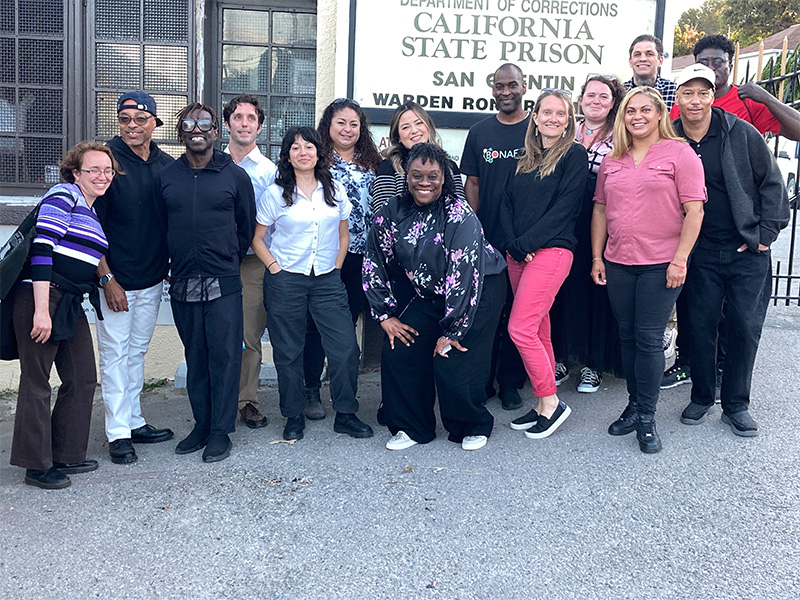
Kirsten Pickering (MTC) Tommy “Shakur” Ross (Restorative Justice for Oakland Youth) Karter Louis (California Lawyers for the Arts) Christopher Laddish (California Department of Rehabilitation) Alyssa Gomez (Reentry Success Center, Rubicon Programs) Gloribel Pastrana (Rubicon Programs) Jasmine Banuelos (Reentry Success Center, Rubicon Programs) Lakeisha Chew (California Department of Rehabilitation) David Cowan (Bonafide) Emily Harris (Ella Baker Center) Kit Berry (CROP) Jesse Foshay (CROP) Sol Mercado (Planting Justice) Corey McNeil (MTC) Forrest Jones (Project Rebound, CSU East Bay) Participating organizations not pictured: Black Men’s Wellness, Code Tenderloin, Community Works West, Just Desserts, and Prison 2 Employment.

Filed Under: MTC News

2022-2023 Faculty Appreciation Party

May 9, 2023 by Mt. Tam College

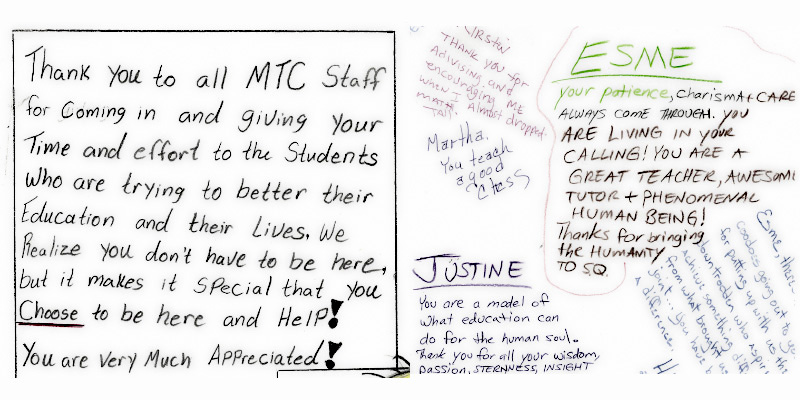
Mount Tamalpais College’s faculty appreciation party for the 2022-2023 school year was a warm, collegial event that celebrated the dedication of MTC’s community of educators. The room was filled with guests meeting, reconnecting, laughing, and exchanging ideas. Student messages to their instructors were displayed, which described courses as “life-changing” and “humanizing,” while instructors were thanked for being patient, relatable, engaging, and knowledgeable. “You are a model of what education can do for the human soul,” wrote a student. “Thank you for your wisdom, passion, sternness, insight, and stories.”  Another student shared that his class inspired him to want to become a math and science teacher himself. 

Mount Tamalpais College Faculty

Mount Tamalpais College’s all-volunteer faculty are drawn from prestigious colleges and universities around the Bay Area; their energy and dedication to their courses have a tremendous impact. Learn more about teaching at Mount Tamalpais College on our Faculty page.

Filed Under: Events, MTC News

Mount Tamalpais College President to Serve on Advisory Council Leading Historic Transformation of San Quentin State Prison

March 30, 2023 by Mt. Tam College

On March 17, 2023, at a press conference inside San Quentin State Prison, California Governor Gavin Newsom announced a historic initiative designed to turn San Quentin into “the preeminent restorative justice facility in the world.” Mount Tamalpais College President Jody Lewen has been asked to serve on the San Quentin Transformation Advisory Council, which will lead the transformation over the next several years.  “We hope that the increased attention this announcement brings to programs inside San Quentin will shine a light on the transformative experiences and unique perspectives of Mount Tamalpais College students and alumni,” said President Lewen. 

The Advisory Council will be co-chaired by former San Quentin Warden Ron Broomfield, Dr. Brie Williams, Professor of Medicine at the UCSF Center for Vulnerable Populations, and Doug Bond, Amity Foundation President and CEO. A list of Advisory Council members, which also includes two MTC alumni, can be found here.

The new model–which Governor Newsom has called The California Model–will focus on reimagining the prison and repurposing space to increase education, job training, and other programs for the approximately 3,300 people incarcerated at San Quentin. The governor is allocating $20M in his 2023-2024 budget to the plan. The announcement garnered national attention, with Mt. Tam College highlighted in the Wall Street Journal, AP News, Sacramento Bee, New York Times, and other news outlets nationwide.  

President Lewen attended the press conference alongside state legislators, service providers, advocates, currently and formerly incarcerated people, and the press. MTC alumnus Phil Melendez, who now serves as the Director of Special Projects at Smart Justice California, took to the podium, sharing how much he benefited from the programs inside San Quentin during his years of incarceration there. “I took college courses that nourished my mind, I took personal growth and accountability classes that healed and fed my soul,” he said. 

More information can be found in this press release announcing Advisory Council members. We look forward to updating our community on developments with the initiative as more information becomes available.

Filed Under: Events, MTC News

Mt. Tam College Students Face Off Against UC Santa Cruz in Ethics Bowl

March 28, 2023 by Mt. Tam College

On February 26, 2023, a team of Mount Tamalpais College students faced off against a team of UC Santa Cruz students in the College’s fourth Ethics Bowl tournament. Ethics Bowl is an intercollegiate debate tournament that models a constructive civic dialogue, with each team defending what they believe to be the best ethical approach to a particular case, rather than being assigned a pro or con position.

Teams were presented with two cases to debate: the first questioned whether or not Carolyn Bryant (nee Donham), the woman who accused Emmett Till of harassment, should be prosecuted as an accomplice in his kidnapping and murder; the second delved into the culpability and liability of a nurse who mistakenly administered the wrong drug in a hospital setting, accidentally killing a patient.  

The MTC team—Angel Alvarez, Jessie Rose, Ben Tobin, Tony de Trinidad, and Rob Tyler—prepared for the debate over the course of a semester, with coaching from faculty members Kyle Robertson, Connie Krosney, and Kathy Richards. “Bringing outside college students inside San Quentin offers MTC students the opportunity to be seen as students and fellow academics instead of inmates,” said Kathy Richards. “Ethics Bowl is also meaningful because it provides an opportunity to explore some of the most important ethical and moral issues of our time and to discuss those important issues in a civilized manner.”

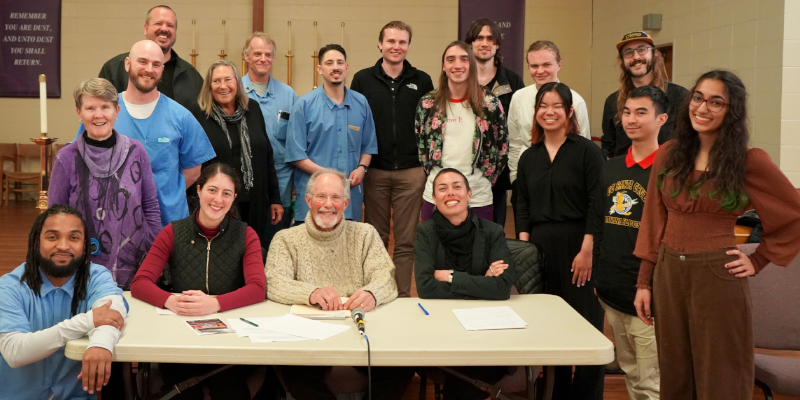
The Ethics Bowl teams with their coaches and judges

With a crowd of fifty MTC and UC Santa Cruz guests, students, and staff looking on, teams huddled to construct their argument on a particular topic, presented their response, then fielded questions from the opposing team. Launching into the first topic on Emmett Till, the MTC team argued that Carolyn Bryant should be held accountable for her role in the murder, emphasizing the racism at the core of this particular case that continues to this day. The law, they asserted, should apply equally to all, regardless of race and class, noting that Bryant’s advanced age and poor health should not excuse her from responsibility. They further argued that the notoriety of this particular case made it all the more critical that persons be held accountable, drawing a distinction between prison time and public accountability.

The UC Santa Cruz team’s response to the second question about the culpability of the nurse who mistakenly administered the wrong medicine focused on the spread of responsibility across many entities, citing the responsibility of hospital administration and pharmaceutical companies. They also raised questions about the potential impact of recruitment and retention of nurses if society begins to hold them criminally negligent for such errors. 

Judging was based on a variety of criteria, including the clarity and thoroughness of each team’s argument, the respect and awareness with which they addressed opposing views, and their responses to opposing team commentary. After eighty minutes of debate, Judges Marian Avila Breach, Eliezer Margolis, and Jeanne Proust tallied up the scores, and the Mt. Tam College team was awarded the win. This is the fourth win the MTC team has garnered against UC Santa Cruz.

Attributions: Photos courtesy of San Quentin Media.

Filed Under: Events, MTC News

California to Transform San Quentin Prison Into Center Emphasizing Inmate Rehab

March 20, 2023 by Mt. Tam College

Gov. Gavin Newsom announces plans for facility that was known for its death row

MARIN COUNTY, Calif.—California aims to turn San Quentin State Prison, one of the country’s oldest penal facilities, into a Scandinavian-style center for inmate rehabilitation that it hopes will become a new model for incarceration in America.

Gov. Gavin Newsom said Thursday the storied institution, built in 1852 on the shores of San Francisco Bay, will be renamed the San Quentin Rehabilitation Center and converted to focus on providing educational programs and other help for inmates making the transition back into society. 

“California is transforming San Quentin—the state’s most notorious prison with a dark past—into the nation’s most innovative rehabilitation facility focused on building a brighter and safer future,” the Democratic governor said.

The idea represents a sharp turn from San Quentin’s harsh history. Resembling a medieval castle, the prison has housed some of the country’s most feared criminals and serial killers, from Manson Family cult leader Charles Manson to “Night Stalker” Richard Ramirez to “Freeway Killer” William Bonin.

In its death row, the largest in the U.S., 421 prisoners have been executed—215 by hanging and the rest by gas and lethal injection, including the Crips street gang co-founder Stanley Tookie Williams III, who was put to death in 2005. One of the institution’s bloodiest days took place on Aug. 21, 1971, when six men—three inmates and three guards—died in a prison riot. 

Along the way, the prison has gained cultural significance—as the setting for the Jack London novel “The Star Rover,” about a former professor serving a life sentence, and a concert by the country singer Johnny Cash. That performance made an impression on a future country star, Merle Haggard, who was serving time following a conviction for armed robbery.

Over the past two decades or so, California prison officials have been shifting the focus of San Quentin—whose death row the governor ordered gradually shut down in 2019—to be more about rehabilitation. 

The concept of emphasizing rehabilitation more than punishment has been gaining momentum around the world. In Norway, prisons have been redesigned to look more like college campuses, while in Sweden inmates are called clients and get job training. In the U.S., states including Colorado have embraced the rehabilitation approach more.

California officials cited statistics that show rehabilitation leads to lower recidivism. According to a 2014 report by the Rand Corp., inmates who participate in correctional education programs were 43% less likely to return to prison than those who didn’t. State officials said they spend $14.5 billion a year on prisons; 3.5% of that is on rehabilitation.

“This system isn’t working for anybody,” Mr. Newsom said during a visit Friday to San Quentin during which he addressed inmates, staff and media in a former mattress factory at the prison that he said was going to be used to house expanded education and help programs. “We have got to recognize that.”

With inmates in blue prison garb applauding his remarks, the upbeat mood was a contrast from the grim surroundings of the facility, where guards sit in towers and razor wire lines the walls. Media were let in through old iron doors and had to pass through several security checkpoints before arriving at the 81,000-square-foot factory, which has been closed for years.

Some said San Quentin is so old it would make better sense to tear it down and sell off the property, which lies on one of the last undeveloped stretches of San Francisco Bay in affluent Marin County. 

“To throw more money at that prison seems crazy,” said Michael Rushford, president of Criminal Justice Legal Foundation, a victims’ advocacy group in Sacramento, Calif.

Marcus Robinson, senior marketing consultant for Coldwell Banker Realty in Mill Valley, Calif., said that San Quentin’s presence reduces by as much as 50% the number of prospective buyers for multimillion-dollar homes in nearby Tiburon within its view. 

“I don’t know one person who wants to keep that prison in Marin County,” Mr. Robinson said.

Mr. Newsom said he and his staff considered closing San Quentin for cost reasons, but dismissed such a move because the prison already is a leader in rehabilitation in the state and benefits by its proximity to so many education programs and volunteers in the Bay Area. 

“Had we shut it down, we would have fallen backwards,” the governor said.

San Quentin’s death row still housed more than 500 inmates as of the fourth quarter of last year, as the state, which hasn’t executed an inmate since 2006, moves them out of the facility.

Inmates considered less dangerous now experience a different type of incarceration. Rehabilitation has become a stronger focus at the prison over the past two decades or so, with a newspaper, film center and even podcast station started over that time. 

When he transferred to San Quentin about 10 years ago following a stay at a higher-security prison, Eddie Herena couldn’t believe his good fortune. “During the day, it felt like a college campus,” said Mr. Herena, 39, who was paroled in 2018 after serving eight years for second-degree murder. “You get reminded you are in jail when you get locked in at night.”

Mr. Herena is now a photographer, a skill he honed while working on the prison newspaper, the San Quentin News.

Kate McQueen, an editor of the nonprofit Prison Journalism Project who volunteers at the paper, said inmates at San Quentin are always busy when she arrives. “There’s a very large yard, and you can see all sorts of people playing their instruments, working out,” Ms. McQueen said. “It’s a place where people incarcerated get to interact with people from the outside world.”

The governor’s new plan for San Quentin, which he aims to kick-start with $20 million in this year’s state budget, should boost enrollment of inmates at Mount Tamalpais College, a two-year program that now serves about 300 of the prison’s 3,300 inmates, said Jody Lewen, president of the liberal-arts school. 

The prison’s current three classes in software coding and one in audiovisual engineering, which now serve 60 students, should also be expanded, said Sydney Heller, executive director of Last Mile, a nonprofit that puts them on.

Steve Brooks, who has served 29 years for crimes including robbery and burglary, said he hopes to get a job in journalism after earning two associate of arts degrees and working as the editor of the San Quentin News while in custody. 

“It’s helped me learn how to become part of communities,” said Mr. Brooks, 51, who showed visitors around a newsroom with desktop computers in a former prison laundry.

Andrew Hardy, who is scheduled for release in 10 months after serving seven years for second-degree robbery, said it was in society’s interest for him not to commit any more crimes.

“I think the governor is honoring victims to get us prepared so there won’t be more victims,” said Mr. Hardy, 43, as he prepared the layout for next month’s San Quentin News.

Write to Jim Carlton at Jim.Carlton@wsj.com

Attributions: This article originally appeared in The Wall Street Journal on March 17, 2023. Photo courtesy of R.J. Lozada.

Filed Under: Current Affairs, MTC in the News, MTC News

Deported to a Country You Can’t Remember

March 13, 2023 by Mt. Tam College

The Biden administration sent Phoeun You, a former child refugee, to Cambodia after more than four decades in the US. Governor Gavin Newsom has the power to bring him back

Over a video call, Phoeun You showed me the nighttime view from his balcony: The soft glow of street lamps lit up a line of low-rise buildings and a snarl of electric cables. He was calling from Sen Sok, a fast-modernizing district in Phnom Penh, Cambodia. It was a beautiful sight; but I was distracted by the bittersweet tone of his voice. It had only been three months since the US Immigration and Customs Enforcement deported Phoeun You, 49, to Cambodia. He was granted parole from California’s San Quentin State Prison in August 2021. He’s free, but he can’t return to the only home he remembers.

Phoeun You, a former Cambodian child refugee, served more than 25 years for murder. In 1995, when Phoeun You was 20, he killed a 17-year-old while trying to shoot someone else in retaliation for hurting his family. Less than 24 hours before he was due to be paroled and reunited with his family, Phoeun You said, he was transferred by the California Department of Corrections and Rehabilitation to an ICE detention facility, where he spent several months in limbo before being deported without warning.

During his incarceration, he got an associate’s degree, became a certified crisis counselor, and was a reporter for the San Quentin News, an inmate-produced newspaper. It was there in 2014 that we met; I was a volunteer editor for the paper for two semesters while studying at the University of California, Berkeley.

Sitting at his desk in Phnom Penh, Phoeun You appeared the same as I’d remembered: a man of small-to-medium build with a shaved head, several tattoos, and a disarming smile that crinkled his eyes. After answering his questions about my life and journalism, I asked him how he was adjusting to Cambodia and freedom. He replied, “It was rough when I first landed. So many pieces [of life in the United States] are unfinished. I didn’t get to say goodbye to my family, and that was devastating. And even though I know I’m free, for the first month I didn’t leave the house. Even buying groceries was overwhelming. The world was strange to me: I don’t know the language, culture. I was shell-shocked.”

Phoeun You was 4 years old when he fled the Khmer Rouge in 1975 with his parents, grandmother, and nine siblings. He recalled his father, a village doctor, carrying him in a sling on his back as the family struggled for days on foot to reach the Thai border. His memories of their escape from Cambodia are murky, but there are snapshots: the smell of wildfire, lost children crying for their families, a man lying beside a tree with his mouth open, lifeless.

After reaching Thailand, the Yous spent a few years at a refugee camp before relocating to Utah in 1980 to live with a Mormon family who took them in as part of a church program. Roughly five years later, the family settled in Long Beach, Calif., after hearing that a growing Cambodian community was being established there. It was meant to be a fresh start. Long Beach was supposed to be a place for them to build a new life and heal alongside other Cambodians.

At the time, Phouen You and his family were among the nearly 158,000 Cambodians, mostly refugees, who resettled in the United States between 1975 and 1994. The number of refugees who fled Cambodia, Vietnam, and Laos totaled 1.1 million, making it the largest mass refugee resettlement in US history.

But the country wasn’t prepared to receive them. Refugees from Southeast Asia were resettled “ad hoc” and “scattered across isolated areas in the US,” according to a report from the Southeast Asia Resource Action Center (SEARAC), a US advocacy group founded in 1979 to respond to the refugee crisis.

Volunteer organizations tasked with helping the refugees weren’t given clear instructions on how to support them beyond greeting them upon arrival, matching families with sponsors—as was the case with Phoeun You’s family—or occasionally providing one-time cash assistance, according to SEARAC.

Left to fend for themselves, many families slipped into poverty. Among Cambodians like the Yous who arrived during or shortly after the fall of the Khmer Rouge, only 40 to 50 percent were able to secure blue-collar jobs. The rest, including Phoeun You’s family, relied on welfare and public assistance.

In the years that followed, the family lived paycheck to paycheck and changed houses with every rental increase—at least 10 times. Living with at least 15 family members at any given time in a three-to-four bedroom house, Phoeun You sometimes had to sleep on the living-room floor. Food and clothing was scarce. But beyond finances, the Yous found themselves culturally ill-equipped to navigate inner-city life in Long Beach, which had an ethnically diverse population and a growing crime rate.

During the first five years that the family lived there, the number of violent crimes jumped from over 4,000 to more than 9,000. Phoeun You remembers being scared by the constant sound of gunfire and sirens as he walked home from school. On the streets and at school, racism and discrimination were rampant.

Gang violence was also a growing menace. In 1986, the year Phoeun You turned 13, Long Beach reported its largest annual increase in crime in the past five years. By 1989, it was recording the biggest jump in serious crimes of any major Californian city, with police blaming the trend on an influx of gangs from Los Angeles. More than 30 percent of murders were related to drugs or gangs, which would grow to encompass 70 street groups, totaling about 11,500 members, according to the Los Angeles Times.

When he was 13, Phoeun You joined a gang that his brother was involved with. The gang gave him a sense of acceptance, safety, and belonging—all things he lacked and craved. He began cutting school, drinking, and experimenting with drugs.

When he was 16, a rival gang shot up his house two nights in a row, in retaliation for his brother’s shooting one of their members. No one was hurt, but a bullet that passed through the door nearly hit Phoeun You’s sister, who was pregnant at the time. A year later, his brother was hospitalized after the rival gang shot him eight times.

Reflecting on his childhood now, Phoeun You said it was only a matter of time until things went terribly wrong. That moment came on March 23, 1995, when he shot into a crowd of what he believed at the time to be gang members who had assaulted him and his teenage nephew the day before. Instead, he killed an innocent 17-year-old boy and injured four others. In 1996, a jury convicted Phoeun You, 20, of first-degree murder, and he received a prison sentence of 35 years to life.

Phoeun You’s incarceration came during a prison boom, resulting from the period’s “tough on crime” policies. During the 1990s, the population of Asian American and Pacific Islanders (AAPI) in prison rose by 250 percent, according to a report by SEARAC and others. Between 1977 and 1997, arrests of AAPI youth catapulted by 726 percent, and Asian juveniles in California were twice as likely to be tried as adults as their white counterparts.

The US also underwent sweeping immigration reforms in 1996, with President Bill Clinton signing into law the Illegal Immigration Reform and Immigrant Responsibility Act and the Antiterrorism and Effective Death Penalty Act—measures that dramatically broadened the range of people vulnerable to deportation. The reforms included a retroactive expansion of the types of crimes classified as “aggravated felonies”—a conviction that could lead to deportation—to include a variety of less-serious crimes with shorter prison sentences, and the removal of the right for noncitizens to appear before an immigration judge to challenge their deportation.

Since 1998, more than 17,000 Southeast Asians—many of whom, like Phoeun You, arrived as refugees and have green cards—have received final orders of deportation, according to SEARAC. But of these, some 15,000 Southeast Asians are still residing in the country, and ICE could deport them at any moment. About 80 percent of the orders given to Southeast Asians are based on old criminal convictions, which account for roughly 17 percent of all final orders of removal.

According to statistics collected by SEARAC, 3,106 Cambodians were given deportation orders and 1,067 deported between 1998 and 2020.

Despite being eligible for naturalization, most refugees had limited resources to pursue citizenship and were unaware that failing to do so could render them subject to deportation if they were convicted of a crime. By the time the rest of Phoeun You’s family applied for and gained citizenship, both he and his brother were already incarcerated. Under US law, those convicted of murder or an aggravated felony on or after November 29, 1990, are permanently barred from naturalization.

Deportees with aggravated felonies are also permanently banned from returning to the US, said So Young Lee, an immigrant rights attorney at the Advancing Justice-Asian Law Caucus who represents Phoeun You. While people with other aggravated felonies can apply for a waiver, those who have been convicted of murder do not have that option, she added.

While deportations were briefly halted in 2017 when the Cambodian government refused to issue travel documents for deportees, they resumed a few months later after the Trump administration responded by imposing visa sanctions on Cambodian foreign ministry officials. Cambodia has repeatedly urged the US to amend its 2002 repatriation agreement on “humanitarian” grounds, most recently at a meeting with President Joe Biden at the ASEAN Summit in November.

Bill Ong Hing, professor of law and migration studies at the University of San Francisco, told me that there are two ways to fight against a deportation order, but both have limited chances of success. One is to overturn or set aside the original conviction through the judicial system; the other is advocating for a pardon from a governor.

“I started doing immigration law in 1974 and represented many who had committed serious crimes. But back then, you could ask for a waiver [of deportation]. That’s what ought to be reinstated: a chance for a judge to assess the person’s situation and see if they deserve a chance,” Hing said. “I’ve always thought we’re [part of] a society that believes in rehabilitation. It’s a disappointment.”

Prison rehabilitation programs were the lifeline that saved Phoeun You, but it didn’t happen right away, he said. For the first seven years of his incarceration, he was trapped in a cycle of depression. Faced with a life sentence, he didn’t believe he could ever reunite with his family, and gave up on having a meaningful life. He would frequently pick fights with inmates and use drugs and alcohol as a means of escape.

But in 2003, everything changed. Phoeun You received the news that his sister had been killed—a jealous boyfriend had shot her and left her to die in a parking lot.

“I automatically went into shock. It was the first time I cried during my whole prison sentence,” Phoeun You said. “After soaking in that pain, I started reflecting on my parents and how they must be feeling. Then finally, I started thinking about the pain I might have caused my victim’s family. That was my first seed of empathy.”

The tragedy of his sister’s death became the catalyst for him to come to terms with the crime he had committed, and eventually embark on his journey of rehabilitation.

By the time we met in San Quentin, Phoeun You had cofounded ROOTS, or Restoring Our Original True Selves—a restorative justice program that helps AAPI inmates address intergenerational trauma. He was also writing personal essays reflecting on his crime for San Quentin News.

I remember sitting next to him on a Saturday afternoon, reading a story he wrote about a man in a car shooting a child on his way home from school. It ended with a vivid scene of the boy lying in a hospital bed, realizing that he was about to die. “I wrote that from the perspective of my victim,” I recall him casually saying, in between edits.

My first reaction was disbelief. It didn’t seem possible that the person sitting in front of me, whom I knew to be incredibly warm and compassionate, could have committed such a terrible crime. Looking back, I now credit the time we spent working together for helping me understand the extent to which people are capable of reform, if they’re given an opportunity and safe space to do so.

Unfortunately, it’s a belief that remains difficult to accept. Attempts to stop the practice of “double punishment” have stalled both federally and on the state level, including in California. Last September, a bill called the VISION Act, which would have blocked Californian jails and prisons from transferring noncitizens to immigration authorities, fell three votes short of passing in the state Senate. According to Mandy Diêc, SEARAC’s California deputy director, opposition from police chiefs played a “big role” in shifting support from the bill, which is now being redrafted to target people more narrowly.

The act could have prevented Phoeun You’s deportation; it could have given him a chance to reunite with his family and community upon release. “A few senators said they were on board until the day of—then they just didn’t step up. It was sad to see,” he said. “If it had passed, I would have been able to seek freedom or at least fought my case and said goodbye to my parents.”

Despite these setbacks, Kham Moua, national deputy director at SEARAC, said he has witnessed more political support for this issue since the end of the Trump administration. In recent years, SEARAC has supported the introduction of the New Way Forward Act, which would roll back harmful immigration policies, and the Southeast Asia Deportation Relief Act aiming to limit deportations from the community.

“I think the current administration has been sympathetic to this community. When you really think about it, it’s really us making sure that the refugees we brought in are able to stay with their families,” Moua told me.

Moua added that growing awareness of anti-Asian hate and a recent strengthening of Asian American identity has helped bring attention to the plight of Southeast Asians, which is often subsumed by other issues.

“Oftentimes we think about the US role in Vietnam, but there isn’t a strong understanding of how the US impacted the entire region, such as our role in the Cambodian genocide,” Moua said. Between 1965 and 1973, the US launched a secret bombing campaign in Cambodia that killed an estimated 50,000 to 150,000 people—creating conditions that historians say gave rise to the Khmer Rouge. “We tore a lot of these families apart, and we’re doing it again when we’re deporting them.”

In late February, I called Phoeun You again. He was standing on his balcony, but this time in the warm afternoon sun, where he often spends a few peaceful moments watching life unfold on the streets below. He’s still learning to adjust, he said, but he can now buy his groceries with ease and feels ready to face new challenges head-on.

He told me he hasn’t given up on returning home. He is campaigning for California Governor Gavin Newsom to grant him a pardon. There is some hope: Last year, deportee Sophea Phea, who spent 11 years in Cambodia, was able to return through a 2020 pardon she gained through years of community and legal advocacy efforts.

Even while abroad, he has continued to support Californian communities through speaking out about the prison-to-deportation pipeline and running workshops on restorative justice. He’s also training to become a certified teacher in hopes of using his skills to help Cambodian children, and participating in local service projects such as a walk to raise funds for cancer treatment.

Moving forward, he wants to focus on healing from his trauma and supporting his family. Since his arrival in Cambodia, he’s had the opportunity to visit some relatives and begin the process of unpacking the more painful aspects of his family’s past. Such conversations were never possible when he was growing up because his family was always struggling to simply survive, let alone reflect on their trauma, he said. “I want to give back. I want to make sure my family knows I’m sorry for the pain I’ve caused. It’s been a lot to hold for me, and for them. Now, everybody is climbing out of that darkness.”

Attributions: This article originally appeared in The Nation on March 10, 2023. Photo courtesy of Joyce Xi and Phoeun You with Advancing Justice-Asian Law Caucus.

Filed Under: MTC News

  • « Go to Previous Page
  • Page 1
  • Page 2
  • Page 3
  • Page 4
  • Page 5
  • Page 6
  • Interim pages omitted …
  • Page 11
  • Go to Next Page »
mtc seal

Contact Us

PO Box 492
San Quentin, CA 94964
(415) 455-8088


Please note: Prior to September 2020, Mount Tamalpais College was known as the Prison University Project and operated as an extension site of Patten University.


Tax ID number (EIN): 20-5606926

Quick Links

CONTACT US
CAREERS
PRESS KIT
ACCREDITATION
PUBLICATIONS
DONATE


Join Our Mailing List

© 2026 | Mount Tamalpais College | Photography by RJ Lozada | Design & Development by //DESIGN AGENCY//

  • About
    ▼
    • Mission & Values
    • Staff & Board
    • Accreditation & Institutional Research
    • Careers
  • Academics
    ▼
    • Admissions
    • AA Degree
    • College Prep
    • Faculty
    • Apply To Teach
  • Students & Alumni
    ▼
    • Students
    • Alumni
    • OpenLine Literary Journal
  • Resources
    ▼
    • Practitioner Support
    • Resources for Incarcerated Students
    • Research on Prison Higher Education
  • News
    ▼
    • Top MTC Stories
    • Recent Press
    • From the President
    • Commencement
    • 2026 Gala
  • Give to MTC
    ▼
    • Donate
    • Shop