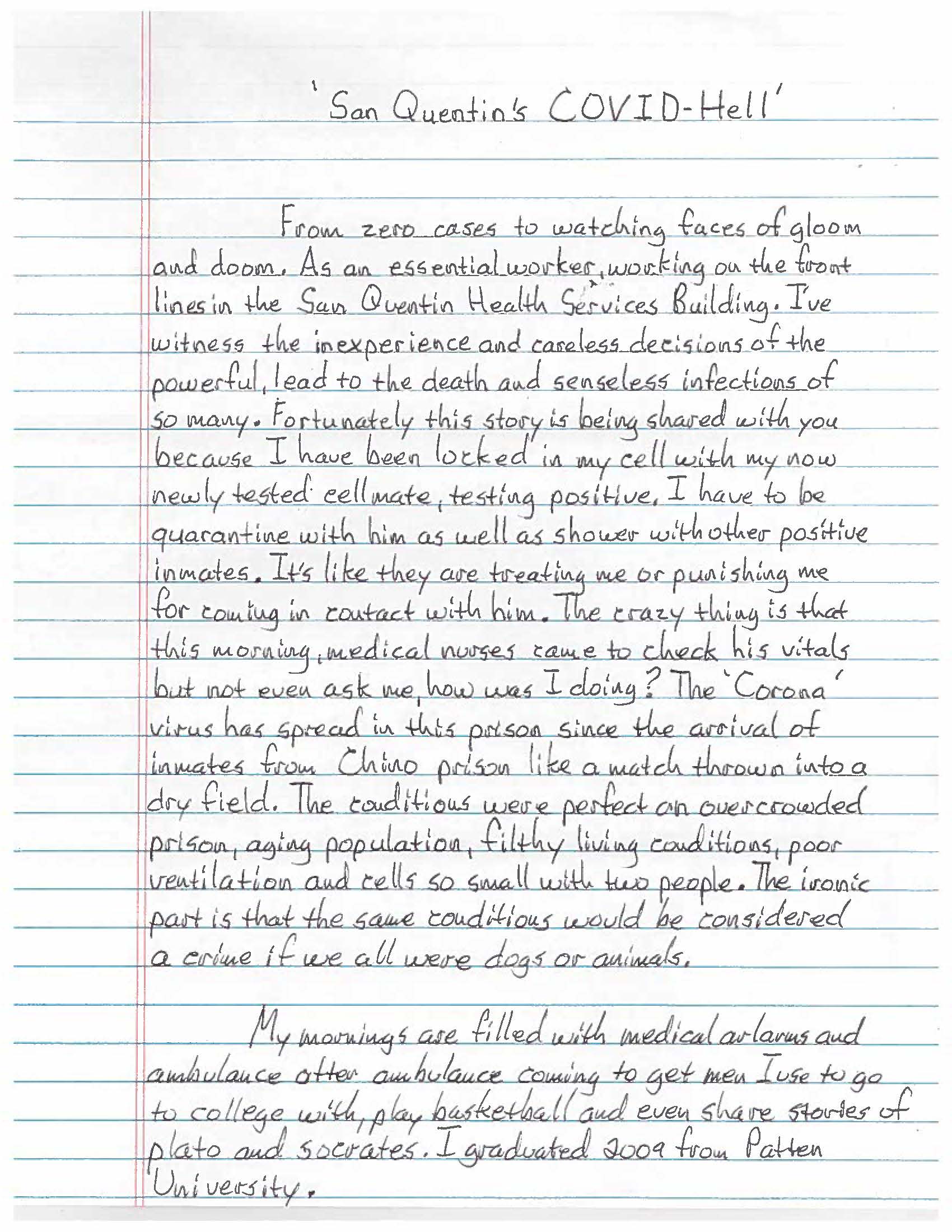
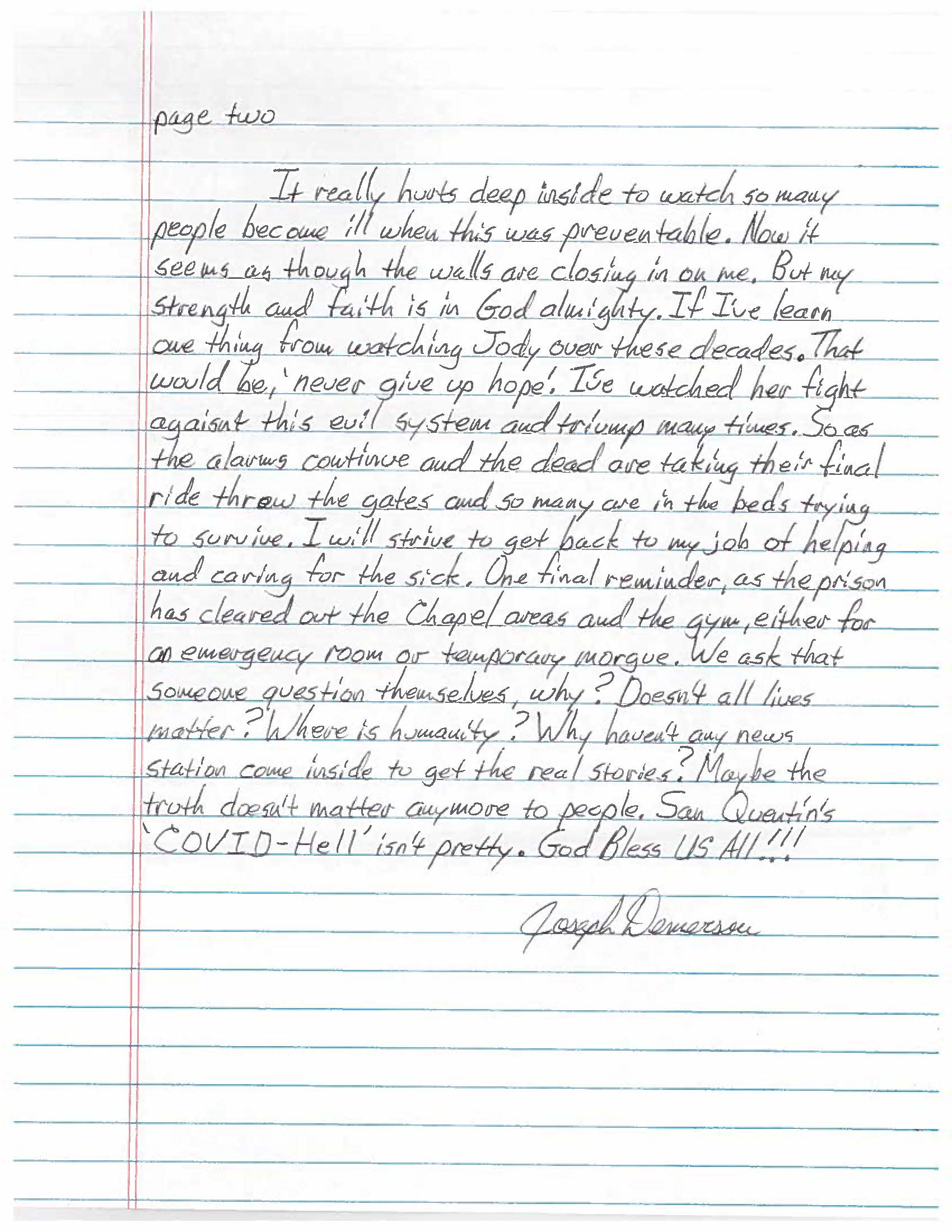
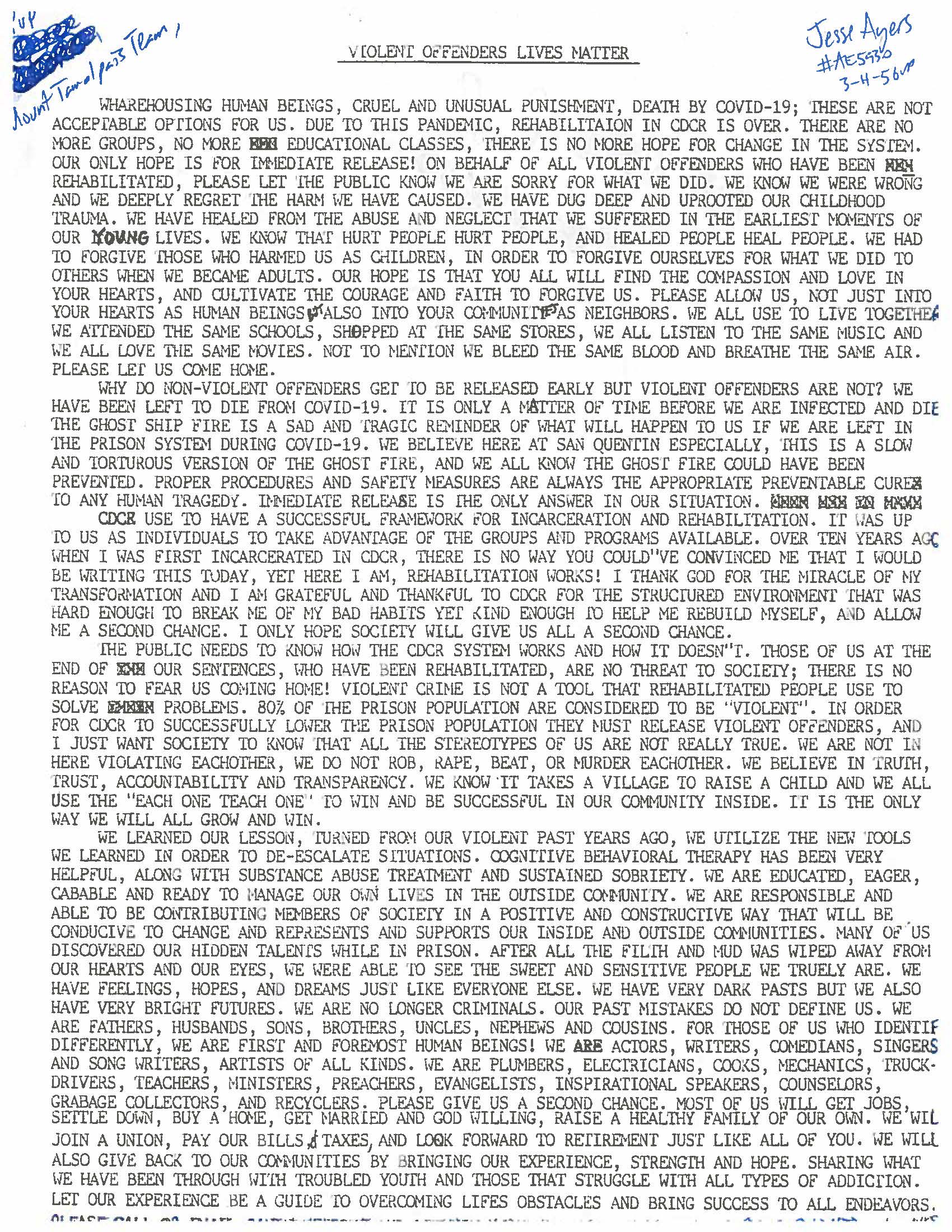
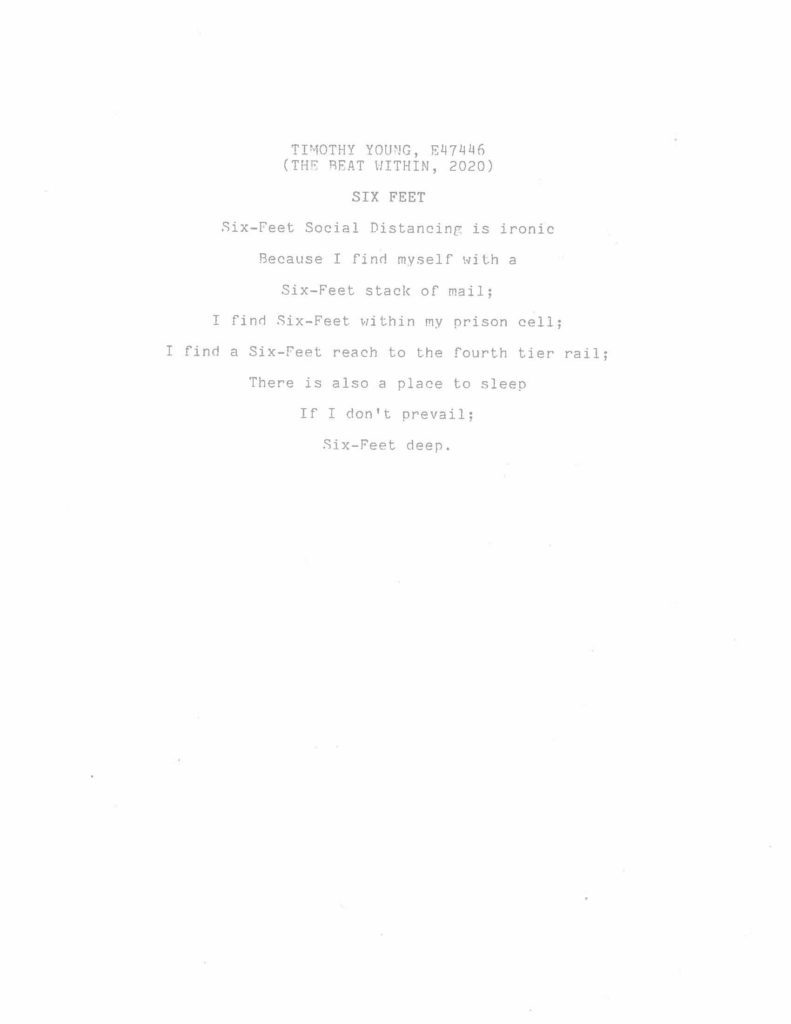
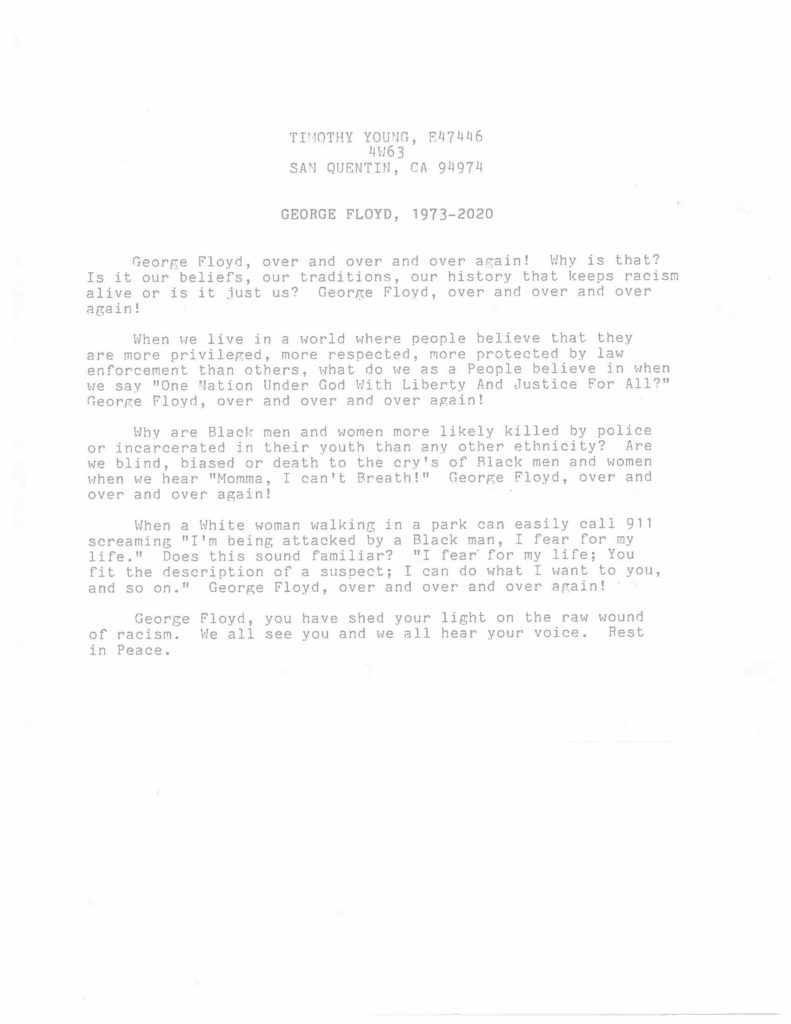
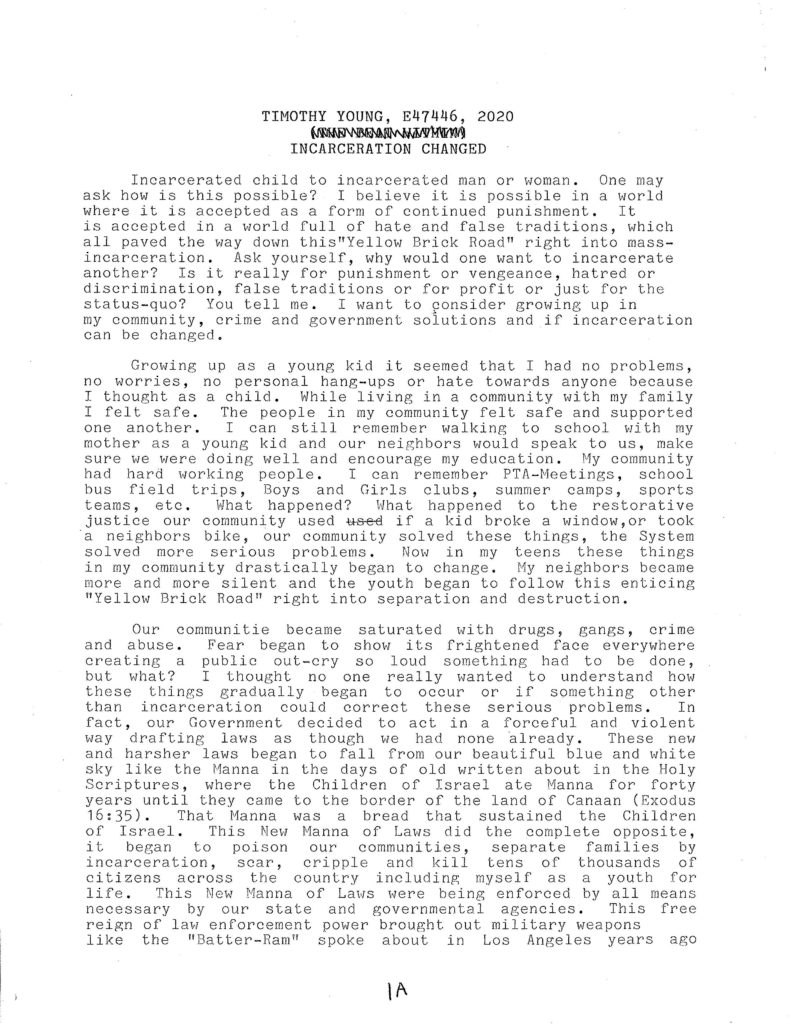
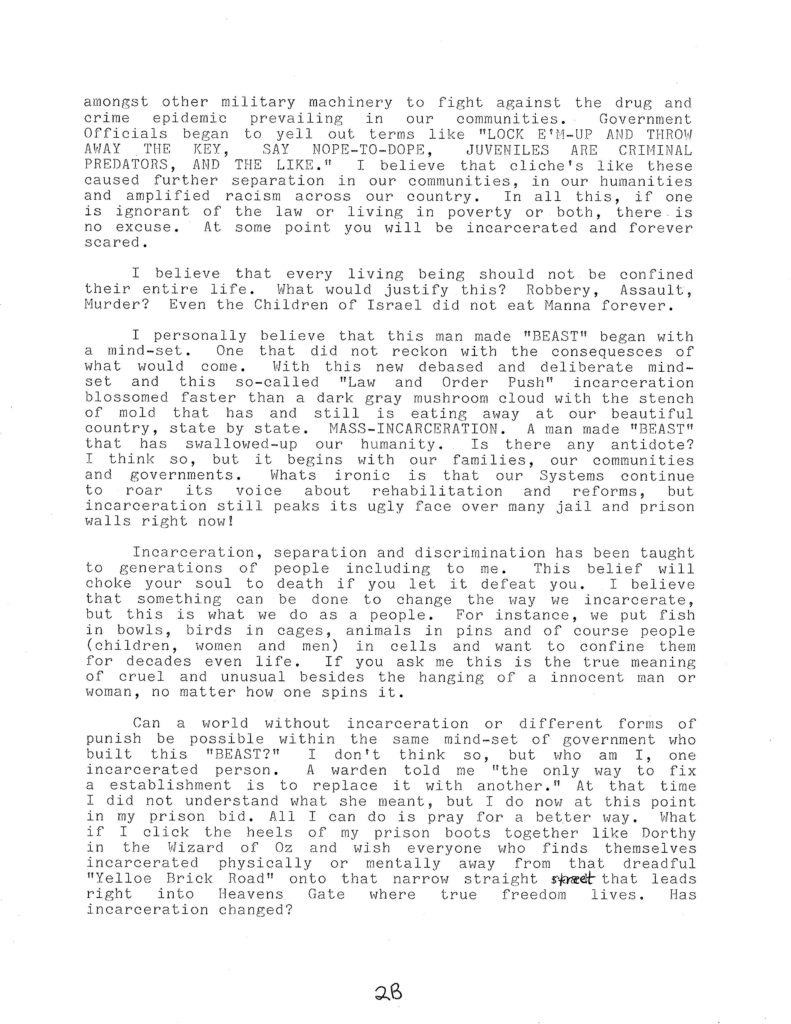
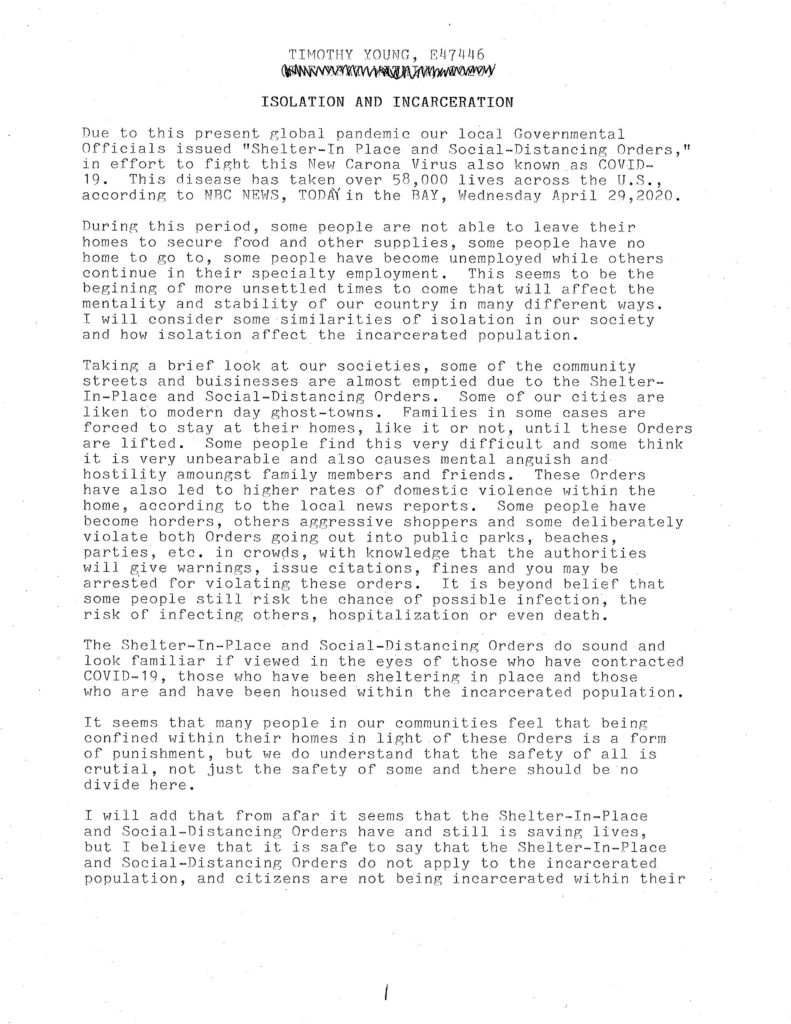
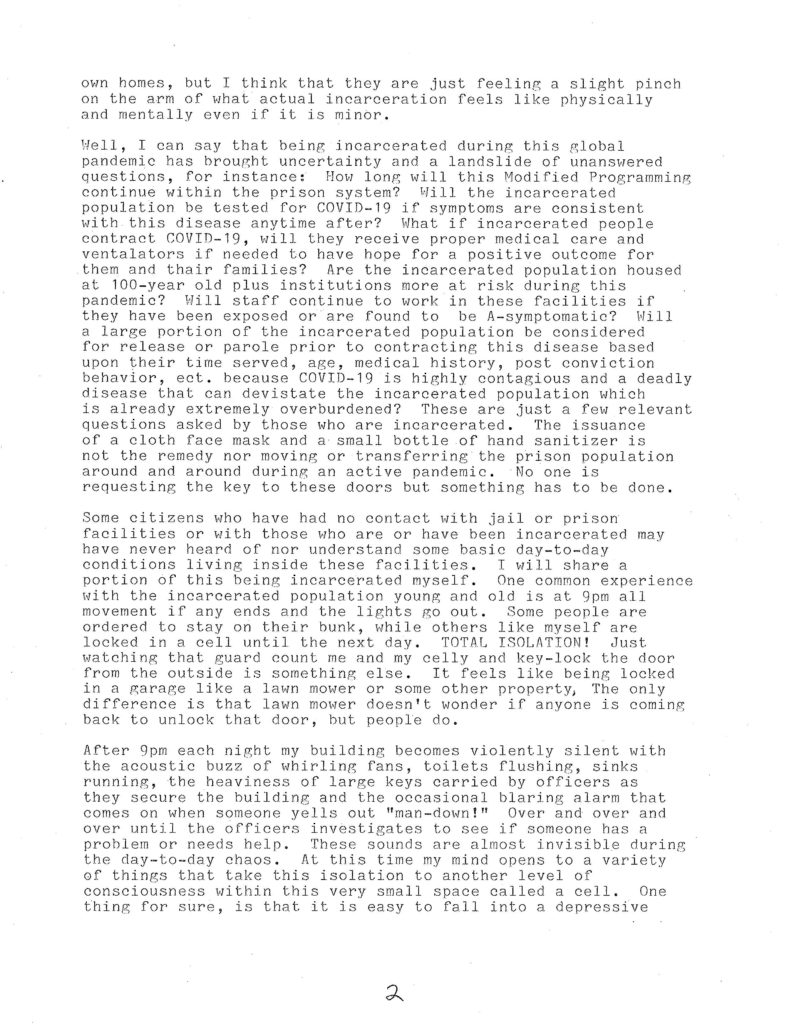
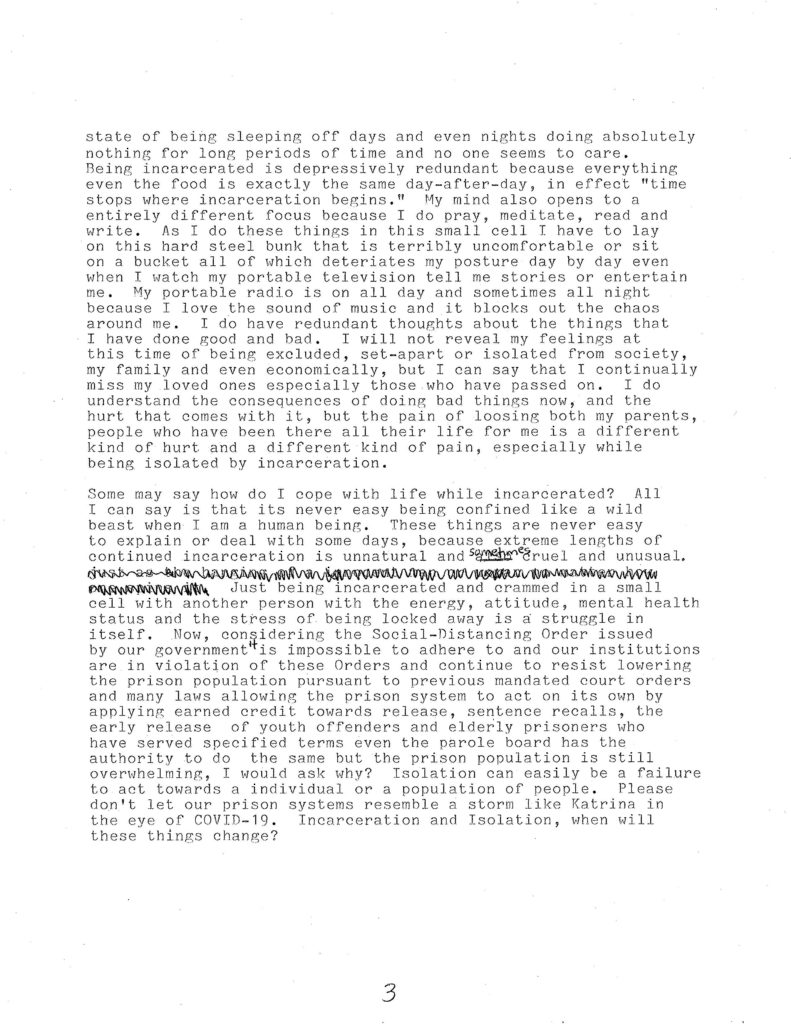
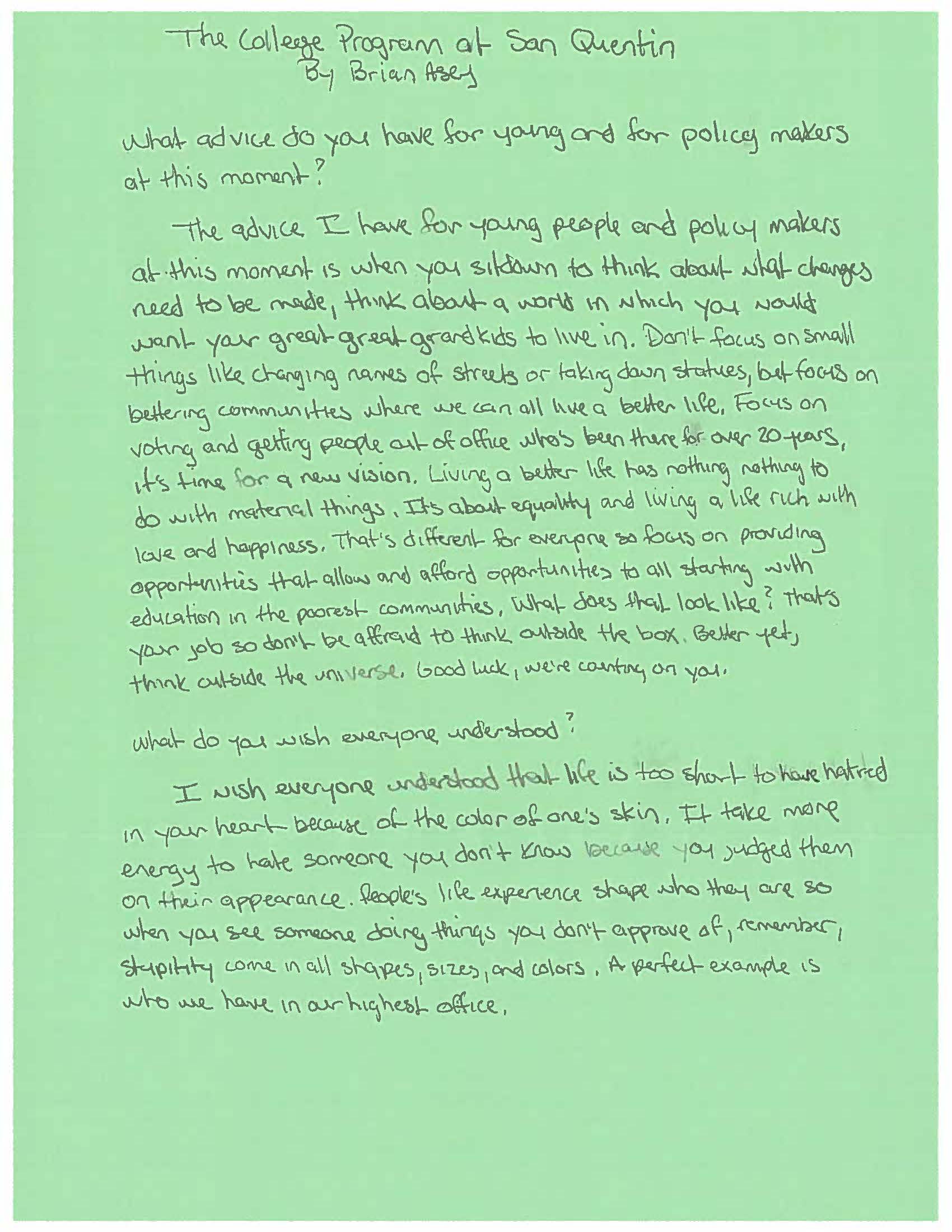
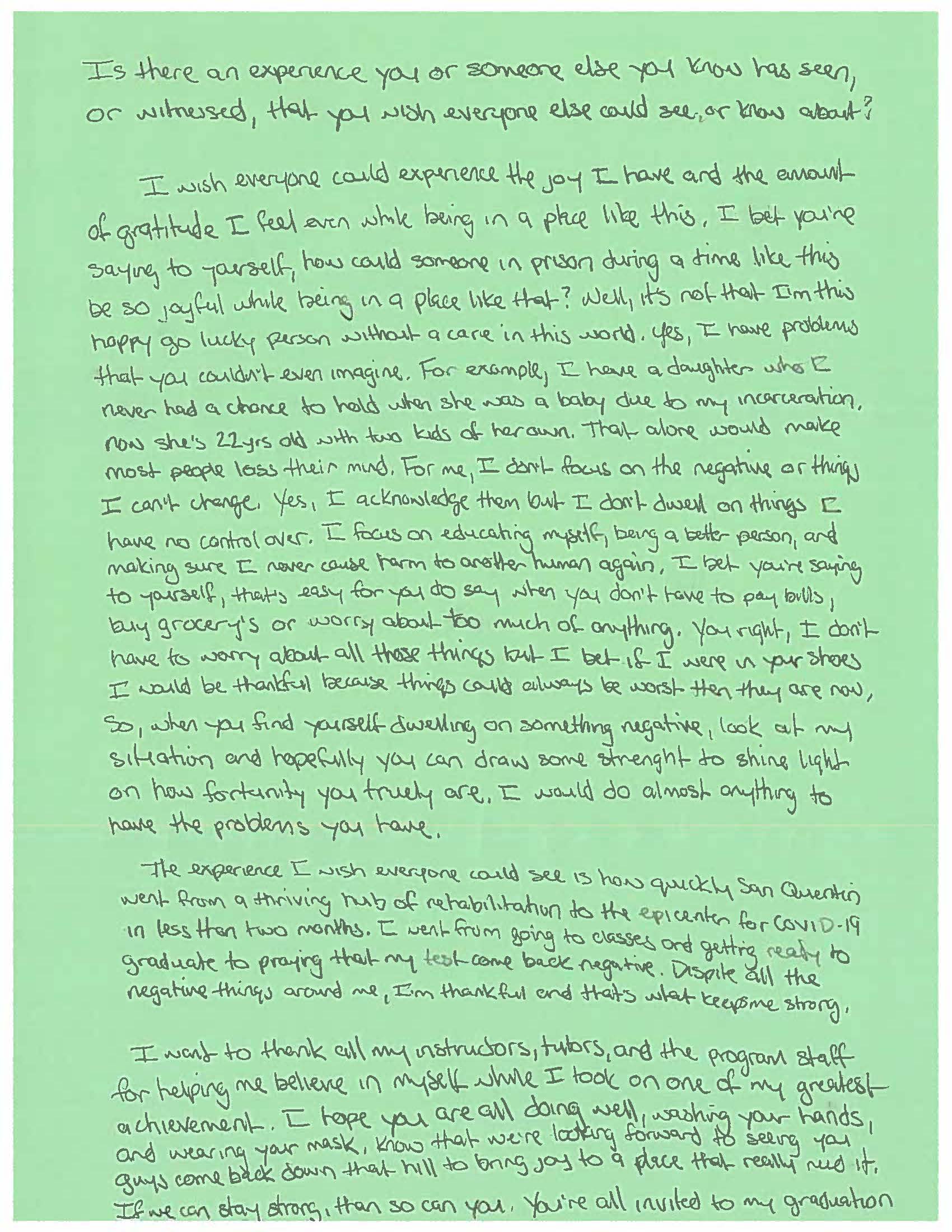
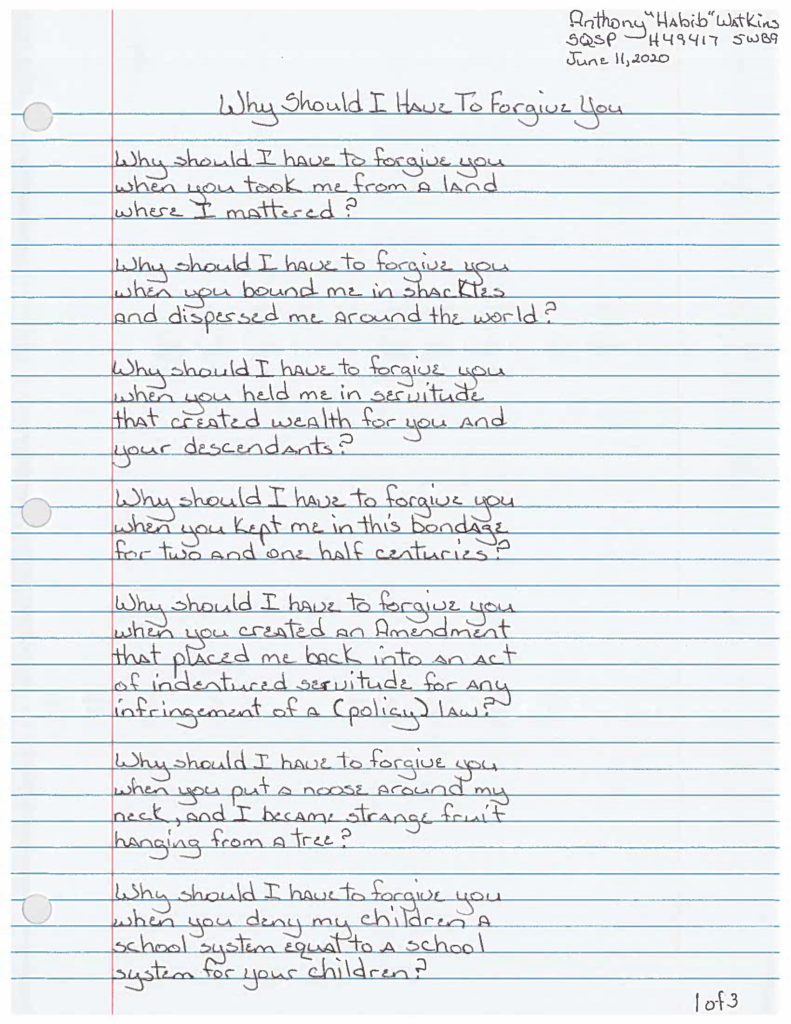
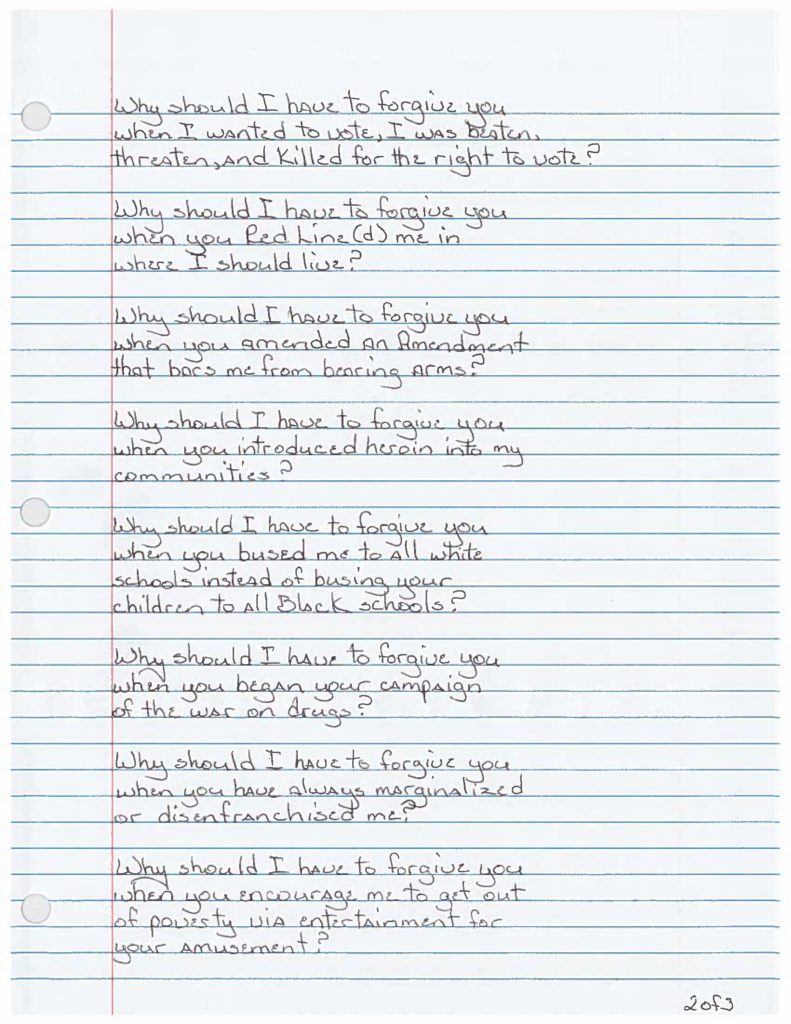
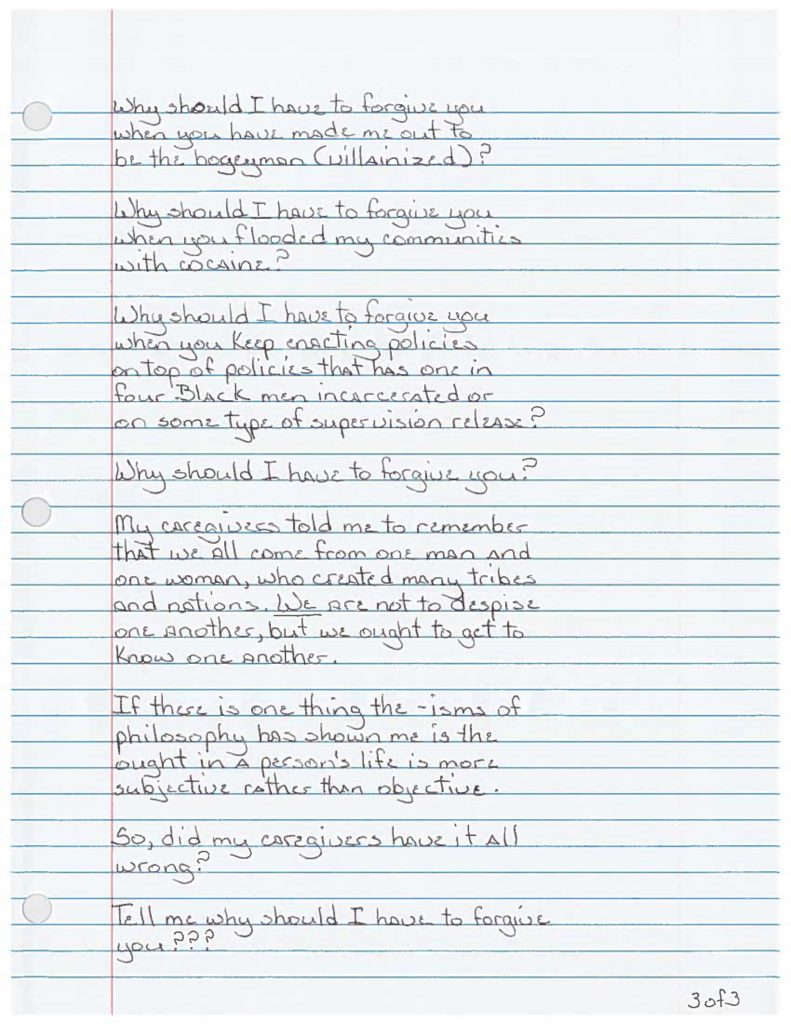
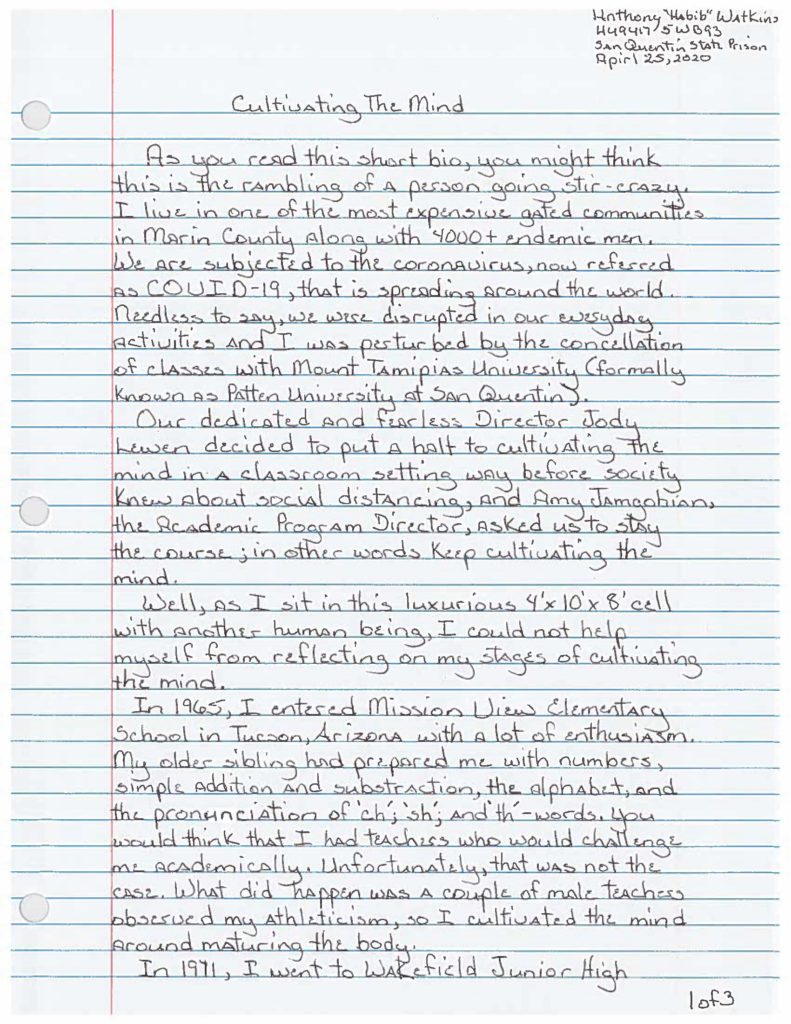
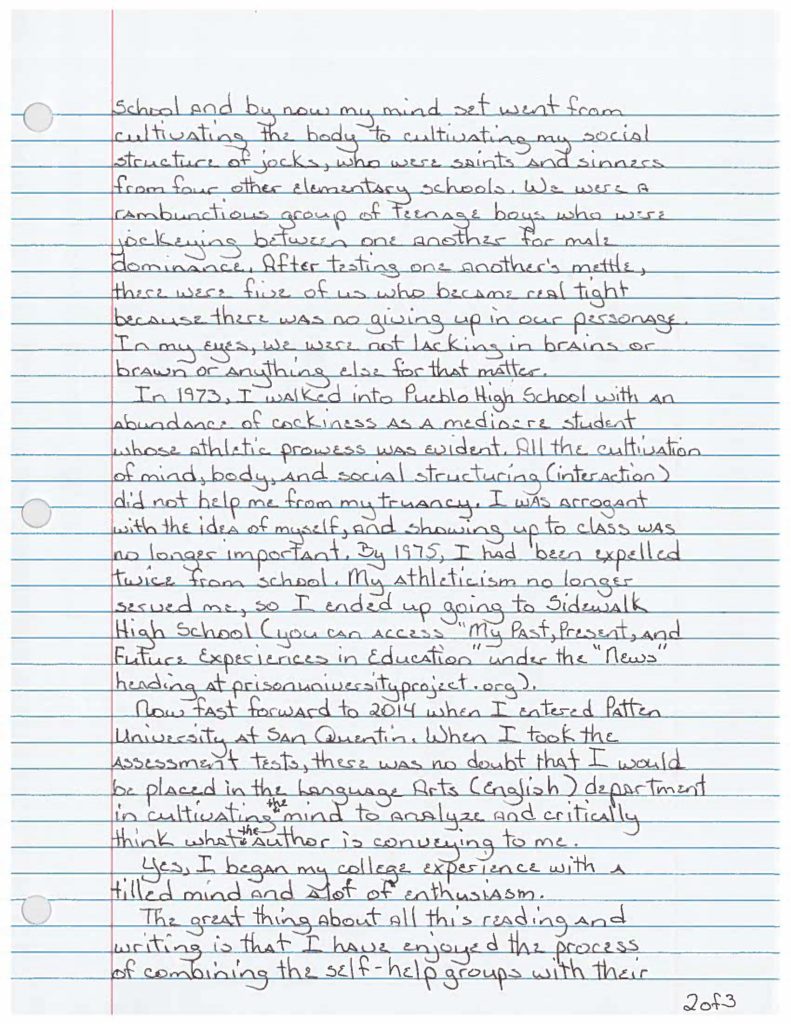
Below is a collection of poetry and prose sent by student Timothy Young from San Quentin during the COVID-19 crisis.
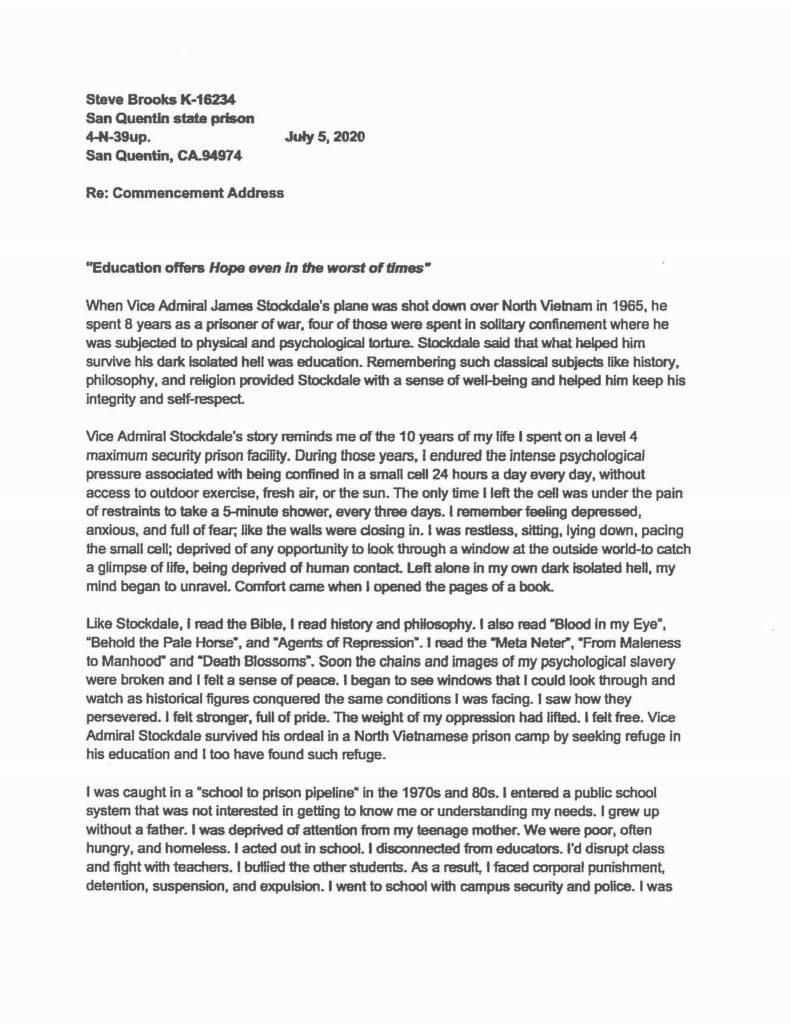
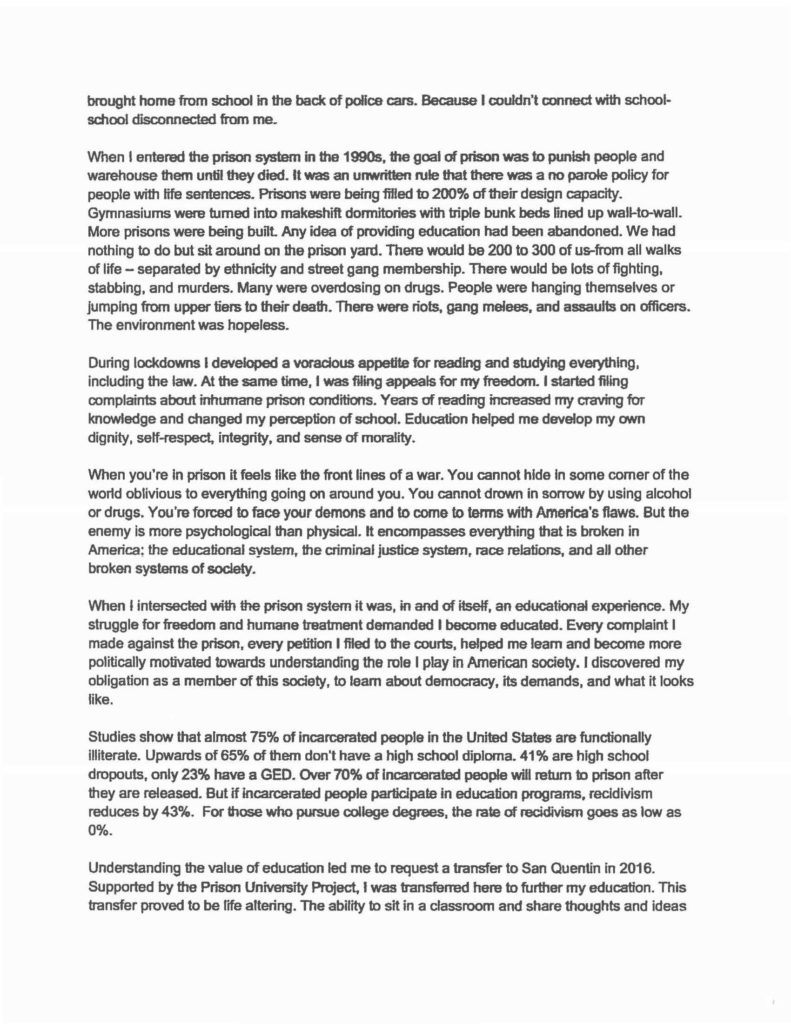
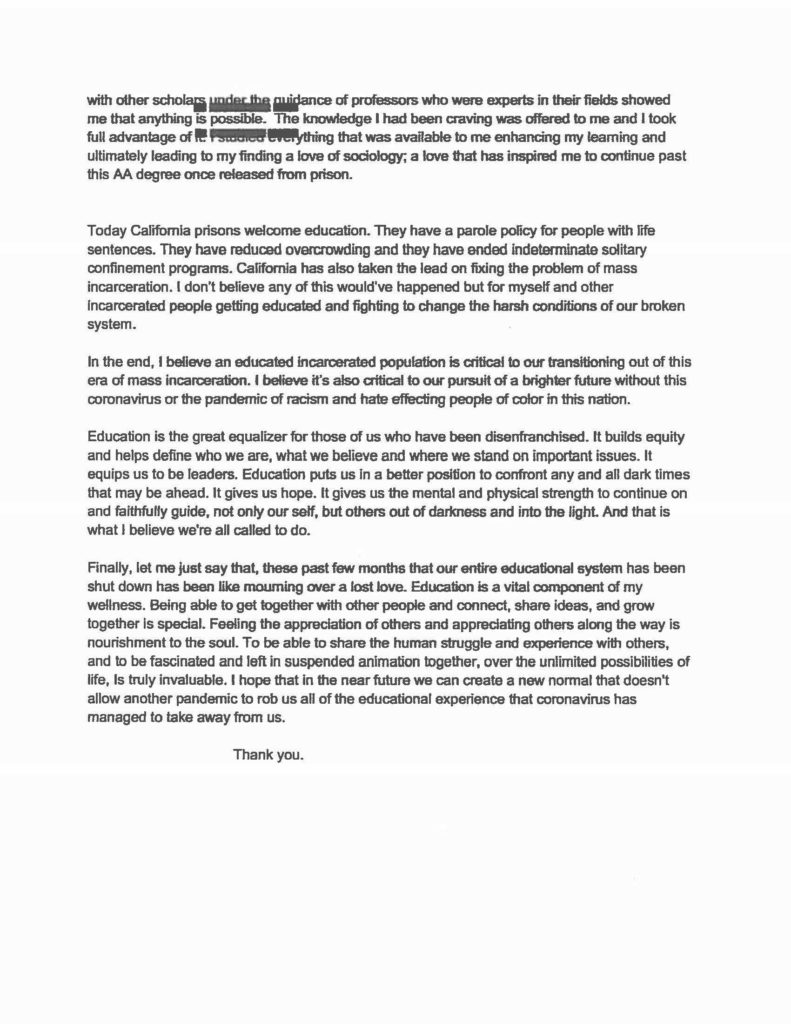
We had to cancel commencement last month due to COVID-19, so we invited our graduates to draft their own commencement addresses. Below is Steve Brooks’s speech on the importance of education.
Published in the November 2019 newsletter, which you can read in its entirety here.
In 2017 I graduated from the College Program with a GPA of 3.22. Thereafter, I found myself involved with the teaching assistant program because I desired to give back to a community that has given me, and others like me, so much. My pursuit of higher education has given me insight into the illiteracy and learning disabilities that once arrested my mental and educational development, which resulted in me succumbing to the psyche of the streets, crime, and gang subcultures of society.
During my 25 years of incarceration, I’ve witnessed thousands of juvenile men of color who entered the prison system, as I did at 16, and came from a subculture that gave them the same thing it gave me: the generational inheritance of being psychologically enslaved to a mindset of the sociopath and psychopath.
This antisocial behavior that clouds over the subcultures of our society ignites within me a passion to strive for positive change—not just for myself, but for all who are affected by a system that dishonors and devalues human life and its right to thrive healthy and happy.
Becoming a teaching assistant and tutor has allowed me the opportunity not only to assist new students in their education, but also to have a platform to create positive dialogue to challenge the mindset of men who hold dear to antisocial behavior. It is through higher education endeavors and my passion for positive change that I seek to obtain my BA and master’s in juvenile justice and counseling.
My experience and observations as a student and teaching assistant have given me the ability to recognize new students’ strong and weak points in their learning skills, and have given me the opportunity to be a living example for new students to see what higher education can achieve. It is important that incarcerated students witness men, like them, incarcerated, who have achieved their college degrees, and are now displaying their educational transformation in the form of a civil servant, with a genuine heart to give back to the community.
Please note that the Prison University Project became Mount Tamalpais College in September 2020.
Published in the November 2019 newsletter, which you can read in its entirety here.
Being incarcerated is physically and mentally stressful enough, even for a young, able-bodied person, but for someone older, the challenges are even more intense. When I invited Peter Bergne to write for this newsletter about the experience of being incarcerated while an elderly person, I imagined he would write about the vulnerability to abuse or exploitation, the sense of social isolation, challenges of accessing medical care, lack of appropriate toiletries, poor nutrition, sleeping on a bad mattress with older bones, or the fear of being involuntarily moved to another prison with far fewer programs due to one’s physical limitations. Instead he wrote a very personal account of what it is like to be repeatedly denied parole. My immediate reaction was to think he’d veered off topic, so I asked him to write some more in response to the original prompt. It was only when I saw his second response that I realized that he was in fact answering the question. I am grateful to Peter both for writing this piece, and for his patience with me. —Jody Lewen
My life as an older inmate is different in that it is more oppressive psychologically, and it is the egregious unconstitutional prison overcrowding that has made incarceration much more difficult today. This is only one issue. Secondly, the isolation and very restricted contact with people on the outside is a problem for older inmates who need better interaction with community volunteers and reentry facilities. Also, time is very valuable to older inmates who are trying in good faith to salvage what time they have left in a free society under parole supervision.
What is not understood very well by others outside in society are the overt abuses in the state’s existing parole system. Life in prison would be made a lot better and more fair if elderly prisoners would be released unconditionally without the “suitability” hurdle by the parole board commissioners if they have served more than 30 years and who 1) are over the age of 70, 2) have not taken the life of a police officer, child, or governmental official, 3) have not been sentenced to death or life without the possibility of parole, 4) have not committed multiple murders, and 5) have not been convicted of first-degree murder except for those who have been granted relief by the courts pursuant to Senate Bill 1437.
Currently, and most unfortunately, California’s parole commissioners with their excessively broad authority and discretion over the fate of life-term prisoners create an atmosphere of fear and even terror in the hearts and minds of many elderly prisoners hoping to be released on parole. Like other deserving and reformed lifers, my 15-years-to-life term is being unjustly and unconstitutionally prolonged and unreasonably hampered by findings of “unsuitability” by unduly biased and prejudicial parole commissioners who have the unfettered liberty of using any one of a dozen or more “highly suggestive reasons” as a basis for denying parole.¹ This abusive practice needs to be overhauled and changed.
Finally, in a higher dimension of human and spiritual thought and awareness, I will add that the principalities and rulers of this Earth shall never dictate to me who I am, where I may be, or where I am going, for I am a reborn child of God and a new creature founded in Christ. I will never know what it is to be an old man because I am still young in spirit, mind, and body. Only my Father in heaven knows when, and if, I will ever become an old man.
¹”Highly subjective reasons” include, for example, “lack of insight,” “lack of remorse,” “lack of appreciation for the impact of a crime on the community,” etc. Also, there is unfair discrimination due to parole applicants’ autonomy, personal beliefs or sexual orientations or tastes in clear violation of the U.S. Supreme Court ruling and precedent set forth under Obergefell v. Hodges, 135 S. Ct. 2584, 192 L. Ed. 2d 609, 621-631 (2015).
Please note that the Prison University Project became Mount Tamalpais College in September 2020.
I grew up in south Los Angeles, in a community that was primarily African American, with a small segment of Latinx and Asian Americans. Although, at that time I didn’t realize it, we were a community of low social economic status. Attending the Los Angeles Unified School District was a struggle for me because I never understood the fundamentals and mechanics of education. However, I noticed that other students seemed to have figured out how to navigate and embrace education. Reading the essay, “Persistence: A Literacy Narrative,” I began to notice the similarities that I had with its author’s learning disabilities. Being that I had a strong speech impediment, I too had an inferiority complex as a result of other students’ reading and speaking skills. So I could identify with the author’s feelings of embarrassment, being ashamed, and outright frustration at the inability to learn. As I reread the essay, memories of my learning disorders began to invade the place in my mind where I had seemed to have suppressed them into the abyss region where embarrassing experiences seemed to rest in grief, waiting for the opportunity to resurrect, to invade my peace. Although I’ve overcome my (self-diagnosed) learning disabilities, the words that had invaded my mind inflamed memories of my adolescent, my teenage, and young adult years of being a functional illiterate.
I recall the day that I understood that having a strong speech impediment in elementary school was frowned upon by fifth grade students. My fifth grade teacher Ms. Black picked me to read and of course I said yes with a hint of nervousness. However, my anxiousness to participate in class like the other students egged me on. When I finally spoke, my words sounded like a submachine gun on fully automatic. My strong speech impediment wouldn’t let me get one clear audible word out. The whole classroom erupted into childish laughter. The embarrassment from being laughed at forced me to stop reading. I told myself I’d rather be silent than to allow someone to ever laugh at me again. I became like the author in “Persistence: A Literary Narrative,” begging in my head, “Don’t call on me, don’t call on me!” My confidence as a child had been deflated like a hot air balloon that had been harpooned in midair.
Writing and doing math for me were like trying to climb Mount Everest with no snow shoes on or walking on hot burning lava from an overflowing volcano. Writing my first essay in junior high school was a tragedy from the beginning because I didn’t understand the structure, process, or sentence formulation, and was therefore ill-equipped. The educational mechanics couldn’t take in my young, confused mind. My mind would go into involuntarily convulsions because I couldn’t put the words together to make a complete paragraph. My math was even worse; I failed math because of my poor attention span. Each time that I studied math, I’d have an anxiety attack because I didn’t understand simple math solving processes, so I’d surrender to the confusion.
At 14 years old I had given up on education because I felt that education was too hard for me to learn. I soon found myself involved with like-minded youth, who like me, had no interest in education. I became involved in gangs and crime, and at 16 years old, a novice in the street life and crime, I found myself caught up in a crime that was beyond my criminal experience. I was arrested for kidnapping and robbery, tried as an adult, and sentenced to state prison. I was transferred to the California Institution for Men, in Chino, CA where I was given an educational exam to determine my educational level. I sat in the prison classroom on a cold October morning looking down at the text booklet and pencil. I was told to shade in the answers that I thought were correct. I opened the test booklet and studied the multiple questions. I began to have that familiar feeling of high anxiety and the heavy mind of confusion again. I answered the questions to the best of my ability. My guided reading level was a 4.6. At that time I didn’t understand what this meant, nor did I care. I now know that I was a functional illiterate.
In 1981, at the age of 19, I was sitting in the Security Housing Unit (SHU) at San Quentin State Prison being accused of conspiring to attack prison officials. The accusation was not true. My only involvement in that situation was guilt by association. I was identified by prison staff as a Crips gang member. During my stay in the SHU, I was housed amongst senior gang members, who were genuinely concerned with education and literacy. So much so that they organized a cell study program to uplift and educate these that were illiterate. The senior gang members would walk the tier administering tests to see who needed help. I was tested for math, spelling, and reading. I failed, shamefully. Being in a cell by myself allowed me to study at my own pace. My tutor came to my cell door everyday to help me with my problem areas in education, which were across the board. He soon discovered that I had a problem processing information that I was reading and what he was conveying to me. I was told that I’d have to learn how to focus on the information that I was receiving and reading. He then gave me a dictionary, then told me to study the definitions of the words from A to Z.
Feelings of embarrassment and shamefulness filled my soul, so I embarked on a diligent study of the dictionary, learning words from every letter of the alphabet. My understanding and writing improved. I was given book assignments. The first book that I was given to read was The Soledad Brothers, a book about George Jackson, who was killed in San Quentin in 1971. I recall sitting on my bunk with the dictionary to my right, a pencil and notepad on my left, and the book in my hands, determined to read about a Black revolutionary. Every word that I came upon that I didn’t understand, I stopped reading to write it down, then I’d grab the dictionary to search for its meaning. Every morning I’d have to give my tutor an explanation on what I had read. (Years later I’d learn this was called a summary.)
With time as an asset, a tutor to help me through my learning disabilities, books to read, simple math equations to solve, and letter writing to improve my spelling and penmanship, I began to have a breakthrough. The clouds were departing and the sun began to shine through the now diminishing learning disabilities that had kept me entombed in a world of illiteracy; I began my resurrection. It was during this tenure of my educational endeavors that I began to have a hunger for knowledge, information, and education that would morph my underdeveloped cognizance into a living, breathing, and vivacious organism of literacy. My intellect became alive. I began to absorb information with every book I read, and I improved my math skills. However, I was still handicapped because my learning skills were subpar. I got up the courage to send a request to the San Quentin education department for a GED preparation textbook. To my surprise, an instructor from the education department came to my cell to give me the GED textbook. I studied this book day in and day out. I was like a sponge absorbing information. Unfortunately, due to my first obligation to my prison family who had adopted me in the SHU, my educational endeavors were curtailed.
In 1993 I was back in prison for a parole violation. I decided to reignite my educational endeavors and take the challenge of obtaining my GED, even though I was self taught. My first day of class the instructor called me over to his desk and stated, “Blackwell, you belong in the ABE II class (elementary school), but I’m going to give you a chance.” This reference of the ABE II class was referring to my 4.6 guided reading level that was recorded by the CDCR in 1979. I didn’t take his comment personal, nor as a negative expression. It was just fuel to the flame that had ignited my hunger for education. I was determined to prove that I could obtain my GED. In every class session, I completed my studies and more. I had my cellmate tutor me in my math struggle. Six months into the GED course, the instructor once again called me to his desk, and began to share with me that he was impressed with my determination to study towards getting my GED because when he first saw me he felt that I was going to be serious about my education. I passed the GED course with a score of 249 on my first try. I was proud of this achievement because I had never completed any educational pursuit.
The ingrained criminal belief system that I had adapted continued to be at the forefront of my objective, so once again I was incarcerated. However, I had been struck out, given 25 years to life under the three strikes law. In 2009, I enrolled in Coastline Community College at California Men’s Colony, East. My first course was health, and as I analyzed this course, I began to notice certain learning disabilities that affected mental stability. In particular, Attention Deficit Hyperactivity Disorder (ADHD), had knocked me to the floor because as I read its diagnosis as “behavioral syndrome of children that is marked by hyperactivity, impulsive behavior, and inattention,” I began to have that ominous feeling that had invaded the region of my mind where I had stored the long forgotten childhood, teenage, and young adult years of being the exemplar of ADHD. I can recall many instances in which I was fidgety, uneasy, and having no concentration when it came to education and studying. I couldn’t wait to get away from anything that had to do with critical or focused thinking, or problem solving. I felt trapped, and my mind would wander about aimlessly when I was in front of a book or had to study math. I’d rather be watching TV or playing games.
When I read the definition of ADHD, I was able to put a name to my self-assessed learning disability. It was during this health course that I obtained information on my processing disorder that was discovered I was in the San Quentin SHU in 1981. Studying this health course not only informed me about the many health related issues that relate to our human existence, it also informed me about vital information about my life and educational disorders.
After completing my first two college courses with Coastline Community College, I felt the need to continue to challenge myself with higher educational aspirations. I was informed about an on-site university at San Quentin, where incarcerated men could have the actual college experience while being housed in San Quentin. I couldn’t wait to apply. However, I held a valid reservation because I had been expelled from San Quentin in 1984 for being a menace. I was accepted by Patten University and was transferred there within a few months.
In 2012, I enrolled in Patten University, full of anticipation and apprehension about experiencing an actual college setting, while also dreading of confrontations with my past transgressions. However, that was not the case. I was arrested by a state of culture shock because the psychological atmosphere of Patten University’s student and administrative body was contrary to what I had been experiencing in other educational settings in prisons.
Prison can be very unhealthy for a human being’s mental health because the psychological atmosphere of prisons has been ravaged by the psychopath’s mentality that dominates that environment. Having such an idealism can arrest your mental development, which can be a threshold to your transitioning into what seems to be a breach of that ideology. The healthy and vibrant psychological atmosphere that the administrative body at Patten University has cultivated at San Quentin is based on humanitarianism and is reverberated by the administrative body’s humane and professional interactions with its student body. This healthy and welcoming psychological atmosphere made me feel uneasy because certain ideals of the prison’s psychosocial environment had conditioned me to be cautious with my interactions with correction officers and any administrative body that was connected with CDCR. However, my hunger for education and the need to reconnect with my humanity was exalted by the reciprocal interaction with Patten University’s community. There began an illumination of the dysfunctional belief system that I had adopted from the antisocial environment of prisons.
Paten University’s community allowed me to see that I wasn’t there just for my higher education, but also for a reawakening and reconnection with my humanity and to hasten the development of my consciousness of how subcultures and its dysfunctional belief system can arrest one’s psychological growth and development.
My five years as a Patten University student was educationally adventurous because its curriculum challenged me to the point of throwing in the towel, like a boxer’s corner man does from witnessing his boxer being beaten to a pulp. However, my determination and hunger to succeed in my higher education motivated me to take the necessary steps to TKO (technical knock out) any difficulty to earn my AA degree. On June 9, 2017, I graduated with a GPA of 3.22. On that day I had many conflicting emotions, but mainly I was elated because I had never walked across the stage to graduate from any educational institution. To be able to participate in my hard-earned graduation ceremony really affected my emotional temperament; I experienced joy at having completed a goal that I longed to achieve and sadness because I wished I could have shared this moment with my family.
My educational aspirations continue to project me towards higher educational achievements, and my quest to educate myself impels me to yearn for more knowledge. I now understand the fundamentals and mechanics of education and how its dynamics are crucial to our understanding of knowledge and how it is vital to our intellect as human beings. Without it, we cannot effectually communicate. It was only through education that I was able to learn of and identify my learning disabilities. Overcoming my learning disabilities has opened a whole new horizon of knowledge and opportunities for me that has challenged my flawed beliefs and values that hindered my humanity. Education demanded that I challenge the very moral fiber that I had built my foundation on, and as a result, I had to rethink and restructure my belief system that was built from a subculture that was flawed.
Don’t be afraid to challenge the very essence of who you think you are. It is only through education and information that you can become a better human being.
Please note that the Prison University Project (formerly an extension site of Patten University) became Mount Tamalpais College in September 2020.