Omair Akhtar has built a career as a leader in the consumer insights industry, studying what earns people’s attention in a crowded media landscape. In recent years, as a volunteer faculty member at Mount Tamalpais College, he has brought that expertise into an educational environment with profoundly limited access to media, helping students sharpen their voices, think critically about influence, and tell their stories with intention.
Before entering the corporate world, Akhtar’s first professional home was the classroom. He taught his first public speaking course as a graduate student at the University of Illinois—an experience that fueled his love of teaching. Later, while studying consumer psychology at Stanford’s Graduate School of Business, he learned about the opportunity to teach in prison as a volunteer faculty member with MTC.
Upon completing his doctorate, Akhtar began working as a consumer researcher at Apple and later joined Netflix, where he has spent the past eight years. In his current role as Head of Member Consumer Insights, his team leads research on the Netflix member experience—studying how people interact with the streaming platform and make decisions about entertainment.
As his career progressed, Akhtar found himself missing the classroom—eager to teach again and to provide access to education for those who would value it most. He thought back to MTC and decided to reach out.
“I’ve loved my career in industry, but one thing that I missed about academia is teaching,” Akhtar shared. “I get joy and energy from it. I’ve gained so much from my time engaging with students. I also come from a background, both in my personal life and in my church world, where we take social justice very seriously. I thought I could bring all those values to my teaching at MTC—and thankfully, MTC felt the same way.”
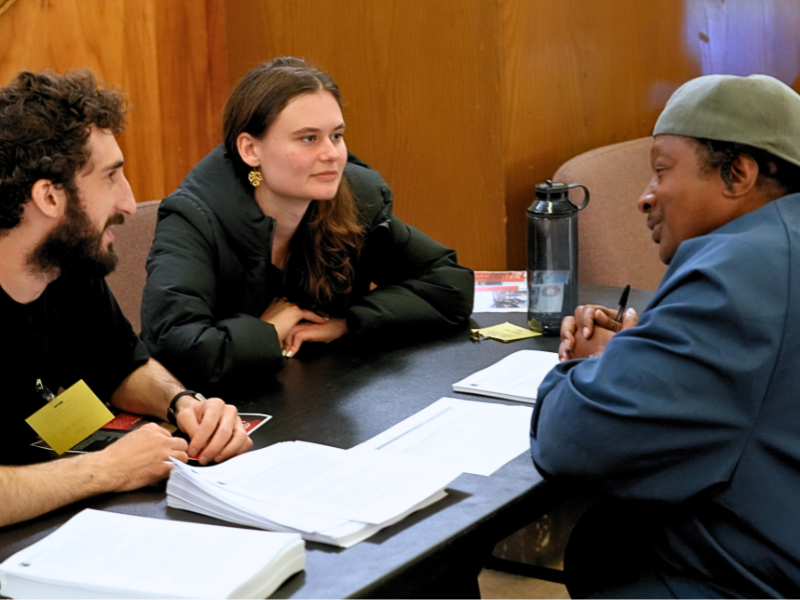
Akhtar joined Mount Tamalpais College as a faculty member in Fall 2023, teaching a public speaking course. In class, he was struck by the level of commitment students brought to their studies.
“The energy was different than when I taught college students on the outside,” he reflected. “They went through a lot to be in that class—it was not a passive set of circumstances that caused them to be there. They were bought in and committed.”
Teaching communication, in particular, allowed Akhtar to engage deeply with students’ perspectives and experiences. Through speeches, debates, and discussion-based coursework, students explored how they see the world and their place within it.
“Students give speeches from their own unique vantage points,” he said. “It allows for us, as a class, to have really constructive, healthy discussions about why we see the world the way that we do, and what it means to advocate for your beliefs, and yourself, in an effective way.”
Over the course of the semester, Akhtar watched students develop not only technical communication skills, but also a stronger sense of agency over their own narratives—an outcome he sees as central to the course.
“The way we talk about it in class is either you control what your story is and how it is communicated, or someone will control that story for you,” he said. “I think we’re able to really help them communicate the principles that they choose to carry with them for the rest of their lives.”
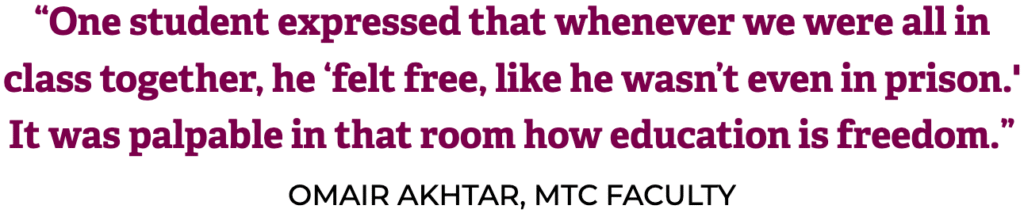
At the end of the semester, Akhtar and the students reflected on their time together in class. “One student expressed that whenever we were all in class together, he ‘felt free, like he wasn’t even in prison,’” Akhtar recalled. “I almost cried. It was palpable in that room how education is freedom.”
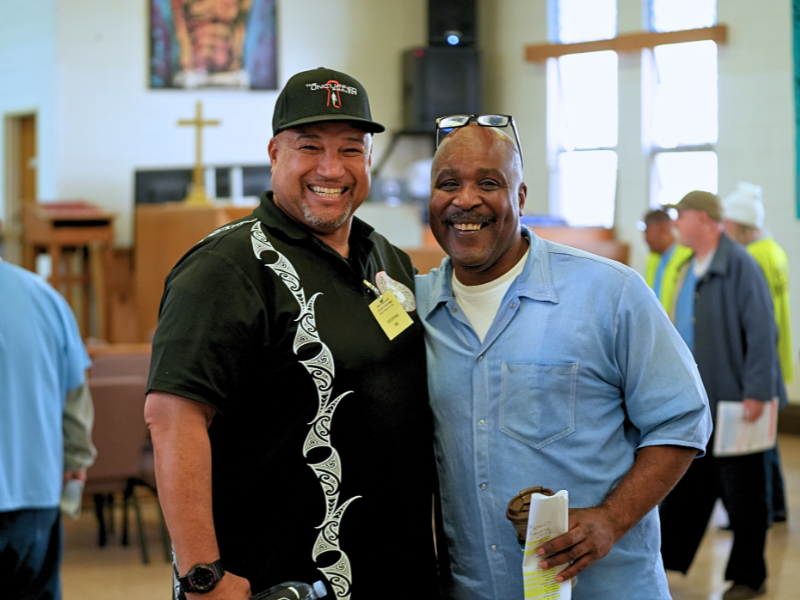
Another meaningful moment came at an MTC Holiday Celebration held outside the prison, when Akhtar ran into a former student who had recently been released.
“When I had been in the prison about a year earlier, I saw him and he told me, ‘Omair, you’re going to see me on the outside.’ Then a year passes, and I see him at this party. It was like an out-of-body experience—he did it, he’s here,” Akhtar recalled. “In class, he had shared with me his vision of what his life would be like on the outside, and now he’s doing the things he said he would. It was just so great to catch up with him.”
In 2025, Akhtar also took part in the College’s ongoing Guest Lecture Series—an extracurricular opportunity available to all MTC students—where he drew from his experience at Netflix to explore the attention economy and consumer decision-making. He noted that many MTC students have a fundamentally different relationship to the attention economy, shaped by their lived experiences inside San Quentin—perspectives that added depth and nuance to the discussion.
“Students reflected on the negatives that come with being restricted from access to social media, but also some of the positives,” Akhtar explained. “I’ve learned so much from hearing their perspectives and how they’ve experienced the world from the inside.”