• Skip to primary navigation
  • Skip to main content
  • QUICK LINKS
    • CONTACT US
    • CONNECT
      WITH US
    • FACULTY APPLICATION
    • PUBLICATIONS
    • PRESS KIT
    • CAREERS
  • About
    • Mission & Values
    • Staff & Board
    • Impact
    • Accreditation & Institutional Research
    • Careers
  • Academics
    • Admissions
    • AA Degree
    • College Prep
    • Faculty
    • Apply To Teach
  • Students & Alumni
    • Students
    • Alumni
    • OpenLine Literary Journal
  • Resources
    • Practitioner Support
    • Resources for Incarcerated Students
    • Research on Prison Higher Education
  • News
    • Top MTC Stories
    • Recent Press
    • From the President
    • Commencement
    • 2026 Gala
  • Give to MTC
    • Donate
    • Shop

Mount Tamalpais College

Current Affairs

How Can You Help People in Prison Right Now?

June 26, 2020 by Mt. Tam College

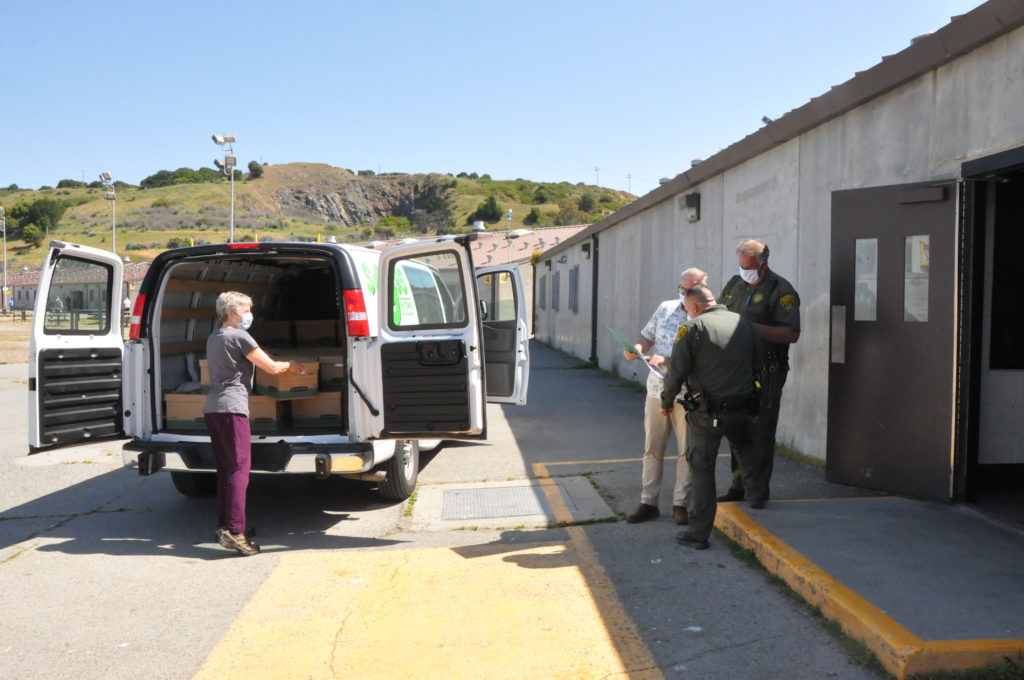
As the COVID-19 outbreak at San Quentin rapidly spreads, we are working to mobilize the resources and networks we have access to in order to protect incarcerated lives.

WAYS TO HELP RIGHT NOW

  • Increase the visibility of incarcerated and formerly incarcerated people by sharing their advocacy efforts and publications widely, and support their work.
  • Donate to the Prison University Project’s general operations. We are uniquely positioned to support and advocate for incarcerated and formerly incarcerated people during this crisis and will continue to provide supplies and educational materials to people inside.
  • Donate to our COVID-19 Care Package Initiative. After a successful delivery of care packages to all 3,900 people incarcerated at San Quentin and a second round of packages to Avenal State Prison, we are now working to raise the funds to send another package to people at San Quentin.
  • Donate to Bonafide, a reentry organization led by the Prison University Project’s Director of Operations David Cowan. Bonafide helps people inside prepare for release, and then supports them from the moment they leave prison—even greeting them at the gate with essential supplies like cell phones, hand sanitizer, and clothes, and then providing social and psychological support in the days, weeks, months and years after.
  • Contribute to Re:store Justice’s Canteen Fund (or here) to help incarcerated individuals buy hygiene products, cleaning supplies, and nutritious food. (People who participate in San Quentin programs should be sure to donate anonymously, to avoid any concerns about “overfamiliarity.”)
  • Write to Prison University Project students inside by sending a message of support to info@prisonuniversityproject.org with the subject, “Message for Students.”

OTHER WAYS TO ENGAGE

Remain informed about inside conditions and response efforts by exploring the following organizations and resources:

  • Urgent Town Hall Meeting for Marin County hosted by Re:Store Justice and Ella Baker Center, Saturday June 27 at 1PM, recording available here.
  • Thursday, July 2nd | 10 AM – 11:30 AM | Transformative In-prison Program Workgroup Statewide COVID-19 Webinar: Register here.
  • Join the attorneys from the Plata Case and leaders from the Ella Baker Center for Human Rights, Re:store Justice, and the Transformative In-Prison Workgroup for an update and call to action on the COVID-19 crisis in CDCR.
  • CDCR COVID-19 Population Tracker
  • Amend at UCSF and Berkeley Public Health
    • Release, Cohort, and Test Memo – May 4, 2020
    • Urgent Memo re: San Quentin outbreak – June 15, 2020
  • #StopSanQuentinOutbreak Demands from Incarcerated Community
  • Reform Alliance
  • Ella Baker Center
  • Uncommon Law 
    • Suggested Actions
  • The Prison Reentry Network 
  • The Northern California Innocence Project 
  • Prison Policy Initiative: “COVID-19 and the criminal justice system”
  • The Justice Collaborative COVID-19 Response & Resources
  • Root and Rebound COVID-19 Response and Reentry Resources
  • Prisoner Advocacy Network COVID-19 Resources
  • Rosen, Bien, Galvan & Grunfeld and Prison Law Office‘s efforts to compel federal court intervention
  • Amend at UCSF: “COVID-19 in Your Correctional Facility: Answers, Advice, and Actions
  • UCSF School of Medicine: “The State of the Pandemic, Opening the Schools, and the Outbreak at San Quentin State Prison”
  • For more ideas, see this article from KQED.

Please note that the Prison University Project became Mount Tamalpais College in September 2020.
Filed Under: COVID-19, Current Affairs

Students and Alumni Respond to COVID-19

June 26, 2020 by Mt. Tam College

Current and former Prison University Project students are spearheading an array of advocacy, public education, and reentry efforts during this crisis and leading the conversation on how COVID-19 affects incarcerated individuals.

  • Kenyatta Leal shared tips for living in isolation in USA Today. Read Story
  • David Cowan, Prison University Project Director of Operations and Director of Bonafide, discussed in an interview how COVID-19 has complicated reentry support. Read Story
  • Student and Senior Editor of the San Quentin News Juan Moreno Haines has emerged as a voice for the incarcerated during the COVID-19 crisis. His published pieces in DemocracyNow! and The Appeal reflect what’s happening inside San Quentin in real time. Read Story
  • Phil Melendez, Los Angeles Outreach Associate atRe:store Justice, was featured on “Coronavirus Impact Podcast with Ben Higgins” from ABC 10 News San Diego. Hear Phil at 13:56.
  • Adnan Khan and Eric “Maserati E” Abercrombie were featured on “GeriPal Podcast” with Dr. Brie Williams, Professor of Medicine and Director of the Criminal Justice & Health Program at UCSF and Director of Amend: Changing Correctional Culture. Listen here. 
  • Adnan also spoke to Alicia Menendez on MSNBC about the threat of COVID-19 in America’s carceral system. Watch Adnan at 34:50.
  • James King and Sajad Shakoor participated in a webinar, “Getting People Out Of Prison: How to Support People in CDCR In Asking For Release Due to COVID-19” sponsored by the Prisoner Advocacy Network.

Please note that the Prison University Project became Mount Tamalpais College in September 2020.
Filed Under: Campus & Community, COVID-19, Current Affairs, People

‘I Spent 11 Years In Prison—And Produced a Rap Album at San Quentin’

June 25, 2020 by Mt. Tam College

I was born and raised in Stockholm and grew up in a loving home. My dad is a doctor from the Gambia in West Africa, and my mom was a scientist, originally from Estonia, but emigrated to Sweden.

At around 8 years old I started learning about hip-hop culture in New York and by 11, I had started rapping. I then started going into studios—at the time in Sweden there were a lot of youth centres that put a lot of effort in having the kids involved in music programmes.

Then on the way home from my sister’s wedding in Italy when I was 17, we were in a car accident and we lost my mom. My dad had moved back to Africa at that time, so it was rough for me as I was living with my grandparents. Yet shortly after, I was offered my first record deal, aged 17, and signed at 18.

I signed another deal aged 23 with my Swedish group, The Navigators, and when we went our separate ways, I started to work with American artists and I was asked if I wanted to put eight bars on an Ashley Tisdale record. I was soon invited by a producer called Bloodshy to work on a Britney Spears record. I then worked more with Ashley Tisdale, I was having meetings with huge agents and I had a really good set up in L.A.

That’s when this incident took place, where in 2008 I made a bad decision and had an altercation that led to the death of a man called Mr Osnes. The following day I was arrested, but I didn’t know he had died—when I was told, I broke down and cried.

Eventually I was sentenced to 15 years-to-life in jail for second degree murder. I take full responsibility and I have extreme remorse for what I did, I took a man’s life. Even though it wasn’t on purpose, I live with that every day.

But it was shocking because I had dreamt about being in LA and I had worked really hard for 20 years in the music industry. That was the hardest time of my life next to losing my mom.

I caught on to the codes of jail pretty quickly. Me being from another country made me vulnerable in one way but also protected me in another, because I’m not affiliated with a gang. “Where you from?” in LA county jails is kind of how they invite you to fight.

I transferred to Solano County Jail and I fit in pretty quickly because I avoided trouble—like gambling or borrowing money. I went to the law library a lot, to church, read the bible and worked as an English and Math tutor. About six months into my sentence I bought a guitar and started playing and writing songs, that was pretty much my life for about three and a half years.

But what happens in an environment like that is that you can’t be soft, because you’re going to become a victim very quickly. You spend your hours in the yard working out to make sure no one messes with you, and walk around like you’re super tough. But you never really deal with all these different emotions you have inside.

The majority of people in prison will eventually get out. So who do you want as your neighbour? Somebody that’s been put in a really violent yard, with no resources to deal with their anger issues. Or do you want somebody who has access to programs like prison yoga or mindfulness meditation, non-violence self help groups and education?

One thing I always did was write music. Then the Swedish Consulate said they could visit me more often if I moved to San Quentin State Prison. Transferring to a different prison is iffy because you don’t know what you’re getting yourself into, but it was approved in 2013.

Within a week I performed in church, I rapped a long verse and the whole church stood up and gave me a standing ovation. The day after a guy came up to me and asked me to come down to the media center. I started working there, editing different radio stories and learning a lot about journalism. I had an iMac computer but there was no music software, so I really wanted to get a keyboard in.

I asked a friend in Sweden to order a keyboard for me. I knew it wasn’t allowed in, but i prayed about it. Gator, my cellmate, happened to be there when the keyboard came. They were going to send it back, and Gator—who knew everyone because he’d been down for more than 40 years—told them it was mine and that I was going to teach him piano. I got the keyboard, and started producing beats in the cell. Half San Quentin Mixtape Vol. 1 is actually made on that keyboard.

People knew me because I used to perform as a rapper in San Quentin—a lot of the youngsters used to come by the media center and listen. But I’d hear them rapping things like, “shoot him in the head!”—crazy type talk that was glorifying violence.

I offered incarcerated men the chance to be on the mixtape and I said I would produce it on one condition; that they use no profanity and no derogatory language at all. Instead, I told them to talk about their struggle, their authentic feelings or how they miss their mom or daughter.

They were not used to doing that in such a vulnerable way. And they definitely weren’t used to rapping without curse words. But I knew that if you take out the curse words, you have to dig deeper, you have to find other words to explain. I showed them some of my songs where I don’t cuss. It was still hardcore beats, but what they were saying was more authentic.

When they rapped, a lot of them broke down in tears because everything became so real. But I think because they were being authentic, everyone else in prison could relate to what they were saying because they felt the same pain.

That’s what is so beautiful about truth.

I recorded hundreds of songs in different volumes—San Quentin Mixtape, Vol. 1 is just the first. It took more than four years, and probably worked with 50 to 60 guys during that time. San Quentin has volunteers come in and they would see me with these youngsters in the San Quentin Music Program, and people started talking about it.

I started working with Dream Corps’ #cut50, founded by Jessica Jackson, Matt Haney and Van Jones. Then I met J. Cole when he came in with Scott Budnick, producer of The Hangover, and eventually Common wanted to come in as well, and we had a meeting and talked. He sat and listened to all the songs.

Word kind of spread around. Kim Kardashian heard about it and came in and talked to me. What surprised me about her was how dedicated she really is to prison reform, and how much she really knows about the issue, and how well her questions were formed. That was something that I was very inspired by.

Before I was released from San Quentin in March, I made sure that I had taught the skills needed to my team. I really wanted it to continue like a professional studio environment. The team at San Quentin are continuing the legacy of it all and I’m still producing the beats from Sweden.

Right now I’m back living in Stockholm. I’m promoting the mixtape and building back my career. But there is still a problem with structural racism, and there are so many different entities within society that contribute to the problem. I went to the Black Lives Matter protest here and what I really hope is that people get away from this “All Lives Matter” thing.

Black Lives Matter is not saying that other lives don’t matter. And it’s so frustrating to keep hearing that. You have to be blind not to see the oppression that’s been going on for Black people for more than 400 years.

There’s a fire going on and it needs to be fixed. It’s a worldwide issue.

I could never just go back to just working and making money and forget about where I’ve been. To me the San Quentin guys are like family.

One thing that was important to me was not only record these mixtapes, but invite people from the music industry to talk to the inmates. So that when these guys eventually parole, they have this connection to the industry.

I love being able to still be part of the project. It’s beautiful to be home, but there are plenty of good men still in prison, and some of those guys I may not ever see again. I get emotional about it—it’s bittersweet.

Attribution: This article originally appeared in Newsweek on June 25, 2020.
Read Story

Filed Under: Current Affairs, Open Line, Perspectives, Published Works

June 18: Update from the President

June 18, 2020 by Mt. Tam College

Dear friends,

I hope everyone is doing OK, during this extraordinarily complex and painful time.

I’ve been struggling to write this latest update for the last several weeks, and it is not getting any easier. Last week San Quentin reported its first confirmed cases of COVID-19, apparently the result of transferring people from the California Institution for Men, in an attempt to shield them from the massive outbreak there. For statistical details of the current situation across the state, see the California Department of Corrections and Rehabilitation’s website, which now lists numbers of cases, people tested, and deaths.

What the numbers of course cannot convey is the terror of this situation for people inside and those who love them. Watching the number of confirmed COVID-19 cases climb while it gradually spreads to more prisons is like watching a fire jump from one building to the next, with tens of thousands of people trapped inside. A handful of passersby see what’s happening; some stand and watch; most just walk by.

Right now, hundreds of thousands of incarcerated people are confronting the threat of COVID-19 in squalid, medically unsafe prison cells and dormitories; with inadequate nutritious food, personal protective equipment, hygiene articles, educational materials, accurate scientific information about the virus, or current news. Their ability to communicate with loved ones, about whose physical health or economic situation they may be deeply worried, is severely limited. They are also justifiably terrified. Some, especially those who are already in ill health or elderly, are expecting to die.

Yet in spite of the formidable advocacy work being done for the release of the medically vulnerable and/or elderly, scant resources are being invested in even the most basic needs of those who remain inside. In the midst of the current explosion of awareness, outrage and solidarity, when literally the entire world’s attention is focused specifically on racist state violence and neglect, the normalized brutality and negligence of conditions inside the U.S. prison system remain of little interest to most Americans.

It’s not hard to understand why people seeking to address the crisis of COVID-19 in prisons would focus on trying to remove people from that danger. Yet most of us would agree that even the most herculean efforts are unlikely to bring about the release of more than 10% of the population. It would thus seem (to put it mildly) logical to also invest resources in the most immediate health and safety needs of both prisoners and staff. Yet most of the largest criminal justice advocacy and philanthropy organizations remain almost entirely focused on the cause of releases, rather than also addressing conditions inside.

The most pressing issues right now relate specifically to supplies, facilities management, and operational policy: Procuring adequate personal protective equipment, cleaning supplies, healthy food and water; repairing or replacing ventilation systems; overhauling the prison TV systems; installing adequate IT infrastructure to support technology-based delivery of education, visiting, medical care, psychological services, and recreational activities; revising Departmental policy regarding allowable materials and access to technology; navigating legally complex labor/management issues (e.g., screening and testing, forming staff cohorts to limit virus spread); and making emergency funding rapidly available for all of these things, as well as for washing machines, changing facilities, quality food services, hotel rooms and other facilities, to support staff mental and physical health. The Department also needs to have emergency plans in place, in the event that staffing shortages become more acute; large numbers of prisoners become severely ill when local ICUs are already overloaded; fire season further degrades the quality of air in the housing units; or an earthquake isolates the institution for an extended period of time.

Tackling these types of projects requires deep familiarity with Departmental policies, as well as close collaboration with staff and administrators. Unfortunately, those communities and organizations that are typically most concerned about the wellbeing of incarcerated people are generally those least likely to be connected to the relevant professional networks. They are also the ones that people working in corrections are most likely to feel threatened by. Those organizations that do have strong contacts inside the world of corrections are often reluctant to openly address issues like living conditions. Other advocates are averse, either as a matter of principle or of public image, to the idea of engaging in a practical sense with prisons. Those who control the prisons and those who care about the people inside are traditionally conditioned to view each other as enemies.

One wonders what would happen if the world of corrections were not so isolated and distrustful of “outsiders,” and if it were subject to vastly more external oversight and accountability. Yet the refusal of large segments of the advocacy community to engage directly with incarcerated people—to, in a sense, look them in the eye, to recognize them as more than a remote, unfortunate abstraction—is a long-standing problem. And its already dire consequences are now escalating sharply.

But this failure to fully register currently incarcerated people as living human beings is not just a moral issue; it is also strategic. Incarcerated people are not only passive subjects of the system; they are also potentially extraordinary agents of change. This country’s greatest experts on systemic racism, as well as on police, prosecutorial, and judicial abuse, live in its prisons, and they are unparalleled advocates and witnesses. Tending to their wellbeing while also amplifying their voices—not just after they have survived incarceration—is an essential strategy for bringing about large-scale change.

At the end of April, the Prison University Project created two initiatives. The first was to distribute gift bags to all of the nearly 3,900 people incarcerated at San Quentin. Each one was packed in a gallon-sized Ziploc bag, filled with beef jerky, tuna fish, trail mix, a bar of soap, a small pad of paper, envelopes, stamps, pens (or pen fillers, for those in housing units where regular pens are not allowed), and three articles: Why Soap Works, by Ferris Jabr; The Pandemic is a Portal, by Arundhati Roy; and Five months on, what scientists now know about the Coronavirus; by Robin McKie. We also included a letter that explained the package.

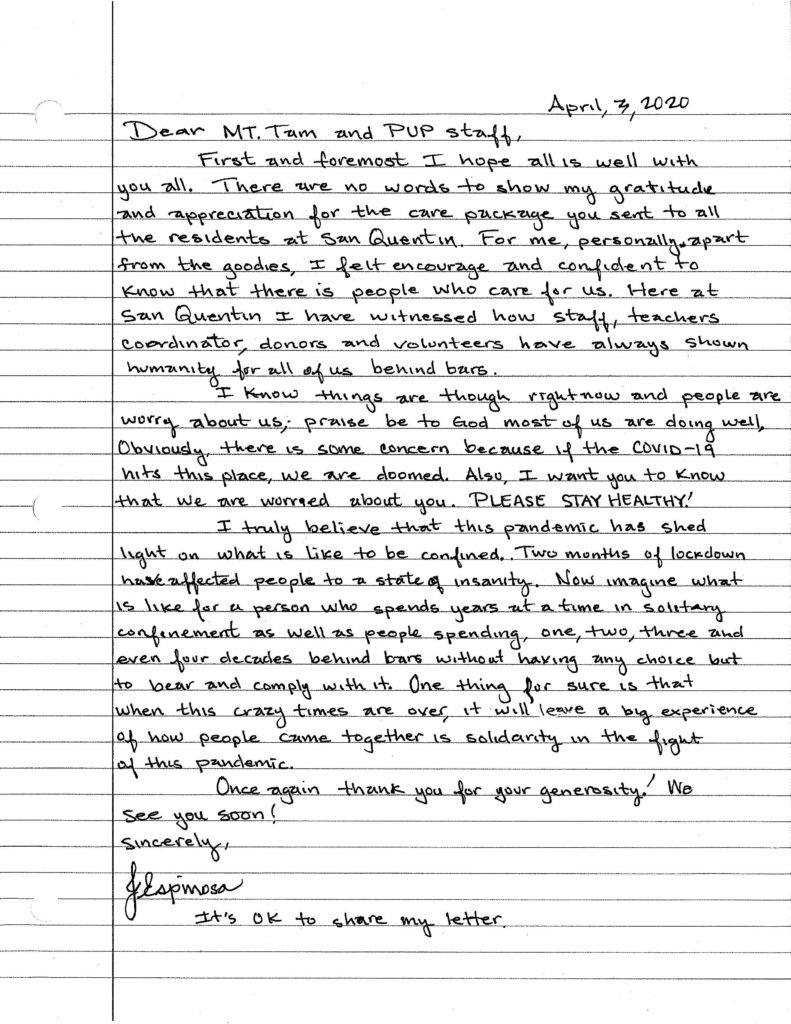
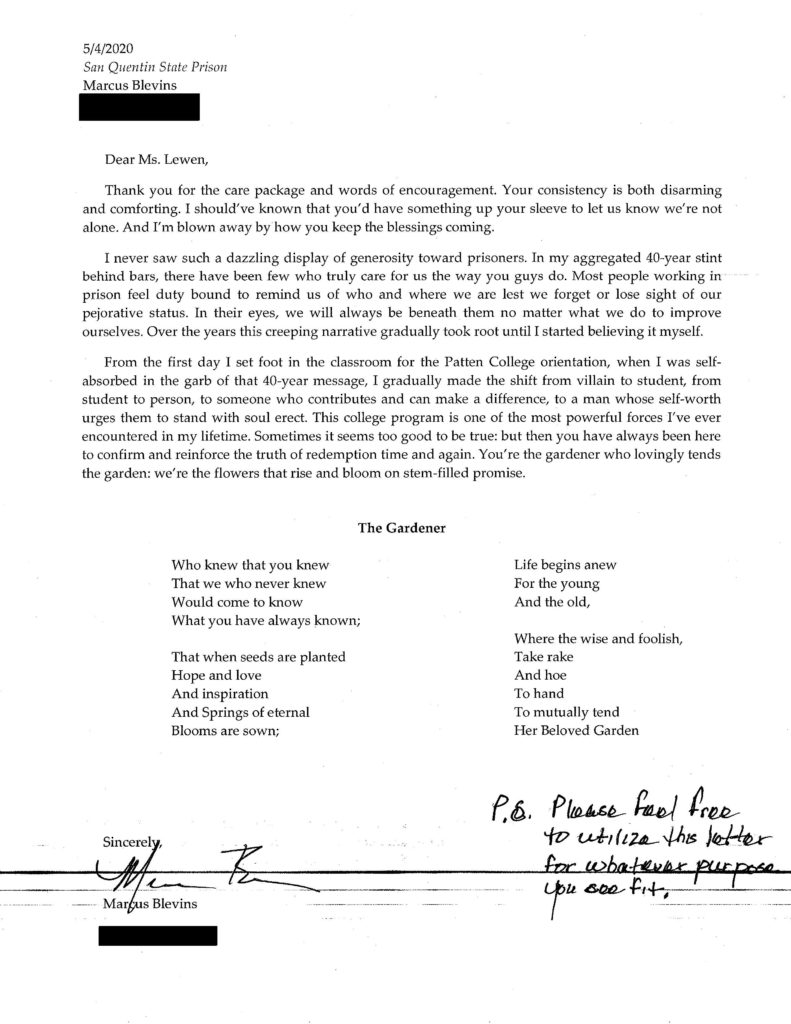
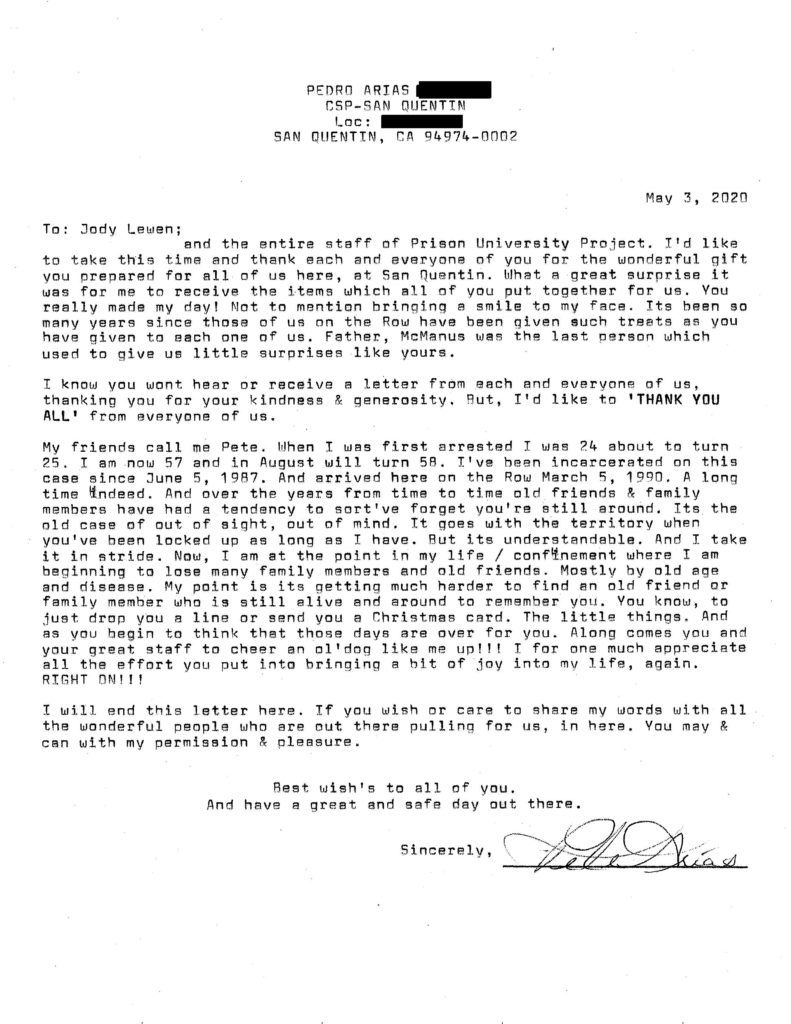
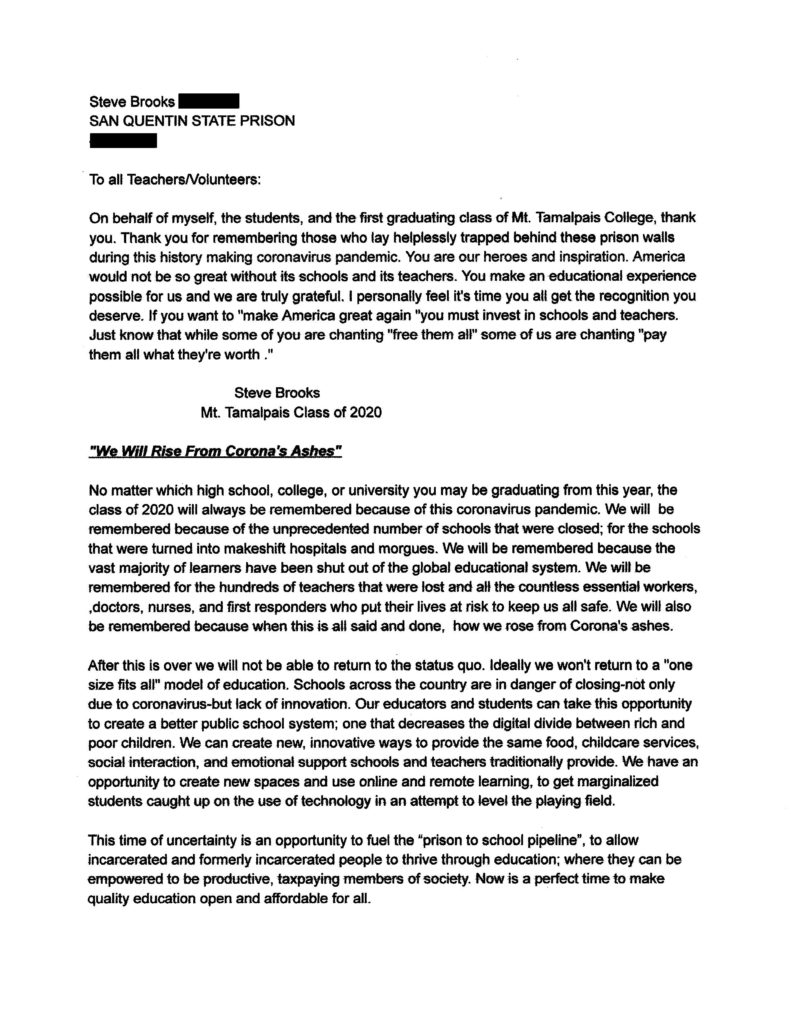
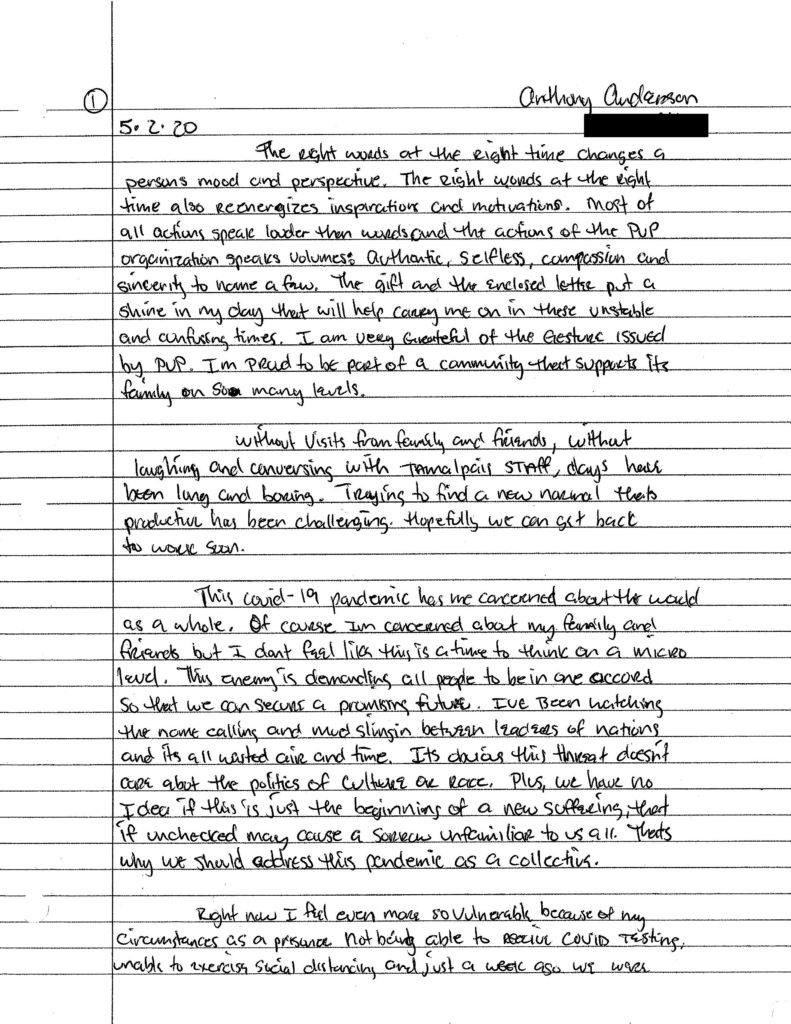
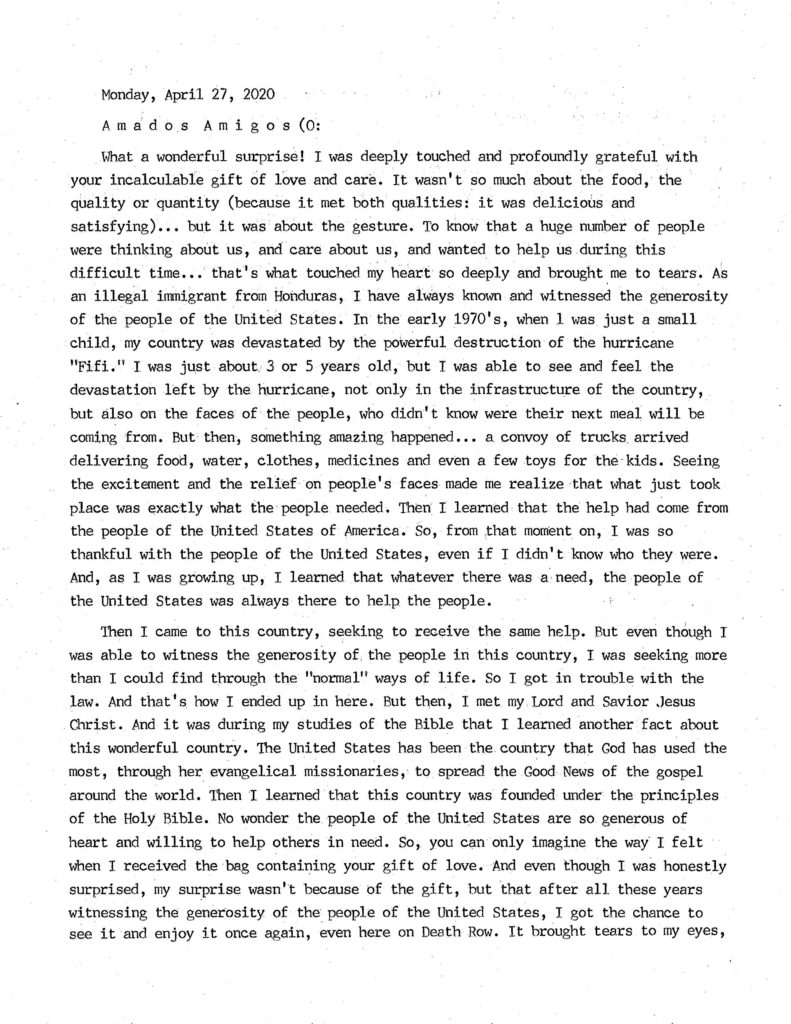
The response from inside was unexpected and profound. Within days, we began receiving hundreds of thank-you letters. Some were from our students (who comprise about 10% of the overall San Quentin population); others came from the vast communities in Reception and on Death Row. With permission, we are sharing a small sample of those letters here. We intend to post more in the near future.

While everyone expressed appreciation for the package’s contents, the thing they stressed the most was the impact of the message it conveyed: There are people on the outside who are thinking of you, and who care. A lot of people described the actual emotional sensations of receiving it—and of realizing it was a gift for them; the way it changed the atmosphere of the whole housing unit, the sounds of joy on the tier. Some described how it transformed their mood, or even their sense of themselves as human. Others said it inspired them to be kind; gave them hope about the future; or strengthened their resolve to keep going. A handful shared artwork or poetry. Many had been in prison for decades. Some had not received mail or a package in years; a few never had. The enclosed articles contained the first information many had ever received on the science of COVID-19. Quite a number expressed gratitude on behalf of others in their unit, reminding us that some people we would not hear from because they cannot read or write.

Some people shared their fears about getting sick—especially those with serious medical conditions, or who are older. Many more expressed concerns about loved ones on the outside, and the frustration of not being able to be there for them. Others described their bleak living conditions—poor ventilation, barely any time outside, scarce cleaning supplies. Many requested reading materials, puzzles, legal information, or a pen pal. A significant number of people acknowledged CDCR’s efforts to prevent the spread of the virus, but also described the impossibility of social distancing, particularly in dorms or showers, and their fear and frustration about some staff’s inconsistent use of masks. People in Reception shared their extraordinary frustration with being stuck indefinitely in a housing unit with no TVs or radios, since COVID-19 had caused transfers to be indefinitely suspended.

Together, the letters provide remarkable testimony about what it is like to be in prison, especially right now—and not just materially, but psychologically. Most of the “public speaking” and outreach I’ve done since the letters began arriving has entailed my channeling what I’ve learned from them to the outside world. This is more or less a continuation of what my job has been like for the last twenty years, but now with some much higher stakes.

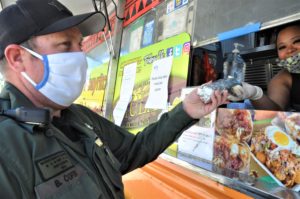
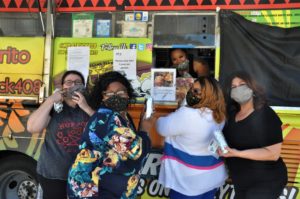
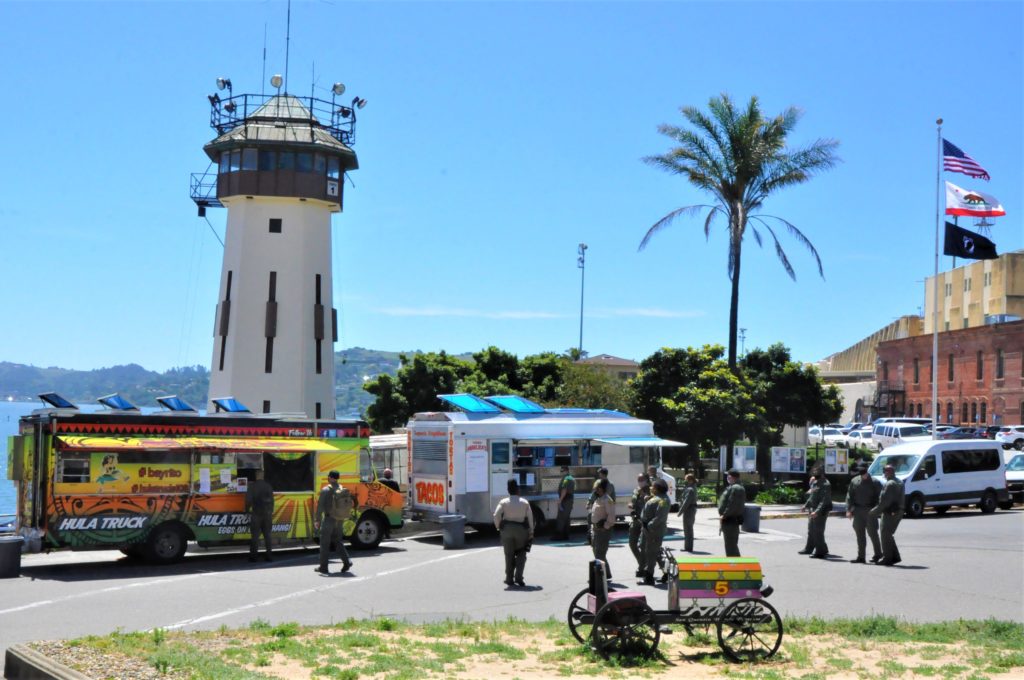
The other for-us unprecedented initiative we undertook in April, also with funding from an individual donor, and tremendous support from the San Quentin administration, was a food truck appreciation event for prison staff. Over the course of a single day, from five in the morning till eleven at night, several Mexican food trucks served burritos during each of the three shift changes to well over a thousand people.

At San Quentin, nearly half of all employees are medical workers and other non-custody staff. The rest are custody and administrators who work throughout the prison. Those on site right now are those who cannot work from home. Most come in sustained direct contact with other people there, and thus experience some level of at least potential exposure to COVID-19.

Over the course of the day, the long, wide stretch of pavement that overlooks the Bay on the way to the Count Gate was transformed into something faintly like a street fair. Second watch staff started arriving in the morning, when it was still dark; a steady stream heading towards the gate, lugging gear or water, some chatting, some with heads down. Throughout the day faces puzzled and then eventually brightened with a smile once they finally believed that the food really was there for them.

Most people who work at San Quentin commute long hours each way, often with van pools. Hundreds also live in trailers on or near prison grounds because there is virtually no affordable local housing. Most prison workers feel some degree of dread or danger about being at work; the pandemic is obviously compounding the physical and mental toll of the job beyond measure. At a time like this, it felt meaningful to be able to offer something so simple and positive. I wonder how the climate of the prison might change if staff—and everyone else—felt that taken care of every day.

As of this writing, we are working to arrange a similar pair of initiatives, this time at a prison in the Central Valley with over 4,000 incarcerated people, 1,000 staff, and a serious COVID-19 outbreak. Depending on our fundraising capacity, and the receptivity of other institutions, we hope to continue these efforts even further in the future.

For several weeks I hesitated to write about these projects, loath to turn bleak lessons about long-term exposure to extreme emotional and material deprivation and toxic stress into a feel-good story about us. But the intensely positive emotional responses to these initiatives illustrate vividly both the need and the opportunities that I urgently hope to convey. Both events also permanently altered my understanding of what it means for any act of goodwill to be effective, significant, or trivial, in a way that I hope will inspire others to do something, anything, rather than just standing by. They also strengthened my resolve to continue doing whatever we possibly can to provide material and emotional support to the entire community at San Quentin, as well as other institutions.

So we will continue… working to ensure that all incarcerated people and prison staff have plentiful access to personal protective equipment and supplies; facilitate the flow of information to the outside world about institutional conditions, needs, challenges, and solutions; foster productive dialogue and collaboration between diverse individuals and organizations; educate and advise journalists, policymakers, family members and other stakeholders; provide quality reading materials and other paper and video-based supplies for education, recreation, and health; support the research and program development efforts of funders; and organize resources in support of people who are now leaving prison during the pandemic.

Above all, we will do everything in our power to make heard the voices, and the vision, of our students and all the other people throughout the system, to mitigate as much as possible the harm of COVID-19, and to help the world understand that they are human beings whose lives have value.

Jody Lewen
Executive Director

Please note that the Prison University Project became Mount Tamalpais College in September 2020.
Filed Under: COVID-19, Current Affairs, From the President

Voices from Inside

June 3, 2020 by Mt. Tam College

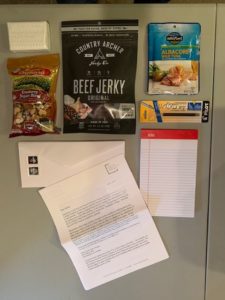
At the end of April, the Prison University Project distributed gift bags to all of the nearly 3,900 people incarcerated at San Quentin. Each one was packed in a gallon-sized Ziploc bag, filled with beef jerky, tuna fish, trail mix, a bar of soap, a small pad of paper, envelopes, stamps, pens (or pen fillers, for those in housing units where regular pens are not allowed), and three articles. We also included a letter that explained the package.

We received over 300 letters in response to the effort with a wide range of topics, from purely thank you messages to reports on conditions inside. All of them provide a window into the incarcerated experience during the COVID-19 crisis, and we feel they are important to share broadly. With permission, we are sharing a small sample of those letters below. We intend to post more in the near future.

Click through to read each letter in its entirety.

Please note that the Prison University Project became Mount Tamalpais College in September 2020.
Filed Under: COVID-19, Current Affairs

David Cowan on Reentry Support During COVID-19

May 31, 2020 by Mt. Tam College

Since returning home from San Quentin eight years ago, Prison University Project’s Director of Operations and Director of Bonafide David Cowan has been committed to fostering opportunities for formerly incarcerated people and has worked to ensure that people affected by incarceration have the material, emotional, and advocacy support they need to both integrate into society and build healthy, productive lives going forward. We spoke to David about Bonafide and how his reentry work has been affected by the COVID-19 crisis. David was honored last year by UnCommon Law at its UnCommon Heroes event.

What does Bonafide do to build social networks?

Bonafide builds social networks mostly by supporting the natural network that exists between people who have been incarcerated for long terms, “lifers” in particular. We make sure that as people are released they know that they have a community to turn to for any type of support. We also try to inject structure, funding, and facilitation into this community.

What drives your work?

There are many drivers for the work but a couple of major ones. I’m very uncomfortable with people being completely lost in the world when they are suddenly released after decades of incarceration. They are at such a huge disadvantage when it even comes to functioning in a modern society. I want to reduce the trauma that comes with that situation. Another driver for this work is that when I was incarcerated and thrust into an environment that I was unfamiliar with, the lifers helped me, encouraged me, and taught me. I spent nearly half of my life with them. Now I get the chance to return the favor.

How has your own experience of reentry informed your current work?

While I was reentering, I had the benefit of a super support system. I had a network of people that I could turn to that were available to teach me everything from how to use the internet to how to use the bike routes. I want everyone to have the same kind of support that I did. I’m saddened to think of what it is like to reenter the community without such support.

What are some misconceptions people have about reentry? What should the public know about people returning home from prison?

I used to think that the biggest misconception about reentry is that everyone coming home is a monster, but I now think that is more of a “war on crime” era misconception. Now I think that the biggest misconception is that the greatest need for people coming home is to learn how to write a resume. Although that and all of the other functional skills are necessary, I’ve learned that they kind of pale in comparison to the need for a returning person to feel supported and emotionally connected to the community. A network of people who care goes a long way to make people feel less out of place.

What challenges are you facing with reentry support right now? How has COVID-19 impacted your work and the reentry experience?

I think that it has been difficult for many of the Californian counties as well as the state to make complete adjustments to support people returning from incarceration during this crisis. However, many community organizations have come to help and depend on each other in ways that they hadn’t before COVID-19. For example, a person leaving incarceration and getting to a destination is no longer just a matter of finding transportation, but now is also a matter of doing it without contracting or spreading the virus. So organizations have been coordinating and sharing supplies to make that happen in many cases. The virus has also limited the in-person time that we spend with people. For now, we don’t run the technology workshops and teaching people to use their phones and to do things online has been a difficult remote task but we’re getting better. 

With so many businesses shuttered, have you found returning citizens struggling to find or keep a job?

Both fortunately and unfortunately most of the types of places that hire formerly incarcerated right away are low-paying “essential” services so many people in that position still have jobs. Though there are some that have lost their jobs too. The biggest barrier to looking for employment at this time has been the inability to get identification cards, which are necessary to be hired because the DMV has been closed.

With the world now essentially living online, how are you helping people with little or no experience with technology adapt?

Our technology workshops have been canceled until it is safe to gather again. Now we help people remotely. Sometimes that means getting on the computer while the person you’re helping is on the phone and being their fingers for them as we fill out forms or other things. For people who have computers, we’ve been sharing screens so that we can walk them through whatever they are doing. We’ve also started installing screen sharing apps to people’s phones so that we can remotely help them learn how to use it.

Have you been able to adapt to the conditions? What are your workaround solutions?

When it comes to meeting people at the gate, our adjustments have been to make sure that their backpacks also include hand sanitizer and masks. Our drivers wear masks and have sanitation supplies as well. We stopped going into diners for breakfast but instead go to places that will bring the food out to us. We also paused shopping for now.

What other organizations or service providers do you work with?

One of the bright spots to come out of the pandemic is that we’ve worked more closely with organizations that we only occasionally worked with in the past such as the California Reentry Program, the Insight Garden Program, the Anti-recidivism Coalition, Project Rebound, and a handful of others.

Are there any resource guides or websites you’d recommend for people who are returning home?

San Francisco has a great resource guide that I’d recommend to anyone paroling to the county. Many reentry programs have their own reentry guides. Another good one is from Root and Rebound.

How can people support Bonafide? How can they support reentry work broadly?

Bonafide could always use financial support. We’ve started paying our welcome home drivers. We could also use people with good practical experience using Android phones and have a good knowledge of how private and public systems function like banking, looking for housing, paying for things online, how to use email, etc. I think that an easy way to support reentry work more broadly is get to know people who are trying to reintegrate from incarceration. They are just trying to get jobs but they are trying to normalize their lives and that really happens when we are a part of a community.

Please note that the Prison University Project became Mount Tamalpais College in September 2020.
Filed Under: Campus & Community, COVID-19, Current Affairs, Partnerships, People

America is Isolated. I’ve Been There Before. Lessons I’ve Learned from San Quentin

April 10, 2020 by Mt. Tam College

When I walked out of San Quentin prison in 2013, I left behind the despair, violence and uncertainty rampant within its walls. Like a suit of armor I had to wear for decades, I gladly shed the protective gear of survival skills that were no longer applicable on this side of the wall. I never imagined that any of those skills would prove useful to my life today.

However, when the coronavirus hit the United States, and shelter-in-place orders were put into effect, it reaffirmed the fact that everything we experience in life is meant to teach us something useful. And my incarceration is no exception.

I spent more than 20 years in the California prison system in one of two ways: in “normal program” or some form of “lockdown.” During normal program, I had privileges: I could exercise in the yard, work on school assignments and have visitors. During lockdown, I was confined to a 6-foot-by-9-foot cell 24/7. Lockdowns are an inevitable part of the prison environment and so is the stress associated with the uncertainty of how long it will last.

Today, on the outside, there’s a familiar anxiety in the air. People are unsure and nervous. People are confined to their homes without an idea of when life will return to normal.

While incarcerated, I survived those periods of uncertainty with a particular mindset and practices. Both helped me endure long periods of isolation.

Below is a guide to some of what I’ve learned:

Develop a practical daily routine. A daily routine that works for you will keep you productive, feeling accomplished and focused on the moment rather than the overwhelming amount of stress in the unknown.

Exercise. Most of us aren’t moving as much as we normally would. Over a long period of time, this could have detrimental effects on our muscle tone and cardiovascular health. Furthermore, exercise has a positive, calming effect on our mind. It can help improve sleep, which is often impacted by stress.

If you think that you can’t exercise while staying inside your home, you’re wrong. I exercised in a tiny cell that I shared with another person for months at a time. There is always a way. Today, we have access to online exercise programs. We can also go outside and take a walk or a jog or a bike ride, as long as we practice social distancing. Find something that works for you, and do it regularly.

Read. Nothing like a good book to stimulate ideas and open one’s mind to possibilities beyond a given set of circumstances.

Cleanliness. Keeping your space clean and organized helps to improve your mental health and, in this case, reduces your likelihood of exposure to the virus. Make your bed every day, clean the dishes right after you use them, put your clothes away. Maintain the order of your house. It will make a big difference.

Create some privacy. Being limited to a confined space for an extended period of time can be stressful. So if you’re sharing a space be sure to define places where you can have a bit of privacy, no matter how small. This alone space can be in the bathroom, on a walk, in the garage. Take some time for yourself every day, no matter how short.

Make the most of what you have. In difficult times, how you think about your circumstances directly impacts your experience. We can always think of what we don’t have and what we can’t do. This can lead us into despair. Instead, think of what you do have, and what you can do. If you have a home base that is safe and comfortable, be thankful. If you have access to food, supplies and the internet, rejoice in how these resources are keeping you and your family safe. Having a perspective of gratitude can change your mental well being and ability to function.

Focus on what you have control over. Lack of control is extremely stressful. If you only think about the uncertainty of your current circumstances and what you don’t know, your anxiety will increase, potentially affecting your physical and mental health. Instead focus your mind on what you do have control over. This approach will keep you focused on the moment and reduce your stress and anxiety.

Stay connected. Communicate with family and friends. During prison lockdowns the only way to stay connected to family and friends was through good old fashioned snail mail. Now, we can leverage technology like Skype and Zoom.

Maintain a positive attitude. Your attitude is the only thing that can change an obstacle into an opportunity. Even though you may be facing the same tough circumstances as someone else, your response to it can change your results.

Embrace that your survival is up to you. Remember that you can choose to follow the rules about social distancing, wearing some sort of mask and self-isolating for the recommended time. People who are incarcerated don’t have the luxury of social distancing. It is very difficult for them to avoid such a highly contagious virus. Prisons are extremely vulnerable, not just for the people who live there, but for the staff, the guards, the nurses and the prison administrators. I think about my friends who are incarcerated today and worry for their safety.

Make a commitment to personal growth. Every time I went into lockdown, I made a goal to be a better, stronger person by the time I got out. This virus affects us all. But we have a choice: We can continue business as usual, or we can change. We can come out of this stronger than before.

We humans have an incredible ability to endure the most difficult of circumstances.

Attribution: This article originally appeared in USA Today on April 7, 2020.
Read Story

Filed Under: Current Affairs, Open Line, Perspectives, Published Works

March 29: Update from the President on COVID-19

March 29, 2020 by Mt. Tam College

Dear friends,

I hope everyone is doing OK. I’m writing to share some further updates as we continue to try to figure out how we can best support our students and the larger community inside during this crisis.

As many of you know, in response to the COVID-19 pandemic, we and other organizations and individuals in California and around the country have been working to bring about the release of the most medically vulnerable incarcerated people and/or others considered “low risk.” The goal is to reduce the risk to them, while also making it easier to control the spread of the virus inside by reducing overall population density.

Around the country, thousands of people have already been released from prisons and jails. While I am deeply heartened and hopeful about these sane, rational developments, I’m indescribably frustrated that it took a pandemic to bring them about. I’m also concerned about the adverse conditions that will confront those individuals being released and those charged with supporting their transition.

Even in the best of times, reentry is a taxing and complex process. Right now, even picking someone up at the gate or meeting with them face-to-face is hardly an option. Today, many transitional houses are either full or closed to intake; service providers are working from home and either scaling back or shuttering their operations. Essential offices like the DMV and Social Security are closed—and without an ID it’s impossible to get a job.

Family members, friends, and organizations that provide housing to new arrivals will not only need space for them to hunker down indefinitely during the shelter-in-place period; they’ll need the capacity to quarantine them for their first 14 days out. New arrivals will also need financial support for the foreseeable future. In many cases, they will have acute medical needs—including, conceivably, health issues related to COVID-19. Those who physically interact with new arrivals to support their reentry will need to have the skills and resources to do so safely, given the risk for all parties of contagion.

Hopefully everyone advocating for mass releases is working just as hard to develop adequate housing for these folks when they arrive home. But even if this can be arranged, what will become of the overwhelming majority of incarcerated people who remain inside the institutions? While even a 20% reduction of the overall prison population would create some much-needed space, it would not produce the medical personnel or material resources sufficient to care for everyone inside, in the event that rates of infection and severity of illness are comparable to what is occurring in the outside population—and they are likely to be much worse.

I am obviously not arguing against evacuating as many people as possible; nor am I suggesting that all of these efforts will be in vain. However, from both a public health and humanitarian perspective, these steps will not mitigate the catastrophic lethality of the system’s very design. Even living in the midst of a pandemic, I personally am safer from illness and death than the average incarcerated person is on an “ordinary” day. None of these steps will change that reality. Especially not right now.

Yet much of the criminal justice-related advocacy work being organized in response to this crisis seems to sidestep the reality that over two million people in the U.S. will experience the devastation of this pandemic from inside prisons and jails. While clearly concerned about the broader issues, most advocates and institutional philanthropists, including those that ordinarily value agility, responsiveness, and innovation, seem unable to engage with the question of what they could do right now to avert a massive loss of human life. Instead, many remain hyper-focused on long-term goals like decarceration, and the gratification of legislative “big wins,” apparently unwilling or unable to respond simultaneously to an impending humanitarian disaster.

Perhaps the situation is too overwhelming to even think about. Prisons are epidemiological tinderboxes. A huge percentage of incarcerated people are elderly and/or have serious existing medical conditions; maintaining physical distance from others in a 100-person dorm, or in a double-bunked cell block, or in a chow hall is impossible; simply keeping one’s hands clean can be a huge challenge. Hand sanitizer is considered contraband in most prisons because of its alcohol content. Prison medical staffing levels, space and equipment are entirely inadequate for an institution-wide disaster—much less a statewide, national, or global one. The vast majority of prisons rely on outside hospitals to provide specialized or acute care, including for respiratory problems. Maybe the only mental response we can muster is the impulse to remove people to safety.

Still, we must imagine the situation when the virus spreads inside, and outside hospitals are already overwhelmed. From Friday to Saturday alone, the number of patients in intensive care in California rose from 200 to 410. What will happen in the coming days and weeks, when more and more incarcerated people become ill, prison staffing levels begin to drop, and both custody and medical staff become increasingly exhausted and frightened, if not ill?

We must ask: what can we do right now to minimize the risk of illness and death to both incarcerated people and to staff? How do we help impede the spread of illness? What do those running the prisons require to keep people safe? How can we prepare incarcerated people for the reality that they and/or others around them may become seriously ill, in many cases with no access to medical care? How can we protect those with severe mental illness or disabilities? How can we help everyone involved cope with justifiable feelings of fear, anger, and frustration, so that despair does not descend and ultimately convert to violence? How can we prevent the catastrophic scenario in which hundreds of people are sick and dying in their cells and dorms, and staff are no longer reporting to work?

I have spent the last few weeks asking these questions of prison staff, administrators, formerly incarcerated people, and other colleagues. Regarding staff, most answers focus on having access to personal protective equipment and other hygiene supplies (gloves, masks, sanitizer, soap, paper towels); ensuring their needs and concerns are heard; and knowing that people around them are aware of what they are going through, and supporting them. Staff also need practical support ensuring that they are not carrying the virus home to their families. To address this concern, and to minimize their driving while exhausted (particularly now that van pools are problematic, and given how far many live from their institutions), we should be booking local hotel rooms for them now. This would be particularly prudent, given that staffing shortages will likely require many to work overtime. They can also use healthy snacks, space to rest or change their clothes before leaving work, and anything else that might allow them to decompress.

To support currently incarcerated people: everyone needs plentiful access to soap, sanitizer, toilet paper, masks, adequate nutritious food, paper and stamps, gloves, as well as regular access to yard and showers. All of these supplies should be distributed for free, rather than sold through canteen—particularly given that lockdowns and “modified programs” mean the cancelation of most jobs, which means people are unable to earn the money they need to purchase such essentials. Many family members who might ordinarily send money are likely also experiencing extreme economic distress as a result of the abrupt elimination of so many jobs on the outside.

Everyone inside also needs accurate, accessible information about the virus itself and how to avoid contagion. In addition, they need medical information about the progression of COVID-19, and advice on how to care for themselves and others in the event that they become ill and are without professional medical support. The institutions must also plan for the possibility that as staffing drops below critical levels, those who are incarcerated may need to maintain basic, life-preserving operations by themselves until help is available. They should prepare now to distribute cell phones.

One piece of good news that I have to share is that at San Quentin, the Warden, the Chief Medical Officer, and the CCPOA Chapter President are exceptionally dedicated and competent people. With adequate resources, I believe they have the capacity to create a model for how to mitigate the impending disaster—before we finally address the horrific dysfunction of the system itself.

As an organization we are now working to help ensure that all necessary supplies and resources are available to both the incarcerated community and staff, and to make sure that everyone knows that they are not forgotten and will not be abandoned. In spite of their radically different positions, in a certain sense the fates of incarcerated people and prison staff are now bound together. The only way to help one group is to help everyone. But all of this needs to happen now; we are out of time.

—Jody Lewen, Executive Director

Please note that the Prison University Project became Mount Tamalpais College in September 2020.
Filed Under: COVID-19, Current Affairs, From the President

March 17: Update from the President on COVID-19

March 17, 2020 by Mt. Tam College

Dear friends,

I’m writing to share some updates regarding the current COVID-19 crisis as it pertains to our community at San Quentin and beyond.

As many of you know, last week we made the painful decision to suspend all programming at San Quentin, in order to eliminate our risk of carrying the virus into the prison. Conducting classes online is not an option, as there is no internet access within the prison. Continuing by correspondence would pose insurmountable logistical challenges, as well as sacrifices to quality inconsistent with our core commitments to students. For now, we are focused on basic issues of health and safety, and hope to address questions related to course and degree completion as soon as we’re able.

For the time being, staff are working from home, focusing on the various tasks and larger picture/bigger project work that can still be accomplished remotely. Thanks to technology, we should all continue to be reachable in all the usual ways.

Until a few days ago, we were planning to have a single staff member go into the prison each day, but like everyone else, our sense of what is appropriate or feasible is rapidly evolving. At this moment, we are taking things one day at a time. We are hoping at the very least to ensure that students are receiving accurate information about the crisis, and also know that we remain deeply committed to their wellbeing. Ideally, it will also become possible to ensure that students have plenty of reading materials to occupy them for the duration. Our options in this regard will depend very much on how overwhelmed prison staff are, and their ability to assist.

As those of you who have firsthand experience in this field are aware, it is extraordinarily distressing for faculty and staff to lose all access to students, particularly in the midst of such an extreme medical crisis, with no way to communicate, much less support them. Students rely on school for a sense of connection, community, purpose, and routine, and we are concerned about how a prolonged disruption, combined with so much fear, isolation, and uncertainty, will impact individuals, as well as the whole social climate, not just at San Quentin but throughout the system as a whole.

If you would like to send a few words of support to students, please email us at info@staging.prisonuniversityproject.flywheelsites.com, with the subject heading, “Message to Students.” We will do our very best to share these messages inside, as soon as we are able.

At this time, as the crisis continues to escalate, we are now focusing our attention on how we can best work with all available partners to deploy our knowledge, networks and resources to keep everyone who is living and working inside the prison system as safe and healthy as possible.

Above all, we are concerned about the humanitarian disaster that may occur when a COVID-19 outbreak starts inside. As of this writing, there are no confirmed cases of COVID-19 inside the California prison system. However, once this does happen, it will be extraordinarily difficult to contain. The Department does not have enough health care workers to treat, or space to quarantine, all those who would likely be affected. It is also not clear what will happen if, in the event of an outbreak, large numbers of prison staff, out of fear, or because they have been directly impacted, stop reporting to work.

For this reason, an increasing number of individuals and organizations are now seeking ways to release and/or divert from the entire system those people who are most medically vulnerable. Community groups working inside and outside of the system, as well as leadership from the California Department of Corrections and Rehabilitation, the Office of the Receiver that oversees medical care for CDCR, and within the Governor’s Office, are all working hard to develop strategies that could be implemented quickly. Witnessing the sense of urgency, personal responsibility, and willingness to collaborate among these diverse groups is reminding me of the importance of distinguishing between the individuals who work within a system and the system itself. Above all, no single individual or entity has the power to avert or mitigate such a crisis alone.

Some resources related to these efforts are at the end of this letter. If successful, hundreds if not thousands of medically vulnerable people will be returning home in the midst of a pandemic, and they will all need housing, financial support, and other supportive services. A vast amount of rapid, advance planning is going to be essential. Supporting organizations that provide reentry services (such as Bonafide, Root & Rebound, and the Anti-Recidivism Coalition) will thus be especially critical during this time.

As throughout the world, many of the prison-related issues that this pandemic is raising are not unique to this specific event; rather, the crisis is bringing long-standing problems into relief. I hope this moment will ultimately launch a much larger public conversation about the vast number of elderly and medically fragile people incarcerated in the U.S; the widespread lack of adequate medical services, and emergency preparedness; the extreme unsanitary conditions (including the scarcity of sinks with water and soap); the poor nutrition; toxic levels of stress; sleep deprivation; exposure to violence; lack of exercise; poor air quality/ventilation; and overcrowded living conditions—precisely those factors that compromise immune-health and make it impossible to protect people from infectious disease.

I hope we finally ask ourselves what it means that we continue to sequester hundreds of thousands of people—often for decades—in squalid, degrading conditions where staying home, washing one’s hands, and social distancing are painfully unattainable goals.

Our work at the Prison University Project is of course only a small piece of this puzzle. Nevertheless, we hope that through all of our work we may somehow leverage this disaster, in order to bring about some large-scale positive change.

With deep gratitude for your support,

Jody Lewen
Executive Director

Letter to Governor Newsom from CA organizations

Interview with Homer Venters in The New Yorker

Opinion piece in The New York Times by Emily Bazelon

Article in the Chicago Sun Times

The Justice Collaborative’s  “COVID Response and Resources”

Prison Policy Initiative’s “Responses to the COVID-19 pandemic”

National Institute of Corrections Coronavirus Information

Please note that the Prison University Project became Mount Tamalpais College in September 2020.
Filed Under: COVID-19, Current Affairs, From the President

Former Student Jesse Vasquez’s Reentry Journey

January 16, 2020 by Mt. Tam College

Former Prison University Project student and former San Quentin News editor Jesse Vasquez shared his reentry journey in Great Big Story’s feature on innovative housing opportunities for formerly incarcerated people.

Please note that the Prison University Project became Mount Tamalpais College in September 2020.
Filed Under: Campus & Community, Current Affairs, People, Perspectives

  • « Go to Previous Page
  • Page 1
  • Interim pages omitted …
  • Page 6
  • Page 7
  • Page 8
  • Page 9
  • Page 10
  • Interim pages omitted …
  • Page 16
  • Go to Next Page »
mtc seal

Contact Us

PO Box 492
San Quentin, CA 94964
(415) 455-8088


Please note: Prior to September 2020, Mount Tamalpais College was known as the Prison University Project and operated as an extension site of Patten University.


Tax ID number (EIN): 20-5606926

Quick Links

CONTACT US
CAREERS
PRESS KIT
ACCREDITATION
PUBLICATIONS
DONATE


Join Our Mailing List

© 2026 | Mount Tamalpais College | Photography by RJ Lozada | Design & Development by //DESIGN AGENCY//

  • About
    ▼
    • Mission & Values
    • Staff & Board
    • Impact
    • Accreditation & Institutional Research
    • Careers
  • Academics
    ▼
    • Admissions
    • AA Degree
    • College Prep
    • Faculty
    • Apply To Teach
  • Students & Alumni
    ▼
    • Students
    • Alumni
    • OpenLine Literary Journal
  • Resources
    ▼
    • Practitioner Support
    • Resources for Incarcerated Students
    • Research on Prison Higher Education
  • News
    ▼
    • Top MTC Stories
    • Recent Press
    • From the President
    • Commencement
    • 2026 Gala
  • Give to MTC
    ▼
    • Donate
    • Shop