• Skip to primary navigation
  • Skip to main content
  • QUICK LINKS
    • CONTACT US
    • CONNECT
      WITH US
    • FACULTY APPLICATION
    • PUBLICATIONS
    • PRESS KIT
    • CAREERS
  • About
    • Mission & Values
    • Staff & Board
    • Accreditation & Institutional Research
    • Careers
  • Academics
    • Admissions
    • AA Degree
    • College Prep
    • Faculty
    • Apply To Teach
  • Students & Alumni
    • Students
    • Alumni
    • OpenLine Literary Journal
  • Resources
    • Practitioner Support
    • Resources for Incarcerated Students
    • Research on Prison Higher Education
  • News
    • Top MTC Stories
    • Recent Press
    • From the President
    • Commencement
    • 2026 Gala
  • Give to MTC
    • Donate
    • Shop

Mount Tamalpais College

Current Affairs

An Airbnb for the Formerly Incarcerated

December 16, 2019 by Mt. Tam College

Former Prison University Project student and former San Quentin News editor Jesse Vasquez was featured in The Atlantic.

Jesse Vasquez first heard about the Homecoming Project while working as the editor of the San Quentin News, an inmate-run newspaper in California’s San Quentin State Prison. Impact Justice, an organization focused on criminal-justice reform, had set up a small program that was recruiting homeowners to open up a room in their house to someone coming out of prison—like Airbnb, but for people who had most recently lived in a cell. He’d never heard of anything like it: strangers, opening their homes to people convicted of felonies and helping them get back on their feet?

The 36-year-old Vasquez had been incarcerated since the age of 17, and was sentenced at 19 to multiple life terms for an attempted murder in a drive-by shooting in Orange County. He thought he might never get out. Then Jerry Brown, California’s governor at the time, commuted his sentence, allowing him to seek parole far sooner than he’d expected. In February 2019, Vasquez’s parole was granted. But where would he go, he thought, and how would he rebuild a life? Then he remembered the Homecoming Project. Impact Justice, he recalled, acted as a matchmaker between a host and a tenant. The organization paid for the first six months of rent, offered the newly released person training and case management, and provided support to the host. That sounded good to Vasquez. He sent in his application.

About three weeks later, Vasquez received a written response from Impact Justice: He was in. The program’s coordinator, Terah Lawyer, had a list of three prospective hosts. He hit it off immediately with the second. Candi Thornton, originally from Florida, was in her early sixties. She was a church leader, ran volunteer programs and charity drives, and managed an assisted-living home in East Oakland for people with disabilities. She had already hosted someone through the Homecoming Project. If he lived with her, she told him, he could join her at church, share a meal from time to time, and call on her for advice. “For me,” she told Vasquez, “it’s all about faith and community.” That sold him. He’d become a devout Christian while in prison, and he could hear the care in her voice, like she wanted him to succeed. They were a match.

It just so happened that Thornton was out of town when he was released, on a sunny morning last May. So, the next day, after Vasquez met with his parole officer, Lawyer took him to Thornton’s house to show him around. It was a big sherbet-pink house on a quiet street off of the 580 freeway in East Oakland, at the base of the nearby wooded hills. The house had a small downstairs apartment with a separate driveway and entrance. It had two bedrooms, one for Vasquez and one for the existing tenant.

The apartment had a kitchen, living room, and couch; there was also a weight-lifting kit, a large television, and a coffee table. The roommate, a trim, tattooed 50-year-old man named Mike Davis, also formerly incarcerated, was on his way out. Thornton had explained the Homecoming Project to him, and he greeted Vasquez warmly. “You need anything,” he said, “you just let me know.”

After everyone left, it was just Vasquez and his apartment and his own set of jangling keys and the vast quiet of the residential street. He closed the door and stayed up nearly the whole night, unable to sleep because of what a good and terrifying feeling it was to be free.

Vasquez didn’t realize, quite yet, how lucky he was. The Homecoming Project had been launched as a pilot, and he was one of only a dozen or so who had been accepted, out of several hundred applicants. Lawyer had chosen him because of all his activities during his life inside—men’s groups, mentorship programs, the paper, college classes. He had even earned an associate’s degree. “If a person can accomplish all of that positivity with so little,” Lawyer said, “imagine what they could do with a little bit of support and encouragement.”

The truth was that the Homecoming Project had a lot riding on Vasquez, too. The funding for the project covered only the pilot phase. To keep it going, they had to convince funders that it worked—that it wasn’t wasted on Vasquez and others in his position. In the conservative culture of criminal justice, private and public funders can be wary of funding experimental programs. “Any new project that is against the norm comes with a lot of risk,” explained Alex Frank, a project director at the Vera Institute of Justice. Nonprofits must meet strict qualifications to be considered for state and federal funding (and are entirely ineligible for some grants); as a result, the same organizations and for-profit businesses tend to be funded again and again, a pattern that doesn’t lend itself to new ideas.

While foundations and private donors are generally more open to innovation, the individual grants are usually smaller, and funding often only lasts for a few years—just long enough to get a program off the ground, but not enough to make it last or bring it to scale. Yet in a country with more than 2 million incarcerated people—a population that states and the federal government are desperate to reduce—the need for innovation is urgent, particularly when it comes to improving outcomes for people who have been released.

Operating in Oakland, where Silicon Valley’s influence is deeply felt, the advocates at Impact Justice had been working for years, against difficult odds, to bring a more innovative approach to criminal-justice reform. In 2015, Alex Busansky, an attorney and Impact Justice’s president, was talking to colleagues about the lack of supportive housing options for people getting out of prison.

Upon leaving prison, he felt, people don’t just need a place to sleep; they need a home—a place where they are cared for and feel they belong—and connections to a positive community. They need to feel welcomed back into society and to have a sense of agency. As Lawyer put it, “People don’t realize that in the way it’s currently designed, they are still ostracized from society, and they are having to fight to get back in.”

Finding housing, especially in California, is the most immediate problem and often the hardest to overcome. Vasquez could hardly have picked a more challenging place to try to rebuild a life. As of November 2019, Oakland had the fourth most expensive rental market in the United States. San Francisco had the most expensive rentals.

Former prisoners are often ineligible for subsidized housing, and finding an affordable place of one’s own from inside prison is nearly impossible. Money is a huge obstacle, of course, but the main issue is having a criminal record: Landlords frequently ask about a potential renter’s prior convictions, and some require background checks.

On top of that, people being released on parole or probation must have their post-release housing arrangement approved by their parole or probation officer. It has to meet a number of requirements, some of which pose serious barriers for recently released inmates. A parolee or probationer often cannot, for example, live with a person convicted of a felony, and a parole or probation officer can nix any housing arrangement that they deem insufficient or a threat to good behavior. (Vasquez said his parole conditions don’t prevent him from living with someone with a criminal record.) In many cases, none of the residents of a house can have been codefendants, witnesses, or victims of the crime for which the parolee served time, and a place where people are known to abuse drugs or alcohol is immediately nixed as too risky. Some parole officers will check to see if the police have responded to calls from or about the residence.

Halfway houses are an option, but they have limited availability. In many cases, they mimic some aspects of prison, with strict regulations restricting residents’ freedom: curfews, required drug testing, unannounced visits from parole officers, restrictions on travel. They are often on the outskirts of communities, far from resources like libraries and banks, as well as the places that people returning from prison need to rebuild their lives, such as the Department of Motor Vehicles, the Social Security office, and hospitals.

A 2016 study by the University of Michigan’s National Poverty Center showed that parolees move an average of about once every five months, compared with the U.S. average of once every five years, and the less money and fewer social connections they have, the more they move. (Formerly incarcerated people are also 10 times more likely to be homeless than the average population.) All of this conspires against people coming home from prisons to make it more likely that they will have inadequate housing—and, in turn, will end up back inside. According to one study, 83 percent of state prisoners across 30 states were back in prison within nine years; in California, about half of those released from prison end up back in prison within just three years. Numerous nation- and statewide studies show that the availability of stable, affordable housing helps determine whether someone ends up back in prison.

When Impact Justice’s Busansky and his colleagues tried to brainstorm how they might come up with housing options for people released from prison, he brought up Airbnb. They joked that all they needed was enough money to pay for nightly Airbnbs for all the returning people in need of homes. But that gave Busansky an idea: What if people opened up their spare rooms to people coming out of prison?

In 2017, following Donald J. Trump’s inauguration, one of Impact Justice’s funders, the Emerson Collective (which owns a majority stake in The Atlantic), sent around a request for proposals for projects promoting justice and unity, and Busansky applied to start a pilot for the Homecoming Project, aimed at securing housing for 50 people over two years (though that goal was eventually lowered to 25 people). He got the grant and hired Terah Lawyer to launch the program. Lawyer was committed to prison reform and social justice and had herself been incarcerated for 15 years; she knew more than most people the perils of rebuilding a life after prison.

Jesse Vasquez is toned from daily workouts, a habit he developed in prison; he has a close-shaved head, a boyish grin, and a poised, determined manner. On his first morning in Thornton’s house, he went shopping for proper bedding with Sam Johnson, the Homecoming Project’s community navigator, and Johnson’s wife. They walked up and down the sheet aisles of the San Leandro Walmart, looking at all the options. “Pick what you want,” Johnson said—the Homecoming Project would pay for it—but Vasquez couldn’t choose. He didn’t want to be greedy, and he was overwhelmed by having any choice at all.

“I already have a big old bed,” he said. “It doesn’t matter to me.”

Johnson understood. He had been locked up for twenty-six years before being released two years earlier.  

“Just pick the one you like,” he told Vasquez. “Pick anything at all.” Vasquez settled on a navy-blue comforter, solid on one side, striped on the other, that suited him well enough: It was manly, he thought, but with some style. That weekend, he and Thornton spoke on the phone.

“This is your home,” she told him. “Don’t you forget it.”  

Thornton had returned from vacation, and Lawyer arranged a meeting at the Impact Justice office downtown. Thornton is a bit shorter than Vasquez, with a wide, kind smile and freckles dotting her cheeks. “I can do yard work,” he told her, wanting to offer something in return for her hospitality.

“Don’t worry about that,” she said. She already had a guy who came twice a month. They signed the paperwork, and Lawyer snapped a picture of them.

Later, driving home, Thornton turned to him. “You let me know what you need,” she said. “I’ll get it for you, and if I can’t get it for you, I’ll find someone who can.”

When Vasquez had moved into his bedroom, there was already a bed frame, a box spring, a mattress, a small white desk with drawers, and a closet with hangers. He had only a few items of clothing, so Thornton helped him find some donated suits and dress clothes, which he hung neatly in his closet alongside his exercise and casual clothes. He bought a steamer to keep everything fresh and wrinkle free. He and Davis had only one pot between them; Thornton went out and bought them a new set of pots and pans. “You need to eat,” she said.

Vasquez moved the bed from alongside the window and pulled it off the bed frame so it sat lower than the window’s ledge; where he’d grown up in Los Angeles, there were enough drive-by shootings that people knew to keep their bed below window level, lest they be hit in their sleep. He situated the desk right next to a window overlooking the gated parking area and the yard with a plum tree, an acacia, and a fig. There was a resident squirrel, too, that he liked to watch dash around the drying grasses and up into the trees.

Dealing with a housemate wasn’t as hard as he had expected. The apartment he shared with Davis, he estimated, was about five times the size of his cell; in prison, he’d had plenty of experience getting along with people in much tighter quarters. Davis was cool, and with their busy schedules, and the fact that Davis spent a lot of time with his girlfriend, Vasquez hardly ever saw him, which suited them both just fine.

One night a few weeks after he was released, Vasquez was home alone. He texted his brother from his room.

“What’s the weather like up there?” his brother asked.

“No idea,” Vasquez wrote back. “I’m inside.”

“Why you inside, stupid? Go outside and take a look around.”

Go outside, at night, by himself? He was used to being indoors, cell gates closed and locked. He opened the door, stepped into the evening air, and sat in a chair across from the plum tree. Dusk settled onto the hills across the highway. It had been a sunny day, and it was a clear night, and here he was, sitting outside a house of his own. He took pictures of the hillsides and the sunset and sent them to his brother.

“Nice,” his brother wrote back.

Vasquez’s room, with its little white desk, became his headquarters: Each morning around 4:30, he’d wake up, make a list of what needed to be done that day, and map his goals for the rest of the week. He’d start sending emails and setting up meetings—informational interviews with journalists, conversations with educators about working as a mentor or speaking at a conference. Vasquez envisioned his home like one of those paddles attached to a ball with a rubber band: You could stretch out from there, knowing you had a place to return to. From there, he could plan everything else—getting a California ID and a birth certificate, applying for Medicaid, opening a bank account. Johnson was his personal reentry assistant, helping keep track of what needed doing and texting him reminders: “You take care of that yet?”

It wasn’t just the big stuff that confounded Vasquez, like how to get a job or get over the paralyzing fear of a cop car driving by. (“Does it still bother you?” he asked Johnson once.) More often than not, it was the smaller stuff on which he needed advice. How much milk are you supposed to buy, and when does it go bad? What do you cook for dinner—how do you cook at all? How do you make sure the produce you pick up at the store—with such good, healthy intentions—doesn’t rot in your fridge? In prison, everything had a long shelf life; you could buy a can of soup and keep it for years before heating it up and slurping it down for dinner. But groceries on the outside spoiled so quickly.

Vasquez didn’t even try to cook at home until three weeks in. He had bought himself some bacon and eggs at the store. Growing up, his mom had cooked for him, and he’d only really known how to boil an egg. But eggs and bacon, he figured, couldn’t be that hard. He separated the bacon strips onto a frying pan and cracked a few eggs. Things were going well enough, but the bacon started to smoke a little, and then a lot, and all of a sudden an alarm began sounding from what seemed like every room in the house.

The alarm in Thornton’s house didn’t just sound; it spoke. “There is a fire in the building,” it announced robotically. “There is a fire in the building.” This repeated again and again, alongside a terrifying, continuous beep. Vasquez had seen on TV how police and fire trucks arrived on the scene during alarms like this. Just what he needed, he thought, a police contact that could affect his parole. The smoke was collecting. The alarm wouldn’t stop. He turned off the stove, opened the doors and windows, prayed for the smoke to go away, and then began fiddling with the smoke detector until the thing finally quieted. He threw his half-cooked bacon into the trash.

“I almost burned the house down,” he confessed to Thornton later, panicked and apologetic.

She asked him what had happened, and when he told her, she just laughed. “Don’t worry,” she said. “Just turn on the vent.” She explained how it worked and where to find the button.

A typical housemate, having taken a risk letting a parolee live with her, might well have balked at this. Thornton encouraged him to try it again. He began Googling recipes and watching cooking shows on YouTube, mimicking the professionals’ moves as he worked his way through his kitchen, trying not to set the house on fire.

The people behind the Homecoming Project see its cost as one of its main selling points. The program spends about $10,000 for each six-month stay, including rent, training for hosts, and case-management costs. A spokeswoman for the Bureau of Prisons said that in the 2018 fiscal year, the average cost of caring for an inmate in a federally contracted reentry center (or halfway house) added up to about $17,246 for the same amount of time—though she warned that it’s difficult to make a direct cost comparison between programs that may be very different.

A less tangible benefit is the informal social networks that participants like Vasquez build through the program. To recruit its hosts, Impact Justice stages presentations at churches and local organizations. Once people apply and are properly screened, Lawyer begins the matching process, as she did with Thornton. Then the hosts attend several evening trainings, where they are immersed in statistics related to the school-to-prison pipeline, recidivism rates, the needs of people returning from prison, and former inmates’ reactions to freedom.

Case management is a central part of the Homecoming Project; the to-do list of people getting out of prison can be so long and daunting, it can bury them. Without a driver’s license, a Social Security card, access to the internet, a bank account, or an understanding of public-transportation lines, it’s nearly impossible to set up a straight life. The Impact Justice team understood that asking the Homecoming Project hosts to shoulder these responsibilities could overwhelm them, as well. (As nonexperts, they could also go about things wrong and inadvertently end up doing more harm than good.) Both hosts and tenants know that if something goes awry or some need arises, they can call Johnson.

The Homecoming Project is designed to last for six months. That’s how long Impact Justice pays the rent, and how long participants like Vasquez get their formal case management. The idea is that after this softened, supported landing, a person like Vasquez will be ready to be on his own—or closer to ready, anyway.

Where Vasquez decides to live after his six months in the program is his choice, and, to some degree, his host’s. If the relationship is working, Lawyer encourages them to continue to live together (an arrangement that not only offers the comfort of continuity, but often costs less than the market rate). Vasquez’s six months are up at the end of this month, and he plans to keep living in Thornton’s apartment; for her part, she’s glad to have him. They’re drawing up a lease of their own.

Sarah Gillespie, a researcher at the Urban Institute focusing on the link between homelessness and recidivism, noted that, among all the people being released from prison, those selected to participate in the Homecoming Project are less likely to end up homeless anyway; they have, in a sense, been hand-picked for success. All Homecoming Project participants are selected based on their hosts’ abilities to support them, meaning they may be less likely to have serious physical disabilities or complex mental-health challenges, for example, which would also create a more complex set of barriers to transitioning back into society. Bridge programs such as this project, Gillespie added, often focus on the months just after reentry, sometimes at the expense of long-term benefit.

So far, though, the Homecoming Project has succeeded in both the initial six-month period and beyond. Since the program began in August 2018, none of the first 14 participants have ended up back in prison. All of them are housed and either gainfully employed or enrolled in school. The 15th participant was released from prison this month. The project remains an experiment, however, with a tiny sample size. Busansky and Lawyer are hoping to scale it, first in neighboring Contra Costa County and then statewide. But their funding is running short.

Lawyer feels that she and her colleagues have found a solution to an intractable problem: how to improve the way in which a community relates to its members who are returning after being incarcerated, while keeping people from returning to prison, with an approach that is both effective and affordable. Lawyer said that, through the Homecoming Project, participants like Vasquez “are really able to ask themselves, ‘If I had all my needs met, what would I do with my time?’” She, Busansky, and Johnson are proud of the support they’ve been able to give 15 people in just a little over a year, but the impact will continue to be minuscule unless they can significantly expand the program.

Lawyer and her colleagues have secured some additional funds since their initial grant, though not enough to start up a new class of participants. They’ve largely tried for private funding, but have found that foundations focused on the reentry population hesitate to fund housing initiatives—they’ll tackle training and job readiness, for example, but rentals are just too expensive and the need for homes too vast. The project’s coordinators have struck out on public funding, too. In November 2018, they applied for a $3 million grant for rental assistance from California’s Board of State and Community Corrections, with an application connecting the dots between the post-incarceration period and homelessness. In late August, they heard that their application was denied.

Another challenge with securing funding for programs like this one, in the view of Maureen Vittoria, Impact Justice’s chief operating officer, is that when a project attempts to radically change the way things are done within an entrenched system, decision makers inside that system are loath to take a chance on funding it—or to even acknowledge that the status quo is flawed to begin with.

Vasquez noticed that Thornton’s otherwise tasteful, tidy, dust-free house was often strewn with boxes. About a decade ago, Thornton launched a partnership with the Alameda County Community Food Bank. Nearby mega-stores, like Target, Walmart, and Costco, would set aside their recently expired or damaged food, and a team of volunteers would pick it up and distribute it at community sites. Over time, the operation grew, and they needed more and more volunteers. Now, Vasquez started helping out, volunteering each Monday for food pickups and setting up for events like Taco Tuesday. Thornton and Vasquez also went to church together every Sunday, and Vasquez started driving people there on occasion.

It was easy for Vasquez to feel like he’d been on a storage shelf for 19 years, collecting dust. He couldn’t make up for being gone, but staying and working with Thornton felt like being mainlined into a sense of purpose. Lawyer had helped Vasquez get an unpaid internship at an organization devoted to criminal-justice reform called the Ella Baker Center for Human Rights. Some teacher friends whom he had met while in prison would take him places like the beach in Marin, and they were preparing a paper for an upcoming conference about the school-to-prison pipeline.

Between this and his work with the food bank, Vasquez’s calendar was packed with meetings. He continued to wake up each morning at 4:30; his to-do list got longer, his calendar more full. Every morning, he took a timed six-minute shower: In prison he’d had five minutes, so he allotted himself an extra minute now that he was free. He was often out the door by eight or nine o’clock.

As a matchmaker, Lawyer knew that every roommate pairing was different. She had worked with one former inmate who had grown up in a volatile household. He now lived with a couple who cooked dinner every night and argued amicably about world affairs, showing him what a healthy relationship could look like. Another participant had been homeless for nearly a year after he’d been released from prison, and for him, living inside a home with others had been all about rebuilding his ability to trust.

Vasquez is a doer, a go-getter. A physical home was an important foundation, but he’d been looking for a broader sense of home—a meaningful place in his community, a feeling of being able to influence others and pursue opportunities. With Thornton, he’d found it.

One day, as Thornton was coming home and Vasquez was heading out, he mentioned his six-minute shower allotment. “You don’t need to time it,” she said to him. “No need to rush it. Just take your time.” Vasquez started giving himself a few more minutes in the shower.

Though new admissions to the Homecoming Project have stalled, Lawyer and her colleagues believe so strongly in it that they are now trying to support similar programs elsewhere—even if they are run by different organizations. They are developing a tool kit and a technical-assistance service so that they can help other organizations hoping to start something similar in their own communities.

Lawyer and Vittoria explained that they are going to start looking into private funding again, while also trying their hand at government funding, however much of a reach that may be. They continue to hope that state and federal officials will remain open to experiments like theirs. Until then, they’re soliciting more private donations and stuck in somewhat of a holding pattern. There are more than 100 applications stacked on Lawyer’s desk and, until there is more funding, zero spots for them.

Vasquez wanted to start working with kids who are struggling in school to offer them the guidance he wishes he’d had when he was their age; he applied to be a volunteer in the Oakland Unified School District. He was cleared, and began volunteering this month. He got permission from his parole officer to go to Sacramento in August, too, to lobby with the Ella Baker Center. He wore one of the suits Thornton had gotten him and spent the day speaking with policy makers in the scorching Sacramento heat about injustice in the prison system: price gouging at the commissaries, unaffordable co-pays to visit a clinic, phone companies preying on inmates’ desperation to speak to people on the outside.

When he got home, he told Thornton all about it.

“I’m so proud of you,” she said. “You’re going places. You are.”

One day Vasquez hopes to shake off his identity as a formerly incarcerated person, to not be seen as a parolee or a “returning citizen.” He just wants to be a regular guy. He feels good volunteering on the food drives, with Thornton directing him and the other volunteers: yogurt over here in the shade, meat on this table, fruit in these bins.

Sometimes, the feeling of usefulness comes with a shadow. If he hadn’t been locked up, Vasquez could have been helping others all along. Now that seems like wasted time. He feels like this at other times, too, like when he goes hiking—something he likes to do a few times a week on the network of trails circuiting the Oakland and Berkeley hills—and sees something astounding, like a stream flowing down along the trail beneath a dome of tall trees. How nice it is, he thinks, to be able to see something like that. And how sad, the number of years he spent cut off from this sight, and all the other beautiful things that make him feel big, and the world gentle and full of possibilities.

Johnson gets it. He tells Vasquez: You never want to go back, but you always want to remember where you came from. Remember where God brought you from. As they drive together through Oakland, past the homeless encampments, the addicts, the schoolyards, the boarded-up buildings, the new high-rises, along the freeway past the box stores and the clanking sailboats in the Oakland estuary, Johnson reminds him: Don’t forget where you’ve been.

Still, it feels good to have a home, food to eat, forward momentum, people you can count on, and people who can count on you. So few people in Vasquez’s position have all of this so soon after prison—if they ever get it at all.

Attribution: This article originally appeared in The Atlantic on December 16, 2019.

Read Story

Filed Under: Current Affairs, MTC in the News

Jody Lewen Moderates Colloquium on Narratives of Incarceration at BAMPFA

December 13, 2019 by Mt. Tam College

Executive Director Jody Lewen moderated Contextualizing The San Quentin Project: Nigel Poor and the Men of San Quentin State Prison, a colloquium at the Berkeley Art Museum and Pacific Film Archive that brought together leading UC Berkeley faculty from the fields of law, social welfare, and literature, along with artist Nigel Poor, to discuss the power of personal narrative and how narratives of incarceration have taken shape across disciplines.

Filed Under: Campus & Community, Conferences, Current Affairs, From the President, Partnerships, Research & Outreach

Prison University Project Board Member Sia Henry on Impact Justice’s Trip to Norway and Finland

November 6, 2019 by Mt. Tam College

In the fall of 2019, Sia Henry, Prison University Project board member and Senior Program Associate at Impact Justice, organized and led a delegation of 23 California state officials, community-based advocates, and funders to visit correctional facilities in Norway and Finland as part of Impact Justice’s Building Justice initiative. We spoke with Sia about her experience and how the lessons learned could help transform California’s criminal justice system.

What was the original idea for this trip?

A housing unit in a Helsinki prison: all incarcerated people have their own rooms, each equipped with a bathroom, desk, storage closet, and windows that open.

Impact Justice is a national innovation and research center dedicated to significantly reducing the number of people entering the criminal justice system, improving conditions for incarcerated people, and providing meaningful support to people as they re-enter society. From September 29 – October 5, 2019, Impact Justice took a group of 23 California state officials, community-based advocates, funders, journalists, and others with relevant backgrounds to visit correctional facilities in Norway and Finland to meet with incarcerated people, facility staff, and members of relevant government agencies and non-profit organizations.

Anne Irwin, founder and director of Smart Justice California and a former Prison University Project board member, worked with Brie Williams at UCSF to arrange a similar trip to Norway in mid-September for a group of about 30 individuals (mainly California Department of Corrections and Rehabilitation wardens and other officials, including CDCR Secretary Ralph Diaz; representatives from the California Correctional Peace Officers’ Association; and a couple of California state legislators). Anne’s group only visited Norway, and their tour focused more exclusively on prison reform rather than broader, criminal justice system reform.

Our next step is to work with Anne’s group to organize a convening for attendees from both of our trips, along with other stakeholders, to debrief lessons learned and identify concrete opportunities to use those lessons to transform California’s criminal justice system. I anticipate that convening will take place around the end of 2019 / early 2020.

Who was invited to attend?

The library in a Helsinki prison

We invited a large and diverse range of people, namely California state legislators; formerly incarcerated, criminal justice reform advocates; journalists; and criminal justice reform funders. We deliberately invited people with such a diverse background because we wanted attendees to have the opportunity to learn, not only from the tours, meetings, and presentations, but also from each other through informal conversations. It was especially important for us to bring formerly incarcerated people, who are truly the most important experts when it comes to discussing prison and criminal justice system reform.

What were the stated goals of the trip?
Our goal was for the group to gain an in-depth understanding of how these two countries have significantly reduced their prison populations while radically shifting the focus of their penal systems from punishment to rehabilitation and healing.

Impact Justice planned this trip with the support of California State Senator Nancy Skinner. Senator Skinner shares Impact Justice’s belief that, as a shared experience, the trip would not only inform and inspire this influential group but also unite them in a common purpose: to transform the lives of the people who live and work in California prisons and others affected by the state’s criminal justice system and, in so doing, the lives of their loved ones and the greater community.

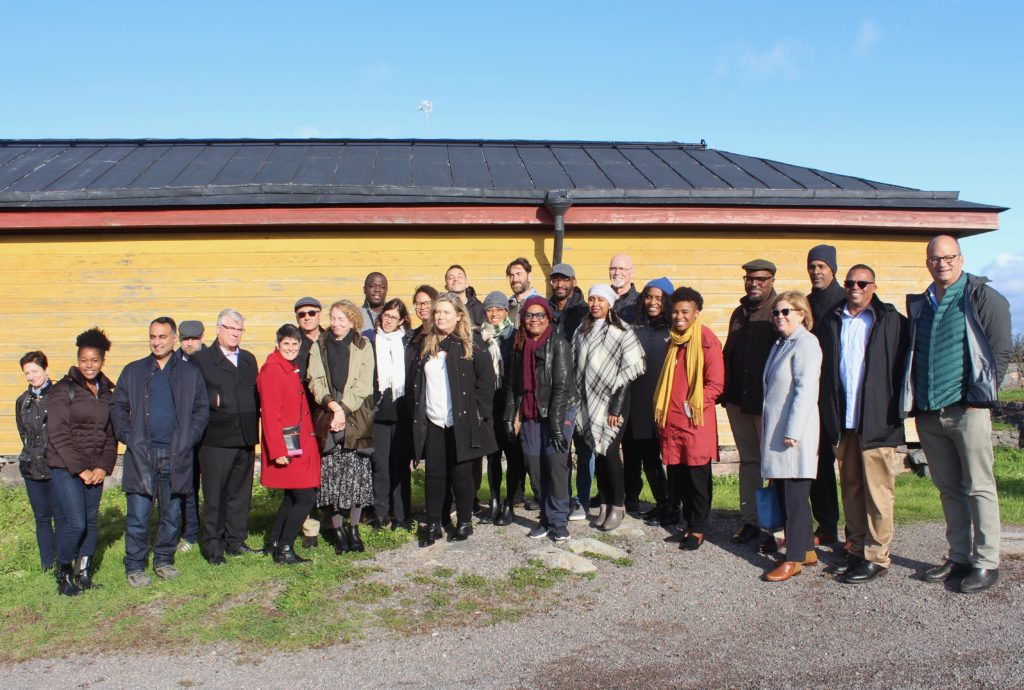
The group visits an “open” prison on Suomenlinna Island in Finland. The men at this prison sleep there but can leave to go back to the mainland for work, school, or to visit loved ones during the day.

What were your personal goals for the trip?
Groups from all over the world have been traveling to Norway to tour their prisons for the last couple of years. Norway is frequently praised as having the “world’s most humane” prison system. While I think it was important for our group to understand that there are much healthier ways to approach incarceration, my real goal was for the group to realize that, in order to move towards a prison system similar to the ones found in places like Norway and Finland, we must significantly and sustainably reduce the number of people we are incarcerating by introducing much-needed resources and services into the communities most impacted by our criminal justice system. On the last day of the trip, we met with the National Mediation Service (a federal agency that started a restorative diversion type of program for youth in Norway a couple of years ago) and the Norwegian Association for Penal Reform (a prison reform / abolition group founded in the late 1960s). I deliberately chose to end our trip with these two groups because I want to challenge the popular belief that the Scandinavian prison system should be our end goal. I wanted to challenge the assumption that we “need” to incarcerate people in order to achieve “public safety” and, instead, push our attendees to really consider the possibility of prison abolition and what it would look like to live in a society that provides universal access to the resources people need to live whole, happy, and healthy lives.

What were your key takeaways from the experience?

  • An outdoor gym overlooking the water at the “open” prison on Suomenlinna Island

    Norway’s approach to incarceration stresses the importance of maintaining “normalcy” for incarcerated people, to the extent possible (i.e. their removal from society should be the only punishment).
  • Before our tour of a maximum security prison in Norway, the director gave us a presentation. One of the correctional officers stopped by the presentation around the same time someone from our group asked about violence at the prison. The prison director introduced the officer and said: “He runs one of the housing units…he could make the men [who live in his unit] dangerous if he wanted to but since we treat everyone here with kindness and respect, we get the same in return.”
  • Even in a country known for having the world’s most “humane prison system,” the Norwegian Association for Penal Reform (the largest prison reform group in Scandinavia that’s been around since 1966) makes it clear that prison abolition should still be the end goal.
  • We can’t reform the criminal legal system, or even prisons, in a vacuum. Instead, in order to bring about meaningful change, we will have to also create a strong foundation / system of welfare to ensure all people within our society have a quality, standard baseline of care.
  • In Finland, crimes committed by people under 15 years old are addressed through the child welfare system because children cannot be charged with a crime.

How might any lessons from this trip inform the work of the Prison University Project? How will they inform your own professional endeavors?
In line with the commitment to maintaining “normalcy” for incarcerated people, in Norway and Finland, the Ministry of Health runs healthcare inside prisons. Similarly, the Ministry of Education runs educational programs and libraries inside. I think the Prison University Project is doing a good job of providing the same level of education offered to people in the community (i.e., the Prison University Project is doing what it can to maintain and instill a sense of normalcy in the area of education for incarcerated people at San Quentin). If possible, I think it’d be valuable to find opportunities for the Prison University Project to collaborate with the broader educational field (especially grade schools) to improve the trajectory for young people at the greatest risk of being impacted by the criminal legal system.

Professionally, I want to be more intentional about engaging with other fields (e.g., education, public health, mental health, architecture, urban planning, etc) to support the creation of the kind of society necessary for prison abolition to be possible.

For more information, read Sia’s “Building Justice Project: Reflections on the Finnish justice system” on Impact Justice’s website.

Please note that the Prison University Project became Mount Tamalpais College in September 2020.

Filed Under: Campus & Community, Partnerships, People, Perspectives

November 2019: Letter from the President

November 1, 2019 by Mt. Tam College

Published in the November 2019 newsletter, which you can read in its entirety here.

One of the most remarkable aspects of San Quentin as a community is the way it has evolved over time as a meeting ground for people from diverse social, cultural, and economic backgrounds. To some extent this is probably typical of prisons generally; yet located as it is in the California Bay Area, San Quentin has become one of the most dramatic examples of its kind. In a demographic sense, it is precisely what colleges should be like, but rarely are.

While educational, religious, and recovery programs have long been central to the intellectual and social life of the prison, in recent years, a much broader range of programs has emerged, including ones that focus on media, political advocacy, and the arts. Many have been initiated and/or are co-facilitated by incarcerated people, rather than by outside individuals or groups only.

By hosting visits, organizing events, and launching every manner of collaborative effort, those programs have become the vehicle through which the community of San Quentin engages with the outside world, and the way the outside world can engage with the world inside the prison. This includes academics, journalists, policymakers, advocates, philanthropists, filmmakers, attorneys, researchers, judges, business people, finance professionals, elected officials, tech industry professionals, law enforcement, and others who are interested in learning from and with people inside.

In any rigorous college setting, students are always discovering new forms of knowledge, different perspectives, and new social conventions. This type of deep learning not only alters one’s relationship to the world at large; it often shapes one’s very sense of identity, one’s notion of community, even one’s life path. But at San Quentin, those who are engaged in such transformative learning include not just students, but the entire community. Even a single visit can prompt a life-changing shift in perspective. And those profound experiences are then carried back to friends, families and colleagues, thus expanding that transformational circle even further.

As teachers and students learn together, and get to know each other, they also establish social bonds, including a sense of mutual appreciation and trust. Those relationships serve a critical function in all teachers’ capacity to support their students’ intellectual and professional development. But in the prison context, those relationships also create bridges between their often radically different worlds – they shed light, lend legitimacy, generate good will, and forge a sense of commitment and responsibility.

All of this teaching, learning, and relationship-building has created the foundation upon which world-changing work being done at and around San Quentin is built. The prison has become the epicenter of an ever-growing social network that now serves, among other things, to support people who are leaving the prison—by connecting them to a larger supportive community of friends and mentors, as well as employment opportunities, housing, and other critical resources.

But that network is not just providing vital support to individuals; it is also advancing an array of cultural, educational, and political initiatives, both large and small, many of which are transforming the criminal justice system and creating a better-informed, healthier world.

The forms this transformation takes are varied: An English instructor and a student at San Quentin team up to co-create a high school course on criminal justice reform. At a roundtable discussion with a group of visiting legislators (hosted by the San Quentin News), a student shares about the impact of medical co-pays in prison; one of those legislators later helps to change those rules for the entire system. Inspired by a lecture (by Bryan Stevenson) at San Quentin, a student founds an organization through which incarcerated and non-incarcerated people use art to transform public attitudes about mass incarceration (Prison Renaissance). District attorneys attending an event at San Quentin hear about a student’s proposal to create a process through which DAs and CDCR administrators can recommend people for early release, and later help put it into practice. Media projects produced by or with people at San Quentin (via the San Quentin News, San Quentin Radio/KALW, Firstwatch, Ear Hustle) are heard by tens of thousands of people every week, all over the world. This essay was written with extensive feedback from a student! The list is endless.

None of this is to say that the internal workings of such collaborations are not fraught with all manner of complex challenges—above all, the unequal distribution of power, access to resources, and social legitimacy—all of these reflect the gross inequalities of both the prison environment and the society as a whole. But this is precisely what makes the work so extraordinary. It is strange to imagine that a prison of all places might model the promise of the university, but in many respects, this is exactly what is happening.

In spite of unimaginable obstacles, this community forges ahead—pooling its collective social, cultural and economic capital, its creativity, compassion, and sheer determination—to support the wellbeing of its members, serve the public good, and transform the society as a whole.

Please note that the Prison University Project became Mount Tamalpais College in September 2020.

Filed Under: Current Affairs, From the President

Using Education to Struggle for Justice: An Interview with Josh Page

October 28, 2019 by Mt. Tam College

Published in the November 2019 newsletter, which you can read in its entirety here.

Since the College Program at San Quentin was founded in 1996, hundreds of people have worked as instructors, teaching assistants, tutors, and guest lecturers. Even years later, many of them describe having been impacted by the experience in profound ways, both personally and professionally, and many find their work at San Quentin has changed the trajectory of their lives and resulted in strong community bonds and professional networks among fellow instructors. Lately we’ve been working to compile testimonials from former faculty, in order to better understand how their experiences engaging with the students and the program at San Quentin have created ripple effects in their lives, and document how students at San Quentin are impacting the larger world.

What did you do at San Quentin, and what are you currently doing professionally?

In 1998 and 1999, I was a teaching assistant for Introduction to Sociology, Creative Writing, and English 99. Today I’m an associate professor of sociology and law at the University of Minnesota. I also have a not-so-secret life as a food writer, and I’m the co-founder and associate editor of Meal Magazine, a new print publication that aims to reimagine food writing and food writers.

How did the experience of teaching at SQ impact you?

It literally changed my career trajectory—and life. I went to graduate school to study racial inequality and politics (not the criminal-legal system). Early in my first semester, I received a random email requesting volunteer teaching assistants for the Prison University Project’s College Program at San Quentin and signed up. After a couple sessions, I began to wonder why so few college programs exist in U.S. prisons. That question became the basis of my master’s thesis, which focused on Congress’s ludicrous (but politically expedient) decision in 1994 to eliminate Pell Grants for prisoners.

I’ve continued to research the politics of criminal punishment and related issues. For my first book, The Toughest Beat: Politics, Punishment, and the Prison Officers Union in California, I analyzed the rise of the CCPOA (the California Correctional Peace Officers Association) as a powerful interest group and traced its influence on penal policy, prison conditions, and carceral labor. My second book (co-authored with Phil Goodman and Michelle Phelps), Breaking the Pendulum: The Long Struggle Over Criminal Justice, offers a new perspective on how penal policy and practice change over time. I recently studied the bail bond industry while working as a bail agent in a large urban county. I am currently writing a book with my colleague Joe Soss that explains how and why government agencies and for-profit companies (including bail bonds) use the criminal justice system to extract billions of dollars every year from poor communities (primarily communities of color). The book, Preying on the Poor: Criminal Justice as Revenue Racket, should be out in 2021.

Did the experience impact how you actually approach your work? Do you see any differences between you and your colleagues who have not had similar experiences?

While participating in the program, I learned to always question one-dimensional visions of justice-involved people, including those who work in the system. Destructive public policy, bad scholarship, and ignorant comments often result from an unwillingness to see people (especially incarcerated people) as multi-dimensional people with varied experiences, desires, and goals.

Unlike some of my colleagues, I do not think recidivism rates and similar quantitative outcomes are very effective for assessing prison-based programs. They don’t consider how programs (like the Prison University Project) inspire hope, self-assurance, and commitment to helping others; improve prison climate; and help people develop the skills and confidence to become effective advocates within and beyond prison.

How do you believe that the community of San Quentin has impacted the larger world?

Over the years the College Program has facilitated strong relationships between publicly engaged scholars with a common vision of using education (teaching, research, and writing) to struggle for justice. Three of my closest colleagues also taught at San Quentin. All three are leaders in their fields and have changed how scholars, advocates, and policymakers think about critical criminal-legal issues.

The first is Amy Lerman (associate professor of public policy and political science at UC Berkeley). She has published path-breaking research on how prisons affect the attitudes, well-being, and behaviors of prisoners and prison officers. Amy and I collaborated on research on the organizational and political determinants of prison officer attitudes in California and Minnesota. Amy’s important, co-authored book, Arresting Citizenship: The Democratic Consequences of American Crime Control, shows how contact with the criminal justice system shapes political attitudes and civic engagement; this research has changed the conversation about the political consequences of mass incarceration and related penal developments.

Karin Martin (assistant professor of public policy at the University of Washington), is a renowned expert on legal financial obligations (e.g., court fines, fees, and restitution). Along with publishing first-rate articles in peer-reviewed journals, she has provided testimony on the scope and effects of criminal justice debt to the New York State Assembly and to the United States Commission on Civil Rights. Joe Soss and I rely on Karin’s research and consultation for Preying on the Poor. 

One of my dearest friends, Keramet Reiter (associate professor of criminology, law, and society at UC Irvine), is the author of 23/7: Pelican Bay and the Rise of Long-Term Solitary Confinement, an incredible study of the rise, transformation, and consequences of the Security Housing Unit (SHU). I assign 23/7 in my course, The Sociology of Punishment; the book successfully challenges students to reconsider their understandings of solitary confinement and popular images of prisoners. (Keramet has participated in the class remotely, and the students love her.) In my opinion, 23/7 is one of the best books written about prisons, because Keramet shows that the book’s subjects (SHU prisoners, state officials, advocates, et al.) are multi-dimensional people with complex backgrounds, a fact that gets lost behind denigrating, simplifying terms like “the worst of the worst.”

Please note that the Prison University Project became Mount Tamalpais College in September 2020.

Filed Under: Academics, Campus & Community, Current Affairs, In the Classroom, People, Perspectives

Footnote to What It is Like to Be an Older Inmate Doing Time in Prison

October 28, 2019 by Mt. Tam College

Published in the November 2019 newsletter, which you can read in its entirety here.

Being incarcerated is physically and mentally stressful enough, even for a young, able-bodied person, but for someone older, the challenges are even more intense. When I invited Peter Bergne to write for this newsletter about the experience of being incarcerated while an elderly person, I imagined he would write about the vulnerability to abuse or exploitation, the sense of social isolation, challenges of accessing medical care, lack of appropriate toiletries, poor nutrition, sleeping on a bad mattress with older bones, or the fear of being involuntarily moved to another prison with far fewer programs due to one’s physical limitations. Instead he wrote a very personal account of what it is like to be repeatedly denied parole. My immediate reaction was to think he’d veered off topic, so I asked him to write some more in response to the original prompt. It was only when I saw his second response that I realized that he was in fact answering the question. I am grateful to Peter both for writing this piece, and for his patience with me. —Jody Lewen

My life as an older inmate is different in that it is more oppressive psychologically, and it is the egregious unconstitutional prison overcrowding that has made incarceration much more difficult today. This is only one issue. Secondly, the isolation and very restricted contact with people on the outside is a problem for older inmates who need better interaction with community volunteers and reentry facilities. Also, time is very valuable to older inmates who are trying in good faith to salvage what time they have left in a free society under parole supervision.

What is not understood very well by others outside in society are the overt abuses in the state’s existing parole system. Life in prison would be made a lot better and more fair if elderly prisoners would be released unconditionally without the “suitability” hurdle by the parole board commissioners if they have served more than 30 years and who 1) are over the age of 70, 2) have not taken the life of a police officer, child, or governmental official, 3) have not been sentenced to death or life without the possibility of parole, 4) have not committed multiple murders, and 5) have not been convicted of first-degree murder except for those who have been granted relief by the courts pursuant to Senate Bill 1437.

Currently, and most unfortunately, California’s parole commissioners with their excessively broad authority and discretion over the fate of life-term prisoners create an atmosphere of fear and even terror in the hearts and minds of many elderly prisoners hoping to be released on parole. Like other deserving and reformed lifers, my 15-years-to-life term is being unjustly and unconstitutionally prolonged and unreasonably hampered by findings of “unsuitability” by unduly biased and prejudicial parole commissioners who have the unfettered liberty of using any one of a dozen or more “highly suggestive reasons” as a basis for denying parole.¹ This abusive practice needs to be overhauled and changed.

Finally, in a higher dimension of human and spiritual thought and awareness, I will add that the principalities and rulers of this Earth shall never dictate to me who I am, where I may be, or where I am going, for I am a reborn child of God and a new creature founded in Christ. I will never know what it is to be an old man because I am still young in spirit, mind, and body. Only my Father in heaven knows when, and if, I will ever become an old man.

¹”Highly subjective reasons” include, for example, “lack of insight,” “lack of remorse,” “lack of appreciation for the impact of a crime on the community,” etc. Also, there is unfair discrimination due to parole applicants’ autonomy, personal beliefs or sexual orientations or tastes in clear violation of the U.S. Supreme Court ruling and precedent set forth under Obergefell v. Hodges, 135 S. Ct. 2584, 192 L. Ed. 2d 609, 621-631 (2015).

Please note that the Prison University Project became Mount Tamalpais College in September 2020.

Filed Under: Campus & Community, Creative Writing, Current Affairs, Open Line, Perspectives, Student Life

Dispatches from San Quentin—Is San Quentin State Prison the Future of Prison Reform?

October 20, 2019 by Mt. Tam College

Prison University Project student and Program Clerk James King explores the future of reform.

I hear it all the time. “San Quentin is unique,” “If only we could take what’s happening here and reproduce it in other prisons,” blah, blah, blah.

You know what? That was kind of overdramatic. Let me start again.

I have yet to meet anyone here who doesn’t think San Quentin is the best prison in the state, and possibly on the country. As a person who has been here for nearly six years, I can confirm that the opportunities at this institution make this far-and-away the best prison experience I’ve ever had. Of course, that’s kind of a low bar, isn’t it?

I live in a building with about 800 other people. The cells are very small, the tiers are narrow, there are less than twenty showers, and there is always some cold or virus floating around. When I’m in a bad mood, (usually because I just got sick) I think of San Quentin as less of a prison and more of a petri dish. On a related note, I recently read that the life expectancy for incarcerated people is over ten years shorter than it is for non-incarcerated people.

Overall, close to 4,000 people live here. There are about 100 self-help groups that cover everything from substance abuse, to empathy for survivors of crime, to developing emotional intelligence, to rehabilitative programming through recreation, coding, writing, acting…the list is long and varied. So are many of the waitlists. Some of the more comprehensive groups have curriculums that take one to two years to complete. The waitlists for those groups can be very long. I’ve been waiting to start a couple of groups for the entire five-plus years I’ve been at San Quentin.

Of course, something is better than nothing and I have had opportunities to attend groups and programs that I would not have had if I were not here. I can’t help but wonder though, wouldn’t the rehabilitative programming be more effective if this prison wasn’t so crowded?

In other words, if we could create access to more resources for incarcerated people, would that then be the model for a more effective prison system? It’s tempting to answer yes, but instead of seeing SQ as the future of prison reform, I believe it’s an important example of the conflict between reform and decarceration.

One thing prisons can’t address are the socioeconomic factors that make crime more likely in certain communities. Many leading social scientists have long asserted that focusing on social issues like poverty and intergenerational trauma rather than individuals who commit crime is key to creating safer communities.

Put bluntly, the more resources a community has, the less likely crime is. That’s not a coincidence. And that’s not a reflection of the quality of the people in those communities. As one person recently wrote, we’ve long confused the best of with the best off.

The system we are trying to reform is one built on the premise that individuals alone are responsible for crime. For decades now, our criminal justice system has permeated marginalized neighborhoods and siphoned off people who commit crimes for increasingly long sentences. Even as, of late, the sentences have shortened, we’ve still opened up whole new categories of crime, like the relatively new “hate crimes”, and created a system that’s akin to a bathtub that has the plug pulled, but the faucets turned up. A small number of people are draining out, but many more are in the pipeline. And all the prison reform in the world won’t fix that. That’s what makes San Quentin such a fitting case study for the future. The programming is beneficial, yet always undermined by the living conditions.

At their best, the groups we take here will prepare us to re-enter our old neighborhoods and better cope with the lack of resources, and resulting trauma. What it won’t do is create a more equitable society. Until we create a system that works for everyone, people will continue to break laws. Not because they are bad people, or because they are mad about their status in life, but more basically because being marginalized is traumatizing and it takes an exceptional person to endure sustained trauma without developing unhealthy thinking patterns and behaviors.

If there is a way to make the public safer by addressing individual actors, while failing to acknowledge larger socioeconomic factors, I’m not sure San Quentin has found it. Maybe we’re on the right track, but there is a major culture shift that has to happen. Ultimately, what I hope to see is a method for treating people who break laws in a humane matter, realizing that people only hurt others because they have yet to develop the tools to deal with past harm in their own lives. Maybe that’s a prison, maybe it’s something else that we have yet to name. We need to be all-in on healing people and creating more access to opportunity.

Many people are impacted by under-resourced schools, pervasive unemployment, and numerous social and cultural factors before they ever break the law. The future of reform requires reforming all aspects of our society, not just our prisons.

Attribution: This article originally appeared in WitnessLA on October 20, 2019.
Read Story

Please note that the Prison University Project became Mount Tamalpais College in September 2020.

Filed Under: Current Affairs, MTC in the News, Open Line, Perspectives, Published Works

I Host a Popular Podcast. I’m Also in Prison.

September 26, 2019 by Mt. Tam College

Prison University Project student Rahsaan “New York” Thomas writes in The Marshall Project about his experience working on the award-winning Ear Hustle Podcast from inside San Quentin.

The sun shines brightly through the gated windows so I grab a pair of Sony headphones and the Tascam (a portable audio recorder) and leave the office with my co-worker, John “Yahya” Johnson, an intellectual Muslim brother out of Oakland. Curious as to how many people behind bars have seen the romance movie “The Notebook,” we venture outside to the yard to find out. I walk up to the first guy I see, someone waiting on the sidelines to play basketball.

“Hey man, can I interview you about the classic romance movie called ‘The Notebook?’”

“I’ve never seen ‘The Notebook.’”

“So what’s the best romance movie you have seen?”

“’Baby Boy.’”

I laugh because Baby Boy, an urban tale about a childish young man who needs to grow up in order to raise his son alongside the mother, is not what I would consider a classic romance movie.

Then I remove a release form (to have the man I’d just interviewed sign) from a green binder with an Ear Hustle logo stuck on the cover.

Ear Hustle is the award-winning podcast about life inside prison—specifically my prison, San Quentin—that has around 30 million downloads in total. It’s the brainchild of Nigel Poor, a professor who taught for years at San Quentin, Earlonne Woods, a man who was serving a life sentence for attempted robbery under California’s three-strikes law, and Antwan “Banks” Williams. The original plan was to circulate the show only inside the prison, but then they got permission to enter a Radiotopia “Podquest” contest.

No one at San Quentin knew how to do a podcast, but they entered anyway—and won. In 2017, Ear Hustle launched to critical acclaim with “Cellies,” featured on the Today Show, tallying nearly 2 million downloads.

As a reporter for the San Quentin News, I covered the rapid rise of the podcast as it defied the gravity of being produced inside a prison. From right next door, I cheered at the accomplishment of something that no incarcerated people had ever been able to do so effectively: reach millions of people.

But in 2018, Gov. Jerry Brown commuted Earlonne’s sentence, and he became a free man; his job as co-producer and co-host was suddenly available. Eager to learn how to tell more effective stories, I jumped at the chance to apply. That meant getting grilled by Nigel, while Earlonne warned me that I probably should just settle for being a producer. It would be hard to follow a guy with a perfect radio voice, I knew.

But Earlonne surprised me a few weeks later, saying, “It’s you, dog. You gonna be the new co-host.” I felt proud to be chosen, of course, but even more scared about following his act. Earlonne’s charisma and rapport with Nigel are a huge part of the podcast’s success. Plus he’s a three-striker, which gets him a measure of sympathy, whereas I’m convicted of murder. Would the world accept me becoming the voice of Ear Hustle?

A few nervous month later, it was decided that Earlonne would actually continue with the show by producing and co-hosting certain stories that covered the other side of incarceration: what it’s like to be on parole. I felt relieved from the pressure to single-handedly maintain the show’s success.

On the yard, Yahya and I continued to ask people about “The Notebook” for an episode about “dating while on parole” called, “I Want the Fairy Tale.” We interviewed about eight more guys at random. A few declined to speak on the record, but most hold Ear Hustle in high regard and were eager for a chance to shine. After finding out that the majority of men at San Quentin won’t admit to being chick-flick fans, we headed back to the media center. There, Nigel sat at an iMac computer editing audio using ProTools software. Across the small space, Antwan worked with Pat Mesiti-Miller, an audio engineer, on sound-designing.

Nigel and Pat are our supervisors, but it feels like the only difference between us is that they get to leave the prison and go home at the end of the workday. Otherwise we are colleagues. I weigh in on stories and how far we can go without losing the respect of the incarcerated people who trust us. (We often have to advise the men not to give us too much information about themselves, for their own privacy and security in here, no matter how many downloads they think their most dramatic story will get.)

I’ve heard it said that there can be no communication until we sit together as equals. Working for Ear Hustle feels like that. In most prisons I’ve been to, it didn’t feel like I could work with society to accomplish anything. Like so many in lockup, I felt alienated from you. But now I feel like a productive member of both the inside and outside community.

Besides working with my colleagues, I also interact with Lieutenant Robinson, the public information officer here. He’s the type of prison official who supports positive endeavors and empowers us to carry them out. It’s his signature on a memo of permission that allows me to walk the yard conducting interviews. For the first time in my life, I enjoy talking with a correctional officer—it’s actually fun to hear him clown around when he records the approvals that we play during each episode.

Today the Lt. came to weigh in on our “Inside Music” episode. A microphone attached to what looks like a robotic arm extends to each side of a small table. ProTools is set to record.

“I went back and forth” on approving this one, the Lt. said into the mic, “because I know there’s a genre you guys missed. There is no country music in this episode. [But], begrudgingly, I am Lt. Sam Robinson at San Quentin State Prison, the public information officer who approves this episode.”

Producing a podcast from prison isn’t all green lights, though. The “Inside Music” episode went up behind schedule because it had to be further cleared by the administration before it could be released, and that happened a day late. They check for “security and safety” concerns.

It can be frustrating, but then I remember: There’s probably no other prison in the world where a man convicted of murder would be allowed to use his time so productively doing something he loves—bringing joy, understanding, and entertainment to the public about the human nature of people behind bars. Because of how much harm I caused many families, it doesn’t feel like I deserve to be co-host of anything. At the same time, I’m hungry to make meaning out of destruction.

With each episode, I wonder if some listener will object to me co-hosting.

At the end of the day, I return to a cell that I share with another incarcerated person. I grab my shower stuff and troop back down five flights of stairs to the shower that’s down there. It’s full. A line of 12 men stand under a small pipe with nozzles streaming water, each just two feet apart.

I wait on the side until a shower becomes available and wash myself there, in front of everyone. About 20 minutes later, I’m back in my cell as a correctional officer locks the door for the night. I’m in prison.

But before walking away, he hesitates, shuffles through some envelopes and says, “Thomas.”

“95,” I answer, indicating the last two numbers of my prison identification number.

“You got some letters.”

He hands three through the side of the gate. I quickly scan the return addresses. One is from someone I don’t recognize.

I open it and commence reading. It starts with, “I heard you on Ear Hustle.”

I grin.

Attribution: This article originally appeared in The Marshall Project on September 26, 2019.
Read Story

Please note that the Prison University Project became Mount Tamalpais College in September 2020.

Filed Under: Current Affairs, Open Line, Perspectives, Published Works

At BAMPFA, ‘The San Quentin Project’ Rewrites the History of Prison Imagery

September 3, 2019 by Mt. Tam College

Former Prison University Project instructor Nigel Poor collaborated with many of our students to put together an exhibition at the Berkeley Art Museum and Pacific Archive.

It started with a box of negatives.

In 2012, Bay Area photographer, educator and podcast host Nigel Poor was one year into teaching the course “Visual Concerns in Photography” at San Quentin State Prison when administrators gave her a box containing thousands of unorganized negatives—images produced between the 1930s and 1980s—from the prison’s archive.

Out of this material chaos, Poor and her students gained a profound understanding of photography as a tool for personal development, and learned how it both serves and undermines rigid institutional narratives. The San Quentin Project: Nigel Poor and the Men of San Quentin State Prison, on view at Berkeley Art Museum Pacific Film Archive through Nov. 17, shares the fruit of that knowledge with the public.

Poor volunteers at San Quentin through the Prison University Project, a nonprofit organization that offers higher education opportunities to incarcerated men. The class she teaches works with students to develop visual analysis skills, a goal achieved through assignments she calls “mapping exercises.”

Poor’s use of the word “mapping” to describe this work is a minor yet compelling detail. Maps represent knowledge; they make it clear who produces and controls the information within them, and for whom that information is intended. The opportunity to work with images created within the prison industrial complex, but without the supervision of that authority, meant that Poor’s students could freely interrogate the official narratives the images convey.

In one assignment, students deconstructed a range of photographs made by notable photographers such as Joel Sternfeld, analyzing what they saw “like a crime scene to be studied, written on, and mapped to reveal its undisclosed story,” Poor relates in a gallery text panel. On the back of each double-sided image, students composed personal responses to the scenes. Six of these minimally framed objects hang in a circle at the center of the BAMPFA exhibition. Reading them is to witness basic visual analysis transform into absorbing and unexpected narrative arcs that begin and end on the same page.

Students next applied their burgeoning analytical skills to images produced from Poor’s prison archive cache. After printing the photographs and organizing them into rough categories, Poor again asked her class to write down what they saw. As visitors see in framed images hung on one of the gallery’s long walls, scrupulous notes attest that no detail was insignificant. Unlike earlier mapping exercises, Poor’s students were now examining images captured on their turf.

The students saw familiar spaces—inmate cells, administrative offices and public areas—being used by the men who came before them. The scenes can be blissfully ordinary or sobering: a father seated on the grass with his baby, a cell tossed for contraband items.

On the opposite gallery wall, The San Quentin Project presents many of the same images unembellished, without commentary. A telling juxtaposition—starkly visualized by an image of a CO (correctional officer) holding up a knife confiscated after a stabbing—implicates photography as it supports specific, authoritative narratives. In one image, block text at the bottom reads simply “stabbing in gym.”

In the companion image, Shadeed Wallace-Stepter notes the officer’s inscrutable expression, writing, “Doesn’t look like he’s been affected by the incident at all. Makes me wonder if he’s always been like this or if the job is responsible.” Wallace-Stepter recognizes the officer’s humanity, his relatability, in an institutional system that has a tendency to dehumanize all caught within it.

The San Quentin Project: Nigel Poor and the Men of San Quentin was produced by Poor and former SFMOMA curator Lisa J. Sutcliffe for the Milwaukee Museum of Art. Since its lauded debut in late 2018, conversations about the links between slavery and mass incarceration and pushes for prison sentencing reform have helped shape a difficult and long-overdue critical dialogue. By hosting this important project a mere 14.5 miles from San Quentin State Prison, BAMPFA brings those ideas—through images—home, making them all the more immediate for Bay Area residents.

Attribution: This article originally appeared on KQED‘s website on September 3, 2019.
Read Story
 
For more information, see “The San Quentin Project: Nigel Poor and the Men of San Quentin State Prison” on BAMPFA’s website.

Please note that the Prison University Project became Mount Tamalpais College in September 2020.

Filed Under: Current Affairs, MTC in the News

I Did 18 Years in Prison for Murder. Now I’m On a Mission to End Gun Violence.

June 28, 2019 by Mt. Tam College

In 1996, I took a man’s life and nearly paid for it with my own.

I was a different person back then — a young man who carried a gun and wasn’t afraid to use it. One evening, I came home and saw my neighbor in a heated argument with his girlfriend. When I tried to intervene, he came at me. I fired once and hit him in the stomach, killing him.

I was convicted of second-degree murder and sentenced to 15 years to life, plus a three-year gun enhancement. At 21 years old, I faced the possibility of spending the rest of my life behind bars.

For the next 18 years, I worked hard to understand what had gone so tragically wrong that day. It wasn’t just about coming to terms with the pain I caused to my victim and his family, as well as my own loved ones and my community as a whole. First, I had to confront the anger and selfishness that had built up inside me, blinding me to the fact that I had so much to lose in that moment, including a young son of my own.

After that, I vowed to dedicate myself to rehabilitation, and to helping other prisoners learn how to help themselves as well.

Luckily, a shift in state policy gave lifers like me a better chance at parole. In 2013, after demonstrating the progress I’d made while incarcerated, I was released from prison. My passion for helping others has taken a variety of forms in the years since, but my latest role, as a neighborhood change agent for Advance Peace in Richmond, has truly brought my life full circle.

At Advance Peace, we work to break cycles of gun violence by offering resources and mentorship to the individuals who are most often at the center of this bloodshed. Many of the young men in the program — our “fellows” — remind me of myself back in 1996: isolated, frustrated, searching for purpose. My job is to reach out to them and show them that they’re not as alone as I felt then.

When they think their back is against the wall and they have no choice but to lash out, I’m there to talk them through it. When they’re ready to commit to a nonviolent life, I’m there to help map out a plan and hold them accountable for sticking to it.

When they’re ready, we create a plan together that roughly maps out their short-, medium- and long-term goals for personal safety, safe housing, education, employment, anger management, conflict resolution, creating positive social networks, financial literacy, behavioral/medical healthcare, substance use disorder support, parenting, recreation and spirituality. Each plan is different, because the goal is to meet each fellow where he is.

Altering the trajectory of someone’s life in this way is tireless work. Conflict never sleeps, and the neighborhood change agents of Advance Peace often don’t, either. But it’s also rewarding to be making such a positive impact.

Since 2009, the year before this mission officially began with the creation of the Peacemaker Fellowship through Richmond’s Office of Neighborhood Safety, the city’s total gun violence resulting in injury or death has fallen by more than 68%. An analysis found that in the first five years of the program’s existence, Advance Peace produced a positive economic impact to the city of roughly $500 million.

This is a good start, but there’s still more to do. For far too long, underserved communities have been made to feel that the system doesn’t want them to succeed. My fellows and I are living proof that anything is possible when we give people the right opportunities and resources. But if we want to replicate success stories like ours, we must invest accordingly. And as my experience shows, we have to do this work on the front end. People need to be able to access these tools before they end up in the criminal justice system, not only after, when the damage is already done.

This message is finally starting to resonate in California. Last week, legislators passed a budget offering $30 million for California’s Violence Intervention and Prevention Grant Program, more than tripling last year’s total. That means an additional $21 million for cities and community-based groups like ours to address serious violence, which is a big deal.

We still need Gov. Gavin Newsom to sign the budget, which is supposed to happen on or before July 1. With Newsom’s support, along with the support of state lawmakers and gun violence prevention advocates, Advance Peace will have more resources to expand our reach and empower neighborhood change agents like myself.

I’m proud of everything we’ve already accomplished at Advance Peace. With the support of the people of California, I can now say confidently that we’re just getting started.

Attribution: This article originally appeared in the San Francisco Chronicle on June 27, 2019.
Read Story

Filed Under: Current Affairs, Open Line, Perspectives, Published Works

  • « Go to Previous Page
  • Page 1
  • Interim pages omitted …
  • Page 7
  • Page 8
  • Page 9
  • Page 10
  • Page 11
  • Interim pages omitted …
  • Page 16
  • Go to Next Page »
mtc seal

Contact Us

PO Box 492
San Quentin, CA 94964
(415) 455-8088


Please note: Prior to September 2020, Mount Tamalpais College was known as the Prison University Project and operated as an extension site of Patten University.


Tax ID number (EIN): 20-5606926

Quick Links

CONTACT US
CAREERS
PRESS KIT
ACCREDITATION
PUBLICATIONS
DONATE


Join Our Mailing List

© 2026 | Mount Tamalpais College | Photography by RJ Lozada | Design & Development by //DESIGN AGENCY//

  • About
    ▼
    • Mission & Values
    • Staff & Board
    • Accreditation & Institutional Research
    • Careers
  • Academics
    ▼
    • Admissions
    • AA Degree
    • College Prep
    • Faculty
    • Apply To Teach
  • Students & Alumni
    ▼
    • Students
    • Alumni
    • OpenLine Literary Journal
  • Resources
    ▼
    • Practitioner Support
    • Resources for Incarcerated Students
    • Research on Prison Higher Education
  • News
    ▼
    • Top MTC Stories
    • Recent Press
    • From the President
    • Commencement
    • 2026 Gala
  • Give to MTC
    ▼
    • Donate
    • Shop