• Skip to primary navigation
  • Skip to main content
  • QUICK LINKS
    • CONTACT US
    • CONNECT
      WITH US
    • FACULTY APPLICATION
    • PUBLICATIONS
    • PRESS KIT
    • CAREERS
  • About
    • Mission & Values
    • Staff & Board
    • Accreditation & Institutional Research
    • Careers
  • Academics
    • Admissions
    • AA Degree
    • College Prep
    • Faculty
    • Apply To Teach
  • Students & Alumni
    • Students
    • Alumni
    • OpenLine Literary Journal
  • Resources
    • Practitioner Support
    • Resources for Incarcerated Students
    • Research on Prison Higher Education
  • News
    • Top MTC Stories
    • Recent Press
    • From the President
    • Commencement
  • Give to MTC
    • Donate
    • Shop

Mount Tamalpais College

Announcements

In-Person Classes to Resume in September

June 3, 2021 by Mt. Tam College

We are thrilled to announce that we have been approved to return to in-person classes inside San Quentin in September. During the summer, we will plan and prepare for the fall semester, run extracurricular activities, provide student advising, and rebuild our campus community. We also launched a summer correspondence term on June 1 with 16 courses, alongside college preparatory math and writing. These one-credit, elective courses qualify for Milestones, which allows a student who passes three correspondence courses to have three weeks reduced from his sentence. The courses for our summer term are listed below.

College Preparatory Math

College Preparatory Writing

BIO 180: The COVID mRNA Vaccine: The Product of Decades of Research

ENG 180: What is Poetry?

ENG 180: Building Fiction from True Stories

ENG 180: Wilderness Stories

EST 180: 1 ST: Contemporary Environmental Issues

EST 180: Introduction to Energy Systems

HED 180: Foundations of Global Public Health

HIS 180: 20th Century Social Justice Movements

HIS 180: The 1619 Project: Examining the Debate over Slavery and the Nation’s Founding

HIS 180: Histories and Strategies of Decolonization

MTH 180: Introduction to Trigonometry

MTH 180: Introduction to Geometry

POL 180: Mutual Aid

POL 180: Parties and Polarization Today

PSY 180: Psychologies of Liberation

PSY 180: The Psychology and Literature of Memory

We piloted correspondence courses in Spring 2021 during the extensive lockdown caused by the COVID-19 pandemic. Over 200 students took courses on a range of topics, including Climate Change, Poetry In Times of Crisis, and Landmark U.S. Court Cases. Although mail delivery slowdowns created hurdles, feedback from students showed that the pilot was a success. We are looking forward to supporting students and faculty with the summer semester and returning to face-to-face instruction.

Filed Under: Academics, Announcements, COVID-19, Current Affairs, In the Classroom, MTC News

Historic Agreement Reached Allowing Laptop Use by Students

June 2, 2021 by Mt. Tam College

We are thrilled to announce that we have reached a historic agreement with the administration at San Quentin State Prison around the use of technology by Mount Tamalpais College students. As we resume in-person classes, we will have laptops, charging carts, and printers available in the prison for student and faculty use. Students will be able to use laptops during class or in the education building.

Laptops will allow students to conduct research independently and access learning supports and word processing capabilities. They may also access online resources available on the California Department of Corrections and Rehabilitation Canvas Learning Management System. This initiative will begin on a limited basis, and will gradually be expanded over time.

This agreement represents a significant gain for our students. For the past twenty-five years, students have not had access to technology or computers during their studies. They have handwritten work and conducted research using printouts and course readers sourced by faculty members and a limited collection of books. In fact, very few programs at San Quentin have been allowed to bring any technology or equipment inside the prison, resulting in a marked technology gap among incarcerated people upon their release.

Ultimately, we hope that students will have access to the laptops during lockdowns or quarantines and be able to engage in synchronous and asynchronous remote instruction as needed. We are now in the process of purchasing and processing the equipment for use as in-person programming resumes. 

Filed Under: Academic Papers & Studies, Academics, Announcements, Current Affairs, In the Classroom, MTC in the News, MTC News, Research & Outreach

Staff Spotlight: Jen Juras

May 17, 2021 by Mt. Tam College

We’re thrilled to welcome Jen Juras as Mount Tamalpais College’s new Chief of Institutional Effectiveness and Research. We asked Jen a few questions to learn more about her background, professional and personal interests, and approach to research and evaluation.

What drew you to this position? 

This role is the perfect blend of my experience, interests, and skills. Back in Michigan, I worked in criminal and juvenile justice reform research and advocacy, and for the past five years here in California, I’ve worked in higher education institutional research. They fit together so perfectly—I never thought that would exist.

What values and interests drive your work as a leader and researcher? 

I’m really attracted to Mt. Tam’s mission of bringing high quality education to all people incarcerated in San Quentin [State Prison]. I think education is a right and an important tool to help people reach their goals and have a voice in their communities. It’s a mission that I can really get behind and that I’m excited about.

How do you plan to approach your work over the coming year? 

There’s a lot to be done for accreditation so that’s a big focus right now. It’s actually nice that it’s happening that way because it provides extra guidance and support around setting up a really effective and comprehensive system of assessment. I’m looking forward to creating systems for assessment and evaluation in partnership with other staff and faculty.

What work are you most excited to dive into?

I’m really looking forward to engaging Mt. Tam’s students in the assessment process. In my past, I did a lot of participatory action research and participatory evaluation with both youth and adults. I think engaging stakeholders and having them be a part of the process to make sure we’re asking the right questions and that we’re going about collecting the strongest data is very important. They [students] can help interpret the results and decide what they mean, and help figure out the ‘So what?’ ‘What do we do to address what we found?’ ‘What actions do we take?’ ‘How do we improve the program?’ To me, that’s the most exciting part of research and evaluation and I’m really looking forward to doing that at Mount Tam College.

How will your work support the ongoing improvement of Mount Tamalpais College? How will it enhance student success?  

For all research and evaluation, the idea is that you’re engaged in a cycle of gathering information so that you can set goals, gathering data to figure out if you’re meeting your goals, collecting additional information to figure out why or why not, and then making course adjustments. Part of that process is just making sure you have data to know if you are being successful.

A question for Mount Tam is: what does student success mean? In more traditional colleges, a typical marker of student success is first-year retention—how many of the students who enrolled one fall return the following fall—but obviously that doesn’t work for us. Another one is time to graduation. That also doesn’t work perfectly for this population; from what I understand, it would be difficult for our students to take a full-time course load of 12-15 credits. So student success is going to look different…I think it’s going to have to incorporate learning what the goals are of particular students involved and not just tying to degree completion, but also tying to whether students are getting what they need to accomplish their own personal goals.

What are your interests outside of work?

I love trail running, especially long distance mountain trail running in other countries. I have a couple of friends I like to sign up for adventure races with—we like to sign up for things that scare us a little bit. One of my favorite races was a marathon that started at Mount Everest base camp.  That was really challenging and scary and exhilaratingly fun. I did another marathon with a friend that went along the Inca Trail route to Machu Picchu. I love the process of signing up for something that scares me a little bit and figuring out a plan to prepare to get there to do it.

Filed Under: Announcements, Campus & Community, MTC News, People

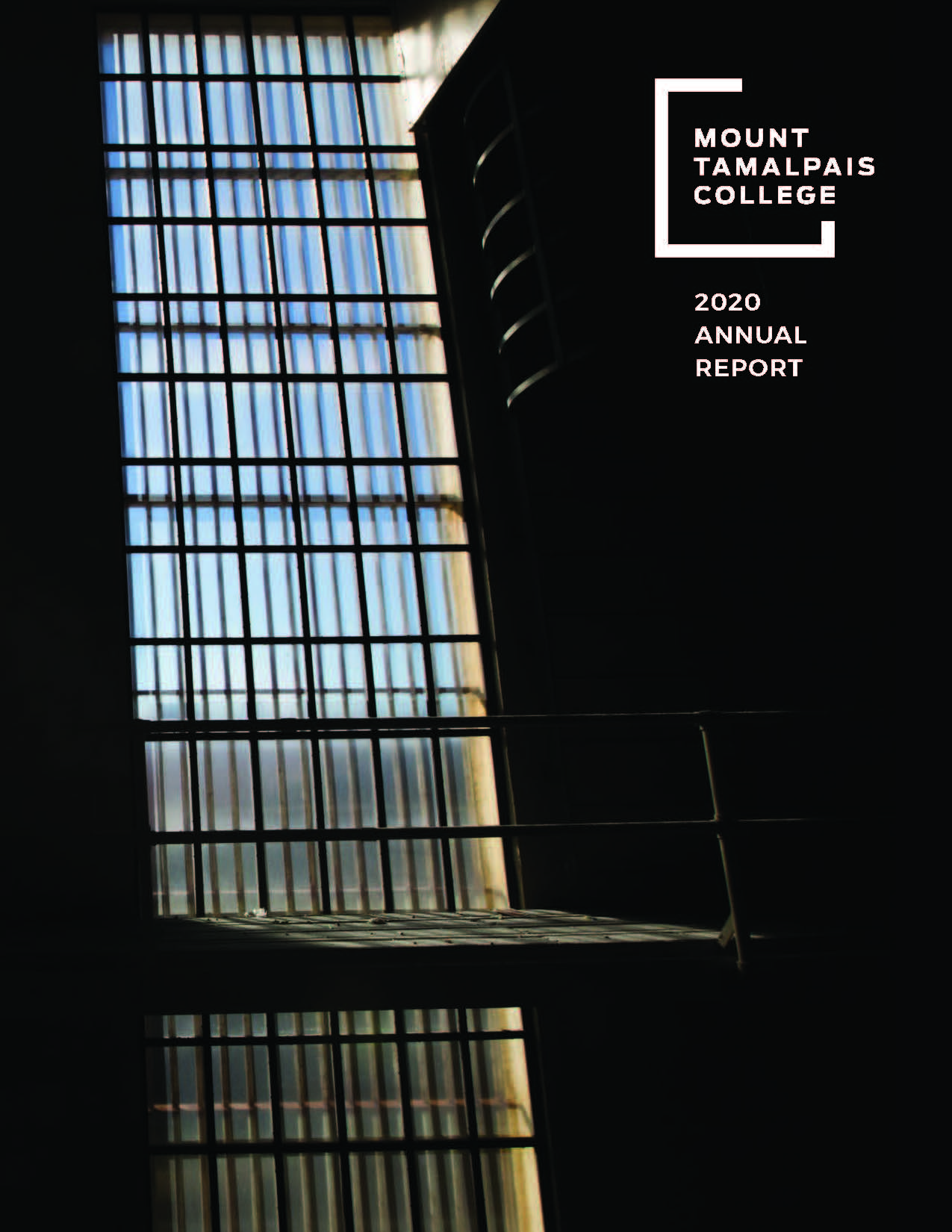
Our 2020 Annual Report is Now Available

April 1, 2021 by Mt. Tam College

It has now been a full year since the pandemic shut down all programs at San Quentin. With this report we hope to not only provide an overview of our work during this unprecedented year, and share insight into how the focus and the impact of our work has shifted focus during this time—we also hope to cast attention on the experiences of incarcerated people in 2020. Thus, in addition to sharing news about Mount Tamalpais College as an emerging institution, we’ve also included an array of content including letters and stories that convey the pandemic’s impact on people in prison, and on those returning home.

The full report is available below.

Filed Under: Announcements, COVID-19, Current Affairs, MTC News

Introducing New Staff Members

January 19, 2021 by Mt. Tam College

Mount Tamalpais College is excited to welcome three new staff members to our team: Denisse Manrique, Jacob Kernodle, and Kevin Milyavskiy.

Denisse Manrique, Development Associate

Before joining Mount Tamalpais College, Denisse worked as the Development Coordinator for the Jewish Community Center of San Francisco for five years. She has been involved with several organizations, including WashPIRG, La Voz Latina, and Glide. She brings with her a passion for equity and creating community to Mount Tamalpais College. She graduated from the University of Washington with a BA in Sociology and Philosophy.

Jacob Kernodle, Registrar

Jacob joined the staff at Mount Tamalpais College after working for nearly ten years serving students and staff in higher education. Through his work as an educator and manager of student systems and records, he has developed a keen devotion to student needs and well-being. He is dedicated to serving marginalized students, especially in the creation of policies and procedures, so he is thrilled to contribute to the Mount Tamalpais College team in their mission. He holds an interdisciplinary BA focused on ethics and leadership from California State University, Monterey Bay.

Kevin Milyavskiy, Assistant to the Chief Academic Officer

Kevin is excited to be part of a mission-driven organization that empowers the incarcerated through education. As a community college graduate, he personally understands how significant Mount Tamalpais College can be for its students. His background includes work in environmental advocacy, technology and human rights, research on political accountability, and immigration law. Kevin earned his BA in Rhetoric from UC Berkeley.

Filed Under: Announcements, Campus & Community, MTC News, People

Program Status and Our Path to Accreditation

June 1, 2020 by Mt. Tam College

Dear friends,

I’m writing several months into the pandemic, which has closed our staff and faculty off from our students, and which has begun to spread among prison populations throughout the US, at rates often far higher than in the general public. It seems at this point that it could be many months before our regular courses are up and running again.

From the start of the pandemic, we’ve been confronted with questions and decisions that feel like ethical thought experiments, but that are all too real: initially—should we keep plowing through the semester, at the risk of bringing the virus into the prison, or to pull our faculty and staff out, severely diminishing the quality of life inside the prison, interrupting students’ academic pathways, and compounding their vulnerability and isolation at the worst possible time? How do we balance risk to life against quality of life? And then, when the answer to that set of questions started to seem more and more obvious, the question that has dogged much of the world of prison higher education swiftly emerged: should we try to devise a way to continue offering credit classes at a distance, even though we know that the quality that we see as the cornerstone of our work would be severely compromised? Or more generally, once we determined that it would not be feasible to continue to offer legitimate credit-bearing coursework inside the prison, where should we focus our energy and resources? What is a college when it can’t run classes?

It seems to me that part of the pandemic experience for almost everyone has included such a barrage of practical and existential questions, at every level, exhaustingly, every day. Should I pull my children out of school? Visit my parents? Teach outdated math to my 6th grader? Am I doing everything I can to flatten the curve? Is technology saving us or poisoning us? What activities put me and others too severely at risk, and what can we or must we continue to do, to preserve our sanity? How has it all come to this? Who am I to complain, when I can sit so comfortably, in full health, on this couch, and go for a run safely?

I’m powerfully aware that my education and access to conversation and consultation with thoughtful and experienced colleagues make it possible for me to think these questions through from multiple angles and to make difficult and sometimes painful decisions with confidence. To wade through this time of crisis and unrest in America and globally, we all need access to trustworthy information; we must be able to think critically and ethically; we need to understand public health principles and basic math; we have to have a grasp of history and politics; we need to have the tools to consider claims about identity and difference carefully; and we have to have opportunities to consider others’ opinions. These and so many other areas of thought and intellectual life are vital for everyday survival, for ethical decision making, now more than ever.

So when we ask what a college is when it can’t run classes, the current calamity is teaching me that our most fundamental responsibility as a college is to help ensure that all people have access to information, learning, and productive dialogue, so that they can take care of themselves, their families, and their communities. Those who are most vulnerable are precisely those who don’t have access to these things. Our students are people who are equally owed these pursuits as rights and whose voices are equally and urgently needed in civic exchanges. Course credits and degrees are critical, but education is more than the semester grind. If we aren’t able to run classes, we can still agitate for and facilitate these crucial skills and dialogues.

So our work continues. As Jody’s letter recounts, our first thought has been for the wellbeing of the community that our campus is embedded within—that is, the entire community of San Quentin. Without physical and emotional safety, learning and thinking are difficult and sometimes impossible. And in voluminous responses to our care packages, we have heard again and again that people at San Quentin are hungry for information and intellectual stimulation. Thanks to the support of iTVS we are now planning a documentary film series to be aired on the prison television channel during the summer. We’re also working with San Quentin to make a large quantity of books that we have stored inside the prison available to the entire population. No amount of academic materials can duplicate the classroom experience, but intervening in the barren intellectual landscape of the prison however possible is especially crucial right now.

Although communication with our students is somewhat delayed by the now-overwhelmed prison mail system, it is still possible, and vital, to hear from them. Specifically related to the current crisis, we are asking how the lives of incarcerated people during this pandemic can be witnessed, so that their social invisibility doesn’t mean their history goes unrecorded. To this end, we have begun an oral history project, which we will be working with students on throughout 2020. Students will learn oral history techniques, then interview others in the prison about their experiences, and develop written narratives to document life inside San Quentin during the pandemic. Through this project, we hope to learn about and disseminate to the broader public a set of experiences and accounts that would otherwise go unseen.

We are also taking this time to continue to building out key features of our program for when we are able to get back inside the prison, exploring ways we may alter and supplement the curriculum during interruptions like the pandemic, lockdowns, and quarantines without compromising quality, rigor, and student support. We’re working with faculty and with our Chief of Institutional Effectiveness and Accreditation, Melanie Booth, to review college preparatory and credit course curricula, as well as to develop regular cycles of learning assessment. Melanie has also been leading the work of constructing the infrastructure and processes required for us to achieve Initial Accreditation status with ACCJC. We remain on track with our accreditation timeline.

During this break from the usual demands of the semester, we’re also turning attention back to our long-standing efforts to bring laptops into this prison. This would greatly improve our students’ access to research materials and other crucial learning tools, as well as prepare us better to continue providing students access to education in the future when we cannot enter the prison. In partnership with leadership at San Quentin and in CDCR, we hope to be able to provide a vastly improved technological education to our students by the time we return to the prison.

Finally, we have been reaching out to alumni and developing plans about future alumni relations. Our team has been working to locate and contact every former student who has been released from prison, to learn about their well-being and needs. In consultation with David Cowan, our Director of Operations and Co-Director of the re-entry organization Bonafide, our Director of Student Affairs, David Durand, has been working to develop our alumni services program. Our aim is to eventually maintain regular contact with our former students, and to provide them with ongoing academic and professional guidance, information, and resources, as well as other critical support services and professional development and networking opportunities.

In the wake of recent horrific reminders of the brutality of racial inequality in America, in the midst of a public health crisis that is unequally ravaging already vulnerable populations, it is clear to me is that the path forward requires a new dedication not only to the safety of the vulnerable, but also to equipping all people with skills, information, tools, and resources, and outlets for their voices and life experiences to be expressed, heard, and learned from. We miss our students terribly, but it’s some relief that we can continue to serve them from afar for now.

Amy Jamgochian
Chief Academic Officer

Please note that the Prison University Project became Mount Tamalpais College in September 2020.

Filed Under: Academics, Accreditation News, Announcements, Campus & Community, In the Classroom, MTC News, Student Life

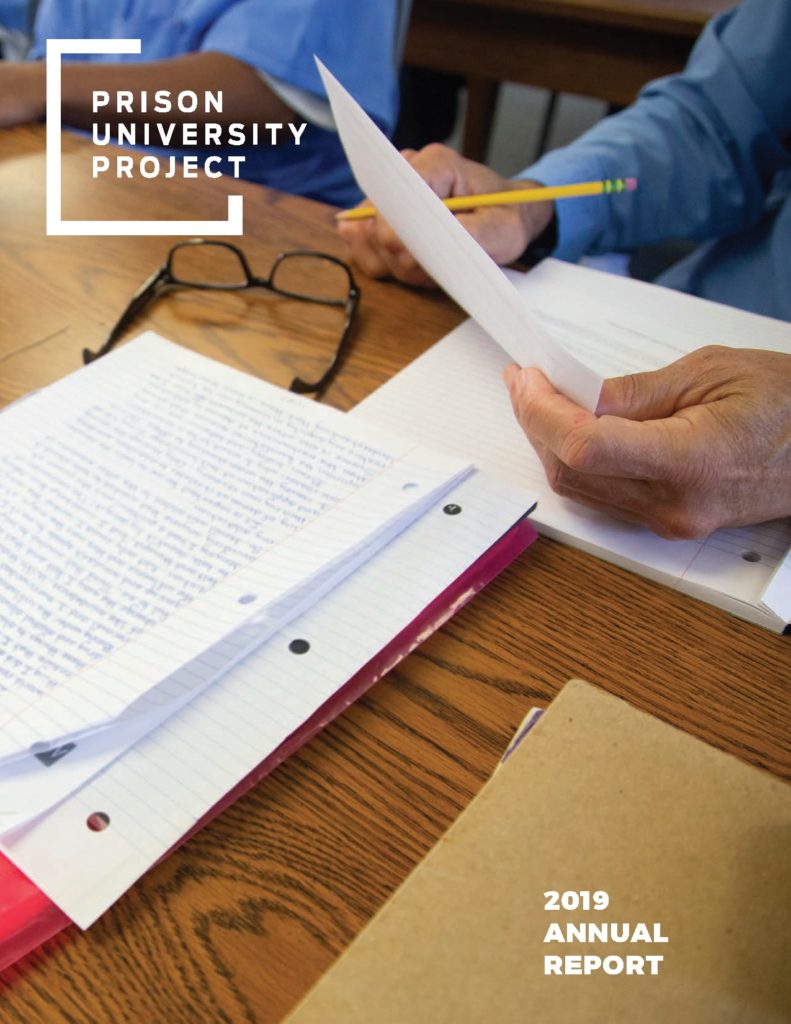
Our 2019 Annual Report is Now Available

May 20, 2020 by Mt. Tam College

Last year was monumental for us as we moved closer towards independent accreditation, and we’re grateful for all of our community members and supporters who helped make it a success. Check out the full report below to see all we accomplished in 2019.

Please note that the Prison University Project became Mount Tamalpais College in September 2020.

Filed Under: Announcements, MTC News

Prison University Project Achieves Candidacy for Accreditation

March 2, 2020 by Mt. Tam College

After 18 months of preparation, the Prison University Project has achieved Candidacy for Accreditation from the Accrediting Commission for Community and Junior Colleges (ACCJC), Western Association of Schools and Colleges. Candidacy is a formal affiliation status granted to institutions that have successfully undergone an Eligibility review, as well as a comprehensive evaluation process, and have demonstrated their ability to fully meet all the Accreditation Standards and Commission policies within the two-year Candidate period. Credits and degrees earned by a Candidate institution are considered to be from an accredited institution

The process of seeking accreditation—and of building out the staffing, internal systems, administrative capacity, and financial resources of a robust, stand-alone academic institution—has been transformative. Joining an institutional community of practice through membership in the Accrediting Commission for Community and Junior Colleges also commits us to a rigorous, ongoing peer-review process, and thus effectively embeds our commitment to high standards and accountability in the fiber of our being.

Above all, creating an independent liberal arts college inside a state prison also sends a powerful statement of commitment to the world of higher education, as well as society at large: serving this community is not an act of charity, or a means of generating revenue, or a strategy for alleviating a burden on taxpayers; our students are fully worthy and capable people, intellectuals, and citizens.

The name of our new school is Mount Tamalpais College, a reference to the prominent mountain in Marin County that dominates the view from San Quentin. Over the course of the coming year, we will continue to build out the infrastructure to support the essential functions of college operation—maintaining an independent student information system; conducting institutional research and establishing protocols for measuring effectiveness; providing students access to information technology, including library services; and establishing robust alumni support services.

The Accreditation page of our website includes resources that document our pathway to this incredible milestone.

Please note that the Prison University Project became Mount Tamalpais College in September 2020.

Filed Under: Accreditation News, Announcements, MTC News

We Are All Directly Impacted: Mapping Societal Wellness, Institutions, and Self

February 28, 2020 by Mt. Tam College

3/10/2020 UPDATE: Due to the threat of COVID-19, the academic conference has been postponed. Please check back for more information soon.

The Prison University Project will host its second academic conference at San Quentin State Prison on April 17, 2020, from 8AM-3PM. The conference, conceived and planned by a committee of Prison University Project students and staff, will involve panels of incarcerated and nonincarcerated scholars. Our conference in 2018 demonstrated the influential perspective shifts that can occur when different communities contribute to dialog around central debates, and we are excited to continue the conversations.

This year, our theme is “We Are All Directly Impacted: Mapping Societal Wellness, Institutions, and Self.” Starting with the observation that both self and institution are socially constructed, our conference aims to explore the ways in which pathways to reaching our individual full potential intersect and conflict with the various social contracts and norms that we are born into. Some institutions, like marriage, effectively create more rights for many participants, while others, like prison, purport to create a safer society by denying rights to those people within its confines. In a similar vein, some institutions like higher education are exclusive to varying degrees, while others, like gender, are largely assigned at birth and difficult to opt out of. At various times throughout the history of this nation, the freedom to drink alcohol, love or marry whom one wants, have various medical procedures, and travel freely, have been deemed detrimental to a healthy society, at the expense of personal wellness. Conversely, institutions that perform policing, military operations, border control, and health or education are considered by many to be essential to our personal wellness.

We will discuss these topics and more at our conference:

  • What is wellness? Is it possible in the context of institutions?
  • How do the individual and the institution intersect?
  • What roles can institutions play in helping individuals reach their full potential?
  • What institutions are missing from our society?
  • What are some empirical indicators of societal wellness? How could these indicators be improved?
  • What are pathways for people with different political ideologies or identities to dialog more effectively?
  • How do wellness and freedom play out across societal structures, identities, and communities?
  • How do different social ways of being affect personal wellness?
  • What roles can or should individuals play to help systems or institutions reach their full potential?
  • How should society respond to people who don’t conform to our institutions or norms?
  • How can institutions of education be reimagined to help more people reach their full potential?

The Prison University Project has been running a college for people incarcerated at San Quentin State Prison since 1996. We run twenty classes each semester and have over 700 active students. The mission of the Prison University Project is to provide an intellectually rigorous, inclusive Associate of Arts degree program and college preparatory program, free of charge, to people at San Quentin State Prison; to expand access to quality higher education for incarcerated people; and to foster the values of equity, civic engagement, independence of thought, and freedom of expression.

Unfortunately, it won’t be possible to have non-presenters attend the conference because of severe space limitations. Please send any questions to conference@prinsonuniversityproject.org.

For more info on last year’s conference, see our news post, “San Quentin’s First Academic Conference: “Corrections, Rehabilitation, and Reform—21st Century Solutions for 20th Century Problems.”

Please note that the Prison University Project became Mount Tamalpais College in September 2020.

Filed Under: Announcements, Conferences, Events, MTC News, Research & Outreach

Introducing New Staff Members

February 12, 2020 by Mt. Tam College

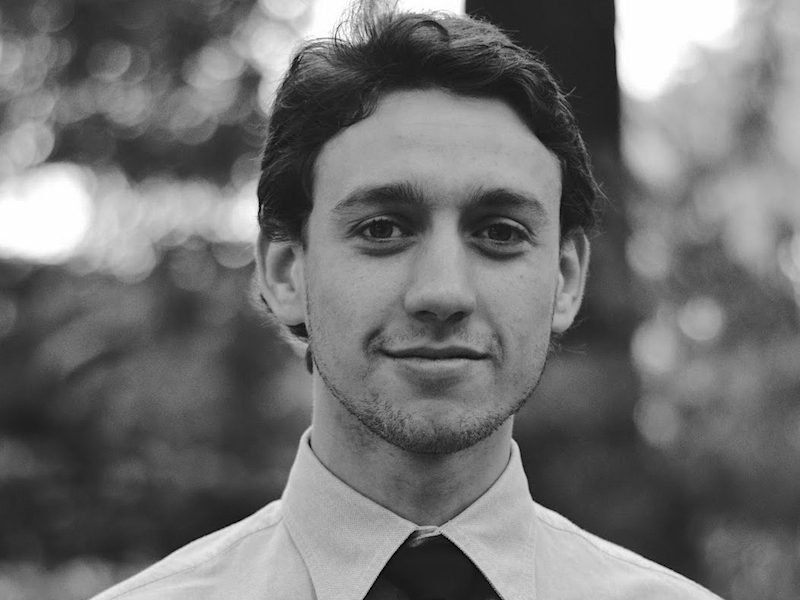
We’re excited to welcome new staff members on board: Melanie Booth, Chief of Institutional Effectiveness and Accreditation; Jahslyn Chen See, Development Associate; Hannah Evans, Technical Assistance Coordinator; Arthur Jackson, Program Clerk; and Makenzie Means, Development Manager.

Melanie Booth has been connected as an advisor to the Prison University Project since the summer of 2019, and joined us in February 2020 as Chief of Institutional Effectiveness and Accreditation. Melanie has served at and consulted with colleges and universities nationally and internationally around educational quality and student success; institutional change and innovation; institutional effectiveness and accreditation; and adult learning and development. She served as the Founding Executive Director of The Quality Assurance Commons as well as Vice President of Educational Programming for WASC Senior College and University Commission. She holds an Ed.D. in Educational Leadership & Change – Higher Education from Fielding Graduate University. She also holds an MA in English, Rhetoric & Writing Studies from San Diego State University and a BA in English from Humboldt State University.

Before joining the development team at the Prison University Project, Jahslyn Chen See served as operations, accounting and professional development coordinator at a residential design firm based in Oakland. Jahslyn is a first generation Afro-Caribbean immigrant currently in pursuit of her MBA with a concentration in Arts Management. She is passionate about emotional intelligence, collective impact, non-violent communication and the art of trauma-informed leadership. Her hobbies include dance, plant-based cooking, and spending time with her brilliant siblings, her fierce mother, and her inspirational chosen family.

Before joining the Prison University Project, Hannah Evans taught English as a foreign language in elementary and middle schools in Nagasaki, Japan. Hannah previously worked for the Prison University Project between 2015 and 2017, and volunteer co-taught a College Preparatory English course for the program in 2017. Her experiences working alongside educators and students at the Prison University Project inspired her to explore a career in teaching, and she went on to teach in a variety of educational settings, including ESL classes for adults, children’s day camps, and tutoring centers for teens. Through teaching, she gained a greater understanding of the value of student-centered education and is excited to rejoin the Prison University Project team in its effort to expand access to high-quality, inclusive education for incarcerated people. Hannah earned her BA from UC Berkeley in Latin American Studies.

Arthur Jackson has been a student with the Prison University Project since 2016 and joined the staff as a clerk in 2019. He served as a teaching assistant for English 99A and currently serves on the student-led academic conference committee. Arthur presented a paper at the 2018 conference at San Quentin, “Corrections, Rehabilitation, and Reform: 21st Century Solutions for 20th Century Problems”. Outside of academics, Arthur is training to become a yoga instructor and working to develop a peer mentorship program for incarcerated youth.

Makenzie Means is thrilled to bring over seven years of experience in nonprofit fundraising to the Prison University Project. Prior to joining the team, she worked in development operations and management at several organizations around the Bay Area. Most recently, she was Director of Development Operations at the Jewish Community Center of San Francisco, and many of her previous roles were similarly focused on education and community-building. Makenzie holds a B.S. in Business Administration from California State University, San Marcos and Master’s Degrees in Public Administration and Nonprofit Management from the University of Southern California and Hebrew Union College.

Please note that the Prison University Project became Mount Tamalpais College in September 2020.

Filed Under: Announcements, MTC News

  • « Go to Previous Page
  • Page 1
  • Page 2
  • Page 3
  • Page 4
  • Page 5
  • Go to Next Page »
mtc seal

Contact Us

PO Box 492
San Quentin, CA 94964
(415) 455-8088


Please note: Prior to September 2020, Mount Tamalpais College was known as the Prison University Project and operated as an extension site of Patten University.


Tax ID number (EIN): 20-5606926

Quick Links

CONTACT US
CAREERS
PRESS KIT
ACCREDITATION
PUBLICATIONS
DONATE


Join Our Mailing List

© 2025 | Mount Tamalpais College | Photography by RJ Lozada | Design & Development by //DESIGN AGENCY//

  • About
    ▼
    • Mission & Values
    • Staff & Board
    • Accreditation & Institutional Research
    • Careers
  • Academics
    ▼
    • Admissions
    • AA Degree
    • College Prep
    • Faculty
    • Apply To Teach
  • Students & Alumni
    ▼
    • Students
    • Alumni
    • OpenLine Literary Journal
  • Resources
    ▼
    • Practitioner Support
    • Resources for Incarcerated Students
    • Research on Prison Higher Education
  • News
    ▼
    • Top MTC Stories
    • Recent Press
    • From the President
    • Commencement
  • Give to MTC
    ▼
    • Donate
    • Shop