• Skip to primary navigation
  • Skip to main content
  • QUICK LINKS
    • CONTACT US
    • CONNECT
      WITH US
    • FACULTY APPLICATION
    • PUBLICATIONS
    • PRESS KIT
    • CAREERS
  • About
    • Mission & Values
    • Staff & Board
    • Accreditation & Institutional Research
    • Careers
  • Academics
    • Admissions
    • AA Degree
    • College Prep
    • Faculty
    • Apply To Teach
  • Students & Alumni
    • Students
    • Alumni
    • OpenLine Literary Journal
  • Resources
    • Practitioner Support
    • Resources for Incarcerated Students
    • Research on Prison Higher Education
  • News
    • Top MTC Stories
    • Recent Press
    • From the President
    • Commencement
    • 2026 Gala
  • Give to MTC
    • Donate
    • Shop

Mount Tamalpais College

Current Affairs

First Person: Why College Matters for People Serving Extreme Sentences

January 19, 2022 by Mt. Tam College

I attended a college surrounded by fences “adorned” with barbed wire. In early 2021, at 50 years old, I earned an associate’s degree from Mount Tamalpais College, which is located on the lower yard of San Quentin State Prison. It’s been life changing.

Mount Tamalpais College, which we call Mt. Tam, provides a classroom education on the prison grounds. The teachers are volunteers from other schools including Stanford, San Francisco State University, Harvard, and Berkeley. It has a study hall area where tutors are available five nights a week and a recently opened computer lab with 36 laptops that allow communication with teachers and access to reference materials through a “mediated internet,” according to Kirsten Pickering, research program fellow. 

For incarcerated people, the quality or success of a college program is often measured by recidivism rates. By that standard, Mount Tamalpais, formerly the Prison University Project, is a success. Its students had a recidivism rate of 17 percent compared to the 65 percent recidivism rate for the California Department of Corrections and Rehabilitation as a whole, according to a 2011 program evaluation. 

Moreover, MTC provides jobs for graduates on parole. I’ve seen Dimitri, a former student, come back into the prison, dressed up in a sharp black suit, as an employee of Mt. Tam. The college recently hired Richard “Bonaru” Richardson, the former editor in chief of San Quentin News. I know of at least three other former incarcerated students that are now Mt. Tam employees. 

For those of us serving long sentences, recidivism rates and jobs can’t measure the success of our college education. My pursuit of a degree started in 2016, approximately 16 years into a 55-years-to-life sentence. I would have to live to be 85 years old to evaluate whether an associate’s degree will break the cycle of incarceration that’s circled my adulthood. Proof of the quality of a Mount Tamalpais education has shown itself in several other ways that impacts society and my life.

Incarcerated graduates have a positive influence on their peers and families. I remember attending a graduation where the valedictorian was a man with locks. His siblings attended the event, two sisters and a brother, plus his mother, sat in the front row as he gave a short speech. Afterwards, one of his sisters said, “I’m so proud of my brother. He’s the first to graduate from college in our family. And if he can do that from prison, I can get my degree too.”

The influence of college on peers is also apparent on the yard. In other prisons, the conversations you usually hear about are sports, war stories, or women. At San Quentin, you can walk by and ear hustle (overhear) debates about ethics, politics, or Plato’s Allegory of the Cave. 

A 2016 qualitative study featuring interviews with 27 Mt. Tam students showed that the program positively transformed how students think about themselves, others, and their futures. Over 90 percent of respondents reported that college positively affected their self-identity, mental health, and personal relationships. More than two-thirds also said that the program has positively influenced the prison culture at San Quentin, particularly in regards to race relations.

Personally, I see education as the key to my success from behind bars. After getting sentenced to a term beyond my life expectancy I needed a path to redemption in the eyes of my mother, my sons, and society that didn’t involve going home. I came up with becoming a writer because my voice was the one part of me that was still free.

I envisioned writing a memoir that people who grew up in tough neighborhoods like I did would read and drop their guns. The problem with that plan was that I only had a high school education and no creative writing skills. In isolation I wrote for 10 years without training or a mentor. Words stacked up that no one heard.

 In 2013, my security level dropped and I was transferred to San Quentin, a progressive lower security prison. Here they have all kinds of programs and I signed up for anything that could make me a better writer, including college, creative writing and the San Quentin News Journalism Guild.

Each program made my writing better and better. I became the sports editor for San Quentin news, and a contributing writer for The Marshall Project and Current. Additionally, the college program offered a communication class that developed my speaking skills. I pursued the oral art to deliver prerecorded speeches over a collect call to reach Stanford, MoMA and to honor James King, the campaign manager for the Ella Baker Center for Human Rights, and California State Senator Nancy Skinner for their work by the nonprofit law firm UnCommon Law. Plus, speaking skills landed me the cohost and co-producer job with the Ear Hustle podcast, which was a 2020 Pulitzer Prize finalist and DuPont award winner. 

In a trailer used for a classroom, I learned the history of Black codes, unions, the New Deal and other events that shaped the environment that shaped me. From gaining this worldview, I began to look beyond the people who bullied me growing up and instead began to see the systems that pitted us against each other. My new perspective made it easier to quit taking things personally, forgive others, let go of my anger, and heal.

Additionally, I learned how political systems work and put that knowledge to use. I inspired Taina Angeli Vargas of the nonprofit advocacy group Initiate Justice to fight for the restoration of voting rights for incarcerated people. Our efforts led to Prop 17, an initiative on a 2020 ballot in California which gained the support to restore voting rights to people on parole.

Another thing that made learning from teachers in person a high-quality educational experience was the socialization. Other prisons only offered correspondence courses that pale in comparison to in person learning. Imagine professors from famous universities volunteering to give you a free education. Their dedication made me feel a love and loyalty to society that I never felt before — I can’t be a waste of their time.

I think the biggest mark of success stemming from my college education on a prison yard is the opportunity to go home. On January 13, 2022 California Governor Gavin Newsom commuted my sentence, which grants me a parole board hearing this summer for a chance of getting a release date in early 2023. As a reason for granting mercy, Newsom’s Legal Affairs Office cited “participating in self-help programming and completing college coursework.”

Editor’s Note: Mount Tamalpais College was founded in 1996 as the Prison University Project, and operated as an extension site of Patten University. In January 2020, the program changed its name to Mount Tamalpais College when it became a candidate for accreditation by the Accrediting Commission for Community and Junior Colleges (ACCJC). The college is the first independent liberal arts institution dedicated specifically to serving incarcerated students.

Rahsaan “New York” Thomas is a writer, podcaster, and director. He was a Pulitzer Prize finalist and won the DuPont Award in 2020 for his work as a co-host and co-producer on Season Four of the Ear Hustle podcast. He’s also the chairperson of the San Quentin satellite chapter of the Northern California Society of Professional Journalists and a contributing writer for Current, the Marshall Project, and San Quentin News. All from a cell at San Quentin State Prison.

Attribution: This article originally appeared in Open Campus on January 19, 2022.

Read Story

Filed Under: Current Affairs, MTC in the News, MTC News

Teaching in Prison: ‘You Have to Respect the Rules’

December 30, 2021 by Mt. Tam College

Even before I started covering college programs in prisons, one of my favorite podcasts was Ear Hustle, which focuses on life inside San Quentin State Prison in the Bay Area.

When I found out that Nigel Poor, one of the co-producers of Ear Hustle, first got involved with San Quentin as a volunteer professor, I reached out to talk about her experience teaching in prison.

In addition to her work with Ear Hustle, Poor is a visual artist and photography professor at California State University-Sacramento. She started teaching a history of photography class with the Prison University Project, now known as Mount Tamalpais College, at San Quentin in 2011.

Poor says that the stories she heard from the men inside San Quentin inspired her to think about how to do artistic projects inside, and she began to volunteer with the prison’s media lab. All of that eventually led to her collaboration on Ear Hustle. She co-hosts the podcast with Earlonne Woods and Rahsaan “New York” Thomas.

This interview has been edited for length and clarity.

Read the full interview here.

CHARLOTTE WEST:  You mentioned that your conversation with the Prison University Project director Jody Lewin helped you feel prepared to teach in prison. What do you think are some of the misconceptions that people might have about prison education?

NIGEL POOR: I think people have misconceptions, first of all, that they’re going to go into this really angry space where people aren’t educated. And that you’re going to be a remedial teacher getting people up to speed because they don’t know how to read and they don’t have basic math skills. And at least at San Quentin, that was not the case. I went into a classroom that was full of people that were really excited to learn and eager to learn. I had students that had master’s degrees. And I had students that had gotten GEDs and had very little formal education but were really prepared to dig in and work hard.

I had to be careful to not go back to my students at Sac State and say, “My students in prison work so much harder than you.” I never get an excuse about why they couldn’t do something. I found very hard-working, rigorous students.

I think that there’s more nuanced things like people going into prison thinking they’re going to save people. There are complex relationships, and you’re going in as a professional to do a job, which is to teach. You’re not going in as a therapist or savior.

You bring that respect and expectation to the classroom that you would bring to any other classroom.

WEST: Were there any rules about what class material you could or couldn’t use? We have this idea of academic freedom on college campuses, but I would imagine that there might be some different rules that you as a faculty member have to follow when teaching in prison. 

POOR: This is what I would tell people: You can have the most radical ideas you want. And you can think that you need to tear prisons down. But when you go into work in a prison, you have to respect the rules that are there. Because you can have all the passion to politically change things, but you always walk out the gate. You can leave behind a shitstorm and cause a lot of problems.

You have to figure out for yourself how to work within a system that you may not respect or respond to, but you have to remember that you always walk out the gate. And I think some people can go on without really thinking about how much trouble you can get other people in if you don’t think through your passions and your ideas.

That being said, I went in pretty naive. I thought, ‘Oh, I’m just going to teach the class I teach at Sac State, I’m going to bring in my PowerPoints on my computer. And I’m going to show all the work that I show.’ And then first thing, Jody was like, ‘No, of course not, you’re not bringing a computer in. You’re going to be using a television to show your PowerPoints.’

And then [I was told by] the prison that I couldn’t show any nudes, no pictures of children, no pictures of violence, drug use or emotionally complex imagery. And I was like, ‘What the hell am I going to teach?’ That is what photography is; it’s about looking at complex issues. The only thing that would be left would be landscape imagery.

San Quentin prison. Photo by Charlotte West. 

But then Jody set up an opportunity for me to meet with the assistant warden to show them what I was going to teach. And so we met and had like a three hour meeting. And I went through a lot of the images that I was going to show and we had a great conversation. And they gave me permission to bring in most of the images, except some images of children.

What that taught me was the really deep importance of conversation and understanding the world that you’re walking into. And that even if you disagree with people, they’re not the enemy. You can have conversations, and you can come to an understanding.

The administration at the prison needed to understand what I was going to show and they needed to feel that they had some control over it. At first, I was upset, but I realized having this conversation opened it up.

WEST: Education is a theme that comes up tangentially in many Ear Hustle episodes. I was recently listening to Catch a Kite 6. When you asked about their proudest moments, Sam Lewis talked about earning his degree and Reggie Thorpe shared how he felt when he found out he was the only African American at San Quentin who had taken Calculus II. Why was that such a big deal for them?

POOR: I think because it’s about self-discovery and realizing your own talents and your own power. For people inside or outside prison, when you realize you can do something that you thought you couldn’t do, it is such a great feeling. It’s exhilarating.

And like Reggie talking about doing calculus, that sounds so frightening to me. And I can imagine when he realized he was good at it and he could help other people, it was like he could all of a sudden see himself in a different way as a leader and someone who could teach, not as someone who’s been incarcerated for a long time.

I’m sure he’s gone through a lot of periods where he felt unseen and unworthy. And so I think education tells you are worthy of something. And that’s just an essential human need. I think that just shows you your own self-worth when you can help bring other people along.

 Charlotte West, a John Jay Justice Reporting fellow, is a national reporter with Open Campus. This article was originally published in the second edition of College Inside, a biweekly newsletter about the future of postsecondary education in prisons, and is reproduced with permission. Sign up for the College Inside newsletter here.  

Attribution: This article originally appeared in The Crime Report on December 30, 2021.

Read Story

Filed Under: Current Affairs, MTC in the News

Mount Tamalpais College Awarded one of 2021 California Nonprofits of the Year

June 25, 2021 by Mt. Tam College

Mount Tamalpais College honored by Assemblymember Marc Levine

San Rafael, June 25, 2021 – Mount Tamalpais College is proud to announce its selection as a 2021 California Nonprofit of the Year by Assemblymember Marc Levine. Mount Tamalpais College is one of more than one hundred nonprofits that will be honored by their state senators and assemblymembers for their tremendous contributions to the communities they serve.

Mount Tamalpais College (formerly the Prison University Project) provides an intellectually rigorous, inclusive Associate of Arts degree program and college preparatory program, free of charge, to people at San Quentin State Prison. It strives to expand access to quality higher education for incarcerated people; and to foster the values of equity, civic engagement, independence of thought, and freedom of expression. For over twenty years, the College Program at San Quentin has been the site of a unique educational enterprise for one of our country’s most vulnerable populations. More than 4,500 students have participated in the program since its founding. Hundreds of alumni are now living, working and/or continuing their studies throughout the state of California.

From Jody Lewen, President of Mount Tamalpais College: “We are overjoyed and deeply grateful to receive this recognition from Assemblymember Levine, especially at such a special moment in the life of our new academic institution. We hope that the community of Marin County, and the state as a whole, will recognize and embrace the transformative and groundbreaking work being done by Mount Tamalpais College, and join us in lifting up the community of San Quentin Prison, and the larger incarcerated population, for the betterment of all.”

“The pandemic and shelter-in-place orders of the past year and a half have put nonprofits – usually hidden in plain sight – in the spotlight,” explains Jan Masaoka, CEO of the California Association of Nonprofits (CalNonprofits). “California Nonprofit of the Year is an opportunity for our elected officials to celebrate the good work they see nonprofits doing in their districts, and for everyone to appreciate the collective impact of nonprofits in our communities.”

Additional Background

California Nonprofits Day, now in its sixth year, was formally recognized by 2021 Assembly Concurrent Resolution 80, authored by Assemblymember Luz Rivas, and co-authored by Senator Monique Limón. Each year legislators from across California have chosen a Nonprofit of the Year in their district.

Traditionally, honorees and legislators are invited by CalNonprofits, Chair of the Senate Select Committee on the Nonprofit Sector Senator Monique Limón (Santa Barbara), and Chair of the Assembly Select Committee on the Nonprofit Sector Assemblymember Luz Rivas to a celebratory luncheon on California Nonprofits Day. This year, like 2020, the luncheon was canceled in response to pandemic restrictions, but legislators moved forward with honoring nonprofits doing great work in their districts.

According to “Causes Count,” a 2019 report commissioned by CalNonprofits, the nonprofit sector is the 4 th largest industry in the state, employing more than 1.2 million people. Each year, California nonprofits generate more than $273 billion in revenue and bring in $40 billion in revenue from outside of California. The unpaid labor contributed by volunteers at nonprofits is equivalent to 330,000 full-time jobs every year.

Filed Under: Awards & Recognition, Current Affairs, MTC in the News, MTC News

In-Person Classes to Resume in September

June 3, 2021 by Mt. Tam College

We are thrilled to announce that we have been approved to return to in-person classes inside San Quentin in September. During the summer, we will plan and prepare for the fall semester, run extracurricular activities, provide student advising, and rebuild our campus community. We also launched a summer correspondence term on June 1 with 16 courses, alongside college preparatory math and writing. These one-credit, elective courses qualify for Milestones, which allows a student who passes three correspondence courses to have three weeks reduced from his sentence. The courses for our summer term are listed below.

College Preparatory Math

College Preparatory Writing

BIO 180: The COVID mRNA Vaccine: The Product of Decades of Research

ENG 180: What is Poetry?

ENG 180: Building Fiction from True Stories

ENG 180: Wilderness Stories

EST 180: 1 ST: Contemporary Environmental Issues

EST 180: Introduction to Energy Systems

HED 180: Foundations of Global Public Health

HIS 180: 20th Century Social Justice Movements

HIS 180: The 1619 Project: Examining the Debate over Slavery and the Nation’s Founding

HIS 180: Histories and Strategies of Decolonization

MTH 180: Introduction to Trigonometry

MTH 180: Introduction to Geometry

POL 180: Mutual Aid

POL 180: Parties and Polarization Today

PSY 180: Psychologies of Liberation

PSY 180: The Psychology and Literature of Memory

We piloted correspondence courses in Spring 2021 during the extensive lockdown caused by the COVID-19 pandemic. Over 200 students took courses on a range of topics, including Climate Change, Poetry In Times of Crisis, and Landmark U.S. Court Cases. Although mail delivery slowdowns created hurdles, feedback from students showed that the pilot was a success. We are looking forward to supporting students and faculty with the summer semester and returning to face-to-face instruction.

Filed Under: Academics, Announcements, COVID-19, Current Affairs, In the Classroom, MTC News

Historic Agreement Reached Allowing Laptop Use by Students

June 2, 2021 by Mt. Tam College

We are thrilled to announce that we have reached a historic agreement with the administration at San Quentin State Prison around the use of technology by Mount Tamalpais College students. As we resume in-person classes, we will have laptops, charging carts, and printers available in the prison for student and faculty use. Students will be able to use laptops during class or in the education building.

Laptops will allow students to conduct research independently and access learning supports and word processing capabilities. They may also access online resources available on the California Department of Corrections and Rehabilitation Canvas Learning Management System. This initiative will begin on a limited basis, and will gradually be expanded over time.

This agreement represents a significant gain for our students. For the past twenty-five years, students have not had access to technology or computers during their studies. They have handwritten work and conducted research using printouts and course readers sourced by faculty members and a limited collection of books. In fact, very few programs at San Quentin have been allowed to bring any technology or equipment inside the prison, resulting in a marked technology gap among incarcerated people upon their release.

Ultimately, we hope that students will have access to the laptops during lockdowns or quarantines and be able to engage in synchronous and asynchronous remote instruction as needed. We are now in the process of purchasing and processing the equipment for use as in-person programming resumes. 

Filed Under: Academic Papers & Studies, Academics, Announcements, Current Affairs, In the Classroom, MTC in the News, MTC News, Research & Outreach

COVID-19 Relief Efforts Expand to Additional Prisons

May 24, 2021 by Mt. Tam College

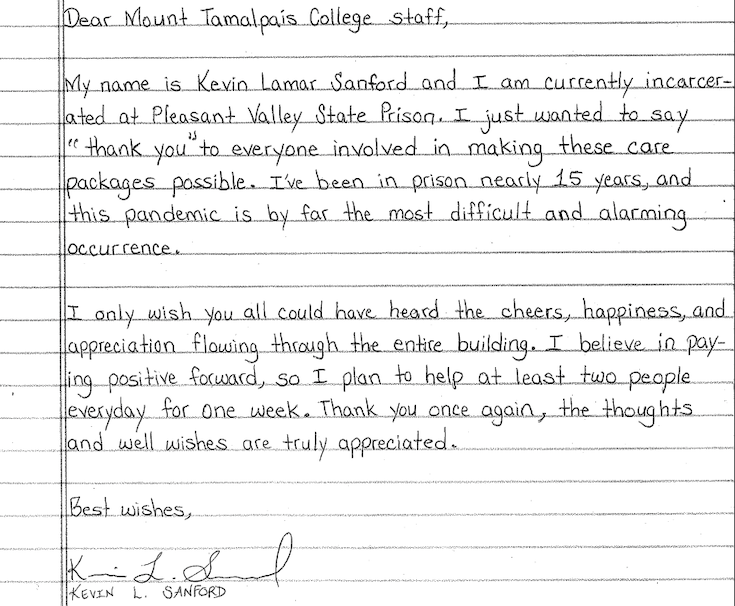
The resoundingly appreciative response we have received for our COVID-19 relief efforts has prompted us to expand those efforts to eight additional prisons in California, including one as far away as the Arizona border. Work that began with a small handful of volunteers in May 2020 has now grown to include dozens of volunteers and staff, providing anywhere from a few hours to weeks or months of support, preparing shipments of more than 3,000 care packages at a time. Funded by a grant from an anonymous donor, the team recently delivered care packages to California Men’s Colony, Calipatria State Prison, Centinela State Prison, Chuckawalla Valley State Prison, Ironwood State Prison, Kern Valley State Prison, North Kern State Prison, and Wasco State Prison.

“We become numb at times. But it is gifts and acts of kindness such as yours that bring us back to reality, and let us know we are never really alone.“

Sonny Aguilar, after receiving a care package while incarcerated at Corcoran State Prison

The contents of the care packages, which have been adapted over the course of the year, include essential supplies that are hard to come by in prisons at the moment: reading and writing supplies, stamps, envelopes, toothpaste, soap, cough drops, non-perishable food items, and information about COVID-19. To support the well-being and morale of corrections staff, we continue to provide food trucks at each prison to serve meals over a 24-hour period.

“What you guys have done is something that moves us deep down inside and gives us a sense of a brighter future.”

Ernesto Sanchez, in response to care package deliveries at Pleasant Valley State Prison

We have now hosted food trucks and delivered over 50,000 care packages to people incarcerated at 18 California prisons. In addition to the aforementioned prisons, these include: Avenal State Prison; California Institution for Men; California Institution for Women; California Rehabilitation Center; California State Prison, Corcoran; California State Prison, Los Angeles County; California Substance Abuse Treatment Facility and State Prison, Corcoran; Folsom State Prison; Pleasant Valley State Prison; and San Quentin State Prison.

This work has been well-received; the California Department of Corrections and Rehabilitation publicly thanked Mount Tamalpais College for boosting morale among employees and we received hundreds of letters from incarcerated people. 

“I didn’t think anyone cared about us in here,” wrote Levi Strong from Pleasant Valley State Prison. “Lots of people in here have nothing and no one so I’m sure it ment [sic] a lot to everyone else in here, not just me.” To read more letters from incarcerated men and women during the pandemic, visit our full library of letters.

“…underneath all the muscels [sic] and tattoos we just want to be loved and you guys showed us a little love today and it goes a long way.”

Levi Strong, thanking Mount Tamalpais College for the care packages delivered to Pleasant Valley State Prison

In addition to care package deliveries across the state, we have also focused on the needs of the incarcerated population at our college site of San Quentin State Prison. For the past year, incarcerated people at San Quentin have spent 23 hours a day locked in their cells. Most outside programming is still on hold and in-person family visits did not resume until April 11. To address this isolation, we secured a grant from the Ravi and Naina Patel Foundation in February 2021 to purchase 200 televisions for incarcerated people at San Quentin who do not yet own one, allowing them a means to stay abreast of the news and a form of entertainment.

Filed Under: COVID-19, Current Affairs, MTC in the News

Journalism at San Quentin

May 3, 2021 by Mt. Tam College

Attribution: This article originally appeared in SFWeekly on April 29, 2021. Read Story

When a COVID-19 outbreak ravaged San Quentin State Prison last May, infecting over half the incarcerated population and killing 28 prisoners, Juan Haines was one of the inmates who tested positive. Rather than placing him in the already maxed-out infirmary, guards moved him to Badger Unit, one of the prison’s solitary confinement wards.

He was quarantined in cell 314, a squalid 4-foot by 10-foot enclosure with no electricity. He was provided scant medical attention and let out only to shower once every three days. Perched on the top bunk, Haines turned to writing. Using pen and paper, he documented the harrowing conditions of the prison and sealed his report in an envelope.

He addressed his letter to the editors of The Appeal, a news outlet dedicated to telling the stories of underserved communities, including the experiences of incarcerated individuals. San Quentin’s treatment of sick inmates was no longer a secret. 

“People were dying left and right,” Haines said during a collect-call telephone interview for this story. “I’m housed in North Block. We’re pretty much double-celled in there, so it was already overcrowded. It was particularly deadly because the buildings are unventilated and the windows are welded shut.”

When Haines penned his letter, he was not only reaching out to a group of fellow human beings, he was also appealing to a professional kinship. Haines is a journalist — an incarcerated journalist — reporting from within an institution historically synonymous with silence. 

As the senior editor of one of the few prisoner-run newspapers in the nation, the San Quentin News, Haines and his incarcerated colleagues work with a team of professional volunteer staff and advisors to produce a monthly paper distributed to inmates across California prisons. Known as “the pulse of San Quentin,” the San Quentin News is a vital source of information for individuals doing time throughout the state, as it provides updates on new state policies and the latest on reform efforts.

In 2015, reporters like Haines were officially recognized as professionals when they became members of the Society of Professional Journalists. Under the guidance of the SPJ, the first chapter inside a prison was born. 

Today, over 40 incarcerated journalists work inside the walls of San Quentin, writing and producing print, radio, and video journalism that has been published locally and nationally in a variety of outlets — including The San Jose Mercury News, The Marshall Project, The Appeal and KQED.

Inside Scoop

In addition to providing his fellow inmates a stream of information tailored to their daily lives, Haines and his peers come to the table with a perspective that few, if any, reporters on the outside could hope to offer.

When COVID-19 hit, the San Quentin journalists — much like members of the press trapped inside the U.S. Capitol on Jan. 6 — were faced with a potentially lethal challenge and a serious scoop. It was the exclusive nobody wanted.

The crisis erupted shortly after the transfer of inmates from the California Institute for Men, a prison already suffering through a major outbreak. The transfers, some of whom hadn’t been tested in up to four weeks, mixed into the San Quentin population.

Haines, who tested positive for COVID-19 in June, wrote a number of stories about the conditions that made San Quentin susceptible to the deadly outbreak, exposing the failures of prison administrators along the way.

Inside the walls of the crowded San Quentin — one of several California prisons operating at more than 100 percent capacity — prisoners feared reporting their symptoms, lest they be quarantined in solitary confinement. Some had the once-a-year privilege of seeing their children revoked due to the outbreak. Others lived out their final days in their cells. 

The California State Senate is currently investigating the San Quentin COVID-19 outbreak. Many prisoners have filed lawsuits and petitioned to be released or relocated. Although San Quentin’s COVID-19 rates have dipped in recent months, infections across the California Department of Corrections’ 35 prisons persist among many of the system’s most vulnerable populations. Over the past year, almost 50,000 CDCR prisoners have tested positive for COVID-19; 222 have lost their lives. 

“It’s terrible. It’s a human rights crime of the highest order,” says Hadar Aviram, a UC Hastings law professor. In October, Aviram wrote a case brief on behalf of the ACLU of Northern California, which was representing San Quentin prisoners. That brief ultimately led the California Court of Appeals to rule that the CDCR administration had acted with “deliberate indifference” in their handling of the outbreak. The court ordered the CDCR to reduce San Quentin’s prisoner population to 50 percent capacity.

In late December, the California Supreme Court sent the case back to the Court of Appeals, effectively putting the order on hold. Today, activists around the Bay Area continue rallying for fair treatment of those behind bars. Aviram, who many regard as a leading voice of prison reform advocacy, says the ongoing litigation around safeguarding inmates during the pandemic amplified the need for reform many have long been fighting for. “I think the virus is illuminating a lot of pockets of suffering and neglect that were there before.”

Aviram works closely with local advocacy groups. Most recently, she’s joined forces with the Stop San Quentin Outbreak Coalition. The coalition, composed of lawyers, family members of inmates, former prisoners, concerned citizens, and young activists, marched to the prison walls in July with bullhorns and banners — publicly demanding that Gov. Gavin Newsom reduce the incarcerated population and take action against the California prison outbreaks.

Aviram says the work of the incarcerated journalists has been essential to activists. “What we desperately need is people trying to advocate for people inside. We can only advocate if we know the facts,” Aviram said. “Folks like the San Quentin News are doing a crucial job because they are the ones closest to what’s actually happening. They’re the ones getting the stories. It’s crucial to have journalism behind bars.”

According to Rahsaan Thomas, an incarcerated journalist interviewed for this story, prison officials do not censor the San Quentin News unless a story incites violence or is perceived to be disruptive to prison security. “As long as there’s no security issue, they can’t tell us what to say, and they generally don’t,” Thomas says.

As for the way members of the prison population — or powerful individuals on the outside — perceive his work, that’s a different concern.

“I do feel like I have to be careful about how I word things sometimes,” Thomas continues. “It could hurt me on parole board. It could affect politicians’ decisions on letting me go early. I am mindful of that.”

Thomas, who’s serving 55 years-to-life for second-degree murder, has developed considerable influence as a chronicler of prison life. 

Through the pandemic, he curated an online art exhibit called “Meet Us Quickly” centering the work of incarcerated artists with the Museum of African Diaspora. He is the co-producer and co-host of a podcast called Ear Hustle, which boasts over 20 million downloads. Working in collaboration with outside producers, Thomas shares snapshots of his daily life with the intent of breaking down stereotypes about people behind bars. 

“You get entertained and you also understand we’re just like you,” Thomas says. “They see you as a non-human, of course, they’re not going to help you. It’s very important to have journalists in here to get the story right so the public gets the full picture and correct information and they can make the best decisions when it comes to breaking these cycles.”

More to Say

As the saying goes in the news business, “If it bleeds, it leads.” And the Marin County prison’s battle with COVID-19 has served to draw a new wave of readership to the San Quentin News.

But the journalists working inside the prison are interested in plenty of topics that have nothing to do with the virus, and their mission — to “report on rehabilitative efforts to increase public safety and achieve social justice” — remains a guiding force.

“I’ve been at San Quentin since 2007, and I’ve been reporting the good, the bad, and the ugly,” says Haines, who’s serving a 55 years-to-life sentence for robbing a bank in 1996. 

“There’s a lot of great things that happen here as far as rehabilitation is concerned, and the opportunities for people to show accountability, redemption, and rehabilitation.”

Open some of the latest editions of the paper and you’ll find hundreds of inmates in caps and gowns graduating from rehabilitative programs, op-eds about Newsom’s new reform policies, or an inmate earning his Master’s of Business and Administration degree. Other editions feature prison administrators and inmates working together to host their annual Mental Wellness Week; Google executives visiting participants of the prison’s coding class; a sit-down visit between the San Francisco Police Department and the men they put behind bars; or public defenders stopping by for a four-course meal prepared by “San Quentin Cooks,” a rehabilitative program aimed at teaching skills for reintegration into the workforce upon release.

“Incarcerated people housed in jails and prisons all over the country write into the newspaper seeking to receive their own copies of the newspaper. Issues that are relevant in California are also relevant elsewhere,” says Lt. Sam Robinson, San Quentin’s Public Information Officer and administrative supervisor of the San Quentin News. “The stories I see that resonate the most are the success stories of people graduating with high school diplomas, GEDs, vocational certificates, or college degrees in addition to the stories of how people have grown and changed their lives through participation in rehabilitative programming, inspire others that they can evolve and have life-changing accomplishments as well.” 

Success Story

This was true for Jesse Vasquez, former editor-in-chief for the San Quentin News, who says his involvement with the newspaper and other rehabilitation programs are the reason he’s a free man today after spending half his life in prison. 

“We [San Quentin News reporters] want to be an instrument of social justice,” Vasquez says. “What society expects in a prison is violence, riots, drugs, and stuff like that, but that isn’t news to the outside. Minds have been trained to think that prisons harbor the most horrible of individuals, and yet you see that they’re graduating, they’re participating in Shakespeare and putting on performances.”

Vasquez was arrested and convicted for attempted murder and assault with a deadly weapon after a drive-by shooting at the age of 17. He says from a young age, he knew he would likely fall into the prison system. 

“It was the way that I lived in my neighborhood, the things that I saw led me to believe that violence was a form of conflict resolution and that was the way that you solve problems.”

His own experience growing up in the prison system made him cynical. He didn’t believe that he and others caught up in the carceral system would ever find another way forward. Then, he says, the San Quentin News gave him reason to second guess his nihilistic views. He was serving time at Folsom State Prison when he read his first copy of the paper.

“I started reading the newspaper and I kind of thought it was just state propaganda,” he says. “I had never seen a prison like this. Every prison I was at had limited programming and there was this us-against-them mentality between staff and the incarcerated.”

But then, something began to change. Vasquez decided that if he were going to be locked up, he’d rather be in an institution that at least attempted to give the inmates a creative outlet and a voice. And so, when he had the opportunity to transfer prisons in 2016, he chose San Quentin.

“I can honestly say that up until the point I got to San Quentin, I was content with being in prison,” Vasquez says. “I had come to terms at a young age that I was likely going to die in these institutions. When I got to San Quentin, that contentment shifted to where I wasn’t satisfied with dying in prison. I wasn’t satisfied with staying in prison the way prison was. I wanted to do something about it because everybody else seemed to think we could do something about it.”

Vasquez, who now manages a housing program in Oakland for formerly incarcerated people, says his relationship with volunteer staff and advisors set him up for success. 

“They mentored me and helped me understand who I was and my professional capacity. That environment facilitated that growth where I’m able to navigate better. I have these skills that I developed because of the volunteers taking the time out of their day to come and visit us inside and impart to us their wisdom and understanding.”

Catalyst for Change

The San Quentin News is not only an inspiration to the incarcerated — it is a catalyst for change throughout California’s carceral system, as more prison news publications spring up around the state. Vasquez says while he was working at San Quentin’s paper, multiple prisons reached out inquiring about how to start a paper or newsletter of their own. 

The Mule Creek Post at Mule Creek State Prison, The Pioneer at Kern Valley State Prison, and Solano Vision at California State Prison Solano are active prison news publications in the mold of the San Quentin News. 

However, according to Steve McNamara, a volunteer advisor for the San Quentin News, while other prison publications are doing their best, they are all missing a key piece of the puzzle: civilian mentorship and support. “Some of the other prisons have begun to experiment with other papers, but of course what they really need in the beginning are volunteers who have some experience in this business and who are willing to devote time to get it off the ground,” says McNamara, former owner of Marin County’s Pacific Sun newspaper.

McNamara, an advisor for the San Quentin News since 2008, says those looking for proof that the paper has made a difference in the culture of the prison just need to look at the data behind prisoner transfers. As it turns out, Vasquez isn’t the only one who has sought to be moved to San Quentin in recent years.

“Inmates angle to get transferred to San Quentin,” McNamara says. “It used to be a scary place, and it is no more.”

McNamara concedes that the prison newspaper itself may not deserve all the credit. Rather, it is the underlying secret to the success of the San Quentin News that has turned the tide. Its proximity to the left-leaning, highly progressive Bay Area means San Quentin benefits from a wealth of willing volunteers all aiming to change the criminal justice system for the better.

At San Quentin, the paper is just one of ample rehabilitation activities and programs aided by thousands of volunteers — all of which are intended to build skills and facilitate avenues of success for the incarcerated.

“All the programs involve a close relationship between the participants and the volunteers who come in,” McNamara says. “They are people who are there predisposed towards believing in the reform of the criminal justice system.” 

Crime & Punishment

Although the Bay Area’s left-leaning population may drive support for programs like the San Quentin News, jailhouse journalism isn’t favored among all Bay Area residents.

“These guys are individuals who’ve committed grave and violent acts against innocent victims,” says Marc Klaas, founder of the KlaasKids Foundation, a victim’s rights organization based in the Bay Area. “They’ve been put in San Quentin and they’re put in these prisons because they’ve lost their right to public access. They’ve lost their right to be able to express their views.”

Klaas is a public figure who speaks on behalf of many victims of crime and their families. His daughter, Polly Klaas, was kidnapped from her Petaluma home at knife-point during a slumber party and later strangled to death at the age of 12 in 1993. Polly’s killer, Richard Allen Davis, sits on San Quentin’s death row.

Since the age of 12, Davis had been in and out of the prison system for both misdemeanors and felonies. In June of 1993, he was released on parole from the California Men’s Colony in San Luis Obispo after serving only half of a sentence for another violent kidnapping in 1984. 

“When my little girl was kidnapped and murdered in 1993, we had a crime epidemic in the entire United States, and it was because there were some very soft-on-crime policies,” Klaas says.

“The guy that kidnapped Polly, for instance, had been convicted twice previously of kidnapping. For his second kidnapping, he was released from prison after serving only eight years of a 16-year sentence, and only three months later my daughter was dead at his hands,” Klaas said. “Now 27 years later there’s a movement to ensure that he’s treated fairly?”

Davis’ extensive criminal record fueled advocacy for the passage of California’s controversial “three-strikes law” for repeat offenders in 1994. The law significantly increases prison sentences for convicts with two or more previous felonies, which has led some to be handed life sentences for non-violent crimes. 

Prison reform advocates say “three strikes” leads to overcrowding in prisons, perpetuating mass incarceration, and deters incarcerated individuals sentenced to life without parole from participating in effective rehabilitative programs. 

Klaas doesn’t entirely disregard support for rehabilitation but says it shouldn’t apply to everyone.

“I believe there are individuals that can be rehabilitated. For instance, I think that people who find themselves in prison because of drug-related situations can be treated and moved back onto a positive path, but once you get into the business of hurting people, of violence against people, I think you’ve taken a step too far and I don’t know if these are people we should be rehabilitating.”

Restorative Justice

The message of victim’s rights advocates has long resonated with political leaders and, according to UC Hastings’ Hadar Aviram, that tough-on-crime position is at once understandable and a roadblock to meaningful prison reform.

“I think that it is very important to listen to victims. And at the same time, it is also important to remember that victims should not be the moral arbiters for every public policy that has to do with justice,” Aviram says. “One of the things that we’ve seen in the culture of California is that victim advocacy groups and victim’s rights movements hijack the conversation to the point that no politician on the right or the left can afford to be seen as soft on crime.” 

UC Berkeley law professor Jonathan Simon believes that rehabilitative measures should be offered to all prisoners. According to Simon, a legal scholar and historian, they are an effective means of addressing the underlying reasons individuals commit crimes, particularly violent offenses. 

“Undoubtedly, the most serious crimes generate strong emotions, but we’ve enhanced it by myopic focus on the act and unwillingness to consider the person’s life courses,” Simon says.

“If we’re going to incarcerate people we should give them access to education and other things that allow them to protect their integrity.” 

To Simon, San Quentin’s COVID-19 crisis is proof that California’s prisons have reached a breaking point and that the correctional system is in need of a serious overhaul.

“When institutions become so toxified that they’re not able to correct themselves by responding to the needs of the humans that they’re managing, it’s time to look for radically different solutions,” he says. “I think it’s hard to conclude from this COVID crisis that we’re not there.”

And yet, as damaging as the pandemic was to public perceptions of CDCR, and as much as the outbreaks amplified public sympathy for the incarcerated and sparked discussions around reform, Simon isn’t holding his breath. With litigation to thinning inmate populations at a standstill, he recognizes a powerful set of beliefs aligned against change. 

“I think it’s a sign of how durable some of these crime myths are, that even at a time when there’s a lot of agreement that we need to change things, it’s been hard to convince the state to dramatically shift,” Simon says. “There’s a whole series of beliefs that are well worn into our legal thinking about imprisonment. One is what I like to describe as the myth of debt, that somehow there’s a debt that a crime creates, and unless somebody pays the full amount of it back, that everybody else has been cheated in some way. It’s powerful. It leads to the opposite, that is a system that can’t stop collecting.”

Still, Simon and other prison reform advocates do see signs of movement — chiefly in the engagement of the young activists who speak out when they recognize injustice. 

“The Black Lives Matter movement, as well as lot of other Americans who joined protest movements over the summer in response to George Floyd’s murder, are pretty significant,” he says, “because it’s the first time we’ve ever had a social justice and racial justice movement that’s squarely focused on the criminal-legal system as the [primary] target. I think that’s very positive in terms of driving change.”

While activists around America have marched in the streets for those historically silenced, the incarcerated journalists inside San Quentin continue to fight — and write — for justice. In that battle, a pen and paper are their weapons of choice.

“I have a saying for people who want to voice themselves,” says San Quentin News editor Juan Haines. “I tell them, ‘Pick up a pen, hold in firmly in your hand, and push it forward.’”

Lily Sinkovitz is a contributing writer. news@sfweekly.com

Filed Under: Campus & Community, COVID-19, Current Affairs, Student Life

How I Convinced My Incarcerated Peers to Make Language a Priority

April 19, 2021 by Mt. Tam College

Rahsaan Thomas, an imprisoned journalist, has long fought to change the way outside media describe people in prison. One of his toughest crowds? His fellow reporters.

I once read an article about an “inmate firefighter” ineligible for compensation because he was incarcerated. The piece highlighted his heroism and argued that people should be paid for such dangerous work, regardless of their imprisonment. But the piece missed the point. The system devalued this hero because he was considered an “inmate” rather than a human being with an identity, history, family or community. The word choice reinforced the very trope the story attempted to challenge.

I know that journalists can do better because I’m one myself. At San Quentin State Prison, where I am serving multiple life sentences, I serve as the chairman of a satellite chapter of the Society of Professional Journalists for Northern California (SQ-SPJ). I also co-host the Pulitzer Prize-nominated “Ear Hustle” podcast, and I co-founded the Empowerment Avenue Writer’s Cohort, a program that pairs imprisoned scribes with volunteer reporters on the outside.

I don’t argue that other journalists should refer to me as a “person in prison” because I’m an angel who deserves steak dinners delivered to my cell. I do it because labels invite people telling our stories to obscure the complexity of crime. Sometimes human beings do horrible things, particularly in response to violence, trauma, shame, poverty, racism and other forms of oppression.

Almost every mass destruction of an oppressed group starts with those in power using language to strip group members of their humanity. Once you aren’t considered human, your life isn’t valued. Take the nearly 150 women incarcerated in California prisons who, between 2016 and 2010, were coerced into sterilization by doctors on contract. Atrocious acts like that don’t happen to “soccer moms.” They happen to “inmates” and “criminals.”

And despite ongoing debate over the concept of journalistic objectivity, I still believe it’s a journalist’s duty to use unbiased language. Terms like “inmate” are not objective. They are jargon that corrections officers use to desensitize themselves to seeing two “inmates” living in a cell the size of a kettle. A C.O. who is fair or friendly to incarcerated people gets branded an “inmate-lover.” (What does that remind you of?)

Almost every mass destruction of an oppressed group starts with those in power using language to strip group members of their humanity. Once you aren’t considered human, your life isn’t valued.

“Prisoner” isn’t objective, either. Like “inmate,” “prisoner” comes preloaded with a specific narrative. In this case it conveys a bias toward incarcerated people because it suggests that they are “political prisoners” or “prisoners of war.” I use the occasional “prisoner” as a civilian but never as a journalist.

In 2019, in an effort to do something about this issue, I decided to hold a symposium at San Quentin. I wanted SQ-SPJ to invite outside journalists into the prison to discuss their coverage of system-affected people. But first I had to convince SQ-SPJ members that it was worth our time; many of the men had no problem labeling themselves.

Everything came to a head in a fall 2019 meeting. In a small room with studio lighting and iMacs along a wall, 15 incarcerated journalists and three sponsors sat in a circle.

“I think we should conduct a survey on the yard to see what they want to be called,” said Tim, a stocky San Quentin News reporter from Oakland.

“It’s not about a survey,” I retorted. “It’s about living up to the principle of professional journalists to minimize harm. The word ‘inmate’ does harm.”

“That’s your opinion,” said Juan, an incarcerated freelance journalist and senior editor of San Quentin News. He supported using “inmate” when “incarcerated person” was too long for headlines and text.

I wanted to say, “We are worth the extra letters,” but I shot back, “This is a matter of behavioral science and testimonial evidence.” I had read “The Lucifer Effect” by psychologist Philip Zimbardo, which describes how ordinary people become capable of mistreating others who they don’t view as human.

“What are we, pansies?” demanded L.A., a bald older man. “It doesn’t matter what people call us. Plus, we need to honor our victims instead of demanding to be called ‘incarcerated people.’”

“We are not our crimes and shouldn’t be labeled by where we live because of our crimes,” I replied. “If we remain ‘inmates’ how will anybody see our changes?”

Out of the 14 other incarcerated men in the room, eight persisted in arguing with me. I switched tactics. “The word ‘inmate’ insults the O.G.’s,” I said, knowing that older guys hate the term. But L.A. hijacked my argument by addressing a man who had been in prison for 45 years. “O.G., you’ve been incarcerated longer than anybody in this room. What’s your perspective?”

We are not our crimes and shouldn’t be labeled by where we live because of our crimes. If we remain ‘inmates’ how will anybody see our changes?

“An ‘inmate’ is a slave and a snitch,” said the O.G., who had spent about half his years in the hole at Pelican Bay. Although we were indoors, he wore a wool hat, dark shades and a three-quarter length jean jacket. “It’s a mentality. A ‘convict’ lives on ethics, morals and scruples. ‘Inmates’ don’t.” Pointing to the door, he added, “You see them running around here? Those are inmates. I’m a convict.”

I understood that the O.G. thought “convict” was a way to convey his principles, but I didn’t agree with that label either. “Convict” still reduces you to your crime.

L.A. spoke up again: “I don’t care about the terms because I broke societal norms and I belong in prison,” he said as if the parole board was listening. “I’m more concerned with how my victim would view me than what journalists should call people in prison.”

“I’m telling you, we should hold a survey,” Tim reasserted. I sighed. A survey wouldn’t educate anyone. Men on the yard would probably pick the word on our uniforms: “prisoner.”

At that point, Sandhya, an audio journalist and sponsor, walked over to the whiteboard. “It’s not about a survey. It’s more about what we as journalists believe is the correct language. For years the media used ‘illegal aliens.’” She wrote those words on the board and continued, “Then we realized it made it sound like people’s existence was illegal, and most of us started using ‘undocumented.’ There was no survey asking immigrants what they wanted to be called.”

Tony, another audio journalist and SQ-SPJ sponsor, chimed in. “If I’m writing a story, I’m probably going to use ‘incarcerated person’ because that speaks to the humanity of the person.”

“So let’s vote!” I said. “If you don’t care what term the media uses to describe you, raise your hand.”

Five hands went up.

“If you believe the media should refer to you as an ‘incarcerated person,’ raise your hand.”

Nine hands went up, and mine made 10. Finally, we had the votes.

A week later, I submitted my proposal for the symposium to a lieutenant, captain and warden. I received the final signature on January 29, 2020. We were all set to change the world on April 25.

Then on March 18, I heard, “Attention, all inmates: institutional recall.”

The announcement meant that we had to shelter-in-cell due to the coronavirus. The media center was closed indefinitely, and the symposium canceled. For days, I watched TV reporters tell our story while calling us “inmates” and detailing our crimes.

To date, COVID-19 has infected over 2,400 human beings in San Quentin — including me. While mostly well-meaning reporters continue to call us “inmates,” the virus has taken 29 lives.

Advocates warned that unless the system reduced its population, prisons would be the epicenter of outbreaks. But California officials refused to release “inmates” convicted of violent crimes, even if they hadn’t committed another such crime in over 20 years.

San Quentin went without any confirmed cases for the first three months of the pandemic. But in late May, the state department of corrections transferred 121 men here from the California Institution for Men in Chino, which had 450 cases. The men tested negative before leaving, but the results were old. Upon arrival, 25 men from Chino tested positive.

On June 12, health experts toured our poorly ventilated cell blocks and reported that San Quentin would need to release 50% of its population to get ahead of the outbreak. Prison officials ignored them.

To date, COVID-19 has infected over 2,400 human beings in San Quentin — including me. While mostly well-meaning reporters continue to call us “inmates,” the virus has taken 29 lives.

I knew some of the men who died. They weren’t “inmates.” They were good people left to die in an overcrowded cellblock.

Rahsaan “New York” Thomas is the co-host and co-producer of the Pulitzer Prize-nominated podcast “Ear Hustle” and the co-founder of Empowerment Avenue Writer’s Cohort. Thomas is also a contributing writer for The Marshall Project and San Quentin News. He is currently incarcerated for murder.

Attribution: This article originally appeared in The Marshall Project on April 13, 2021. Read Story

Filed Under: Current Affairs, Open Line, Perspectives, Published Works

Following Deadly COVID-19 Outbreak, Incarcerated People at San Quentin Grapple with Vaccinations

April 9, 2021 by Mt. Tam College

Last July, San Quentin State Prison was home to one of the nation’s most severe coronavirus outbreaks, which killed 28 prisoners and one staff member. In January, the California Department of Corrections and Rehabilitation began distributing vaccinations to the men inside, many of whom are still traumatized by the outbreak, suffering from an extended, one-year lockdown, and distrustful of medical treatment from the state. 

It was under these circumstances that the men in blue grappled with their feelings on vaccinations and what it would mean for the future of San Quentin State Prison following “the worst epidemiological disaster in California correctional history,” as a state appeals court deemed. A survey conducted by myself, an incarcerated journalist, and my incarcerated reporting colleague Kevin Deroi Sawyer, polled 209 of the approximately 1,500 general population prisoners housed in San Quentin’s North and West Blocks. 

178 prisoners responded between Jan. 25 and Feb. 15, sharing thoughts that ranged from willingness to receive a vaccine and return to rehabilitative, educational and workforce programs; hesitation while people outside remain unvaccinated; and apprehension of prison medical care.

Among these opinions, there’s a concern commonly shared inside: that the rush to vaccinate prisoners is also an attempt to avoid significantly decarcerating the long-overcrowded prison. Last fall, a judge ruled that the CDCR must release or transfer half of San Quentin’s population, a directive that has since been on hold. 

The department of corrections prioritized “COVID-naive patients who have the highest risk of serious consequences from COVID-19,” according to a Jan. 29 newsletter produced by prison officials. It continued that prison officials are “working with the California Department of Public Health to determine who can be offered the vaccine next.” 

“COVID-naive” refers to the people at San Quentin who never tested positive for the virus, which infected at least two-thirds of the population. (The CDC recommends that people who have recovered from COVID-19 should still receive the vaccine.) John Gillies, 57, and Harry Goodall, 45, took the first of two vaccinations under this category. Goodall said he’s been tested 22 times for coronavirus, “ever since July.” They’ve all come back negative. 

“A rationally minded individual would deduce his health and safety interest to take the vaccine,” said Goodall, incarcerated 22 years. “It’s impossible to socially distance inside San Quentin State Prison.” Gillies, who’s been incarcerated 13 years, said that “I don’t know how I remained COVID free … I did the same program as everyone else.” 

North Block (414 cells) and West Block (449 cells) are enclosed and unventilated buildings. The windows are welded shut. Each building has five tiers of windowless cells that are roughly four-feet wide and 10-feet long — smaller than the average parking space. Two people are assigned to each cell. Since March 2020, the majority of prisoners have been locked inside their cells for more than 23 hours a day. 

74 percent of survey respondents said they will take the vaccine, with eleven respondents under the age of 65 reporting they’ve already taken at least one vaccination shot. James Benson, 65-years-old, has been incarcerated 23 years. He took the first of two vaccinations. “I took it because I’m concerned about my welfare and those around me,” Benson said. “Based on the fact that CDCR has shown ‘deliberate indifference’ about my welfare, I was infected with coronavirus.” 

Benson referred to the state appellate court order to half San Quentin’s population after the administration was found to show “deliberate indifference” in the botched transfer of men from an already-infected prison. Since then, men have been in limbo as far as how the CDCR may adhere to court rulings. The case is currently up in the air in the California Supreme Court. 

A recent article in the New England Journal of Medicine entitled “Vaccination plus Decarceration — Stopping Covid-19 in Jails and Prisons” stated that “several factors suggest that vaccination alone will not be enough to stop carceral outbreaks.” The article points out how the significant churn of people in and out of prisons and jails creates an ongoing risk for COVID-19.

“We should anticipate high rates of vaccine hesitancy among staff and especially among incarcerated people, who have been offered little to no educational material about Covid-19 vaccines and have abundant reasons for distrust, given U.S. carceral facilities’ long-standing violations of basic human rights and histories of abuse,” the article noted.

That distrust is evident inside San Quentin. “I’m concerned about trusting San Quentin, given what’s happened here,” said 43-year-old Miguel Sifuentes. He shares a cell with another prisoner. “Several of our friends have died and all of us have lived under terrible circumstances [San Quentin prison officials] created over 11 months.” 

Asked if he would accept a vaccination for coronavirus, Sifuentes said, “Perhaps. On the no side, because it’s new, like the artificial RNA component. It’s not natural. In addition, I’m concerned about the variants and reinfection. It’s not like we’re immune forever, just because we got infected. On the flip side, I’d take it to have programs [at the prison] and to see my family.” 

Sifuentes takes issue in that no prison official has been held accountable. “It’s hard to trust that they have our best interest at heart,” Sifuentes said. “They still have 700 people in West Block, stacked on top of each other, but they want me to take a vaccine.”

Kevin Sample, 55-years-old, has been incarcerated 24 years. He said he has no immediate plan to take the vaccine. “I don’t trust the system or the science,” Sample said. He described “the system” as the prison administration and its medical department. He said his mistrust of the science comes from inadequate healthcare services in his underserved neighborhood where he grew up. 

There were other reasons men didn’t want to take a vaccine. 

Kenny Rogers, 63, who has been incarcerated 13 years and takes the seasonal influenza shot “religiously, every year,” said he’ll decline because he has antibodies. “Why waste the vaccine on someone who has active antibodies, instead of older people who need it?,” he wrote.  “I trust God’s protection. I’ve had COVID, lived and trust my antibodies.” 

Reginal Thorpe contracted the virus and has not been vaccinated due to his concern for others receiving it first. “I refuse to get a vaccination before people in society who make appointments, wait in long lines for hours upon hours to be told they cannot get vaccinated that day or people who need the vaccine more than I do,” Thorpe said. “I want to get vaccinated, but I do not believe I need to be vaccinated.” 

Some men trust in the process — and expressed a strong desire to return to programming and family visits. “I got vaccinated because I believe the science,” said Gillies. “Vaccinations done in the past for other diseases saved lives, and I believe the COVID vaccination will save lives,” he said, adding “I want to get back to normal program.” 

A recent San Quentin newsletter reminded prisoners the impact of COVID-19 on their lives is far from over: “Today, experts still do not know what percentage of people need to get vaccinated against COVID-19 in order to be confident that a community is protected,” it said. “Continue to stay proactive in keeping yourselves and each other safe from transmission.” 

Juan Moreno Haines and Kevin Deroi Sawyer are professional journalists incarcerated in San Quentin. This report was funded by the Akonadi Foundation. Top illustration by Mark Stanley-Bey.

Attribution: This article originally appeared in El Tecolote on April 8, 2021. Read Story

Filed Under: COVID-19, Current Affairs, Open Line, Published Works

Our 2020 Annual Report is Now Available

April 1, 2021 by Mt. Tam College

It has now been a full year since the pandemic shut down all programs at San Quentin. With this report we hope to not only provide an overview of our work during this unprecedented year, and share insight into how the focus and the impact of our work has shifted focus during this time—we also hope to cast attention on the experiences of incarcerated people in 2020. Thus, in addition to sharing news about Mount Tamalpais College as an emerging institution, we’ve also included an array of content including letters and stories that convey the pandemic’s impact on people in prison, and on those returning home.

The full report is available below.

Filed Under: Announcements, COVID-19, Current Affairs, MTC News

  • « Go to Previous Page
  • Page 1
  • Interim pages omitted …
  • Page 3
  • Page 4
  • Page 5
  • Page 6
  • Page 7
  • Interim pages omitted …
  • Page 16
  • Go to Next Page »
mtc seal

Contact Us

PO Box 492
San Quentin, CA 94964
(415) 455-8088


Please note: Prior to September 2020, Mount Tamalpais College was known as the Prison University Project and operated as an extension site of Patten University.


Tax ID number (EIN): 20-5606926

Quick Links

CONTACT US
CAREERS
PRESS KIT
ACCREDITATION
PUBLICATIONS
DONATE


Join Our Mailing List

© 2026 | Mount Tamalpais College | Photography by RJ Lozada | Design & Development by //DESIGN AGENCY//

  • About
    ▼
    • Mission & Values
    • Staff & Board
    • Accreditation & Institutional Research
    • Careers
  • Academics
    ▼
    • Admissions
    • AA Degree
    • College Prep
    • Faculty
    • Apply To Teach
  • Students & Alumni
    ▼
    • Students
    • Alumni
    • OpenLine Literary Journal
  • Resources
    ▼
    • Practitioner Support
    • Resources for Incarcerated Students
    • Research on Prison Higher Education
  • News
    ▼
    • Top MTC Stories
    • Recent Press
    • From the President
    • Commencement
    • 2026 Gala
  • Give to MTC
    ▼
    • Donate
    • Shop